Novelhalla
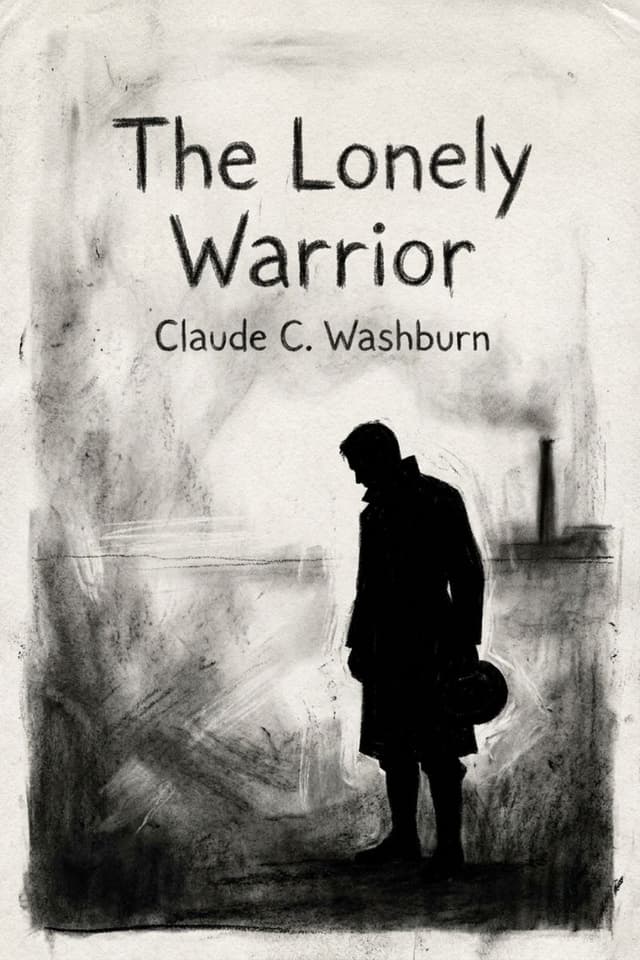
The Lonely Warrior
Read The Lonely Warrior by Claude C. Washburn for free on Novelhalla, and try out our easy-to-read modern edition of this classic book. You can also download the EPUB and read it on any device if you prefer!
The Plot
November 5, 1914
Edward Carroll is a rich man in a middle-western city, vice-president of a cement works, director of a bank, the deciding vote on a copper mine. On this particular afternoon he is doing none of it. He's sitting in his office staring at the date on the wall calendar, waiting for his son.
Stacey Carroll is thirty and doesn't look it. Nine years of school and college, two years wandering Europe, three years at the Beaux Arts in Paris, a junior partnership waiting for him at a good firm of architects, two hundred thousand dollars in bonds his father handed him, and a beautiful fiancée. He has come to tell his father he's going to England to enlist.
His father's argument is the best one available and Stacey knows it: it took thirty careful years to build you, you are an expensive instrument, and you are proposing to throw it away doing a job any untrained laborer can do better. Stacey has an answer. His father, in the end, has nothing except the question he finally asks, which is: what about me?
That night Stacey goes to tell Marian Latimer, who has spent her whole life in a Florentine villa full of her father's books and Chinese vases and who is the loveliest thing he has ever seen. Her face lights up. Her first thought is that he's going to be a hero. Her second thought is that he might die.
Stacey never criticises Marian. He's incapable of it. But that half-second gap between her first thought and her second is the very first wound the war gives him, and it's inflicted three thousand miles from any trench.
Afterward, on the dark street, Marian's mother comes out of the house in a fur coat to catch him alone. She has almost nothing to say and she says it anyway: if the war changes you in deep strange ways neither of us can imagine, please don't add to your suffering by blaming yourself for the changes.
Then the ship pulls out and the mist comes up between Stacey and everything he has been.
June, 1919
He comes back off a pier at Twenty-Third Street wearing a captain's uniform and the ribbon of the Distinguished Service Cross, and the first thing you notice about him is how efficiently he moves. He unpacks in exactly the time it takes the bathwater to run. He walks up Fifth Avenue with a fluent economical stride that isn't remotely how he used to walk. His face doesn't change at anything he sees until he reaches the victory arch at Madison Square, reads the battle names carved on it, and swears at it.
He goes uptown to see Philip and Catherine Blair, his oldest and closest friends, who come running down the hall to meet him.
And then Catherine, who has never in ten years managed a personal question, asks him straight out what the war does to a man. He tells her the truth, because he can't be bothered to lie to them: it wipes him out and puts somebody else in his place. He is not fond of them any more. He's not fond of anyone. If he saw a man cut in half by a bus he would feel mild distaste.
He has two decorations. One of them he won carrying out an order he considers plain murder. The other thing he did, the thing he'd tell a son about, is the reason he came home late and without his promotion: on the night of November tenth, 1918, knowing the Armistice was coming, he was handed orders to take a hill at five the next morning. He didn't do it.
Home to Vernon
There's a crowd at the station. His father with his face rigid. His sister Julie crying and laughing. And Julie's five-year-old in a tiny khaki uniform, saluting his uncle, because she trained him so carefully to do it.
Stacey has to live in this. His father, who cannot stop saying that the Armistice was the greatest disaster in history, that the country is rotten with unrest, that labor is Bolshevism. Colin Jeffries, the city's first citizen, who stops his car to shake the returning hero's hand and explain that the young men who saved the country from one danger are now expected to keep saving it from another. His old firm, offering him a partnership on the spot, which he turns down because he physically cannot draw plans for a billboard and doesn't know why.
And Marian, who waited five years, who has sent everyone out of the house for the afternoon, and who is standing between the portières waiting to be looked at.
What's Left
Stacey is not the man who left, and the town cannot see it, and the few people who can see it can't do anything about it. He has kept exactly one thing out of the fire, and it's not affection or ambition or belief. It's a hard, unforgiving appetite for the truth, which he now applies to everything and everyone in front of him, including the people who love him and the fortune his father built.
Vernon in 1919 is not a soft place to land. There are strikes coming. There is a city full of men who came back like him, and men who never went, and men who got rich while they were gone. There's a father who wants his son to take over an empire, and a woman he doesn't love who is beautiful enough to keep him coming back anyway, and her mother, who is the only person in the city he can sit beside without effort, and who has a secret about her own family that will turn his stomach.
And there are the Blairs, back in a Harlem apartment, where the wife who has never once let him past her reserve wept the moment he told her the truth, and then couldn't explain why.
About the Author: Claude C. Washburn
Mankato and Duluth
Claude Carlos Washburn was born in Mankato, Minnesota, in October 1883, and the family moved to Duluth when he was six. His father, Jed Washburn, was a wealthy lawyer who became a leading man of the town and helped organise Jay Cooke State Park. Claude went to expensive boarding schools in Florida and Massachusetts, then to Harvard, where he graduated magna cum laude in 1905.
He never had to earn a living. It shaped everything he wrote, including this book.
Paris
After Harvard he drifted around Italy thinking vaguely about teaching. Then McClure's bought a story of his in 1908 and he settled in Paris to be a writer instead. Plays, verse, essays, a collection of Parisian sketches published in 1910.
In Paris he met Ive Sinclair Gowen, a nineteen-year-old American, well-bred and broke. They married in Florence in 1911 and lived, for most of the next fifteen years, in Europe. His first novel came out in 1914, about a rich young man who inherits a mill in a fictional town closely resembling Duluth and cannot decide whether he belongs in the Midwest or Paris. The reviews were tepid.
The War He Watched From Rome
Here is the fact that hangs over this particular book. Washburn did not fight.
He and Ive spent the war moving between Paris, Italy, Duluth, and the family's winter place in North Carolina. When America came in, he took a post as a translator attached to the American Embassy in Rome, where he stayed sixteen months. His only child, John Larry, was born there in 1918. He resigned from the Embassy on the first of March, 1919, four months before the June morning on which his fictional captain walks off a pier in New York.
The Novelist Sinclair Lewis Watched
Washburn was a friend of Sinclair Lewis, and for a few years he was the kind of writer other writers name-checked. Then his career flattened out. Two more novels followed, one in 1925 and one in 1926, the second of them also about a veteran who can't come back. Both were reviewed decently and sold poorly.
The Last Years
In 1925 Ive left him for another man. He took his son and went back to America, ending up in his parents' house in Duluth. He spent the summer of 1926 there writing essays while the boy was at a camp on a lake outside town. In early August he got sick, and on the tenth he died of a streptococcal infection. He was forty-three.
Fun Facts About the Book
The Man Who Wrote It Spent the War at a Desk in Rome
Stacey Carroll fought with the British on the Somme, transferred to the American army, took a battalion through the Argonne, and won two decorations. Claude Washburn translated documents for the American Embassy in Rome.
That gap is the most interesting thing about the novel. Washburn was close enough to the war to see a great deal of it and far enough from it to have kept his own illusions, and what he produced is a book about a condition he observed rather than one he had. Reviewers at the time found the front-line material convincing anyway.
Sinclair Lewis Put Him in "Main Street"
In 1920, two years before this book came out, Lewis published the biggest American novel of the decade. In it, the lonely small-town lawyer Guy Pollock shyly lists the writers he loves: Sir Thomas Browne, Thoreau, Agnes Repplier, Arthur Symons, Claude Washburn, Charles Flandrau.
Being the man a fictional character reads to feel less alone in Gopher Prairie is an odd sort of immortality, and it's now the main reason anybody encounters his name.
Lewis Privately Wrote Him Off the Year Before Publication
In a 1921 letter to the publisher Alfred Harcourt, Lewis gave a confidential verdict on his friend: he didn't think Washburn would go much further, that he'd stay at his present level, and that what he lacked was any passionate reaction to daily life.
Harcourt published this book the following year.
The Armistice-Eve Order Was Not Invented
The one thing Stacey is proud of is refusing an order to attack a hill at five in the morning on November 11, 1918, hours before an armistice he already knew was coming. Attacks were in fact launched on the final morning of the war with the hour of the ceasefire already fixed and known to commanders, and men died in them. It became one of the bitterest arguments of the postwar years.
Vernon, Illinois, Does Not Exist
Washburn built a fictional middle-western city of two hundred thousand people, close enough to Chicago to feel metropolitan, sophisticated enough for plays and music, and specifically not provincial. He'd done the same trick before with an invented Wisconsin town in his first novel. Both are Duluth wearing a hat.
There Is a Prohibition Joke on Page One of the Homecoming
When Philip Blair pours his returning friend a sauterne cup, he cracks that there's only a short time left and that it's the sole subject of conversation in the republic. The Eighteenth Amendment was ratified in January 1919 and took effect the following January. Stacey has come home to a country that is, among many other things, about to stop drinking.
He Died of Something Penicillin Would Have Fixed
Washburn was forty-three and healthy when a streptococcal infection killed him in his parents' house in the summer of 1926. He was two years too early for Fleming's discovery and nearly twenty years too early for anyone to be able to do a thing about it.
The Family Wasn't Finished With Literature
His niece Carol Russel grew up to be the short story writer Carol Bly.
Themes
What Comes Home Instead
The book's central claim is not that Stacey is traumatised in any sense a 1922 reader would have had a word for. It's stranger and more specific: the part of him that responded to things has been burned out. He has a magnificent body, perfect efficiency, and a total inability to want anything. He isn't in pain. He's in the absence of everything, and he half suspects that's an improvement.
The Home Front Wants a Story
Everyone in Vernon has prepared a version of Stacey and needs him to inhabit it. His father wants a strong man to run a company. Colin Jeffries wants a Legionnaire to hold the line against labor. Julie wants a hero with a medal to mention at parties. Marian wants a laurel-crowned knight. His sister has trained a five-year-old to salute him. The novel is very good on the specific loneliness of being celebrated for something you experienced as an atrocity.
Money
Once Stacey loses the ability to feel anything, he becomes an extremely good observer, and what he observes over and over is money: whose grace depends on it, whose politics are made of it, who got rich off the war he fought. His hatred of it is the closest thing he has left to a passion, and the novel is honest enough to notice that it's a hatred available only to a man with two hundred thousand dollars in bonds.
The Individual and the Mass
Philip Blair lays out the argument early: he and Stacey are individualists by birth, upbringing, and trade, and the entire direction of the century is against them. The war accelerated it. Everything after the war, the strikes and the counter-strikes and the crowds on both sides, keeps proving him right, and the novel never quite decides whether that's a tragedy or just weather.
Fathers and Sons
Edward Carroll is not a fool or a villain. He's a generous, hardworking, deeply loving man who has never in his life had an unsimplified thought, and who cannot understand a single thing that has happened to his son. The scenes between them are the saddest in the book precisely because nobody is behaving badly.
The Broken Glass
Somewhere around 1916 Stacey made up a story about a man in a house with a stained glass roof who loses it in a hailstorm and consoles himself that at least now he's seeing real daylight, then bends down to find out what did the damage. What he finds isn't worth the roof. That image is the whole novel compressed, and it's Washburn's best piece of writing.
The Book's Legacy
This came out in 1922, and that date is the thing to hold onto. "The Sun Also Rises" was four years away. "A Farewell to Arms" was seven. The American novel of the hollowed-out veteran, the one everybody thinks Hemingway invented, was already being written and published and widely reviewed while Hemingway was still filing newspaper copy.
It was read as a contemporary issue novel: the returned soldier problem, the labor problem, the Bolshevik scare, the country coming apart in the streets, all of it inside one man who cannot make himself care. Reviewers found the prose overloaded and the drawing-room dialogue stilted, and they weren't wrong. The New York Times reviewer put it well by noting that the characters, buried as they are under all those words, still struggle against the author to say what they mean.
What's held up is not the style but the diagnosis. Washburn caught something in 1922 that took American fiction another decade to say more beautifully, and he caught it from the vantage point of a man who watched the war rather than fought it, which may be exactly why he could see its shape.
He is completely forgotten now. His only biography is a four-hundred-page manuscript his son wrote and never published, sitting in an archive in Duluth.