Novelhalla
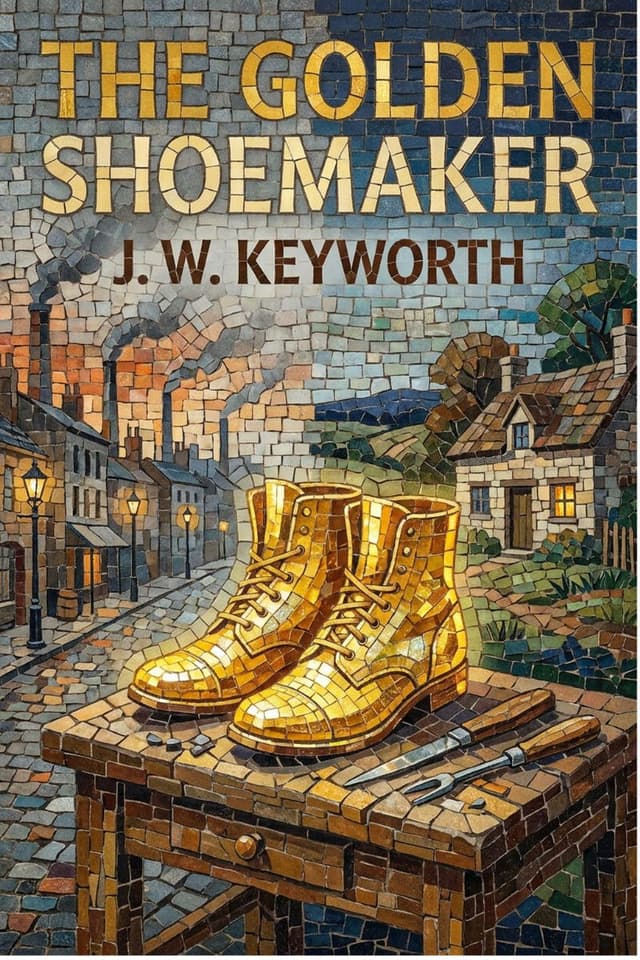
The Golden Shoemaker
Read The Golden Shoemaker by J. W. Keyworth for free on Novelhalla, and try out our easy-to-read modern edition of this classic book. You can also download the EPUB and read it on any device if you prefer!
The Plot
A Cobbler and His Little Girl
In a cramped house on a back street of Cottonborough, a busy manufacturing town, Thomas Horn sits at his bench tapping as softly as he can on a pair of boots he promised to finish that night, while his young wife lies upstairs dying. He's a big, quiet, deeply faithful man, and when she's gone, the only light left in his life is their four-year-old daughter Marian, a dark-eyed, fiercely stubborn little thing who adores her father and is a born wanderer.
Into this grieving household marches Aunt Jemima, Thomas's older sister, who arrives uninvited and immediately takes over. She isn't wicked, and she honestly believes she's doing the right thing, but she's as rigid as a fence post and about as warm. Toys get locked in a drawer, bedtimes get moved earlier and earlier, and Marian is forbidden to speak unless spoken to. Her father pushes back where he can, but the little girl's world keeps shrinking until she decides, all on her own, that she's had enough.
A Bright May Morning
One spring day, Aunt Jemima forgets to lock the door. Marian ties on her pink sun-bonnet, waves off her friend Tommy Dudgeon, one of the tiny twin shopkeepers across the street, and trots off toward the countryside, certain there won't be any Aunt Jemimas out there among the fields.
Her father isn't worried at first. She's wandered before and always found her way home. But dinner comes and goes, then teatime, then nightfall. What follows is a frantic search through workhouse wards, slum courts, and dark country roads, and the clues Thomas eventually finds only make things worse. The reader, meanwhile, gets to follow Marian a little further down that lonely road than her father ever could, and it's not a comfortable walk.
The Letter That Changes Everything
Twelve years later, Thomas is still mending boots in the same little shop, still quietly believing that somehow, someday, his daughter will come back. Then a thick blue envelope arrives from a firm of London lawyers. A rich uncle in America, a man the family never heard from, has died without a will, and Thomas is suddenly worth close to a million pounds.
Most people would quit the bench that afternoon. Thomas finishes the boots he promised for dinnertime. Then he starts doing things with his fortune that leave his lawyers speechless, his greedy landlord kicking himself, and his sister throwing her hands in the air. The newspapers dub him "the Golden Shoemaker," and the begging letters start pouring in by the dozen, then by the bagful.
A Fortune and a Mystery
Buried under correspondence, Thomas takes his minister's advice and hires a secretary: a capable, dark-haired young woman named Miss Owen, an orphan raised by friends in Birmingham. Aunt Jemima is ready to despise her on sight and somehow can't. And from the moment Miss Owen steps into the old cottage, she can't shake the strange feeling that she's been there before.
Meanwhile, the Golden Shoemaker's ambitions keep growing. There's a whole village that came with the inheritance, a long-lost scapegrace cousin somewhere across the ocean, a household of servants he has no idea what to do with, and a town full of critics who think a cobbler has no business being this generous. And through it all, little Tommy Dudgeon is keeping watch, because he's beginning to suspect something nobody else has noticed.
About the Author: J. W. Keyworth
A Name on the Title Page
Very little is known about J. W. Keyworth beyond what's printed on the book itself. The title page credits Keyworth as the author of two other stories, Mother Freeman and The Churchwarden's Daughter, and names the London publisher as J. Williams Butcher of Ludgate Circus Buildings. Beyond that, Keyworth's life has slipped almost entirely out of the historical record, which makes it all the more fitting that this author wrote a book about someone who vanished.
The World Keyworth Wrote For
The Golden Shoemaker belongs to a big wave of Christian family fiction that poured out of Britain in the late Victorian and Edwardian years, books meant to be read aloud at home, handed out as Sunday school prizes, and passed between families. J. W. Butcher's firm worked in that same Methodist Sunday school world, and around 1907 it took over the Wesleyan Methodist Sunday School lantern slide business. The book's chapel-going characters, its plain-spoken minister, and its deep concern with how a good man ought to use money all point to an author who knew that community from the inside.
Fun Facts About the Book
The Nickname Came From the Papers
Within the story, Thomas doesn't name himself. A newspaper he buys to read on the train home from London has already turned his inheritance into a headline and christened him "the Golden Shoemaker," and the name follows him everywhere after that.
A Grammar School Joke
The local schoolboys call Tommy and John Dudgeon "the little Twin Brethren," a cheeky twist on the classical twins Castor and Pollux, whom Thomas Babington Macaulay famously called "the great Twin Brethren" in his Lays of Ancient Rome. Two pint-sized shopkeepers getting compared to legendary warrior twins was apparently too good for the boys to pass up.
A Hard Bargain in Reverse
When Thomas goes to buy his humble rented cottage, his miserly landlord Daniel Froud asks £600 for it. Thomas talks him down to £450, then gives him a lecture on greed on the way out. Froud only learns afterward exactly how rich his tenant has become, and his reaction is one of the funniest moments in the book.
Free Cobblery
Even as a near millionaire, Thomas refuses to give up his trade. He renovates his old workshop and keeps mending shoes for the poor of the neighborhood, free of charge, which is how the town comes to know him as "Cobbler" Horn.
An Ancestral Village
Part of the inheritance is almost an entire village called Daisy Lane, the Horn family's ancestral home, which the uncle bought up piece by piece because he fancied owning it. Thomas and Jemima had never even visited the place.
Lawyers Straight Out of Dickens
The London lawyers handling the estate are Messrs. Tongs and Ball, a pair whose names and looks are pure Victorian comedy. Mr. Tongs is small, round, and rosy, while Mr. Ball is tall and bony and, according to the narrator, looks much more like a bat than a ball.
Chapel or Church?
The narrator pauses to note that the place where Thomas worships was the kind once called a "chapel" but more often called a "church" by the time of writing. It's a small aside that captures a real shift in how Britain's Nonconformist congregations were coming to see themselves.
Themes
Wealth as a Trust
Thomas never thinks of his fortune as his. He sees himself as a steward holding money on someone else's behalf, and he even worries that some of his uncle's wealth was made unfairly. The whole story asks what it would actually look like if a rich man took that idea completely seriously.
Grief That Doesn't Harden
Thomas loses his wife and then his daughter, and he never turns bitter. The book is interested in a kind of sorrow that stays tender instead of curdling, and in how a person keeps hoping year after year without any evidence to hold onto.
Love Done Badly
Aunt Jemima isn't a villain. She loves her brother and means well, but her love comes out as rules, punishments, and scoldings. The novel takes a hard look at what harsh, well-intentioned discipline does to a sensitive child, and at what it costs the person who dishes it out.
Little People With Big Hearts
The book's real heroes tend to be the overlooked ones: a cobbler, a pair of tiny twin hucksters, a poor orphaned secretary. Tommy Dudgeon in particular, small and easy to laugh at, turns out to have more quiet courage and decency than almost anyone around him.
What Money Does to People
Sudden wealth works like a mirror. The landlord gets greedier, neighbors start fawning, begging-letter writers come out of the woodwork, and critics line up. The one person it doesn't seem to change is Thomas himself, and that's exactly what makes everyone else so uneasy.
Historical Context
Consumption and the Workhouse
Thomas's young wife dies of what the Victorians called consumption, which was tuberculosis, a disease that killed enormous numbers of young adults in crowded industrial towns. When Thomas searches for his daughter, one of the first places the police take him is the casual ward of the workhouse, where homeless wanderers could get a night's shelter in exchange for work. Both details would have been instantly familiar to the book's first readers.
Tramps on the Open Road
Victorian Britain had a large population of vagrants drifting between towns on foot, and lonely country roads were genuinely dangerous places for a child alone. Parents of the period worried about children being lured away and robbed, and Keyworth taps right into that very real fear.
The Book's Legacy
The Golden Shoemaker never became a famous classic, and its author has faded almost completely from memory. But the book has quietly found new readers in the digital age, and it holds up surprisingly well as a page-turner.
What makes it worth discovering today is how it blends two kinds of story people have always loved: the "what would you do if you suddenly got rich" fantasy and the heart-in-your-throat lost child mystery. Thomas Horn is a refreshingly decent hero, Aunt Jemima is a wonderfully prickly character who grows in ways you won't expect, and the Dudgeon twins bring real warmth and comedy. For anyone who loves Victorian family sagas with a mystery at their heart, it's a hidden gem.