Novelhalla
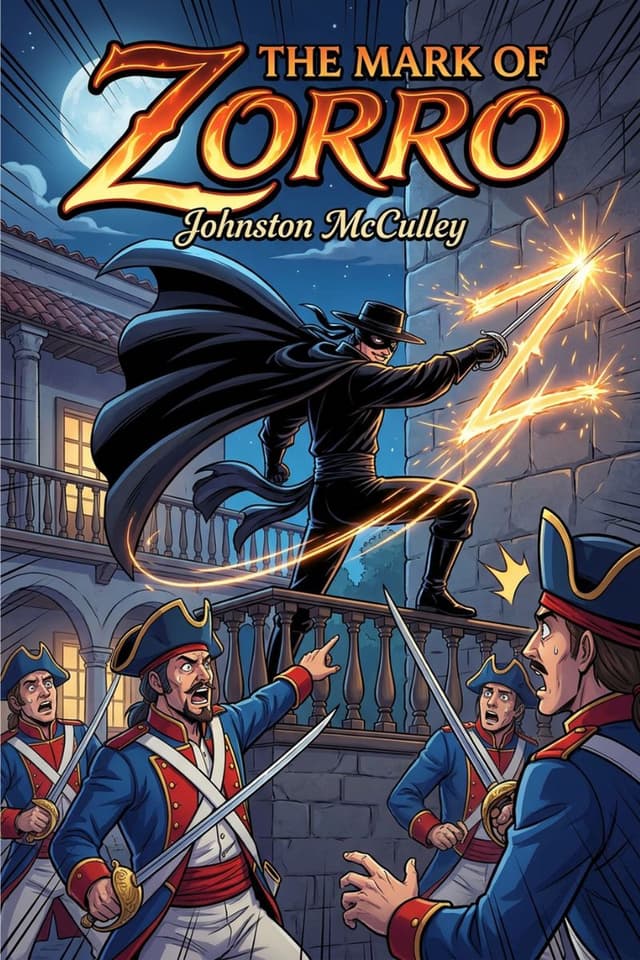
The Mark of Zorro
Read The Mark of Zorro by Johnston McCulley for free on Novelhalla, and try out our easy-to-read modern edition of this classic book. You can also download the EPUB and read it on any device if you prefer!
The Plot
The Fop
In the dusty, sun-scorched pueblo of Los Angeles, Spanish California is rotting from the inside. The governor is corrupt. His soldiers bully the natives, shake down the friars, and terrorize anyone who falls out of political favor. The wealthy young caballeros who could do something about it are too busy drinking and dueling to care.
Into a rain-soaked tavern one night walks Don Diego Vega, son of the richest man in the territory. He is twenty-four, recently returned from Spain, and he is... disappointing. He yawns constantly. He has no interest in swordplay. He finds romance exhausting. His own father is quietly ashamed of him. The soldiers laugh behind his back, and the women find him about as thrilling as a wet napkin.
Meanwhile, a masked rider called Senor Zorro has been terrorizing the corrupt authorities up and down El Camino Real. He robs dishonest officials. He defends beaten natives. And when he's finished with you, he leaves his calling card: three quick slashes of his blade, carving the letter Z into your skin.
The governor wants him dead. Sergeant Pedro Gonzales, a mountain of a man with a mustache like a pair of black wings, wants the reward. Captain Ramon, the cruel and ambitious officer running the local garrison, wants to make his career on the capture. Nobody can catch him.
The Girl
Don Diego's father has arranged for him to court Senorita Lolita Pulido, the daughter of a once-noble family that has fallen out of favor with the governor. The Pulidos have lost nearly everything. A match with the Vega fortune could save them.
There's just one problem. Lolita meets Don Diego and immediately wants to throw herself off a balcony. He sits in her family's parlor, limp as a rag, yawning about how fatiguing the ride was. He suggests he might send a servant to sing under her window on his behalf. She tells her parents he is a fish.
But ten minutes after Diego leaves, a very different man appears in Lolita's garden. Zorro. Bold, passionate, reckless, and funny. He recites poetry. He risks his life just to see her smile. Lolita is instantly, hopelessly smitten.
She has fallen in love with a masked outlaw with a price on his head. And a boring rich boy she can barely stand wants to marry her.
The Villain
Captain Ramon has his own designs on Lolita. He's from a good family, he has the governor's ear, and he is not a man who handles rejection well. When Lolita makes it clear she has no interest in him, the captain decides to take what he wants by force.
He corners her alone in Don Diego's house while her parents are away at dinner. What happens next brings Zorro crashing through the door, blade already singing. The captain is humiliated, forced to his knees, made to apologize. And before Zorro leaves, he carves his mark into the captain's flesh.
Ramon doesn't forget. He can't get to Zorro, but he can get to the people Zorro cares about. He writes to the governor, accusing the Pulido family of treason and conspiracy with the masked outlaw. The Pulidos, already barely surviving, now have a target on their backs.
The Reckoning
The governor rides south to deal with the Zorro problem personally. Friars are whipped in public. The Pulidos are arrested and thrown into jail. The pueblo is turning into a prison, and the caballeros, the young noblemen who have been sitting idle through all of it, are about to have their loyalty tested.
Zorro has always fought alone. But one man, no matter how fast his blade, cannot take on an entire garrison. And with Lolita's family in chains and Captain Ramon circling like a vulture, the stakes have moved beyond highway robbery and carved cheeks.
The question is no longer just whether Zorro can escape. It's whether the men of California will finally stand up. Whether the mask is strong enough to hold. And whether the languid, yawning Don Diego will ever become the man his father needs him to be, or whether something else entirely is going on behind those bored eyes.
About the Author: Johnston McCulley
Early Life
Johnston McCulley was born in 1883 in Ottawa, Illinois, and orphaned by the age of eleven after his mother died when he was an infant and his father was killed in a scaffolding accident. He was raised by his grandparents in the small town of Chillicothe, where he developed a love of history and storytelling fueled by the frontier tales of rural Illinois.
The Newspaper Years
After graduating high school in 1901, McCulley threw himself into journalism. He spent fourteen years bouncing between newsrooms in Chicago, Peoria, Kansas City, Portland, Seattle, Denver, San Diego, and Los Angeles. He worked as a police reporter, covering crime and the full spectrum of human behavior. He later credited this period with teaching him everything he needed to know about creating characters. The newspaper world taught him speed, too. He could produce copy on a deadline like few others.
Pulp Writer
McCulley transitioned from journalism to fiction and became one of the most prolific writers the pulp magazine world ever saw. Over a career spanning more than fifty years, he produced hundreds of stories and at least fifty novels, frequently writing under pseudonyms so he could appear in the same magazine multiple times without editors catching on. He created dozens of characters, including the criminal mastermind Black Star, the Robin Hood figure The Crimson Clown, and the pickpocket Thubway Tham. He also served as an Army public affairs officer during World War I.
Southern California became his permanent home and his favorite backdrop. He was fascinated by the old Spanish colonial history of the region, and it was this fascination that eventually produced his most famous creation.
Legacy
McCulley wrote Zorro stories for nearly forty years, from 1919 until his death in 1958. He never planned for Zorro to be more than a one-time character. It was the runaway success of the 1920 Douglas Fairbanks film that convinced him to bring the fox back. He died in Los Angeles at seventy-five, having created a character that would long outlast him, one that helped invent the modern superhero and has never stopped appearing in new stories, films, and shows.
Fun Facts About the Book
A Different Title
McCulley's original story was called "The Curse of Capistrano" when it was first serialized in five parts in the pulp magazine All-Story Weekly in 1919. The title was changed to "The Mark of Zorro" when the book was published in 1924, borrowing the name from the wildly successful Douglas Fairbanks film.
A One-Time Hero
McCulley intended Zorro's story to be finished after a single serial. The ending wraps everything up neatly. It was only after Douglas Fairbanks turned the story into a hit film in 1920 that public demand convinced McCulley to write sequels. He eventually produced over sixty Zorro stories across four decades.
The Honeymoon Selection
Douglas Fairbanks and Mary Pickford, the biggest movie stars in the world at the time, chose "The Curse of Capistrano" as their first project for their new studio, United Artists, while they were on their honeymoon. The resulting film broke box office records and launched an entire genre of swashbuckling adventure cinema.
Fairbanks Reinvented the Character
The Zorro most people picture today owes as much to Douglas Fairbanks as to McCulley. The all-black costume, the round hat, the acrobatic rooftop leaps, the playful humor, and even the exaggerated foppishness of Don Diego were largely Fairbanks' innovations. McCulley liked them so much that he incorporated many of these elements back into his own subsequent stories.
The Scarlet Pimpernel Connection
McCulley drew heavy inspiration from Baroness Orczy's "The Scarlet Pimpernel," published in 1903. Both stories feature a nobleman who pretends to be a useless fop while secretly fighting tyranny. Both heroes operate under a secret identity and signature mark. Zorro transplanted the formula from the French Revolution to Spanish colonial California and gave it a sword.
The Godfather of Superheroes
Zorro is widely considered the prototype for the modern costumed superhero. Bob Kane and Bill Finger, the creators of Batman, directly cited Zorro as an inspiration. The parallels are unmistakable: a wealthy man with a dual identity, a hidden lair beneath his home, a faithful servant in on the secret, a dark costume, and a personal war on corruption. Superman's creators also credited Zorro and the Scarlet Pimpernel as influences on Clark Kent's mild-mannered disguise.
Batman's Origin Story
In DC Comics canon, "The Mark of Zorro" is the film young Bruce Wayne watches with his parents on the night they are murdered outside the theater. This detail was established by Frank Miller in "The Dark Knight Returns" in 1986 and has remained a cornerstone of Batman's mythology ever since. The masked avenger who inspired Batman in the real world became the fictional inspiration for Batman within his own story.
Themes
The Mask and the Man
The novel's central trick is also its central question: which version of Don Diego is real? The bored aristocrat who can barely lift a fork, or the masked swordsman who leaps from rooftops? McCulley plays with the idea that identity is performance, that the face you show the world may have nothing to do with who you actually are.
Justice Outside the Law
When the law itself is the instrument of oppression, what does justice look like? Zorro is a criminal by every legal standard. He robs, he assaults, he evades arrest. But the system he fights against is built on cruelty and theft. The novel asks readers to consider when breaking the law becomes the only moral option.
Class and Responsibility
The caballeros of California are wealthy, privileged, and doing absolutely nothing while the people beneath them suffer. Zorro's mission isn't just to punish the corrupt. It's to shame the comfortable into action. The novel draws a sharp line between inherited status and earned honor.
The Power of Reputation
Zorro is terrifying not just because he's skilled with a blade, but because of the story that surrounds him. The carved Z, the black mask, the laughter in the dark. He is as much myth as man, and McCulley understood that fear and symbolism can be more powerful weapons than steel.
Love as a Complication
Lolita's romantic predicament mirrors the novel's larger tensions. She is drawn to the outlaw and repelled by the aristocrat, not knowing they are the same person. Her story raises questions about what we value in others, whether we see people as they are or as they perform.
The Book's Legacy
"The Mark of Zorro" launched one of the most enduring characters in popular fiction. Within a year of publication, Douglas Fairbanks had turned it into a genre-defining film. A 1940 remake starring Tyrone Power was so acclaimed it was later added to the National Film Registry. Walt Disney turned Zorro into a beloved television series in the late 1950s starring Guy Williams. The 1998 film "The Mask of Zorro" with Antonio Banderas introduced the character to yet another generation.
But Zorro's influence runs deeper than his own franchise. He is the direct ancestor of the costumed superhero. Without McCulley's masked nobleman fighting corruption from the shadows, the template that gave us Batman, the Lone Ranger, and arguably the entire superhero genre might never have existed. The dual identity, the hidden lair, the symbol left behind at the scene, the war against institutional injustice waged by a single person in a costume: it all starts here.
More than a century after a pulp writer banged out a five-part serial for a cheap fiction magazine, Zorro remains one of the most recognized fictional characters on the planet. The fox is still running.