Novelhalla
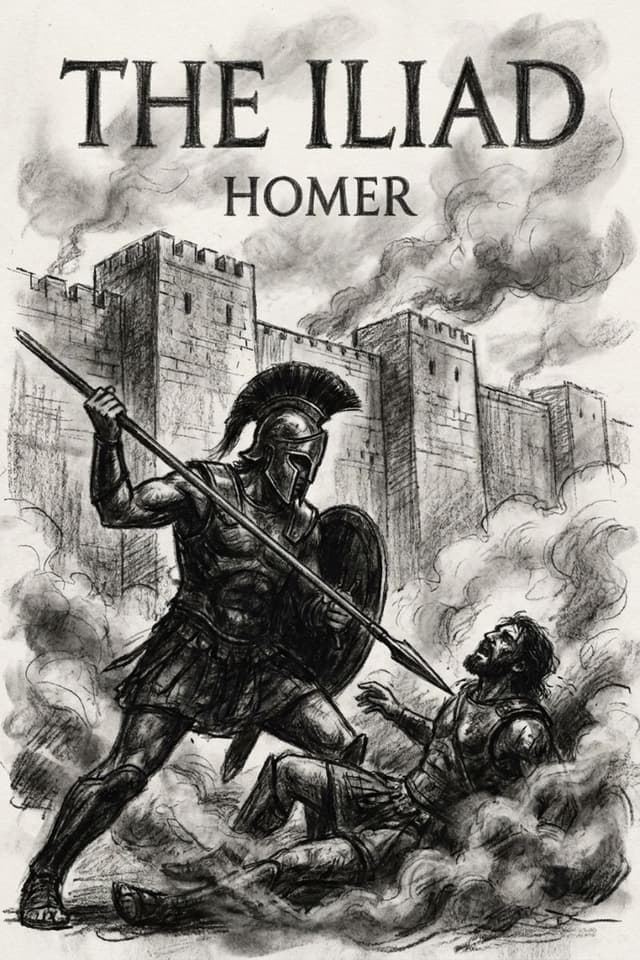
The Iliad
Read The Iliad by Homer for free on Novelhalla, and try out our easy-to-read modern edition of this classic book. You can also download the EPUB and read it on any device if you prefer!
The Plot
This is a prose translation of the poem, because obviously we can't remaster the poem, that's way too hard.
The Rage of Achilles
The Trojan War has been grinding on for nine years. The Greeks have sailed a thousand ships to the shores of Troy to take back Helen, the most beautiful woman in the world, stolen from her husband King Menelaus by the Trojan prince Paris. Nine years of siege, nine years of fighting, and Troy still stands.
The story doesn't start with Helen. It starts with a fight between two men on the same side.
Agamemnon, the king of kings and commander of the Greek forces, has taken a war captive, the daughter of a priest of Apollo. When the priest comes begging for her return, Agamemnon sends him away. Bad move. Apollo sends a plague ripping through the Greek camp. Men die by the hundreds.
Achilles, the greatest warrior alive, calls an assembly and demands they figure out why the gods are angry. When the truth comes out, Agamemnon is forced to give the girl back. But his pride can't take the hit, so he seizes Achilles' own captive, a woman named Briseis, as compensation.
Achilles is so furious he nearly kills Agamemnon on the spot. Instead, he does something worse. He quits. The best fighter the Greeks have, the man the Trojans fear above all others, sits down by his ships and refuses to fight. And he asks his divine mother, the sea goddess Thetis, to make Zeus turn the war against the Greeks until Agamemnon comes crawling back to admit what he's done.
Zeus agrees.
The War Without Achilles
What follows is a sprawling, brutal, magnificent account of war. Without Achilles, the Greeks are in trouble. The Trojans, led by Hector, the eldest son of King Priam and the best warrior Troy has, begin pushing the Greeks back toward the sea. The fighting is vivid, close, and savage. Men die in specific, horrible ways. Homer names them. He tells you where they came from, who their fathers were, what they hoped for. Then he kills them.
The gods are in it too, and not as distant observers. They pick sides. They argue. They cheat. Athena and Hera back the Greeks. Apollo and Aphrodite back the Trojans. Ares, the god of war himself, wades into the battle and gets stabbed by a mortal with divine help. Zeus tries to maintain order from Olympus but keeps getting outmaneuvered by his own wife. The gods are powerful, petty, and often funnier than anyone on the ground.
Meanwhile, the human drama deepens. Hector returns to Troy for a brief respite and finds his wife Andromache and their infant son at the gates. He knows he will probably die in this war. She knows it too. He reaches for his boy and the child screams in terror at his father's plumed war helmet. Hector laughs, takes off the helmet, and holds his son. It is one of the most human moments in all of literature, and it's surrounded on every side by slaughter.
The Embassy
The Greeks are losing badly enough that Agamemnon finally swallows his pride. He sends an embassy to Achilles: his old tutor Phoenix, the clever Odysseus, and the massive warrior Ajax. They bring gifts. They bring apologies. They bring the offer of Briseis' return. They beg.
Achilles refuses. He is beyond gifts now. His anger has calcified into something cold and absolute. He says he'd rather sail home than fight for a man who dishonored him. He says glory means nothing if it costs him his life. He says things that are true and things that are self-serving and things that are heartbreaking, sometimes all in the same breath.
The embassy fails. The Greeks are on their own.
Patroclus
Achilles' closest companion is Patroclus, a gentler man who watches the Greeks dying and can't bear it any longer. He begs Achilles to let him fight. If Achilles won't go himself, at least let Patroclus wear his armor and lead his men. The sight of what looks like Achilles returning to battle might be enough to turn the tide.
Achilles agrees, but with a warning: drive the Trojans back from the ships, then stop. Don't push too far. Don't chase glory.
Patroclus puts on the armor, rallies the troops, and charges into battle. He is magnificent. He drives the Trojans back. He saves the Greek fleet. And then, riding the high of victory, he ignores every warning Achilles gave him.
He pushes too far.
The Fury
What happens to Patroclus changes everything. Achilles' anger toward Agamemnon evaporates instantly, replaced by something far more terrifying: grief and rage without limit, directed at one man.
Achilles has no armor (Patroclus was wearing it), so his mother commissions the god Hephaestus to forge him a new set. The shield alone is a wonder: the smith hammers into it images of cities at peace and cities at war, harvests and dances and oceans, the whole world in miniature on a circle of bronze. It's the most famous piece of equipment in literature.
Armed with divine weapons and burning with a fury that frightens even the gods, Achilles returns to the battlefield. What follows is not a battle. It's a massacre. Achilles kills so many Trojans that the river god rises up to drown him and has to be beaten back by the god of fire. The entire Trojan army flees behind the walls of the city.
All except one.
The Duel
Hector waits outside the gates of Troy. He has been brave and honorable throughout the war. He has led his people, loved his family, and fought without complaint. But when Achilles comes for him, something human happens. Hector's nerve breaks. He runs.
Achilles chases him around the walls of Troy three times before the gods intervene in the cruelest possible way. Athena disguises herself as Hector's brother, tells him she'll fight alongside him, and convinces him to stand and face Achilles. When Hector turns to his brother for a spear, there is no one there.
He knows. He faces Achilles anyway.
After
The aftermath of that duel, and what Achilles does with his grief, and who finally has the courage to confront him about it, is where the poem finds its real power. The Iliad is a war story, but it ends not with victory or defeat but with something much harder: the question of whether rage and sorrow can ever be laid down, even for a moment, even between enemies.
The answer, when it comes, is one of the most quietly devastating scenes in all of literature.
About the Author: Homer
The Mystery
Here is what we know for certain about Homer: almost nothing.
He is credited with composing the Iliad and the Odyssey, two of the most influential works in all of Western literature. Ancient Greeks treated him with near-religious reverence. They called him simply "the Poet," and Plato said he "taught all of Greece." Seven cities claimed to be his birthplace. None could prove it.
What Tradition Says
Ancient biographies, written centuries after he supposedly lived, describe Homer as a blind wandering poet, possibly born in Smyrna or on the island of Chios, sometime around the 8th century BCE. The blindness may come from a character in the Odyssey, a blind bard named Demodocus who performs at a royal court and who many readers have taken as a self-portrait. Whether this is autobiography or convention is anyone's guess.
The Homeric Question
Since at least the 3rd century BCE, scholars have debated whether one person actually wrote both the Iliad and the Odyssey. Some argued the poems were too different in style and temperament to be by the same hand. In the 19th century, a school of thought emerged claiming "Homer" never existed at all, that the poems were a patchwork assembled by generations of anonymous bards.
The modern consensus has shifted back toward a single genius. The poems show too much structural complexity and thematic unity to be the product of a committee. But they also clearly draw on a long tradition of oral storytelling. The best guess is that Homer (or whatever his name actually was) was a master poet who took existing stories, characters, and phrases from centuries of oral tradition and shaped them into the works we have now.
Legacy
It's hard to overstate what Homer did. The Iliad and the Odyssey were the foundation of Greek education for centuries. They shaped how the Greeks understood their gods, their heroes, and themselves. They influenced virtually every major writer in the Western tradition. The Aeneid, The Divine Comedy, Paradise Lost, Ulysses: all of them are, in one way or another, responses to Homer.
The playwright Aeschylus described his own tragedies as "crumbs from the banquet of Homer." Twenty-seven centuries later, we're still eating from the same table.
Fun Facts About the Book
It's Not About the Trojan War
The Iliad covers roughly fifty days in the tenth year of the war. It doesn't include the beginning of the war (Paris stealing Helen), the Trojan Horse, or the fall of Troy. Those stories existed in other poems, now mostly lost. The Iliad is specifically about the rage of Achilles and what it costs everyone around him.
The Catalog of Ships
Book 2 contains a massive list of every Greek contingent that sailed to Troy, naming their leaders, their cities, and how many ships they brought. It reads like a military roll call and it's actually one of the most valuable sections for historians, because many of the places named correspond to real Bronze Age settlements. It's a war epic that doubles as an archaeological database.
Oral Poetry
The Iliad was almost certainly composed for oral performance, not reading. The repeated phrases you find everywhere ("swift-footed Achilles," "rosy-fingered Dawn," "wine-dark sea") weren't lazy writing. They were building blocks that helped the poet compose in real time, fitting words to the strict rhythmic pattern while performing from memory. In the 1930s, scholar Milman Parry proved this by studying living oral poets in Yugoslavia who used identical techniques.
The Shield of Achilles
The description of the shield that Hephaestus forges for Achilles in Book 18 is one of the most famous passages in literature. It depicts an entire world: two cities (one at peace, one at war), farmers plowing fields, a vineyard at harvest, a wedding procession, a court of law, herds of cattle, dancers, and the ocean encircling it all. Poets and artists have been reworking the image for nearly three thousand years.
No One Wins
The Iliad ends without a winner. Troy hasn't fallen. The Greeks haven't gone home. Achilles is still alive but his death has been foreshadowed so heavily it might as well be carved in stone. The poem ends with a funeral and a moment of shared grief between enemies. For a story so full of violence, it closes with an extraordinary act of tenderness.
How Old Is It?
The Iliad is generally dated to around 750-700 BCE, making it one of the oldest surviving works of Western literature. But the story it tells reaches back even further, to a possible real conflict around 1250-1200 BCE. Archaeological discoveries at the site of Troy (modern Hisarlik in Turkey) have confirmed that a city matching Homer's description existed and was destroyed by fire around that period.
Themes
Rage and Its Costs
The first word of the Iliad in Greek is "menin," meaning "rage" or "wrath." The entire poem is about what happens when the most powerful warrior in the world lets his anger consume him. Achilles' rage is justified at first, then excessive, then terrifying, then finally, maybe, something he can begin to set down. The arc of his anger is the arc of the poem.
Mortality and Glory
Achilles knows he has a choice: a long, quiet life at home, or a short, brilliant one at Troy. He chooses glory, but the poem never lets you forget what that choice costs. Every death in the Iliad is a reminder that even the greatest heroes are mortal. The gods are immortal and largely unbothered. The humans are the ones who suffer, and that suffering is what makes them matter.
The Enemy Is Human Too
One of the most radical things about the Iliad is its sympathy for the Trojans. Hector is as fully realized and as deeply human as Achilles, maybe more so. His scenes with Andromache and his son are among the most moving in the poem. Homer never lets you forget that the people on the other side of the battlefield have families, hopes, and fears identical to those of the Greeks.
Honor and Pride
The war itself started because of wounded pride (Menelaus losing his wife). The crisis at the poem's center is about wounded pride (Agamemnon taking Briseis). Nearly every escalation in the story comes from someone's honor being threatened. The Iliad takes honor seriously as a value but also shows, relentlessly, the destruction it causes when it becomes the only value.
War as Hell and War as Glory
Homer does something unsettling: he makes war both beautiful and horrifying, often in the same passage. A warrior's charge is described with the grandeur of a simile comparing him to a lion or a forest fire. Three lines later, his spear goes through someone's eye socket. The Iliad refuses to simplify war into either pure heroism or pure horror. It holds both truths at once, which is what makes it so hard to shake.
The Book's Legacy
The Iliad is arguably the most influential work of literature ever composed. It invented or codified the conventions of epic poetry that writers have been borrowing from for nearly three millennia. Every war story, every superhero narrative, every tale of a warrior's rage and redemption owes something to this poem.
It has been translated into every major language on Earth, multiple times. Notable English translations include those by Alexander Pope (1715-1720), Richmond Lattimore (1951), Robert Fagles (1990), and Caroline Alexander (2015), the first English translation by a woman.
The Iliad has inspired works across every art form: Virgil's Aeneid, Shakespeare's Troilus and Cressida, Madeline Miller's novel The Song of Achilles, Wolfgang Petersen's film Troy, and countless paintings, operas, and sculptures. The shield of Achilles alone inspired a famous poem by W.H. Auden.
But the Iliad's deepest legacy might be its insistence that war stories are really stories about people. About grief, and love, and what we owe each other, even in the worst circumstances imaginable. Nearly three thousand years after it was composed, it remains the standard by which all epic literature is measured.