Novelhalla
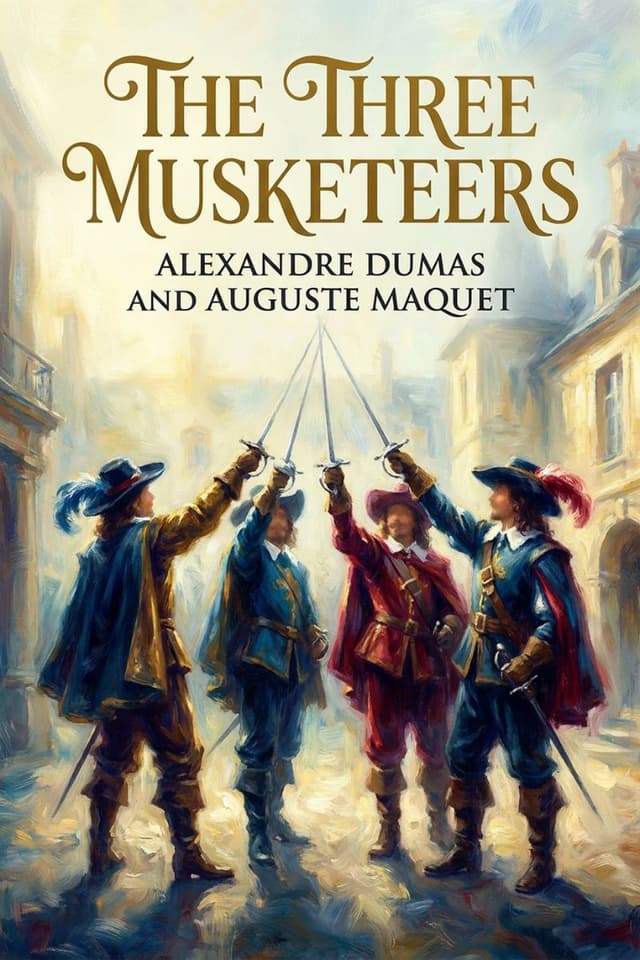
The Three Musketeers
Read The Three Musketeers by Alexandre Dumas and Auguste Maquet for free on Novelhalla, and try out our easy-to-read modern edition of this classic book. You can also download the EPUB and read it on any device if you prefer!
The Plot
The Hothead from Gascony
It's 1625, and a young man named d'Artagnan is riding toward Paris on a horse so ugly that people laugh at him in the street. He's eighteen, broke, armed with his father's old sword, and carrying a letter of introduction to Monsieur de Treville, captain of the King's Musketeers. He has exactly one plan: become a musketeer. He has exactly zero backup plans.
Before he even reaches Paris, someone insults his horse at an inn and d'Artagnan demands a duel. He gets beaten unconscious for his trouble and his letter of introduction is stolen. He arrives in the capital bruised, robbed, and riding a joke. But he's not discouraged. He's Gascon. Discouragement is not in the vocabulary.
He talks his way into an audience with Treville anyway, and within an hour of being inside musketeer headquarters, he manages to offend three separate musketeers so badly that each one challenges him to a duel. That's three duels in one afternoon, scheduled back to back. With the most dangerous swordsmen in France.
All for One
Here's the thing nobody told d'Artagnan: those three musketeers are best friends. Athos, Porthos, and Aramis. When he shows up for his first duel with Athos, the other two are already there as seconds. D'Artagnan realizes he's about to fight all three of them. Before a single sword is drawn, though, a squad of Cardinal Richelieu's guards arrives to arrest everyone for illegal dueling.
D'Artagnan makes the decision that changes his life. Instead of walking away (he's not a musketeer, this isn't his fight), he draws his sword and stands with the three men who were about to kill him. Together, the four of them beat the Cardinal's guards senseless.
By sundown, they're inseparable.
The Queen's Secret
France in the 1620s is a powder keg. King Louis XIII sits on the throne, but the real power belongs to Cardinal Richelieu, who controls the government and commands his own private army. Richelieu is brilliant, ruthless, and always three moves ahead. The King's Musketeers and the Cardinal's Guards despise each other, and the streets of Paris feel like a cold war fought with rapiers.
Into this political minefield, d'Artagnan stumbles onto something enormous. Queen Anne of Austria has a secret, one that could destroy her if Richelieu finds proof. The Cardinal is already circling, setting a trap so elegant that the Queen won't see it closing until it's far too late. The only people who can save her are four men with swords, fast horses, and a reckless willingness to ride straight into danger.
D'Artagnan volunteers. Of course he does.
The Road to England
What follows is one of the great chase sequences in all of literature. D'Artagnan and the three musketeers ride out of Paris on a desperate mission, and one by one, they're picked off. Ambushes, poisoned wine, staged fights. Richelieu's agents are everywhere, and someone has been tipped off about exactly where they're going. Porthos gets trapped in a duel. Aramis is wounded. Athos is arrested. Only d'Artagnan makes it through, alone, racing against a deadline that will not move.
The mission takes him across the English Channel, into foreign courts and back again, all while the Cardinal's web tightens around everyone he cares about.
The Woman Called Milady
And then there is Milady de Winter.
She is beautiful. She is charming. She is connected to some of the most powerful men in France and England. And she is the most dangerous person in this entire story. Milady works for Richelieu, but she also has her own agenda, and a past that connects her to the musketeers in ways none of them fully understand. Athos goes pale at the mention of her name. D'Artagnan doesn't know why. He will.
When d'Artagnan crosses Milady, he makes an enemy who doesn't just want to win. She wants to destroy. And she is patient, resourceful, and completely without mercy.
War and Reckoning
The story widens into war. France besieges the Protestant city of La Rochelle, and the musketeers march to the front. But the battlefield is almost beside the point. The real war is personal. Milady is moving pieces into position. Richelieu is playing his endgame. And d'Artagnan is fighting on two fronts: the siege outside and the web of betrayal within.
Constance Bonacieux, the woman d'Artagnan loves, is caught in the middle of all of it. She's brave and loyal, but bravery and loyalty are not always enough when the people hunting you have unlimited resources and no conscience.
The four friends have survived duels, ambushes, and assassination attempts. But Milady is something different. She doesn't fight with swords. She fights with secrets, seduction, and poison. And the closer the musketeers get to stopping her, the more desperate and dangerous she becomes.
Whatever is coming, it will cost them. The only question is how much.
About the Author: Alexandre Dumas
A Remarkable Heritage
Alexandre Dumas was born in 1802 in Villers-Cotterets, a small town northeast of Paris. His family story reads like one of his own novels. His grandfather was a French marquis who lived in the colony of Saint-Domingue (now Haiti). His grandmother, Marie-Cessette Dumas, was a Black enslaved woman. Their son, Thomas-Alexandre, was brought to France as a teenager, took his mother's surname, and rose to become a general in Napoleon's army, the first person of African descent to reach that rank in the French military.
General Dumas was a legendary figure: six feet tall, enormously strong, and reportedly able to lift a horse. He fell out of favor with Napoleon, was imprisoned as a prisoner of war for two years, and came home broken in health. He died in 1806, when Alexandre was just three. The family was left nearly penniless, but Alexandre grew up on his mother's stories of his father's battlefield heroics, and those stories lit a fire that never went out.
The Rise
Young Dumas had almost no formal education, but he read voraciously and taught himself to write. He moved to Paris at twenty with little more than his father's famous name and beautiful handwriting (which landed him a clerical job with the Duke of Orleans). Within a few years, his plays were the talk of Paris. By his thirties, he was one of the most famous writers in France.
Dumas lived as extravagantly as his characters. He built a lavish estate called the Chateau de Monte-Cristo, threw legendary parties, maintained dozens of mistresses (scholars count nearly forty), and spent money faster than even his extraordinary output could generate it. He employed a network of collaborators and research assistants, the most important being Auguste Maquet, a trained historian who helped plot and draft many of Dumas's greatest works.
The Factory of Genius
Dumas's output was staggering. He is estimated to have written or co-written over 100,000 pages of fiction, plays, memoirs, travel writing, and essays across his lifetime. He published a massive culinary encyclopedia. He founded a newspaper. He built his own theater. For a stretch in the 1840s, he was simultaneously serializing multiple novels in different newspapers, producing new chapters on punishing weekly deadlines. The Three Musketeers and The Count of Monte Cristo were both written during this same astonishing burst of productivity in 1844.
Later Life
Dumas's fortunes rose and fell dramatically. He made and lost several fortunes, fled France for Brussels when political winds shifted after the 1848 revolution, traveled widely through Russia and Italy (where he supported Garibaldi's unification campaign and founded a newspaper), and returned to Paris in his final years with his health and finances declining. He faced racial prejudice throughout his life but met it with characteristic defiance. When someone insulted his ancestry, he reportedly replied: "My father was a mulatto, my grandfather was a Negro, and my great-grandfather a monkey. You see, Sir, my family starts where yours ends."
He died in December 1870 at age sixty-eight. In 2002, his remains were moved to the Pantheon in Paris, France's highest honor for its great citizens, where he rests alongside Victor Hugo and Emile Zola.
About the Collaborator: Auguste Maquet
Auguste Maquet was a Parisian historian and aspiring novelist who was introduced to the already-famous Dumas in 1838. Their working method became one of literature's most productive partnerships. Maquet did historical research, developed plot outlines and character frameworks, and often wrote rough first drafts. Dumas then transformed the material, adding his trademark dialogue, humor, pacing, and vivid characterization.
Maquet contributed to many of Dumas's most beloved works, including The Three Musketeers, its two sequels, and The Count of Monte Cristo. The partnership ended bitterly in 1851 when Maquet sued for co-authorship credit and unpaid fees. The court ruled in Dumas's favor on authorship but ordered him to pay substantial debts to Maquet. When Maquet's version of a chapter was compared to Dumas's in court, the difference in quality reportedly settled the question. Maquet went on to publish novels under his own name, but none achieved lasting fame.
The consensus among scholars is that the partnership produced something neither man could have achieved alone, but that Dumas's creative genius was the essential ingredient. As one court observer put it: "Dumas without Maquet would have been Dumas. What would Maquet have been without Dumas?"
Fun Facts About the Book
The Original Newspaper Serial
The Three Musketeers was first published in installments in the French newspaper Le Siecle between March and July of 1844. Readers across France waited eagerly for each new chapter, and the serial format shaped the novel's breathless pacing and relentless cliffhangers. Dumas was a master of the form, ending chapters at moments of maximum tension to keep readers buying the next issue. The technique is essentially the same one streaming shows use today.
Based on a Real Person (Sort Of)
D'Artagnan was based on Charles de Batz de Castelmore, a real Gascon who served as captain of the King's Musketeers under Louis XIV and died at the siege of Maastricht in 1673. Athos, Porthos, and Aramis were also loosely based on real musketeers: Armand de Sillegue d'Athos, Isaac de Portau, and Henri d'Aramitz. Even Monsieur de Treville was real. Dumas found them in a fictionalized memoir written in 1700 by Gatien de Courtilz de Sandras, which he treated as a starting point and then cheerfully reinvented almost everything.
The Famous Motto Isn't Quite in the Book
"All for one, and one for all" is probably the most famous line associated with The Three Musketeers. The phrase does appear in the novel, but not as the grand, ringing declaration most people imagine. It shows up more casually, as a practical agreement among friends. The iconic, motto-like version is largely a product of the many adaptations that followed.
Dumas Wrote It at Superhuman Speed
In the single year of 1844, Dumas produced The Three Musketeers, began its sequel Twenty Years After, and wrote The Count of Monte Cristo. That's roughly 1,500 pages of some of the most beloved adventure fiction ever written, all produced under serial deadlines while he was also working on other projects. Even accounting for Maquet's contributions, the pace is almost incomprehensible.
The Library Book He Never Returned
According to records kept by the Marseille library, Dumas checked out a copy of the Memoires de M. d'Artagnan by Courtilz de Sandras, the book that inspired the novel, and never returned it.
A President Played d'Artagnan
In 2004, a young Ukrainian comedian named Volodymyr Zelenskyy played d'Artagnan in a musical comedy adaptation of The Three Musketeers, in which the three musketeers were all played by women. It was one of his earliest screen roles. Fifteen years later, he was elected President of Ukraine.
Themes
Brotherhood and Loyalty
The heart of the novel is the bond between four men who would die for each other without hesitation. Their friendship is immediate, unconditional, and tested constantly. In a world of political scheming and personal ambition, the musketeers' loyalty to one another is the one thing that remains uncorrupted. It's the reason the story endures.
Honor in a Dishonorable World
The musketeers live by a code, but the world around them doesn't. Richelieu manipulates. Milady deceives. The King is weak. The musketeers fight duels over trivial insults while genuine injustice goes unpunished. Dumas doesn't shy away from this contradiction. His heroes are brave, loyal, and occasionally terrible people who treat servants badly and kill over wounded pride. The novel lets you love them while also seeing them clearly.
Power and Its Abuses
The political backdrop is more than scenery. Richelieu represents the machinery of state power wielded without accountability. He isn't a simple villain. He's competent, patriotic in his way, and genuinely dangerous because he believes his ends justify any means. The musketeers' struggle against him is personal, but it also asks larger questions about who holds power and what they're willing to do with it.
Youth, Ambition, and the Cost of Adventure
D'Artagnan arrives in Paris wanting glory, and the novel delivers it in spectacular fashion. But Dumas is quietly honest about what glory costs. Friends are wounded. Lovers are endangered. The adventure that seems so thrilling at the start grows darker and more morally complicated as the stakes rise. By the end, the young man who rode into Paris on a ridiculous horse has learned that getting what you want and being happy about it are not always the same thing.
The Book's Legacy
The Three Musketeers essentially invented the modern adventure story. Its DNA runs through every buddy action movie, every heist film, every story about a band of loyal friends taking on impossible odds. The structure Dumas perfected in 1844, fast pacing, vivid characters, escalating stakes, a mix of comedy and real danger, became the template for popular entertainment that still works almost two centuries later.
The novel has been adapted for film more times than almost any other book in history. The first screen version appeared in 1903, just eight years after the invention of cinema. Douglas Fairbanks made it a swashbuckling spectacle in 1921. Gene Kelly danced through it in 1948. Richard Lester's 1973 version, with its all-star cast of Oliver Reed, Michael York, Faye Dunaway, and Charlton Heston, is still considered one of the great adventure films. The 1993 Disney version introduced the story to a new generation, and a lavish two-part French adaptation in 2023 brought it back to the big screen again.
Dumas wrote two sequels that followed the musketeers through another thirty years of adventures, wars, and political upheaval: Twenty Years After and The Vicomte de Bragelonne (which contains the famous "Man in the Iron Mask" story). Together, the three novels span an entire era of French history, but it's the first book, with its young hero and its unshakable friendships, that captured the world's imagination and never let go.
The phrase "All for one, and one for all" has become one of the most recognized mottos in any language. It appears on the coat of arms of Switzerland. It gets quoted in locker rooms and boardrooms. It has outlived the novel's historical context entirely to become a universal shorthand for solidarity.
Nearly two hundred years after publication, The Three Musketeers remains one of the most widely read novels ever written, translated into virtually every major language. It's the book that made swashbuckling a genre, turned friendship into an epic subject, and proved that popular entertainment and great storytelling are not mutually exclusive.