Novelhalla
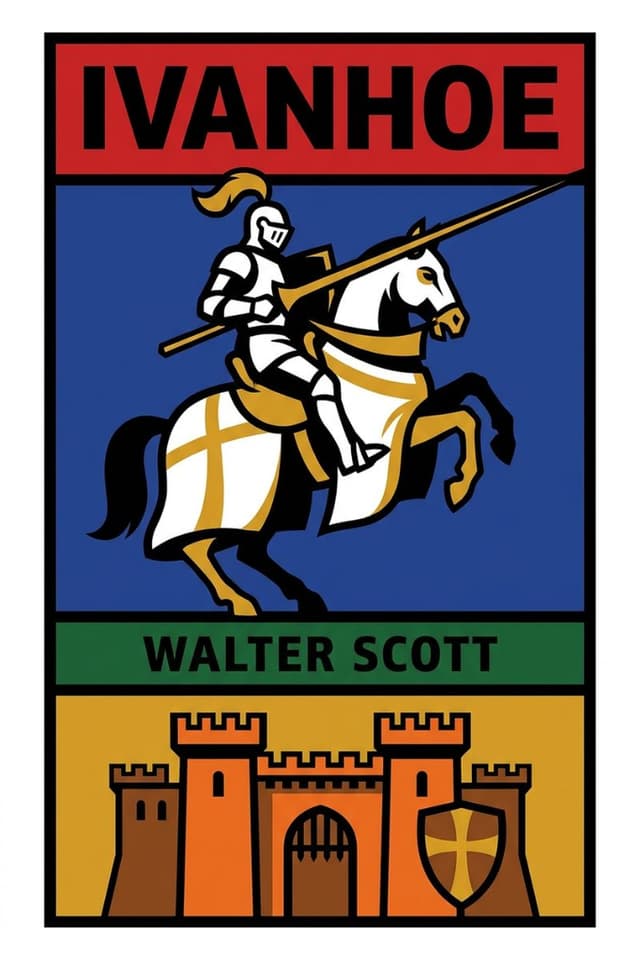
Ivanhoe
Read Ivanhoe by Walter Scott for free on Novelhalla, and try out our easy-to-read modern edition of this classic book. You can also download the EPUB and read it on any device if you prefer!
The Plot
England in the 1190s is a nation divided. The Norman conquerors have ruled for over a century, but the Saxon population remains subjugated and resentful. King Richard the Lionheart is away fighting in the Crusades, and his treacherous brother Prince John schemes to seize the throne. Into this volatile world rides a mysterious knight who will upset everyone's plans.
The Disinherited Knight
Wilfred of Ivanhoe is a young Saxon nobleman who has been disowned by his father Cedric for two offenses: following the Norman King Richard to the Crusades, and falling in love with Rowena, Cedric's ward, whom Cedric intends to marry to a Saxon lord to unite the old bloodlines. Ivanhoe returns to England in disguise, wounded and without resources, determined to reclaim his place.
At a great tournament at Ashby-de-la-Zouche, a mysterious knight in plain armor calling himself "the Disinherited Knight" defeats the best Norman warriors, including the powerful Templar knight Brian de Bois-Guilbert. He crowns Rowena the Queen of Beauty, then collapses from wounds he's been hiding. His identity remains a secret, though some begin to suspect.
Captives in the Castle
The story brings together a large cast of characters whose fates become intertwined. Cedric the Saxon travels with Rowena, the jester Wamba, and the swineherd Gurth. They encounter Isaac of York, a Jewish moneylender, and his beautiful daughter Rebecca, who is skilled in medicine. A palmer (a holy pilgrim) joins their party, as does a mysterious Black Knight who appeared at the tournament.
Through treachery, many of these characters end up prisoners in the castle of Front-de-Boeuf, a brutal Norman lord. Cedric and Rowena are held for ransom. Isaac is tortured for his gold. And Rebecca catches the obsessive eye of Brian de Bois-Guilbert, who is torn between his vows as a Templar and his desire for her.
Siege and Rescue
An unlikely alliance forms to rescue the captives. Robin Hood (here called Locksley) and his band of outlaws join forces with the mysterious Black Knight. They storm the castle in a desperate battle while fires rage and the walls crumble. Old sins are revealed, old scores are settled, and not everyone survives.
Rebecca's medical skill has saved Ivanhoe's life, and she has fallen in love with him, though she knows a union between a Jew and a Christian is impossible. Her kindness to him only inflames Bois-Guilbert's jealousy and sets in motion a final confrontation.
Trial by Combat
The Templars, embarrassed by Bois-Guilbert's behavior, put Rebecca on trial for witchcraft, blaming her for bewitching their knight. She is condemned to burn unless a champion will fight for her innocence. Bois-Guilbert, trapped by his own order, must fight against any champion who appears, even though he loves the woman he is meant to destroy.
The novel builds to a climax that will decide Rebecca's fate, reveal the true identity of the Black Knight, and settle the conflict between Saxons and Normans, at least for this generation.
About the Author: Walter Scott
Scottish Origins
Walter Scott was born in Edinburgh in 1771, the son of a lawyer. A childhood illness left him with a permanent limp, and he spent time recovering at his grandfather's farm in the Scottish Borders, where he absorbed the ballads, legends, and history that would fuel his writing. He trained as a lawyer like his father but was always more interested in literature and antiquities.
Poetry and Fame
Scott first became famous as a poet. His long narrative poems like The Lay of the Last Minstrel, Marmion, and The Lady of the Lake were enormously popular in the early 1800s. He was considered the greatest poet of his age until Byron came along and stole his thunder. Scott good-naturedly conceded the field and turned to prose.
The Waverley Novels
In 1814, Scott published Waverley anonymously, launching a series of historical novels that would make him the most popular and best-paid author in the world. He kept his authorship secret for years, though everyone suspected. The novels were credited to "the Author of Waverley" and Scott enjoyed the game of pretending not to be himself.
Financial Ruin and Recovery
Scott lived grandly, building an enormous estate called Abbotsford and collecting antiquities. When his publisher and printer went bankrupt in 1826, Scott was left with crushing debts. Rather than declare bankruptcy, he spent his remaining years writing furiously to pay off his creditors. He largely succeeded, though the effort destroyed his health.
Death and Legacy
Scott suffered a series of strokes and died in 1832 at sixty-one. He was mourned across Europe as one of the great literary figures of the age. He had essentially invented the historical novel as a genre, influencing writers from Dickens to Tolstoy. His reputation faded somewhat in the twentieth century but has revived as readers rediscover his storytelling power.
Fun Facts About the Book
Invented the Medieval Tournament
The tournament at Ashby-de-la-Zouche, with its jousting knights, heralds announcing combatants, and queens of beauty, established the popular image of medieval tournaments that persists today. Real medieval tournaments were messier and less romantic, but Scott's version is what we all picture.
Created Robin Hood as We Know Him
Robin Hood existed in ballads before Ivanhoe, but Scott gave him many of the characteristics we now consider essential: the merry outlaw in Lincoln green, the band of loyal followers, the residence in Sherwood Forest, the conflict with Prince John. Later writers and filmmakers built on Scott's foundation.
The Jewish Question
Scott's portrayal of Isaac and Rebecca was complex for its time. Isaac fits some anti-Semitic stereotypes of the money-grubbing Jew, but Scott also shows his dignity and his suffering. Rebecca is one of the novel's most admirable characters, brave, intelligent, and virtuous. Scott was making a point about English prejudice, though modern readers may find even his sympathetic portrayal uncomfortable.
Richard the Lionheart
The Black Knight's identity is one of the novel's open secrets. Scott romanticized Richard considerably. The real Richard spent almost no time in England, spoke French rather than English, and viewed his kingdom mainly as a source of revenue for his wars. But the legend of Good King Richard versus Bad Prince John was too good to resist.
Templar Villains
Scott's portrayal of the Knights Templar as corrupt, power-hungry, and hypocritical influenced how the order has been depicted ever since. The historical Templars were dissolved in 1312 under accusations of heresy, but Scott's sinister version of them fed into conspiracy theories that persist to this day.
The Saxon-Norman Divide
Scott dramatized the conflict between Saxons and Normans more than historical evidence supports. By the 1190s, the two peoples had largely merged. But the idea of an oppressed native population versus foreign conquerors made for great drama and resonated with Scott's readers, some of whom saw parallels to their own times.
Language Lesson
Scott famously pointed out in Ivanhoe that English uses different words for animals and their meat: cow/beef, pig/pork, sheep/mutton. The animals have Saxon names because Saxons tended them; the meats have Norman French names because Normans ate them. Linguists still cite this passage.
Themes
National Identity
Who are the English? The novel grapples with a nation forged from conquest, where the descendants of the conquered and the conquerors must somehow become one people. Scott suggests that England's strength comes from this fusion, though the process is painful and incomplete.
Chivalry and Its Limits
The tournament scenes celebrate chivalric ideals: courage, honor, courtesy, protection of the weak. But Scott also shows chivalry's dark side. Bois-Guilbert is a perfect knight in skill but a monster in morality. The code of honor can become a trap, forcing men into actions they know are wrong.
Religious Intolerance
Rebecca and Isaac face constant persecution simply for being Jewish. They are denied legal protections, subjected to violence, and excluded from society. Scott clearly sympathizes with them and uses their treatment to critique Christian hypocrisy. The Templars who condemn Rebecca are far worse sinners than she.
Loyalty and Legitimacy
Who deserves loyalty? The absent Richard, the scheming John, or neither? Various characters must choose whom to serve and what principles to uphold when lawful authority has broken down. Scott explores how legitimacy is constructed and contested.
The Romance of the Past
Scott invented the popular Middle Ages, a time of tournaments and castles and damsels and outlaws. He knew the real medieval period was harsher, but he understood the appeal of a romanticized past. Ivanhoe is less about the twelfth century than about the nineteenth century's dreams of it.
The Book's Legacy
Ivanhoe was a sensation when published in 1819 and remained enormously popular for over a century. It shaped how generations imagined the Middle Ages. Every Robin Hood movie, every Renaissance faire, every tale of knights and tournaments owes something to Scott.
The novel pioneered techniques of historical fiction that later writers adopted: the blend of fictional and historical characters, the use of past conflicts to comment on present ones, the careful recreation of period detail. Scott showed that history could be entertainment without ceasing to be serious.
Modern readers sometimes find Scott's prose dense and his pacing slow by contemporary standards. But the set pieces remain thrilling: the tournament, the siege, the trial by combat. The characters are vivid even when they're types. And the novel asks questions about nation, identity, and belonging that have not gone away.
Ivanhoe endures because its medieval England, however invented, feels true to something we want to believe about heroism, loyalty, and honor. Scott created a myth, and myths have power that outlasts their makers.