Novelhalla
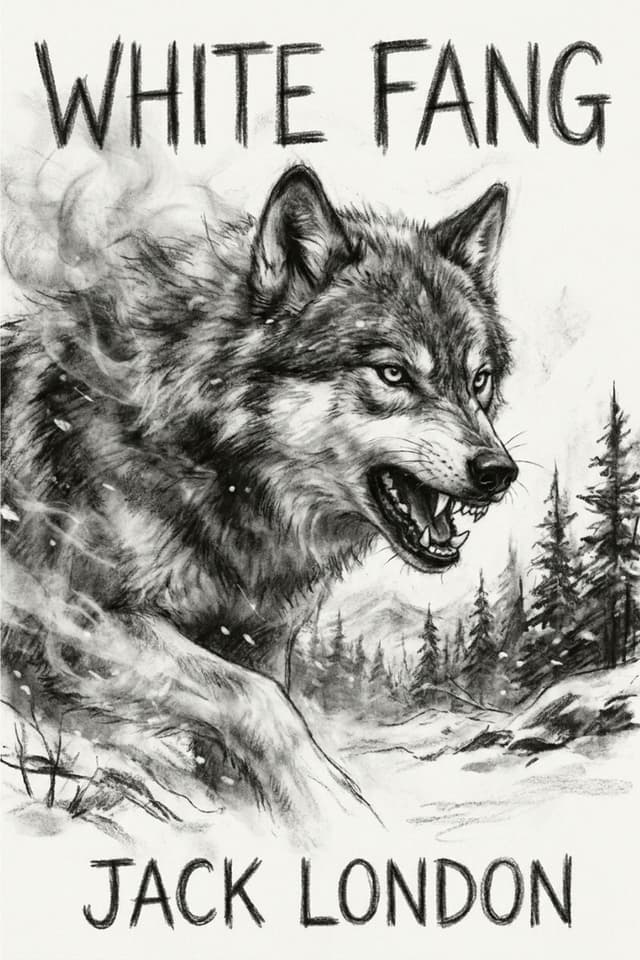
White Fang
Read White Fang by Jack London for free on Novelhalla, and try out our easy-to-read modern edition of this classic book. You can also download the EPUB and read it on any device if you prefer!
The Plot
The Wild
Somewhere in the frozen reaches of the Yukon Territory, a she-wolf runs with a starving wolf pack. They are hunting two men and their sled dogs through the endless winter dark, picking them off one by one. The men hear the wolves at night. They count their dogs each morning and come up short.
The she-wolf is not fully wild. She is part dog, and she once had a name. But hunger has driven her back to the pack, and she is as deadly as any of them.
When the famine breaks and the pack scatters, she dens up with a lone wolf in a cave by a river. She gives birth to a litter of cubs. Only one survives. He is grey, with the fang-white markings of his mother. He has never seen sunlight. He doesn't know what the world is.
He's about to find out.
The Cub
The little wolf-dog's first weeks are a brutal education. The cave is safe, but it is small, and beyond its mouth lies a world of blinding light and terrifying unknowns. He learns the law of meat early: eat or be eaten. He learns pain from a mother ptarmigan protecting her chicks, from a lynx that nearly kills him, from the river that almost drowns him. Every encounter teaches him the same lesson. The Wild does not care about him. It will kill him the moment he stops paying attention.
But the cub is fast, and he is smart, and he has something most of the other animals don't. He has the wolf's instinct and the dog's cunning. He is built for this world in ways that nothing else quite is.
Then the men come.
The God's Domain
A group of Indigenous people find the she-wolf and recognize her. She belonged to one of their own, years ago, before famine sent her running. They take her back. They take the cub too, and they give him a name: White Fang.
Camp life is nothing like the wild. There are fires and shelters and rules, and the other dogs hate him on sight. He is wolf enough to be an outsider and dog enough to be kept around. One dog in particular, Lip-Lip, makes White Fang's life a relentless misery, attacking him at every opportunity, turning the whole pack against him.
White Fang survives. He does more than survive. The persecution makes him vicious, solitary, and terrifyingly efficient. He becomes the best fighter in the camp. He earns respect from the people, but not affection. Not from anyone. His mother is sold away to another camp, and the one creature who ever showed him tenderness disappears from his life.
He learns to serve people. He does not learn to love them.
The Enemy of His Kind
When White Fang's owner brings him to Fort Yukon during the Gold Rush, everything changes. The fort is chaotic, full of desperate men and whiskey and greed. A man called Beauty Smith, who is neither beautiful nor kind, wants White Fang. He gets the owner drunk, again and again, until the price of the next bottle is the wolf-dog himself.
Beauty Smith doesn't want a sled dog. He wants a fighter.
White Fang is chained, starved, taunted, and beaten until the savagery that the wild and the camp planted in him blooms into something terrifying. He becomes a pit fighter, thrown against dog after dog, wolf after wolf, even a lynx. He wins every time. The crowds cheer. The money changes hands. White Fang knows nothing but the chain, the ring, and the kill.
Then they bring in a bulldog, a squat, relentless animal built for one thing: to lock its jaws and never let go. For the first time, White Fang faces something his speed and ferocity cannot solve. The bulldog gets hold of his throat and begins to crush.
White Fang is dying in the dirt when a stranger pushes through the crowd and stops the fight.
The Last Master
The stranger is a man named Weedon Scott, a mining engineer with money and authority. He buys White Fang from Beauty Smith by force and takes him home. What follows is not a rescue in any simple sense. White Fang doesn't understand kindness. He has never experienced it, not really. He flinches from hands. He bites. He cannot tell the difference between a touch and a blow.
Scott is patient. Unbelievably patient. He talks softly. He moves slowly. He does not hit back.
The question the rest of the novel asks is whether a creature shaped entirely by violence, who has learned that the world is nothing but teeth and hunger and pain, can be remade by something as fragile as gentleness. Whether the damage is permanent, or whether buried somewhere inside White Fang there is still the cub who once pressed against his mother's warm side in the dark of a cave.
Scott is betting everything on the answer. But when the time comes for him to leave the Yukon, he'll have to decide whether White Fang can survive in a world he's never seen, a world of green lawns and sunshine and people who have never known the Wild.
And White Fang will have to decide what he's willing to become.
About the Author: Jack London
A Rough Start
Jack London was born John Griffith Chaney in San Francisco in 1876. His biological father, an astrologer, abandoned the family before Jack was born. His mother remarried, and Jack took his stepfather's surname. The family was working class, and London's childhood was shaped by poverty and instability. By fifteen, he was an oyster pirate on San Francisco Bay, stealing from commercial beds under cover of darkness. By sixteen, he'd switched sides and joined the Fish Patrol, enforcing the same laws he'd been breaking.
He worked in a cannery, shoveled coal, sailed the Pacific, and rode freight trains across the country as a hobo. He was jailed for vagrancy at eighteen. He was, by any measure, living the kind of life most writers only imagine.
The Klondike
In 1897, at twenty-one, London joined the Klondike Gold Rush. He sailed north with his brother-in-law, hauled a ton of supplies over mountain passes on his back, and made it to Dawson City. He didn't find gold. What he found was worse: scurvy, malnourishment, and the loss of his front teeth. He also found the landscape and the stories that would make him famous.
The frozen wilderness, the desperate men, the sled dogs, the wolves, the thin line between survival and death. London absorbed all of it. He later said of the Klondike: "It was there I found myself. Everybody thinks. You get your true perspective."
He came home broke and began writing.
Fame and Fortune
Success came fast. His first story collection, The Son of the Wolf, was published in 1900. The Call of the Wild made him a celebrity in 1903. By his early thirties, London was one of the highest-paid and most widely read authors in America, a position he held for the rest of his life.
He was extraordinarily prolific, producing over fifty books of fiction and nonfiction, along with hundreds of short stories. He was also a committed socialist, a war correspondent, and a tireless adventurer who sailed the South Pacific in a small ketch and built a grand ranch in Sonoma County, California.
Final Years
London's health deteriorated in his late thirties, likely due to kidney disease compounded by years of hard living. He continued writing and managing his ranch, but the work slowed. His dream home, Wolf House, burned to the ground before he ever moved in. He died in November 1916 at his ranch in Glen Ellen, California. He was forty years old.
His reputation dipped in America during the 1920s but remained enormous worldwide. A commemorative edition of his works published in Russia in 1956 reportedly sold out in five hours.
Fun Facts About the Book
The Mirror Novel
White Fang was deliberately written as the reverse of The Call of the Wild. Where Buck, the protagonist of the earlier novel, is a domesticated dog who answers the call of the wilderness, White Fang is a wild animal who moves toward civilization. London called the two novels companion pieces, and they work as a kind of philosophical argument with each other about nature, nurture, and what is truly "natural."
Written from the Animal's Perspective
Much of the novel is told from White Fang's point of view, which was a bold and unusual choice in 1906. London goes to great lengths to portray how an animal might perceive fire, language, human behavior, and the passage of time without attributing human thoughts to the animal. People are described as "gods" because that is the closest concept White Fang has for beings who control fire and food.
The President Disagreed
Shortly after White Fang's publication, President Theodore Roosevelt publicly called London a "nature faker," singling out the bulldog fight scene as absurd. Roosevelt was part of a broader movement criticizing writers who, in his view, attributed impossible behaviors to animals. London fired back, arguing that his portrayals were grounded in observable animal behavior and evolutionary science. The debate became a national literary controversy.
Serialized First
White Fang was originally published in serial form in Outing magazine between May and October 1906, before being released as a complete novel. Serial publication was common for popular fiction at the time, and it meant readers followed White Fang's story in monthly installments, each one ending on a hook.
Translated Into 89 Languages
White Fang has been translated into at least 89 languages, making it one of the most widely distributed American novels ever written. Its popularity has been particularly enduring in Russia, where London's themes of survival, class, and the natural world resonated with readers across generations.
Autobiographical Undertones
Critics have noted that White Fang's journey from outcast to accepted member of society mirrors London's own life. Born into poverty, hardened by years of brutal labor and vagrancy, London eventually found his way into middle-class respectability through talent and determination. The novel can be read as an allegory of that transformation.
Themes
Nature vs. Nurture
This is the novel's central engine. White Fang is shaped by every environment he enters: the wild makes him a hunter, the camp makes him a fighter, the dog ring makes him a killer, and a kind master begins to remake him again. London is deeply interested in whether character is fixed or fluid, whether cruelty breeds cruelty forever or whether a single sustained act of kindness can undo years of damage.
The Law of the Wild
London's wilderness operates on one rule: survival. There is no morality in the Wild, no fairness, no mercy. The strong eat the weak. The fast outlast the slow. White Fang internalizes this law so completely that when he encounters human society, he cannot understand any other way of being. The novel asks whether civilization is truly an improvement or just a different kind of cage.
Power and Cruelty
Every master White Fang serves represents a different relationship to power. Grey Beaver is pragmatic, neither cruel nor kind. Beauty Smith is sadistic, using White Fang's strength to enrich himself while destroying the animal's spirit. Weedon Scott offers something White Fang has never seen: power exercised with restraint. The novel is quietly devastating about how easily strength becomes abuse.
Loyalty and Trust
White Fang's capacity for loyalty is the thread that runs through every stage of his life. He is fiercely loyal to his mother, then to Grey Beaver, even when neither loyalty is returned. The tragedy is that his loyalty is exploited before it is ever honored. The novel suggests that trust is the most dangerous thing a creature can offer, and the most valuable.
The Violence of Civilization
London does not let human society off the hook. The Gold Rush camps are as brutal as the wilderness, just with different rules. Dog fighting, exploitation, alcoholism, and casual cruelty are everywhere. The "civilized" world is not inherently better than the Wild. It simply has more elaborate ways of being savage.
The Book's Legacy
White Fang has been adapted for film and television repeatedly since as early as 1925. The most well-known adaptation is the 1991 Disney film starring Ethan Hawke, which reimagined the story with a human protagonist alongside White Fang. A 2018 animated version produced for Netflix returned closer to the novel's animal-centered perspective, with voice work from Nick Offerman and Rashida Jones. A Japanese anime adaptation was produced in 1982, and a television series was filmed in New Zealand in 1993.
The novel remains a staple of school reading lists worldwide and is widely considered one of the essential American adventure stories. While some critics have ranked it just below The Call of the Wild in literary quality, many readers prefer White Fang for its emotional depth and its willingness to sit with the question of whether redemption is possible for a creature the world has tried its hardest to destroy.
London's vivid, unsparing prose and his refusal to sentimentalize the natural world continue to set White Fang apart from other animal stories. This is not a tale of a good boy. It is a story about what it costs to survive, what it means to be tamed, and whether love is strong enough to reach something that has every reason to bite the hand that offers it.