Novelhalla
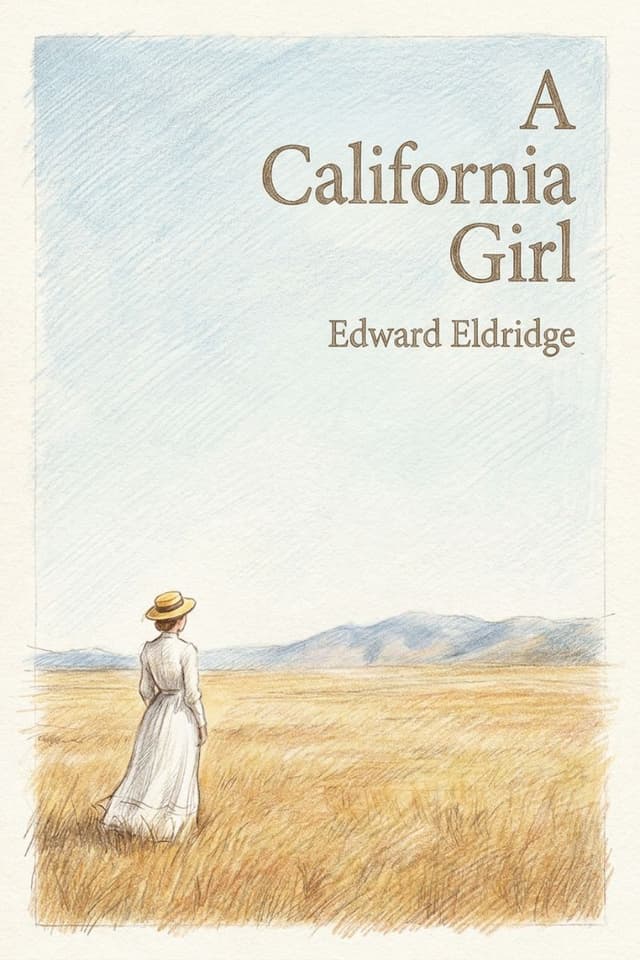
A California Girl
Read A California Girl by Edward Eldridge for free on Novelhalla, and try out our easy-to-read modern edition of this classic book. You can also download the EPUB and read it on any device if you prefer!
The Plot
A Perfect Day to Be Married On
Clara Lawton is twenty-two, warm-hearted, and about to marry the best catch in the county.
Charles Herne owns Treelawn, a beautiful ranch six miles outside the little California city of Roseland, tucked into the foothills of the Sierras. Orange and lemon orchards on one side, figs and almonds and walnuts on the other. A modern house, lawns, roses, and money in the bank. Charles is twenty-eight, generous, and famous in the district for treating his hired men like human beings, which in 1900 makes him either a saint or a fool depending on who you ask.
Clara has no idea what she is walking into. Not because Charles is hiding anything. Because Clara has been taught her whole life that a wedding is the finish line, the end and aim of her womanhood, the last chapter of the only story a woman gets. Nobody has ever suggested to her that marriage might only be the first step toward something much larger, and much stranger.
She is going to find out.
Orangeville
The settlement is called Orangeville. A store, a post office, a church, a schoolhouse, a blacksmith, and two saloons. Everybody knows everybody, and everybody talks.
Charles keeps the wedding secret, which lasts approximately one morning. By noon the news has traveled from the barn to the kitchen to the neighbors to the stage driver to the Crow's Nest saloon, where four men raise four glasses of whiskey to a bride none of them have met. The women of Orangeville begin calling on the new Mrs. Herne with a list of questions: Is she proud? Is she pretty? Can she do housework? Will she wear the breeches?
It is a place where nothing happens and everything is noticed. Which is exactly the wrong kind of place for what is coming.
The Girl Who Knows Her Power
Julia Hammond is the belle of Orangeville. Twenty-one, black-eyed, magnetic, with a stubborn iron will and a habit of playing men like cards.
She wants Ben West, the handsomest and most popular young man in the district, and she has decided she will have him. Ben does not know it yet. Charles Herne watches the whole thing from across a party and tells his wife flatly that Julia will get what she wants, because Julia would do anything to get what she wants.
And there is something else about Julia. Something her adoptive parents know and almost nobody else does. She was not born a Hammond. Her father was shot dead over a card game when she was a baby, and the older she gets, the more of his hot blood shows in her. The Hammonds have started quietly hoping that somebody, anybody, will marry her soon.
The Man Who Went North
Ben West announces he is going to the Klondike.
Nobody can understand why. He is an only child, his father owns a good ranch, he can earn four dollars a day whenever he likes. But at his farewell dance Julia plays her cards, and Ben goes home that night with his blood on fire, understanding for the first time that he has become a willing slave, and that the feeling is both wonderful and unbearable.
What follows is thirty days of rain and mud on a trail lined with sick men, dying men, and dead pack animals. Then freezing. Then Dawson City. Then partners who cheat, partners who quit, and a foot that freezes solid sixty miles from town with a fortune sitting in the ground behind him.
Ben West is going to come home rich. That was never really the question. The question is what a man like Ben West does when he finally has everything he went north to get, and discovers that the wanting has not stopped.
The Stranger in the Hills
A mile past the last decent road, in a four-room house on a scrap of orchard, live a woman named Mrs. Lenair and her son.
His name is Penloe. He was raised in Calcutta, took his degree at the university there, and came back to California to wash dishes in San Francisco restaurants and swing a pick with a thousand-man railroad gang. He takes the hardest jobs on the roughest ranches in the county, the places where men sleep in barns and drink and fight and talk about nothing but liquor, prize fighters, and women. His mother, asked why an educated man would choose that, says only: that is his work.
The stories about him have started to spread. The night he gave a sick tramp his blankets and slept uncovered on the hay. The way the meanest boss in the district went soft and stayed soft. The way people around him stop being sick. The men who work beside him say he has some power for healing, and that heat and cold and wet and dry all seem the same to him.
Mrs. Herne has heard the stories. She wants to meet him. Her husband tells her that something will happen, in some way, so that they will.
The Girl Who Does Her Own Thinking
Stella Wheelwright comes home from school at sixteen, brilliant, fearless, and already dangerous.
She accepts nothing without examining it. She takes what she calls her investigating axe to the customs and usages of society and cuts away the roots holding her free spirit in bondage, one at a time. The local men have opinions about girls like Stella. One of them says he would not give a book woman barn room.
Stella has questions piling up faster than she can answer them, and she is waiting for her last year of school to end so she can finally get at them.
Then she is going to meet Penloe.
What Orangeville Does Not See Coming
There is a sermon coming. There is an address coming, one that Penloe will deliver about a man who won the heart of an Oriental lady, and the author of this book states plainly in his prologue that any young man or woman who actually tried to live the way that address describes would become what Penloe and Stella have become.
There is a wedding coming in Orangeville, and it will not look like Clara's.
There is a party at the Hernes' coming, and a visit from two men named Barker and Brookes, and a chapter this book calls simply "Out of Bondage."
The word bondage is all over this novel. Sexual bondage. Bondage to money. Bondage to what the neighbors will say. Every character is tied to something, and most of them have no idea the ropes are there.
Somebody in Orangeville is about to cut them, in public, in front of everyone. And this is a community that noticed a wedding before breakfast.
About the Author: Edward Eldridge
The Man Nobody Can Find
Here is the honest truth about Edward Eldridge: almost nothing is known about him.
There is no birth date, no death date, no photograph, no obituary anyone has turned up. He appears to have written one book, published it in 1902, and vanished. Library catalogs list him as the author of this title and nothing else. He has no biography because nobody wrote one.
This is not unusual for the kind of book this is, and it may not be an accident.
What the Book Tells Us
What we have instead is the prologue, which is one of the more revealing author's notes you will find.
He says the book is not for specialists. It is for shop girls, factory girls, clerks, mechanics, farmers, merchants, and busy housewives. He calls them God's secular army, people whose natures are hungry for something better than what they see around them but who have no time for learned treatises. He wanted to hand them the newest thinking in the world in a form they would actually read.
He says the material is not invented. Much of it, he insists, is real.
He says that Penloe was drawn from life, and that he personally knew a man with greater spiritual gifts than Penloe has in the novel, a man still living at the time of writing, with an illuminated countenance and a remarkable personality.
And he signs off with a line that reads like a confession: whatever is wrong in this book comes from his own ego, and whatever is true and loving in it belongs to the One who brought him up out of the marshes and lowlands and let him drink at the crystal fountains of the hills.
Somebody wrote that sentence about himself. Whoever he was, he had been somewhere bad and believed he had gotten out.
The World He Was Writing From
Even without a biography, the book places him precisely.
He knows ranch labor from the inside: the mules, the broken harness, the gates without hinges, the barns where hired men sleep in December, the exact texture of the talk in a bunkhouse at night. He knows the Klondike route in operational detail, down to what it costs to hire a man in Dawson City and what a claim sold for. He knows the vocabulary of New Thought, of Theosophy, of dress reform and sex reform and vegetarianism and mental healing, the whole ferment of turn-of-the-century Southern California spiritual counterculture. And he knows Hindu religious thought well enough to make it the engine of his hero.
That is a specific person. We just do not have his name in any meaningful sense.
Fun Facts About the Book
It Was Published by America's First Vanity Press
The publisher was The Abbey Press of New York, at 114 Fifth Avenue, and it holds a genuine place in publishing history: it is generally considered the first American firm that operated principally as a vanity publisher, producing books at the author's own expense. It was founded by Charles Frederick Rideal and operated from roughly 1899 to 1903.
In other words, Eldridge almost certainly paid to print this. He believed in it enough to fund it himself.
A Suspicious Fire Erased the Records
In February 1903, less than a year after this book appeared, a suspicious fire destroyed The Abbey Press and its business records.
Whatever paperwork existed about who Edward Eldridge was, what he paid, where he lived, and what correspondence he had with his publisher very likely burned in that fire. It is a large part of why he is a ghost.
It Is a Klondike Novel Written While the Klondike Was Still News
The Klondike stampede peaked in 1897 and 1898. This book came out in 1902. Ben West's journey north is not historical fiction, it is current events, written for readers who had personally known men who left and men who came back.
The Ranch Talk Is Deliberate
Eldridge included a warning to what he called the sensitive, fastidious reader: an author who wants to be true to life has to present certain characters as they actually are, and put in their mouths the language they actually use.
He was not kidding. The bunkhouse chapters are wall-to-wall profanity by 1902 standards, and one long passage is a genuinely funny riff on how the word hell has been used so casually and so constantly that it has become, in one character's phrase, a spent thunderbolt.
Phrenology Was Still Being Cited as Science
The book quotes George Combe, the Scottish phrenologist, at length and in earnest on the maternal instinct. Elsewhere a character's appetite is described as his alimentive faculty being in a state of great activity.
Both are straight phrenological terminology, used without irony, which tells you a great deal about what counted as respectable popular science in 1902.
There Is a Cameo by a Hit Verse Play
One chapter opens with a long extract from Stephen Phillips's verse tragedy "Paolo and Francesca," specifically Lucrezia's speech about childlessness. Eldridge footnotes it to the Literary Digest of December 1899.
Phillips was, briefly, one of the most celebrated writers in the English-speaking world. Quoting him was the 1902 equivalent of opening a chapter with lyrics from the song everyone was streaming that year.
It Was Announced Like a Baby Being Born to an Entire Ecosystem
One of the strangest and most charming passages in the book is the announcement of a birth at Treelawn, which passes from the doctor to the nurse to the cook to the chore boy to the teamsters to the ditch men to the orchard men, and then to the prune trees, who whisper it to the apricot trees, who whisper it to the peach trees, and onward to the cows, the mules, the roosters, the hens, the orioles, the dogs, and the cats.
It goes on for a full page. It is completely sincere.
The Book Was Effectively Lost for a Century
There is no evidence of a second edition, no reviews of note, no reprints, no scholarly literature. The novel survived because a copy survived, and it reached modern readers only when Project Gutenberg volunteers digitized and proofread it in 2009.
Themes
Bondage
The word runs through the entire novel, and Eldridge uses it in every register at once.
Ben West calls himself a willing slave to a woman he barely knows. A rancher's wife is described as a cook-stove slave and a butter-making machine whose husband demands his marital privileges as a right regardless of her wishes. Stella takes an axe to the roots holding her spirit captive. The prologue promises the reader help getting out of bondage.
The argument of the book is that most people are chained to something, that they mistake the chain for the natural order of things, and that seeing it clearly is the first act of freedom.
Marriage as a Beginning Rather Than a Destination
Clara Lawton is presented sympathetically and never mocked, but the narrator makes it explicit on the very first pages that she has been handed a false ending. That she is a soul in the process of development. That marriage is one step toward something higher. That the true union is two people joining hands to work for humanity.
The novel then builds a second marriage as a counterexample, so the reader can compare.
The Idolatry of Money
There is a blistering passage about the worship of the successful young financier, the Napoleon of Finance, whose money covers over any number of moral failings, and whose faults are excused by every mother with an unmarried daughter.
Eldridge rewrites Proverbs to fit the age he lived in: with all thy getting, get money, honestly if you can, but get it anyway.
How You Treat the People Who Work for You
The Herne ranch is a working argument. Charles gives his men private rooms, bathrooms with hot water, a piano, a billiard table, magazines, a horse team for their own use, and a five-and-a-half-day week. The result is that nobody swears at the animals, nothing gets broken, nobody quits, and there are ten men waiting for the next opening.
The neighbors admit it works and mostly refuse to copy it. One of them observes that Herne does not preach Christianity at his men, he just quietly practices it.
Health as Something You Choose
Mrs. Lenair has not eaten meat in seventeen years, does not get sick, has not had an ache or pain in years, and looks a decade younger than she is. Her neighbor cannot make sense of her, since every unmarried girl in the district is ailing and every married woman has her aches and pains.
The book presents illness as largely a byproduct of how a person thinks, eats, and lives, which puts it squarely inside the New Thought and mental healing movement that was sweeping California at the time.
East Meeting West
Penloe is explicitly described by the author as the interior life of the Hindu combined with the best practical thought of the West.
This is 1902, decades before Eastern spirituality became a familiar feature of American life, and only a few years after the Parliament of the World's Religions introduced Vivekananda to a stunned American public. A novel that makes a Calcutta-educated mystic its moral hero, in a California orange grove, is doing something genuinely early.
Everyone Is Watching
Orangeville is a surveillance machine. A wedding is known to the entire district before the bride has unpacked. Every visitor to the new Mrs. Herne generates hours of speculation.
It matters, because the ideas this book wants to introduce are ideas that will have to survive being talked about at the Crow's Nest saloon.
The Book's Legacy
This is a book with almost no legacy, and that is what makes it worth reading now.
It was never adapted, never reprinted in any serious way, never reviewed into the historical record, and never studied. It was self-funded by an unknown man, published by a firm that burned down the following year, and it slipped straight through the floor of literary history. For roughly a hundred years it existed only as scattered physical copies until digitization pulled it back into circulation.
What survives is a remarkably direct window into a moment. Turn-of-the-century California was full of health reformers, dress reformers, sex reformers, vegetarians, spiritualists, mental healers, New Thought lecturers, and seekers of every description, and most of what they believed reaches us secondhand, filtered through historians and skeptics. Here it is firsthand, in a novel, aimed squarely at factory girls and mechanics, written by someone who plainly considered himself one of the converted.
It is also a genuinely odd reading experience. Long stretches are broad, funny, close-observed rural comedy: gossiping wives, cursing teamsters, a man being managed through his stomach, a hired hand's opinions on book women. Then the floor drops out and it turns into a spiritual manifesto about sexual freedom, the failures of conventional marriage, and the reformation of the human race. Very few novels contain both of those books at once.
For a modern reader, the appeal is partly the reform novel and partly the accidental documentary. The mule teams, the barn where men sleep in December, the Dawson City dance halls, the price of a Klondike claim, the exact things Orangeville women wanted to know about a stranger's bride. Eldridge said much of it was real, and it reads like it.
He wanted to change the lives of shop girls and mechanics. He almost certainly changed nobody's. But the attempt is still here, intact, and it is far stranger and livelier than it has any right to be.