Novelhalla
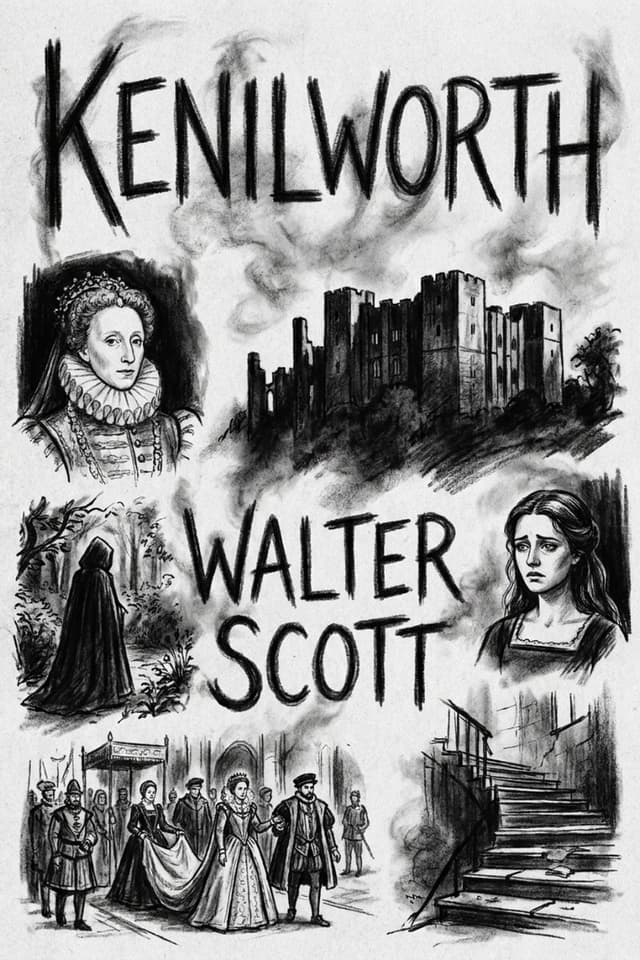
Kenilworth
Read Kenilworth by Walter Scott for free on Novelhalla, and try out our easy-to-read modern edition of this classic book. You can also download the EPUB and read it on any device if you prefer!
The Plot
A Secret Marriage
The story opens at the Black Bear Inn in the village of Cumnor, where a young traveler named Edmund Tressilian has come looking for a woman he once loved. Her name is Amy Robsart, and her family believes she has been seduced and carried off by Richard Varney, the scheming servant of Robert Dudley, Earl of Leicester. Tressilian finds Amy hidden away at Cumnor Place, a secluded country house, and begs her to come home. She refuses.
What no one outside these walls understands is that Amy has not been ruined by Varney. She has secretly married the Earl of Leicester himself, one of the most powerful men in England and the favorite of Queen Elizabeth I. Leicester loves Amy, but he loves his ambition more. Elizabeth is rumored to be considering him as a husband, and if she discovers he is already married, his career, his fortune, and possibly his life will be destroyed. So Amy is kept hidden, visited rarely, and told to be patient while her husband plays the courtier.
The Web of Lies
Tressilian, believing Amy is Varney's victim, takes his case to court. He gains the support of the Earl of Sussex, Leicester's great rival, and petitions the Queen herself for justice. Now Elizabeth demands answers, and the lies begin to pile up. Varney claims Amy is his own wife, and Leicester, standing right there, confirms it. The deception holds, but barely.
Elizabeth commands that Amy be brought to the grand festivities she will attend at Leicester's magnificent castle, Kenilworth. Leicester writes to Amy, asking her to appear there pretending to be Varney's wife. Amy, proud and heartsick, refuses to play along. She will not deny her marriage any longer.
Meanwhile, Varney has his own plans. He is not merely Leicester's loyal servant. He is a man of consuming ambition who sees Amy as an obstacle. If Leicester marries the Queen, Varney rises with him. If Amy insists on being acknowledged, everything crumbles. Varney enlists a sinister alchemist named Alasco to help keep Amy out of the way, first through drugs, then through darker means.
The Road to Kenilworth
Amy escapes from Cumnor Place with the help of Wayland Smith, a resourceful and quick-witted jack-of-all-trades who serves as one of the novel's most entertaining characters. Together they make their way to Kenilworth Castle, where Elizabeth's arrival has turned the estate into a spectacle of pageants, fireworks, feasts, and theatrical displays on a scale the country has never seen.
Amy manages to reach the castle and even confronts the Queen directly, but her desperation and Leicester's panic only tangle the situation further. Leicester is torn between confession and self-preservation, between his love for Amy and his hunger for power. And Varney, always watching, always scheming, moves to ensure that the truth stays buried no matter what.
The novel builds toward a climax where loyalty, ambition, love, and treachery collide in the corridors and grounds of one of England's greatest castles.
About the Author: Walter Scott
Early Life
Walter Scott was born in Edinburgh on August 15, 1771, the ninth child of a solicitor and a physician's daughter. Six of his siblings died in infancy. At the age of two, he contracted polio, which left him with a permanent limp. He was sent to his grandparents' farm at Sandyknowe in the Scottish Borders to recover, and it was there, listening to his grandmother's stories of ancestors and border raids and his aunt's recitations of poetry, that he fell in love with the history and folklore that would shape his entire career.
He attended the Royal High School in Edinburgh and then the University of Edinburgh, where he studied law. He was called to the bar in 1792 and practiced as a lawyer for years, eventually becoming Sheriff-Depute of Selkirkshire and Clerk of Session in Edinburgh. He held both positions for most of his life, writing his enormous body of literature around the edges of a full legal career.
The Poet Turned Novelist
Scott first made his name as a poet. His long narrative poems, especially The Lay of the Last Minstrel (1805) and The Lady of the Lake (1810), were sensations that made him the most popular poet in Britain. But when Lord Byron arrived on the scene and began eclipsing him in verse, Scott quietly shifted to prose.
His first novel, Waverley, appeared anonymously in 1814 and was an immediate triumph. It is now widely regarded as the first true historical novel in Western literature. Scott followed it with a torrent of novels published under the byline "By the Author of Waverley," though his identity was an open secret for years. He did not publicly acknowledge authorship until 1827.
He married Charlotte Charpentier, a woman of French descent, on Christmas Eve 1797 in Carlisle. They had five children, four of whom survived to adulthood. In 1811, he purchased a farm on the River Tweed and transformed it into Abbotsford, a grand estate designed to look like a medieval manor, which he filled with antiquarian treasures, old weapons, and historical curiosities.
Ruin and Legacy
In 1820, Scott was made a baronet. By the mid-1820s he was the most famous and best-selling author in Europe. Then disaster struck. The financial collapse of 1825 brought down his publisher, Archibald Constable, and with it the Ballantyne printing firm in which Scott was a partner. He was left with debts of roughly 130,000 pounds, a staggering sum.
Scott refused to declare bankruptcy. He placed his home and income in trust for his creditors and resolved to write his way out of debt. For the next seven years he produced novels, biographies, histories, and essays at a punishing pace, working mornings, afternoons, and evenings. His wife Charlotte died in 1826, adding private grief to financial pressure.
The effort broke his health. He suffered a series of strokes beginning in 1830, attempted a recuperative tour of the Mediterranean, and was brought home to Abbotsford to die. He passed away on September 21, 1832, at the age of sixty-one, in the study surrounded by the books that had been both his livelihood and his joy. His debts were finally cleared by continued sales of his novels shortly after his death.
Scott was buried at Dryburgh Abbey beside his wife. The Scott Monument on Princes Street in Edinburgh, a soaring Gothic spire completed in 1844, remains one of the largest monuments to a writer anywhere in the world. Edinburgh's Waverley Station is named for his first novel, the only major railway station in the world named after a book.
Fun Facts About the Book
Written in Three Months
Scott completed Kenilworth in roughly three and a half months, writing from September to late December 1820 while juggling his legal duties. The novel was published on January 13, 1821, with an initial print run of 10,000 copies. A second edition of 2,000 more followed within two months.
Gleefully Inaccurate
Scott knew his Elizabethan history very well, which makes his deliberate liberties all the more entertaining. The real Amy Robsart died in 1560, but Scott sets her story amid the Kenilworth festivities of 1575, fifteen years later. He also includes William Shakespeare as a character at the court, even though Shakespeare was only eleven years old in 1575. One character even quotes The Tempest, a play that would not be written for another thirty-six years. Scott was not trying to fool anyone. He was writing a romance, not a textbook.
The Real Amy Robsart
The historical Amy Robsart was found dead at the foot of a staircase at Cumnor Place on September 8, 1560. Her neck was broken. The coroner ruled it an accident, but suspicion fell on her husband Robert Dudley almost immediately. Rumors swirled that he had arranged her death to clear the way for a marriage to Elizabeth. The mystery has never been solved. Some historians have suggested she may have been suffering from breast cancer, which could have weakened her bones and caused a spontaneous fracture. Others suspect foul play. The scandal effectively prevented Dudley from ever marrying the Queen.
The Cumnor Place Ghost
Cumnor Place, where Amy Robsart died and where much of the novel's early action takes place, was demolished in 1810, reportedly to lay Amy's ghost to rest. Local legends about her haunting the house had persisted for over two hundred years.
Eleven Operas and Counting
Kenilworth inspired an extraordinary number of musical and theatrical adaptations. At least eleven operas were based on the novel, including Gaetano Donizetti's Elisabetta al castello di Kenilworth (1829) and works by Auber, Weyse (with a libretto by Hans Christian Andersen), and others. Arthur Sullivan composed a cantata called The Masque at Kenilworth in 1864. A stage adaptation appeared at Covent Garden less than two months after the novel's publication. Even the young Victor Hugo tried his hand at dramatizing the story.
Raleigh's Cloak
The famous scene of Sir Walter Raleigh throwing his cloak over a muddy puddle so Queen Elizabeth can pass is one of the most memorable moments in the novel and has become one of the most enduring images of Elizabethan England. There is no reliable historical evidence that it ever actually happened. The story appears to have originated in a much later source, and Scott helped cement it permanently in the popular imagination.
It Put Kenilworth on the Map
Scott's novel revived public interest in Kenilworth Castle, which had been in ruins since the English Civil War. The book turned the castle into a tourist destination and a site of literary pilgrimage, a status it retains today as one of English Heritage's most visited properties.
Portland, Oregon Connection
The Creston-Kenilworth neighborhood in Portland, Oregon, takes the latter half of its name from Scott's novel, one of many places around the world that bear the name thanks to the book's enormous popularity in the nineteenth century.
Themes
Ambition vs. Love
The novel's central tension lives inside Leicester himself. He loves Amy, but he wants the crown. He cannot have both, and his refusal to choose destroys the person he claims to care about most. Scott presents ambition not as an abstract vice but as a daily series of small compromises that gradually become irreversible.
The Danger of Secrecy
Almost every disaster in the novel flows from the decision to keep Amy's marriage hidden. Secrecy breeds dependence on untrustworthy people, creates opportunities for villains, and traps the innocent in situations they cannot escape. Scott shows how the need to maintain a lie warps every relationship it touches.
Power and Vulnerability
Amy is a countess in name but a prisoner in practice. She has no independent means, no public identity, and no one she can safely appeal to. The novel quietly but forcefully illustrates how power operates through visibility. Those who are hidden from the world are at the mercy of those who control their visibility.
Loyalty and Its Limits
Varney presents himself as Leicester's most devoted servant, but his loyalty is entirely self-serving. Tressilian risks his life for a woman who has rejected him, expecting nothing in return. The novel tests what loyalty actually means by putting it under extreme pressure and showing which versions hold and which ones shatter.
The Elizabethan World as Theater
Scott fills Kenilworth with pageants, masques, costumes, and performances, and this is not merely decorative. The entire court is a performance. Everyone is playing a role, managing appearances, and trying to control what the Queen sees and believes. The line between the staged entertainments and the political maneuvering around them is deliberately blurred.
The Cost of Greatness
Elizabeth is portrayed as a genuinely formidable ruler, but the novel also shows the human cost of her position. She cannot be deceived without danger, she cannot trust without risk, and the people around her are always performing. Leicester's tragedy is that he wants intimacy with a woman who can never simply be a woman, and power from a system that demands he sacrifice everything personal to obtain it.
The Book's Legacy
Kenilworth was one of the most popular and widely read novels of the nineteenth century. In Scott's own time, it was considered among his finest works, a book that could stand alongside Ivanhoe and The Heart of Midlothian. It sold rapidly, was adapted for the stage almost immediately, and inspired operas, paintings, and poems across Europe. Richard Parkes Bonington's painting of Amy Robsart and Leicester, inspired by the novel, hangs in Oxford's Ashmolean Museum. Balzac referenced the book in his own fiction. The young Victor Hugo and Alexandre Soumet each wrote competing dramas based on it.
The novel played a significant role in shaping popular perceptions of the Elizabethan era. Scott's portrait of Elizabeth, his depiction of court intrigue, and his rendering of the grand Kenilworth festivities became the template through which millions of readers understood the period. His version of the Raleigh cloak story became more famous than any historical account.
Kenilworth also revived and permanently fixed the legend of Amy Robsart in the public imagination. The real Amy's death in 1560 was a genuine historical mystery, but it was Scott's dramatic retelling that turned her into a tragic romantic figure known far beyond the circles of Tudor scholarship.
Like much of Scott's work, the novel's readership has contracted considerably since the nineteenth century. His dense prose, archaic dialogue, and leisurely pacing are harder sells for modern audiences. But for readers willing to meet Scott on his own terms, Kenilworth offers something rare: a fully realized vision of Elizabethan England as a world of dazzling surfaces and lethal depths, where love and power are locked in a contest that only one of them can win.