Novelhalla
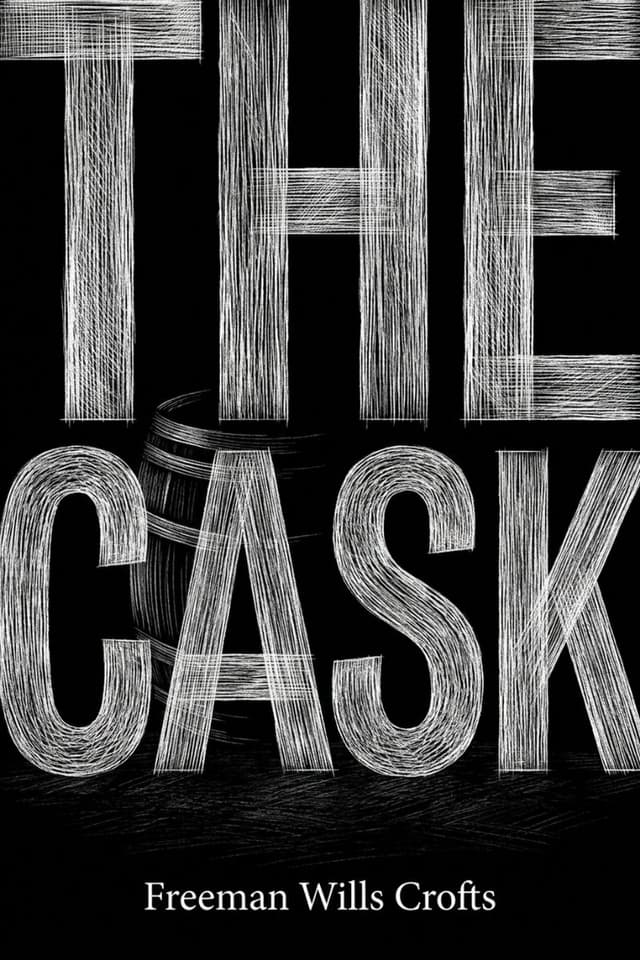
The Cask
Read The Cask by Freeman Wills Crofts for free on Novelhalla, and try out our easy-to-read modern edition of this classic book. You can also download the EPUB and read it on any device if you prefer!
The Plot
An Accident on the Docks
A steamer called the Bullfinch comes in from Rouen with a consignment of French wine, and a young shipping clerk named Broughton is sent down to the wharf to check it off. It's a dull job. He's bored before he starts.
One barrel in the load isn't like the others. It's larger, its sides are reinforced with extra staves and iron bands, and the paperwork says it holds a statue from a firm of monumental sculptors in Paris. It's also far heavier than it has any business being.
The sling slips while it's being hoisted. The barrel drops onto the quay, the lid splits, and sawdust pours out across the stones. So do gold sovereigns.
The dockers stop working and start filling their pockets. Broughton, trying to get some idea of what he's dealing with, pushes the sawdust aside to see how far down the coins go.
What he finds under them are the fingers of a woman's hand.
The Barrel That Isn't There
Broughton runs for his manager. His manager comes back with him at speed, because a thing like that has to be reported and reported quickly.
The cask is gone. Not opened, not emptied. Gone off the wharf entirely, in the twenty minutes he was away, with paperwork that looks almost right and a carter nobody can name.
By the time Scotland Yard is called in, the situation has stopped being a horror and become something worse: a logistics problem. Somewhere in London, in a city of ten thousand yards and sheds and stables, there is a barrel on a cart, and every hour that passes it gets further away, and the only thing anybody knows for certain about the woman inside it is that she was wearing rings.
Inspector Burnley
The man they send is not a genius. This matters, and it's the point of the whole book.
Burnley of the Yard doesn't have a violin or a cocaine habit or a theory of criminal types. What he has is patience and a notebook. He goes to the carriers. He goes to the stables. He compares delivery times, he interviews clerks about handwriting, he works out how long a horse takes to travel a given distance with a given load, and he loses the trail repeatedly and picks it up again each time off something almost too small to count.
It's astonishing how tense this turns out to be.
The Man with the Perfect Explanation
The trail leads to a Frenchman named Léon Felix, an artist living quietly in a villa on the London outskirts, who has a story ready and no apparent nerves about telling it.
He says he got a typed letter from a friend in Paris. He says the friend won a large sum in a lottery and, because of a bet the two of them had made about whether money could be got past the customs, was sending Felix his share hidden inside a shipment of statuary. He says he had no idea what else was in there. He says he simply went to collect what was his.
It's an absurd story. It's also exactly the kind of absurd thing that happens to be true sometimes, and Felix can produce the letter.
Then the police search his house, and what they find is a great deal worse for him than the letter is good.
Paris
Everything in this case points one direction, and it points there so neatly, so completely, with such a helpful abundance of the right sort of evidence in all the right places, that a careful man might start to wonder about it.
Burnley crosses to Paris and takes up with a detective of the Sûreté named Lefarge, and between them they start pulling on the other end of the thread: where the cask was made, who ordered it, who filled it, and where a woman went on a particular night while her household believed she was somewhere else.
There's an alibi in this book. It's a good one. Somebody in it can account for every hour of the relevant time, with witnesses, in two countries, and there is not one visible crack in it anywhere.
Someone is lying beautifully. The question is which of them, and whether a man with a notebook and a train timetable is enough to prove it.
About the Author: Freeman Wills Crofts
Dublin, and a Vicarage
Freeman Wills Crofts was born in Dublin in 1879, several months after his father died of fever in Central America while serving as an army surgeon. His mother remarried a Church of Ireland clergyman, and Crofts grew up in a vicarage in County Down and went to school in Belfast.
At seventeen he was apprenticed to his uncle, Berkeley Deane Wise, who happened to be chief engineer of the Belfast and Northern Counties Railway. That decided the next thirty years of his life.
Thirty Years of Railways
He worked on a rail extension in Donegal, then became a district engineer at Coleraine, and by 1910 was chief engineer for the Northern Counties Committee at Belfast. He married Mary Bellas Canning in 1912. He was an organist and choirmaster wherever he lived. He gardened and did carpentry.
This is the entire biography of a man who was never going to be a novelist. He was good at his job, he liked timetables and load calculations and the exact number of minutes a thing takes, and there is no indication he had literary ambitions of any kind.
An Illness
Then he got seriously ill, and the recovery went on for months, and he was bored out of his mind.
He started writing a detective story to pass the time. When he got better he put it aside and went back to work. Eventually the manuscript was sent to a literary agency, which placed it with Collins, who printed a thousand copies in the summer of 1920.
Within twenty years it had sold a hundred thousand copies across Britain, Europe, and America, and he was one of the most respected mystery writers alive.
Two Careers at Once
Here's the part that says everything about him: he kept the day job. For nine more years he wrote a book a year in his spare time while running railway engineering for Northern Ireland, and his final engineering assignment was chairing a government inquiry into a drainage scheme.
In 1929 his health forced a choice, and he picked writing. He moved to Surrey, joined the Detection Club alongside Agatha Christie and Dorothy L. Sayers, kept playing the organ, and produced roughly a novel a year for the rest of his life, most of them featuring Inspector Joseph French. He was elected a fellow of the Royal Society of Arts in 1939.
He died in Worthing in 1957, at seventy-seven, in the same year his last book was published.
Fun Facts About the Book
The Author Explained Exactly How Badly It Was Built
In an introduction he wrote for a 1946 reissue, Crofts admitted the book was constructed a day at a time. Every new good idea got jammed in as it occurred to him, and it kept turning out the next morning that the shiny new idea contradicted something he'd already written. He reckoned the thing had been rewritten at least five times before it reached its final state. He also said that if he were writing it later in life he'd have made a far greater effort to interest the reader in the people.
Very few authors of a famous book will tell you in print that they were making it up as they went along.
1920 Produced Two Debuts
The other one was a first novel by a young woman named Agatha Christie, introducing a Belgian detective. Historians of the genre usually credit her with starting the Golden Age of detective fiction that year. There's a decent argument that it started twice in 1920, and that this is the other half of it.
It's Set Before the War
Published in 1920, but deliberately set in 1912. No trenches, no ration books, no shadow at all. Whether that's nostalgia or just the fact that Crofts had been sketching the thing for a while, the effect is a world with the lights still on.
The Alibi Habit Starts Here
Crofts became famous for one specific thing: the unbreakable alibi, constructed with the precision of an engineer and dismantled with the patience of one. He got there honestly. The man spent his working life calculating exactly how long it takes to get from one place to another, and he simply pointed that skill at murder.
This Isn't an Inspector French Novel
The detective everyone associates with Crofts doesn't appear until his fifth book, four years later. This one belongs to Burnley, and to a French counterpart, and to a couple of other investigators besides.
The Investigation Changes Hands
The book is built as a series of linked inquiries, each led by a different person, each having to be brought up to speed on what came before. Modern readers either find this hypnotic or find it maddening, and reviews split almost perfectly down that line. It also means the person who finally cracks it is not the person you started the book with.
Americans Had to Wait Four Years
Collins published it in Britain in 1920. It didn't get a US edition until 1924. First printings of either are scarce and expensive, which is what tends to happen when a book's first run is a thousand copies and nobody knows yet that it matters.
Raymond Chandler Liked It, Which Is Surprising
Chandler spent most of his famous essay on detective fiction demolishing the English puzzle-plot school. He made an exception for Crofts, calling him the soundest builder of the lot when he stayed away from the fancy stuff. Agatha Christie liked him well enough to parody his detective. Julian Symons later lumped him into a group he labelled the Humdrums, and the label stuck hard enough to keep Crofts out of the histories for decades.
Themes
Detection as Manual Labor
Nobody in this book has a flash of insight in an armchair. They have feet, notebooks, and a great many stairs to climb. The case is solved by asking hundreds of ordinary people small dull questions and writing down the answers. Crofts is making an argument about what police work actually is, and he's the first major writer to make it at novel length.
The Value of a Wasted Afternoon
A huge proportion of the investigation goes nowhere. Leads die, witnesses turn out to be useless, a whole day's travel produces one negative fact. Crofts leaves the dead ends in, on purpose, because eliminating a possibility is the job too. It's why some readers call the book slow and others call it the most honest procedural ever written.
Too Much Evidence
The book is fundamentally about what to do when the case is too good. When every clue points the same way and each one arrives just where you'd want it, the very tidiness becomes the anomaly. That's a genuinely sophisticated idea for 1920, and the whole plot is engineered around it.
The Machinery of Modern Life
Steamships, customs forms, carters' receipts, railway timetables, telegrams, typewriters, hotel registers, bank drafts. The murder in this book only becomes solvable because the modern world writes everything down. Crofts, an engineer who lived inside that paperwork, saw before almost anyone that the paper trail was the future of the detective story.
What Gold Does to People
The first thing that happens when the sovereigns spill is that working men start putting them in their pockets, and the book notes it without much comment. There's a body a foot below the coins. Nobody has looked that far yet.
Two Nations, One Case
Half the book takes place in France, with a French detective who is neither a fool nor comic relief but a competent equal, and a genuine sense of what it costs in time and effort to run an investigation across a border. Golden Age detective fiction is often accused of being an insular little village world. This is the counterexample.
The Book's Legacy
It's a cornerstone, in the literal sense. It appears on the standard lists of the books that built the genre, and for a stretch of the 1920s and 1930s Crofts was spoken of in the same breath as Christie and Sayers, selling in comparable numbers and outselling plenty of writers who are better remembered now.
The line runs directly from here to the police procedural. Inspector French, who arrives a few books later, is the first significant fictional policeman who solves crimes by doing his job rather than by being a genius, and every methodical detective who follows, in print and on television, is working in that tradition whether or not anyone involved has heard of Crofts.
Then came the fall. Julian Symons's Humdrum label did real damage, and for decades Crofts was the writer you mentioned to illustrate everything supposedly wrong with old English mysteries: no characters, no style, nothing but timetables. The books stayed in print but stopped being talked about.
He's been coming back. The revival of Golden Age reprints has put him in front of new readers, and the modern verdict is more interesting than either the praise or the sneering. He can't write people. His dialogue is stiff, his emotional register is a flat line, and if you want characters you should read almost anyone else from the period.
But the plot is a machine, and the machine works. If you like watching a difficult problem get taken apart one bolt at a time by someone who genuinely knows how, this is one of the purest examples ever written. It's a book by an engineer, about engineering, and there has never been anything dishonest about that.
Also, over a century later, a barrel splitting open on a wharf and a woman's hand appearing under a pile of gold is still one of the best opening images anybody has managed in the genre.