Novelhalla
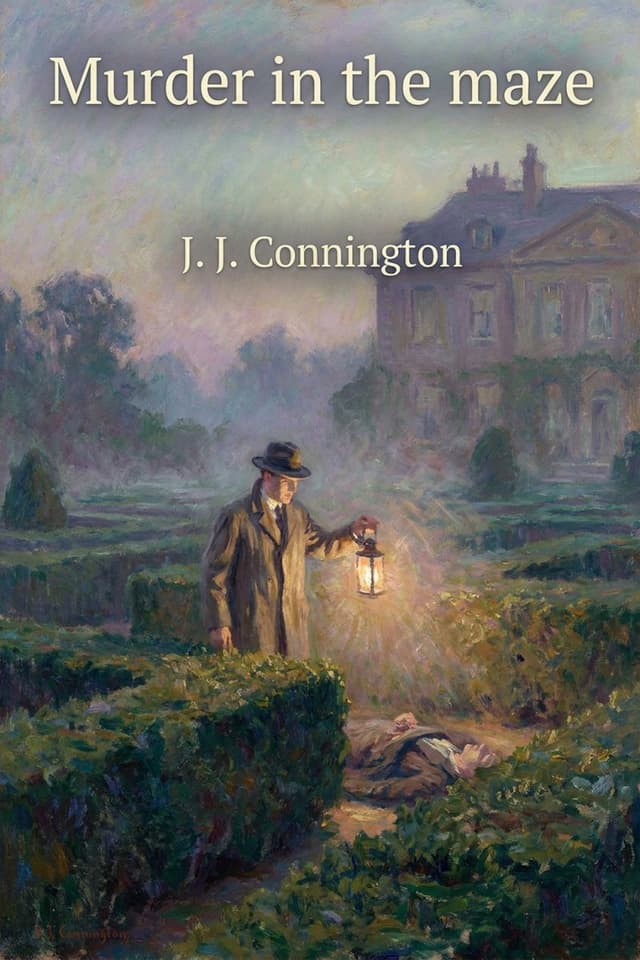
Murder in the Maze
Read Murder in the Maze by J. J. Connington for free on Novelhalla, and try out our easy-to-read modern edition of this classic book. You can also download the EPUB and read it on any device if you prefer!
The Plot
Two Brothers, Two Centres
Neville Shandon has a cross-examination to prepare. He's a barrister, he's the man the prosecution is resting on in the Hackleton case, and the trial comes on this week. What he needs is somewhere nobody will find him for a few hours, and there's a piano somewhere in the house playing the same four bars of Sinding wrong for the hundredth time.
His twin brother Roger has the perfect answer, because Roger owns Whistlefield, and Whistlefield has a maze. Not a decorative one either. Half an acre of ground with more than half a mile of path folded into it, hedges twelve feet high and thick enough to stop a man, laid out on the island pattern so that you can wander for an hour through its little archipelago of dead ends without getting one step nearer the middle. It beats Hatfield. It beats Hampton Court. The gardeners keep it clipped into something that looks less like shrubbery than green masonry.
And it has two centres. Helen's Bower and the Pool of Narcissus. So the brothers agree to split them. Neville takes one, Roger takes the other, and each of them goes off in the afternoon to sit alone behind a wall of hedge with nobody able to reach him.
That's the setup, and the moment you read it you know exactly what kind of afternoon this is going to be.
The House Full of Reasons
Whistlefield is not a happy house.
Ernest Shandon is the third brother, the one who never amounted to anything, living on an allowance from Roger and treated with open contempt by both twins. He's indolent, vague, endlessly polishing his glasses, and he's either the least perceptive man in the county or a remarkably good actor.
Sylvia and Arthur Hawkhurst are the orphaned niece and nephew. Sylvia runs the household so well that everyone in it adores her. Arthur is recovering from encephalitis, which has left him with a temper that swings without warning, and Roger has recently given him three months to get out. Arthur is also the one who spends his mornings wandering the grounds with an air gun.
Stenness is Roger's private secretary, and the word people keep using about him is ideal. Impeccable, efficient, absolutely on top of everything. Whether that's the whole of him is another question.
Dr. Ardsley lives nearby and happens to be a toxicologist. Vera Forrest and Howard Torrance are staying as Sylvia's guests. And somewhere on the edge of the estate there's a man named Costock who has been hanging about, who has done time, and who says Roger put him there and kept the money.
Roger Shandon, for his part, has a past full of transactions he'd prefer not to discuss, and Neville has a courtroom enemy with deep pockets and a week left to do something about him.
An Afternoon in the Hedges
Vera Forrest and Howard Torrance decide to try the maze that afternoon, and sensibly enough they separate to race for the centres.
What follows is one of the finest suspense sequences in 1920s detective fiction. There's a dull concussion somewhere in the green. Then a metallic rasp, the sound of something being wound back. Then it happens again. Vera, alone, walled in, with no idea which way the paths run and no way to signal anyone, works out roughly what she's hearing and then works out the next thing, which is that whoever is making that sound is still inside the maze with her, and that on his way out he might turn a corner and find her standing there. She would be a witness. She would not be a useful one for very long.
By the time anyone gets help, there are two bodies, one in each centre, and a very small dart in each of them.
The Chief Constable
Sir Clinton Driffield happens to be in the neighbourhood, staying with his old friend Wendover, who everyone calls Squire. Driffield is the Chief Constable of the county and he's thirty-five years old, which is young for the job and shows: he's quick, dry, faintly ruthless, and completely uninterested in being impressive. He decides to take this one himself.
What he's walking into is a case with no shortage of anything except answers. The poison on the darts is exotic and there's a specialist in exotic poisons living a mile down the road. The weapon appears to be an air gun and there's a young man in the house who carries one everywhere. The secretary is clearly holding something back. One guest may be in the pay of the man Neville was about to cross-examine. The third brother inherits.
And there's a prior question nobody can settle, which changes everything depending on the answer. The twins looked alike. Was one of them killed by mistake, and the other killed afterward to correct the error? Or did both of them need to die, for reasons that have nothing to do with each other?
Driffield tells Wendover at one point that the trouble with treating real life as a detective story is that in a book the author only puts in what matters, so the clues stand out as though someone had a spotlight on them. Out here, everything is in the picture and none of it is labelled.
It Isn't Over
Whoever went into that maze with a charged air gun and a supply of poisoned darts is still walking around Whistlefield, still has the weapon, and gives no sign whatsoever of being finished.
Driffield knows it. Wendover knows it. And the closing movement of the book goes back, inevitably, into the maze, twelve feet of hedge on either side and half a mile of path between you and open ground.
About the Author: J. J. Connington
Early Life
J. J. Connington was a pen name. The man behind it was Alfred Walter Stewart, born in Glasgow in September 1880, the youngest of three sons of a Presbyterian minister who taught at the university there. He studied at Glasgow, then at Marburg in Germany, then took his doctorate at University College London.
The Day Job
Stewart was a working chemist, and a serious one. He was a Carnegie research fellow at Queen's University Belfast, lectured in organic chemistry there, moved to Glasgow to lecture in physical chemistry and radioactivity, and worked for the Admiralty during the First World War. In 1919 he returned to Belfast as Professor of Chemistry, a chair he held for twenty-five years, and served as dean of faculties. His textbooks on recent advances in organic and inorganic chemistry were standard reading for a generation of students.
The Other Job
He came to fiction late and then produced an enormous amount of it. His first novel, in 1923, wasn't a mystery at all. After that he turned to detection and didn't stop, publishing more than two dozen crime novels between 1926 and his death. Sir Clinton Driffield, introduced here, carried seventeen of them. A second detective, Superintendent Ross, got two.
His training shows on every page. Where other Golden Age writers waved vaguely at poisons and blood tests, Stewart knew exactly what he was talking about and built plots that would survive an expert reading them.
Final Years
Recurring heart trouble forced him to retire from academic work in 1944. He published his memoirs in 1947 under the title Alias J. J. Connington, and died that July, aged sixty-six.
Fun Facts About the Book
T. S. Eliot Reviewed It
Eliot was a serious and regular reviewer of detective fiction in The Criterion, the literary magazine he edited, and he singled this book out for its plot construction and its liveliness, calling it a really first-rate detective story. That line has been on the cover of nearly every reissue since.
The Author Named a Thing You Learned in Chemistry
In 1918, thinking about what happens to an element when it emits a beta particle, Stewart proposed the term isobar for atoms with the same mass number but different atomic numbers, as a complement to isotope. The word stuck. The man who wrote this book is in your chemistry textbook under his real name.
Two Centres
The double centre is the whole engine of the plot and it isn't a cheat. Real historic mazes were built with more than one goal, and the design Connington describes, the island pattern where paths loop around isolated blocks of hedge, is a genuine and genuinely infuriating maze technique. He'd clearly thought about the geometry very hard before he put anybody in there.
A Detective Debut
This is the first appearance of Sir Clinton Driffield, who went on to headline sixteen more books, and of Squire Wendover, his friend and sounding board. Connington got so tired of Driffield that he tried to write him out two years later and had to bring him back anyway.
He's Only Thirty-Five
Readers who come to this after the later books are often startled to find Driffield is a young man here, and a notably hard one. Chief Constable of an entire county before forty, and quite happy to do things his own way rather than the official way.
The Air Gun Has a Famous Ancestor
Sherlock Holmes readers will recognise the air gun as a murder weapon from "The Adventure of the Empty House." Connington gives it a very different use and pairs it with a poison that nobody in an English village garden has any business owning.
The First Novel Was an Apocalypse
Before he ever wrote a murder, Stewart wrote Nordenholt's Million (1923), in which mutated soil bacteria destroy the world's plant life and a millionaire seizes control of Britain, selects five million people to save, and abandons the rest. It's one of the earliest serious ecological catastrophe novels in English and is still in print and still studied.
A Busy Year
He published two Driffield novels in 1927. This one came first, and Tragedy at Ravensthorpe followed the same year, while he was running a university chemistry department.
Themes
Fair Play
This is a fair play mystery in the strictest sense: everything you need is on the page, in front of you, at the moment the detective sees it. Connington goes further than most of his contemporaries in laying clues out, and he's slightly reckless about it, because a sharp reader can get there ahead of Driffield. He'd rather you had the chance than not.
Method, Motive, Opportunity
The book is almost a tutorial in the three legs of a case, written for an audience still learning what a detective novel could be. Driffield keeps returning to the question of who could physically have done this, rather than who seems the type, and the pleasure of the thing is watching a set of possibilities narrow by pure logic while the human noise of the household keeps trying to drag the investigation sideways.
The Labyrinth
A maze is a machine for producing helplessness. You can be six feet from another person and unreachable. You can hear something happen and have no idea where it happened. You can run and end up back where you started. Connington uses it for suspense, for the mechanics of the crime, and finally as the shape of the investigation itself, because Driffield spends the book in a structure with a great many promising paths and only one that leads anywhere.
Families Who Live Together and Know Nothing About Each Other
Everyone at Whistlefield has been under one roof for years. Not one of them can say with confidence what any of the others actually wants, or is capable of, or does with an afternoon. The murder simply makes visible how little they ever knew.
What the Detective Does With What He Finds
Late in the book a number of unrelated misdeeds surface, the ordinary sort of wrongdoing that any investigation turns up when it starts lifting floorboards. What Driffield chooses to do about them, given that he's the Chief Constable and could do whatever he liked, tells you more about the man than any amount of description would. It's the first time readers had met him, and it's still the best introduction to him.
Historical Context
The Sleeping Sickness
Arthur Hawkhurst's illness would have needed no explanation to readers in 1927. An epidemic of encephalitis lethargica swept the world from around 1915 into the mid-1920s, infecting roughly a million people. Survivors were frequently left with severe and permanent after-effects, including radical changes of temperament and behaviour. It was recent, frightening, poorly understood, and in the news, and Connington drops it into a country house full of people who need a reason to be afraid of each other. Modern readers may know the condition through Oliver Sacks's Awakenings, written about surviving patients decades later.
Curare
The poison on the darts was, in the 1920s, a thing you read about in accounts of South American exploration rather than something you expected to meet in an English shrubbery. It kills by paralysis, and Connington, who actually knew his pharmacology, is precise about what it does and how quickly. He also makes sure to put someone in the neighbourhood with a perfectly innocent professional reason to have some.
The Book's Legacy
This is the book that made Connington's name, and it's still the one most people mean when they recommend him. Martin Edwards, the historian of the Golden Age, credits it with putting him in the top tier of detective novelists. Critics have called it one of the finest country house mysteries any British writer produced in the 1920s.
Its reputation rests on three things. The setting, which nobody had used this well before and which crime writers have been borrowing ever since, John Dickson Carr included. The opening murder sequence, which is genuinely frightening in a genre that mostly wasn't trying to frighten anybody. And the rigour, which comes straight from the professor of chemistry who wrote it and who could not bear to build a puzzle that didn't hold up.
It also arrived at exactly the right moment. 1927 is early. The great decade of the puzzle plot was still ahead, the conventions were still being invented, and readers were still working out what the rules were. Connington was one of the people writing them. Read now, the book has the pleasure of watching a form being assembled by somebody who clearly loved taking things apart to see how they worked, and who had spent his professional life doing precisely that.