Novelhalla
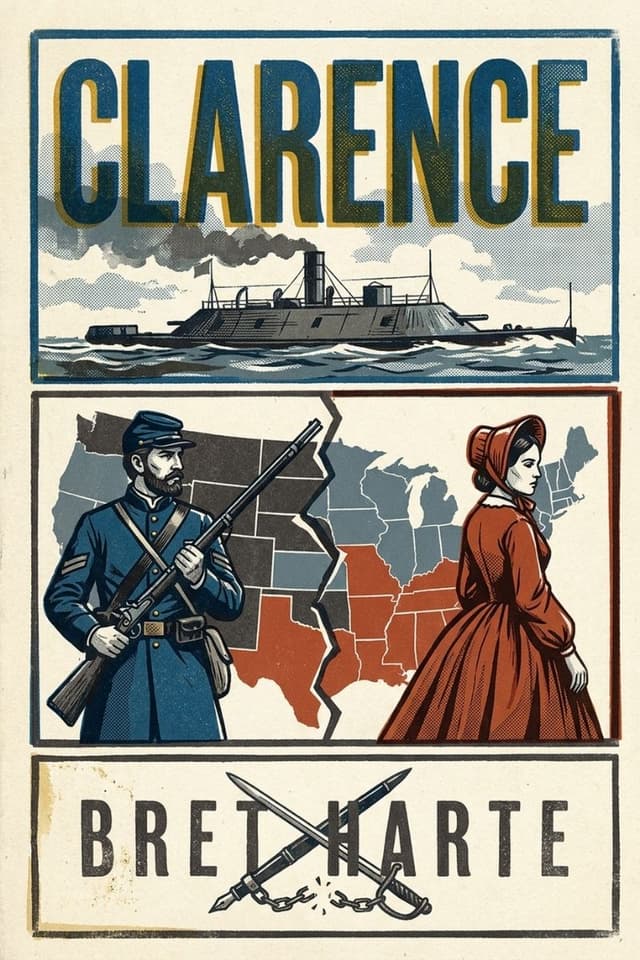
Clarence
Read Clarence by Bret Harte for free on Novelhalla, and try out our easy-to-read modern edition of this classic book. You can also download the EPUB and read it on any device if you prefer!
The Plot
A Man With Everything and Nothing
Clarence Brant is the kind of man other men envy on sight. He's handsome, he's rich, he's president of the Robles Land Company, and he's married to the wealthy widow of John Peyton, which makes him master of one of the great Spanish ranches in California. When he steps out of a San Francisco theater into the winter rain, people nod and smile at him the way people smile at the lucky.
He's only gone to the theater to avoid going home.
Because the truth is that a year into his marriage, Clarence is lonelier than he has ever been in his life. His wife is beautiful, gracious, and utterly opaque to him. She keeps her own counsel, her own friends, and her own opinions, and the opinions are the problem. It's 1861. The country is coming apart at the seams. Clarence is a Union man to the bone. His wife is not.
And there's a particular cruelty in the arrangement that he tries very hard not to think about. He first met that ranch and that family as a penniless orphan boy crossing the plains beside a little girl named Susy. Susy grew up in the Peyton house as a daughter. Clarence grew up and married Susy's mother.
The House Party at Robles
Then a woman he used to know corners him with an accusation, and she doesn't bother to be gentle about it. While Clarence has been playing the gentleman in San Francisco, his wife has been filling the old adobe ranch house at Robles with guests. Not neighbors. Not friends. Secession leaders, Southern officers, men with plans for California.
There's a real conspiracy in the state, she tells him, and Washington knows about it. General Sumner has already been sent west. The command at Fort Alcatraz has already been changed. Every piece of the plot is known to the government except one, which is where and how these men actually meet.
She knows where. It's under his own roof, and it's his own wife who's gathering them.
Clarence smiles his way through it, because that's what he does. But the smile is a wall, and behind the wall a man is doing arithmetic he doesn't want to finish. If it's true, then his wife isn't merely a woman with unfashionable sympathies. She's the center of a treason plot. And he's either the last man in California to figure it out or the one person nobody will ever believe didn't know.
There's a Captain Pinckney in the picture too. There's a matter of honor that a smile won't settle. And in 1861, a man who can't settle things at home has a way of settling them at dawn with pistols.
A Continent Away
What Clarence does next takes him about as far from Robles as a man can get. Four years later he's a Union brigadier general with a brigade of his own, headquartered in a commandeered Southern mansion called Gray Oaks, and he's buried his old life so thoroughly under marches and bivouacs and dispatches that most days he can almost believe it's gone.
The mansion doesn't cooperate. The deep verandas and the smell of jasmine at the window are too much like the old casa at Robles, and in the quiet afternoons his past comes up out of the floorboards to sit with him.
Then a young Southern woman arrives at his headquarters carrying a pass signed by the President himself, giving her the right to enter his lines and collect her family's belongings from the house he's living in. The pass is genuine. It's countersigned. It's completely, maddeningly regular. Every officer in the army has heard of these passes and every officer in the army dreads them, because they're issued in Washington by influences no general can see and no general can fight.
She sweeps past his men, pulls her skirt aside as though the whole Union army might rub off on it, and moves into his house.
What a Man Can Be Accused Of
Clarence is a general in the field, which means he is watched. By his subordinates, by his superiors, by the newspapers, and by people whose interest in him has nothing to do with the war and everything to do with what he knows.
Somewhere out beyond his picket lines there are Confederate officers who share a surname with his houseguest. Somewhere behind him in Washington there are men and women whose reputations depend on things staying buried. And somewhere in between is a woman he married in California, who has not stopped believing what she believed at Robles, and who has every reason to travel east now that her husband wears a star.
An accusation of treason doesn't require proof. It only requires a pattern that looks bad enough, and Clarence's life has been assembling one for years without his permission. His name, his marriage, his ranch, his houseguest, the pass nobody can explain. Any one of them is innocent. All of them together are a hanging.
He's spent his whole life being the boy who came from nowhere and made himself into something. Now the question is whether anything he made can survive being looked at closely by people who want him gone.
About the Author: Bret Harte
A Poor Start in Albany
Francis Brett Hart was born in Albany, New York, on August 25, 1836. He was a bookish, sickly kid who published his first piece, a satirical poem, at eleven. Formal schooling ended for him at thirteen. His schoolteacher father died in 1853, and the family scattered west to Oakland, where his mother had remarried.
The California Years
Harte followed his mother to California at seventeen and spent the next several years failing at nearly everything the West had to offer. He tried mining and it didn't take. He taught school in the Sierra foothills. He rode as a Wells Fargo messenger guarding treasure boxes on stagecoaches, which lasted a few months. He set type. He clerked.
He finally landed as assistant editor of the Northern Californian in Humboldt County, and that's where he did the bravest thing of his life. In February 1860, white settlers massacred somewhere between eighty and two hundred Wiyot people at a village near Eureka, most of them women, children, and the elderly. Harte's boss was out of town. Harte was in charge of the paper. He printed a detailed, furious account of what had been done, naming it for the atrocity it was.
The town threatened to lynch him. He was gone within a month.
The Most Famous Writer in America
San Francisco made him. He wrote for the Golden Era, helped found the Californian, and took a steady job as secretary at the San Francisco Mint that paid the bills while he wrote. In 1868 he became the founding editor of the Overland Monthly and published "The Luck of Roaring Camp," followed the next year by "The Outcasts of Poker Flat." The country went wild for them. Nobody had put the Gold Rush on the page like that before: gamblers, prostitutes, drunks, and outcasts written with a straight face and a soft heart.
By 1870 he was arguably the most celebrated writer in the United States. In 1871 he went east and signed a contract with the Atlantic Monthly for ten thousand dollars a year, an unheard-of sum, in exchange for twelve pieces.
The Fall
It went badly almost immediately. The work he turned in wasn't what had made him famous, the contract wasn't renewed at the end of 1872, and Harte spent the rest of the decade scrambling. He lectured about the Gold Rush to audiences who wanted the old magic. He republished old material. At one point he wrote an advertising jingle for a soap company. He collaborated with Mark Twain on a play that flopped, and the two men, who had been friends in California, ended up despising each other.
In 1878 he took a government appointment as US commercial agent in Krefeld, Germany, then moved to the consulate in Glasgow in 1880. He lost the post in 1885 and settled in London.
Twenty-Four Years Away
He never came home. Harte spent the last twenty-four years of his life in England, writing at an astonishing pace to keep himself afloat, mining a California he hadn't seen since 1871 and would never see again. He wrote to his wife and children regularly and sent money, but he never brought them over and never went back, and he generally explained it by saying he couldn't afford to.
He was living on the estate of the Van de Velde family in Camberley, Surrey, when he died of throat cancer on May 5, 1902, at sixty-five. He's buried in the churchyard at Frimley. The stone reads "Death shall reap the braver harvest."
Fun Facts About the Book
It's the End of a Trilogy
This is the third and final volume of a story Harte told across three short novels: A Waif of the Plains in 1890, Susy, a Story of the Plains in 1893, and this one in 1895. Together they follow Clarence Brant from an eleven-year-old orphan on an emigrant wagon train all the way to a general's tent. You can read this one cold and it works fine, but readers who've done the whole run get the full weight of what happens to that boy.
Harte Wrote It Six Thousand Miles From Its Setting
Every word of this book was written in England by a man who hadn't set foot in California in more than twenty years and never would again. The Robles ranch house, the San Francisco streets, the Spanish adobe with its monastic shadows, all of it is memory and longing, produced in a country where he was more popular than he was at home.
The Conspiracy Was Real
The secession plot Harte builds the first half of the novel around isn't invented. In 1861 there was a genuine, organized effort to pull California out of the Union and create a Pacific Republic, run largely through a secret society called the Knights of the Golden Circle. Sumner himself estimated the secession party in California at around thirty-two thousand men.
So Was General Sumner
When a character in the novel says that Sumner has been sent west and that his first act was to change the command at Fort Alcatraz, Harte is dropping in something his first readers would have remembered vividly. Brigadier General Edwin Vose Sumner really was dispatched to San Francisco in secret in the spring of 1861 to relieve Albert Sidney Johnston, whose loyalty Unionists in California had come to doubt. Johnston resigned, went south, and became one of the Confederacy's most senior generals.
Harte Lived Through It
He wasn't guessing at the atmosphere. Harte was in San Francisco through the whole crisis, working at the Mint, and he wrote patriotic Union verse during the war years. The paranoid charge of the opening chapters is a man remembering what the air actually felt like.
The First Edition Was a Beautiful Object
Houghton Mifflin's 1895 edition came with eight inserted plates illustrated by A. Jule Goodman, a title page printed in red and black, blue pictorial cloth stamped in light blue, orange, black and gold, untrimmed edges, and floral decorated endpapers. It came out in July, and a publisher's catalogue was bound in the back.
A Western Writer Who Left the West
Harte is filed under Gold Rush fiction forever, and there's a real irony in the fact that one of his last novels is a Civil War espionage story. He kept reaching for California to the very end, but by 1895 he was reaching for it across an ocean and three decades.
Themes
Loyalty When Loyalty Is Divided
The book's engine is a simple, awful question: what do you owe a country, and what do you owe the person you married, when the two want opposite things? Clarence never gets to choose one and be done with it. Every choice he makes on one side costs him on the other, and the war doesn't care that his enemy shares his bed.
The Marriage That Can't Be Read
Harte is unusually sharp on the specific misery of being married to someone you don't understand. Clarence's house is comfortable, well-appointed, and empty. He can't tell what his wife thinks, what she wants, or what she's doing when he isn't looking, and he's discovering that the not-knowing is worse than any answer would be.
The Self-Made Man's Vertigo
Clarence built himself out of nothing. Orphan, waif, drifter, then landowner, then general. But a man who built himself can be unbuilt, and Harte keeps circling the anxiety underneath the achievement: none of it is inherited, so none of it is safe. All it takes is enough people deciding he was never really one of them.
Women Working the War
The women in this novel are not decorative. They gather conspirators, carry information, secure presidential passes over the objections of the entire army, and move through military lines that stop armed men cold. Harte noticed something his contemporaries mostly didn't, which is that the parts of the war where women had power were exactly the parts nobody could regulate.
Reputation as a Weapon
Guilt and innocence barely matter here. What matters is what a thing looks like, who's telling the story, and whose reputation is being protected by whom. Harte lets you watch a man discover that the truth is not going to save him on its own.
The Past You Buried Comes Up Anyway
Clarence spends four years trying to lose himself in the war, and the war obligingly hands him a Southern mansion that smells like the ranch he ran away from. Harte keeps making the point gently and then not gently: the thing you're running from is usually already waiting at the next stop.
Historical Context
California Almost Left
It's easy to read the first half of this book as melodrama unless you know how close it came. In early 1861 California was a slaveholding-sympathetic state government away from serious trouble. Southern-born men held the custom house, the post office, the Mint, the arsenal at Benicia, and the forts around San Francisco Bay. The commander of the entire Department of the Pacific was a Southerner whose loyalty half the state doubted.
Washington got word, sent Sumner out quietly by way of Panama, and he relieved Johnston within an hour of docking. The forts held. The Pacific Republic never happened.
Harte's readers in 1895 remembered all of it. When his characters talk about who's meeting at which ranch and which officer just got reassigned from Alcatraz, they're talking about the closest thing to a coup the West Coast ever came to.
The Book's Legacy
This is late Harte, written for money by a man in exile, and for a long time that was reason enough for critics to skip it. That's a shame, because it's one of the more unusual American Civil War novels of its century: an espionage story where the spy is the hero's wife, set half in Spanish California and half in occupied Virginia, written by the man who invented the literary Gold Rush.
It also completes one of the earliest genuine trilogies in American popular fiction, following a single character from childhood to middle age across three books and fifteen years of publishing. That structure was far from standard in 1895.
Modern readers tend to be startled by how contemporary the marriage feels. The suspicion, the silences, the careful politeness covering a chasm, the sense of living with someone whose interior life is a locked room, none of that reads like 1895. Neither does the political shape of it, in which a household splits along the same fault line as the country and nobody in it can talk about anything else without talking about that.
Harte's reputation now rests almost entirely on a handful of short stories he wrote before he turned thirty-five. Books like this one are the argument that he kept working, kept reaching, and kept getting California down on paper right up to the end, from as far away as a man can get from it.