Novelhalla
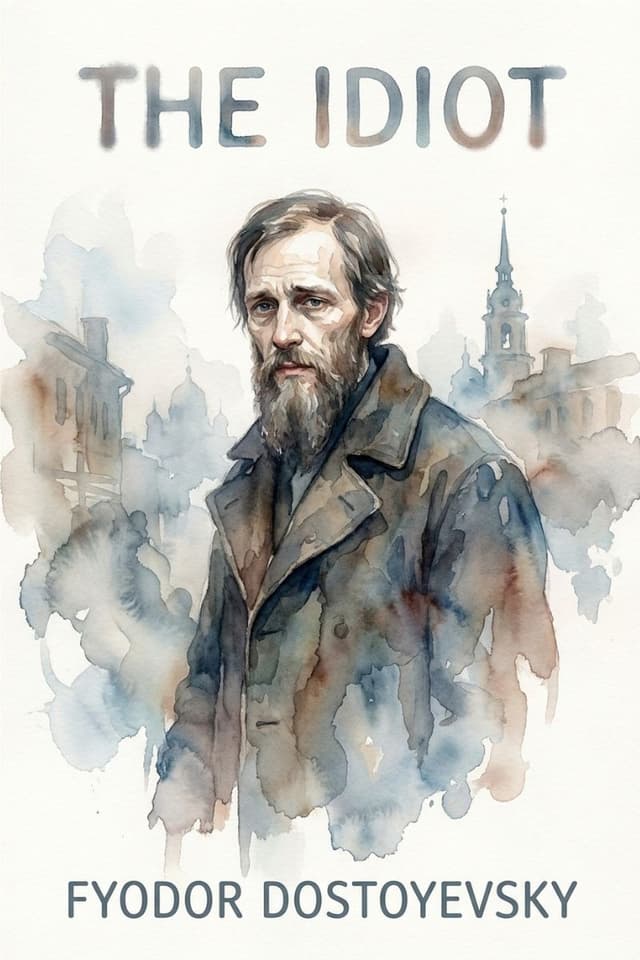
The Idiot
Read The Idiot by Fyodor Dostoyevsky for free on Novelhalla, and try out our easy-to-read modern edition of this classic book. You can also download the EPUB and read it on any device if you prefer!
The Plot
The Prince on the Train
A young man in a thin cloak is riding a third-class train into St. Petersburg on a freezing November morning. He has almost no money, no luggage to speak of, and no real plan. His name is Prince Lev Nikolayevich Myshkin, and he is returning to Russia after spending nearly five years in a Swiss clinic being treated for epilepsy. He is twenty-six years old and has the kind of open, trusting face that makes strangers either confide in him or try to cheat him.
Across from him sits a man who could not be more different. Parfyon Rogozhin is dark, intense, and burning with a single obsession: a woman named Nastasya Filippovna. Rogozhin has just inherited a fortune, and he intends to use it to possess her. He talks about her the way people talk about a fever they can't shake. Before the train reaches the station, Myshkin knows three things: Rogozhin is dangerous, Nastasya Filippovna is in trouble, and the two of them are already pulling him into something he doesn't fully understand.
Two Women
Myshkin arrives in St. Petersburg with a letter of introduction to the Epanchin family, distant relatives on his mother's side. General Epanchin is wealthy and well-connected. His wife Lizaveta is shrewd and impulsive. Their three daughters are the talk of the city, and the youngest, Aglaya, is considered the most beautiful and brilliant of them all. Aglaya is sharp, proud, unpredictable, and she takes an immediate and complicated interest in this strange, guileless prince who says whatever he's thinking and seems incapable of pretending to be anything he's not.
Then there is Nastasya Filippovna. Orphaned as a child, she was taken in as a ward by a wealthy man named Totsky, who used his guardianship to make her his mistress while she was still barely grown. The arrangement ruined her socially and psychologically, and now, years later, Totsky is trying to marry her off to a respectable young man named Ganya Ivolgin so he can wash his hands of her and pursue a marriage to one of the Epanchin daughters. Nastasya is stunningly beautiful, ferociously intelligent, and radiating a self-destructive fury that everyone around her either wants to tame or exploit.
Myshkin meets her on his very first day in St. Petersburg. And something in him, some deep current of compassion that he cannot control, reaches out to her suffering and will not let go.
The Party
That evening, at Nastasya Filippovna's birthday gathering, the novel detonates. Rogozhin arrives with a hundred thousand rubles in cash, offering to buy her outright. Ganya, humiliated but desperate, is willing to take her as part of his own financial arrangement. Myshkin, with nothing to offer but sincerity, tells Nastasya he would marry her. He has just learned he's inherited a fortune, but that's not why he's asking. He sees her pain. He wants to save her.
What Nastasya does with these three offers, and the hundred thousand rubles, is one of the most electrifying scenes in all of Russian literature. It is also the moment that seals everyone's fate.
The Web
From here the novel spirals outward into a vast, crowded, breathlessly paced story that follows Myshkin through Petersburg society and the summer resort town of Pavlovsk. Everywhere he goes, people are drawn to him. His honesty is disarming. His kindness is real. He listens to people in a way they are not used to being listened to, and he forgives things that other people would never forgive. Children love him. Con artists confess to him. Dying teenagers read him their manifestos at three in the morning.
But his goodness also destabilizes everyone around him. His inability to deceive means he cannot navigate the social games that hold this world together. His compassion for Nastasya and his growing love for Aglaya pull him in opposite directions, and he lacks the ordinary human selfishness that would let him choose one and let the other go. He cannot bring himself to abandon someone in pain, even when staying means destroying something else.
Meanwhile, Rogozhin circles closer and closer to Nastasya, and his love looks less and less like love and more like something darker. The two men exchange crosses like brothers, but there is a knife in Rogozhin's house and a question in his eyes that Myshkin tries very hard not to see.
The Collision
As summer deepens, the tensions converge. Aglaya forces a confrontation. Nastasya pushes everyone to their breaking point. Myshkin stands at the center of it all, trying to hold things together with nothing but compassion, and the novel asks, with increasing urgency, whether that is enough. Whether a truly good person can survive contact with the real world. Whether love that refuses to choose can save anyone at all.
The answer Dostoevsky gives is not the one you expect. And it is not gentle.
About the Author: Fyodor Dostoevsky
Early Life
Fyodor Mikhailovich Dostoevsky was born in 1821 in Moscow, where his father worked as a doctor at a hospital for the poor. Despite the setting, the family was not impoverished. His father was strict and volatile; his mother was patient and devout. Dostoevsky was educated at home and then at boarding schools, where he devoured Romantic and Gothic fiction. His father pushed him into military engineering school in St. Petersburg, a career he had no interest in. When his father died in 1839, reportedly killed by his own serfs, Dostoevsky abandoned engineering and committed himself to writing.
His first novel, Poor People, was published in 1846 and was an immediate sensation. The great critic Belinsky hailed it as a work of genius. The praise went to Dostoevsky's head, and his second novel flopped. It was the beginning of a pattern: his life would alternate between triumph and catastrophe with almost no middle ground.
The Scaffold
In 1849, Dostoevsky was arrested for his involvement with the Petrashevsky Circle, a group of intellectuals critical of the Tsar's government. He was convicted and sentenced to death by firing squad. On December 22, he and his fellow prisoners were led to a public square, forced to kneel and kiss the cross, tied to posts, and blindfolded. The firing squad took aim. At the last possible moment, a messenger arrived with a reprieve from the Tsar. The execution had been staged from the start, a calculated act of psychological terror. The sentence was commuted to four years of hard labor in Siberia, followed by compulsory military service.
Those minutes before the reprieve changed Dostoevsky permanently. The experience of facing certain death and then being handed back your life left a mark that appears in nearly everything he wrote afterward, and most directly in this novel, where Prince Myshkin describes the ordeal in vivid, autobiographical detail.
Siberia and Transformation
Dostoevsky spent four years in a Siberian prison camp, where his only permitted book was the New Testament. He emerged in 1854 a profoundly changed man: more religious, more conservative, more consumed by questions about faith, suffering, and the nature of good and evil. He served out his military obligation on the frontier, married a widow named Maria Isaeva, and was finally allowed to return to St. Petersburg in 1859.
Gambling, Grief, and Genius
The 1860s were brutal. Dostoevsky's wife and his beloved brother Mikhail both died in quick succession. His literary magazine failed. He fell into crushing debt, which he made worse through a devastating addiction to roulette. He would win thousands and lose them back the same night, then pawn his wife's possessions and try again. The addiction consumed years of his life and kept him perpetually on the run from creditors.
In 1866, facing a deadline that would have cost him the rights to all his works, he hired a young stenographer named Anna Snitkina and dictated an entire novel, The Gambler, in twenty-six days. He then married Anna, and she became the stabilizing force his life had been missing. They fled to Europe to escape his debts and spent four years abroad, during which he wrote The Idiot. He was still gambling. Anna was managing the money and, increasingly, managing him. It was during this nomadic period, moving between Switzerland and Italy, that he completed the novel month by month for serialization, often not knowing where the plot was going until he sat down to write.
Final Years
The Dostoevskys returned to Russia in 1871. With Anna managing his business affairs, his financial situation slowly stabilized. He published Demons, The Adolescent, and finally The Brothers Karamazov, which was an immediate triumph. He died in January 1881, at fifty-nine, of a pulmonary hemorrhage. Thirty thousand people attended his funeral procession through the streets of St. Petersburg.
Fun Facts About the Book
Written Without a Map
Dostoevsky serialized The Idiot in monthly installments in The Russian Messenger from 1868 to 1869, and he frequently had no idea what was going to happen next. He wrote each installment under deadline pressure, often rewriting extensively and sometimes scrapping entire drafts. He went through eight different plans for the novel before settling on the version we have. The result is a book that feels unpredictable in a way that more carefully plotted novels don't, because it genuinely was.
The Impossible Task
Dostoevsky described his central ambition for the novel as depicting "the positively good and beautiful man." He was acutely aware of how difficult this was. In his notebooks, he cited Don Quixote and the character of Mr. Pickwick as the only successful examples in literature, and he noted that both achieved their effect partly through being comic, which made them sympathetic rather than preachy. His own attempt, Prince Myshkin, remains one of the most debated characters in world literature.
The Painting That Nearly Broke Him
While traveling through Basel, Switzerland in 1867, Dostoevsky saw Hans Holbein the Younger's painting "The Body of the Dead Christ in the Tomb." His wife Anna wrote that he stood before it as if stunned and wouldn't move for nearly twenty minutes. The painting shows Christ's body in unflinching, decaying realism, with no trace of divinity or hope of resurrection. Dostoevsky later said a painting like that could make a person lose their faith. He put it into the novel, where it hangs in Rogozhin's house and becomes a touchstone for the book's deepest questions about whether goodness can survive in a world governed by blind, indifferent nature.
His Favorite Child
Despite feeling that the novel was not entirely successful, Dostoevsky reportedly considered The Idiot his personal favorite among his own works. He felt the idea at its heart, the testing of pure goodness against the machinery of the real world, was the most important thing he had ever attempted, even if the execution was imperfect.
The Critics Didn't Love It
Contemporary Russian critics were largely unimpressed when The Idiot was first published. They found it structurally chaotic and tonally uneven. The novel's reputation grew slowly but steadily over the following century, and it is now considered one of the essential works of world literature. One modern critic compared it to a bumblebee: by every law of physics it shouldn't be able to fly, but since it doesn't know that, it flies anyway.
The Burned Manuscript
When the Dostoevskys finally returned to Russia in 1871, Fyodor burned several manuscripts during the train journey, including drafts related to The Idiot. He was worried about problems with Russian customs. What was lost in that fire is anyone's guess.
The Epilepsy
Myshkin's epilepsy is drawn directly from Dostoevsky's own experience. Dostoevsky suffered from epileptic seizures throughout his adult life, and he described the moments just before a seizure as a kind of ecstatic clarity, a flash of perfect understanding that felt like touching something divine. He gave this experience to Myshkin, and it becomes one of the novel's most striking paradoxes: the moments of greatest insight come just before the body betrays the mind completely.
Themes
The Good Man in a Fallen World
The novel's central experiment is devastatingly simple: what happens when you place a genuinely good, purely compassionate person into a society built on vanity, greed, and self-interest? Dostoevsky doesn't stack the deck. Myshkin isn't naive out of ignorance. He sees people clearly, often more clearly than they see themselves. But seeing clearly and being able to act effectively in a corrupt world are two very different things, and the gap between them is where the novel lives.
Compassion vs. Desire
Myshkin's feelings for the two women in his life represent two fundamentally different kinds of love. His attachment to Nastasya is rooted in compassion, a need to heal her suffering that is almost Christlike in its selflessness. His feelings for Aglaya are closer to ordinary human love, passionate and personal. The novel asks whether it is possible to hold both at once, and whether compassion without boundaries might be as destructive as selfishness.
The Terror and Gift of Being Alive
The theme of execution, reprieve, and the value of a single moment runs through the entire book like a heartbeat. Myshkin's long speeches about capital punishment are Dostoevsky's way of asking: if you were given your life back after facing certain death, how would you live? The answer, both for Myshkin and for Dostoevsky himself, is not simple. The awareness of life's preciousness doesn't automatically make a person better at living it.
Beauty and Destruction
Nastasya Filippovna is the novel's most volatile element, a woman of extraordinary beauty who has been so damaged by exploitation that she can no longer accept love without trying to destroy it. She punishes herself because the world taught her she deserves punishment. The novel treats her with immense sympathy while never pretending that suffering automatically makes people wise or kind.
Faith vs. Nihilism
Dostoevsky was writing in an era when atheism and nihilism were gaining traction among Russia's educated classes, and the novel stages a direct confrontation between Christian love and the arguments of those who see the universe as cold, mechanical, and godless. The dying teenager Ippolit Terentyev, angry and brilliant, makes the case for meaninglessness with terrifying force. Myshkin embodies the opposing argument, but he embodies it through his life rather than through debate, and the novel is honest enough to let both sides wound each other.
The Limits of Innocence
There is a question the novel keeps circling back to, never quite answering it directly: is Myshkin's purity a gift or a disability? His inability to lie, scheme, or protect himself makes him beautiful and also makes him vulnerable in ways that have consequences not just for himself but for everyone he loves. Dostoevsky refuses to let innocence be entirely heroic. He also refuses to let it be entirely foolish. The tension between those two refusals is what makes the book so hard to put down.
The Book's Legacy
The Idiot stands alongside Crime and Punishment and The Brothers Karamazov as one of Dostoevsky's supreme achievements, though it has always been the most difficult of the three to categorize. It is a love story, a philosophical novel, a social satire, and a spiritual thriller, and it doesn't always hold together in the ways readers expect. That unevenness is part of its power. The novel feels alive in a way that more polished works often don't, as though the characters are making decisions the author didn't fully anticipate.
The book has been adapted numerous times for film, television, and stage. Akira Kurosawa made a celebrated Japanese adaptation in 1951. The Royal National Theatre in London staged a major production. Composers have turned it into operas. It remains endlessly fascinating to adapters because it resists being tamed into a single interpretation.
Dostoevsky's influence on world literature is almost impossible to overstate. He is a direct ancestor of existentialism, of modernist fiction, of the psychological novel as we know it. Writers from Kafka to Camus to Toni Morrison have acknowledged his impact. His willingness to push characters to their absolute extremes, to test ideas by putting them inside living, suffering people rather than arguing them abstractly, changed what fiction could do.
And The Idiot, messy and magnificent, remains perhaps the purest expression of his most radical question: can goodness survive? The novel's refusal to offer a comfortable answer is what keeps readers returning to it, generation after generation, hoping that this time the bumblebee will learn to obey the laws of physics, and knowing it won't.