Novelhalla
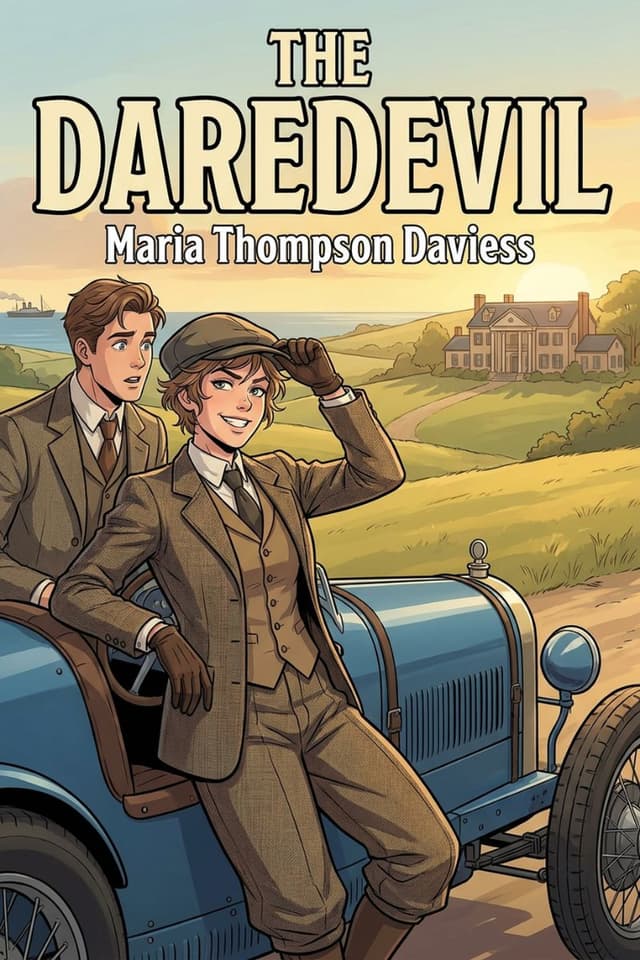
The Daredevil
Read The Daredevil by Maria Thompson Daviess for free on Novelhalla, and try out our easy-to-read modern edition of this classic book. You can also download the EPUB and read it on any device if you prefer!
The Plot
A Dying Man's Last Order
Roberta Carruthers has spent her whole life being the wrong thing. She was born a girl to a father who wanted a hunting companion, and she became one anyway: she rides anything ever foaled, drives fast cars, shoots a hare out of a field, and can fence better than most of the young officers who come courting. Her mother was a French opera singer who became a marquise. Her father was an American who gave up his country, his family, and his inheritance to marry her. He called his daughter a daredevil the first time he caught her hanging off a hundred foot ledge at the Chateau de Grez, and the name stuck.
Now he's dying in a convent hospital with German bullets in him, and he has one last instruction. Go back to America. Find my brother Robert in the Harpeth Valley. He cut me off years ago and never forgave me for your mother, but he's blood and he'll take you in.
So Roberta crosses the Atlantic through mined waters with everything she has left in the world: an old nurse named Nannette, a small crippled brother named Pierre, and a title that's worth nothing in the country she's sailing toward.
The Letter That Changes Everything
The money is gone before she's off the dock. What's waiting for her instead is a letter from the uncle she's spent her childhood imagining as a one-eyed ogre.
It's addressed to "my dear nephew Robert."
Her uncle has confused the two children. He thinks the daughter is the invalid and the son is the strapping one, and he's delighted, because he needs a nephew immediately, urgently, for reasons of business. He also writes, cheerfully and in plain ink, that if she had been the girl he'd have had to dispose of her somehow. Even murder. He has no use for women.
Roberta has one hour before her train leaves. She has a pocket of her uncle's money, a men's clothing shop on Sixth Avenue, and a hotel room she can walk into as a marquise and walk out of as somebody else entirely.
She cuts her hair off in front of a mirror and goes south as Mr. Robert Carruthers.
The State of Harpeth
What she finds in the Harpeth Valley is not an ogre. General Robert Carruthers is enormous, white haired, ferociously kind, and so glad to have a boy in the house that he can barely speak about it. He also despises women as a species, on principle, at volume, roughly every twenty minutes.
He needs his nephew because France is about to buy five thousand mules, and somebody in Hayesville is quietly arranging for the deal to be a swindle. The state has no legal authority to make it. The paperwork has been shaped so that when it collapses, it lands on one man: Governor Williamson Faulkner, who has trusted the wrong people and is about to sign away his honor without knowing it. The General intends to stop it or die trying, and he needs someone who can read French and who he can trust absolutely.
He has decided that person is his nephew.
Everything She Can't Say
There are complications, and they compound fast.
There's Madam Patricia Whitworth, who shared a sleeping car with Roberta on the way down and who is beautiful, funny, dangerous, extremely interested in the movements of a certain French officer, and married to the man at the center of the mule deal. She has taken a great deal of interest in the charming young Frenchman, and she is not being maternal about it.
There are the young people of Hayesville, who fold Robert Carruthers into their circle as a brother, with an easy physical affection between men that Roberta had never once glimpsed from behind a fan.
And there is the Governor himself, who is spoken of as an iceberg, who has been chased by too many women to look at any of them, and who greets this strange foreign boy with a comrade's kiss on both cheeks and a kindness that goes straight through the tweed.
Roberta is a woman living inside a lie, in a house of men who trust her because they believe she isn't one, in a state where the honor of a government and the food supply of an army both hang on her keeping the lie perfectly. Every friend she makes is a person she is deceiving. Every day the disguise works is a day it gets harder to end.
And she's falling in love with the one man in America who must never, ever find out.
About the Author: Maria Thompson Daviess
Kentucky and Nashville
Maria Thompson Daviess was born in Harrodsburg, Kentucky in November 1872, into a family with ink already in it. Her paternal grandmother, who shared her name, had been a newspaper columnist and a lecturer at a time when that was a genuinely unusual life for a woman.
Her father died when she was eight and the family moved to Nashville, Tennessee. That city, and the countryside around it, became the material she spent her whole career mining.
The Painter
Writing wasn't the first plan. Daviess spent a year at Wellesley College and then went to Paris to study art, which is worth remembering when you read her descriptions of French houses, French manners, and the particular way a French woman handles a room. She came home to Nashville and kept painting, and the writing grew up alongside it rather than replacing it.
The Bestseller
Her first novel came out in 1909, when she was already in her late thirties. What followed was a run that's hard to imagine now: sixteen novels in about eleven years. "The Melting of Molly" was one of the best selling books in America in 1912. Several of her books were snapped up by the movies almost as fast as she could write them.
She also invented a fictional country for herself, the Harpeth Valley, and kept going back to it, so that readers who loved one book could recognize the hills in the next.
The Suffragist
Daviess wasn't a bystander to the woman question, she was in the middle of it. She helped found the Nashville chapter of the Equal Suffrage League and served as its vice president, and organized the chapter in Madison, Tennessee. She wrote a novel called "The Elected Mother: A Story of Woman's Equal Rights."
She never married and had no children.
Last Years
She moved to New York City in 1921 and published an autobiography, "Seven Times Seven," in 1924. She died in New York that September, at fifty one.
Fun Facts About the Book
The Whole Book Is in Her Accent
This is the thing nobody warns you about, and it's the best part. The entire novel is narrated by Roberta in her own English, which is her American father's slang laid over a French woman's grammar. She refers to "my Uncle, the General Robert" and "that Mr. Slade of Detroit" and "the Gouverneur Faulkner." She calls a dime fifty centimes. She reports that she did some "tall thinking." It takes about four pages to tune your ear, and then it's a voice you'll hear in your head for a week.
It Was a Piece of Propaganda
The book came out in 1916, while the United States was still officially neutral and arguing bitterly about staying that way. Daviess wrote a novel in which a French officer explicitly instructs a young woman to go make friends for France in America, and in which the villains are Americans getting rich off cheating French soldiers. She wasn't being subtle, and she wasn't wrong about which way the wind was blowing.
The Mules Were Real
The mule contract at the center of the plot isn't invented color. The Allied armies burned through horses and mules at a rate Europe couldn't supply, and buyers fanned out across America to purchase them by the hundred thousand. Tennessee was one of the states they bought from, and a British purchasing agent set up mule inspections in Nashville as early as September 1915. Readers in 1916 would have known exactly what she was writing about.
The State of Harpeth Doesn't Exist
Hayesville and the State of Harpeth are Daviess's stand ins for Nashville and Tennessee, and she used the Harpeth Valley across multiple books, including "Rose of Old Harpeth" and "Phyllis." It let her write about a state capital's political corruption without naming anybody's actual governor.
It Was a Movie Within Two Years
A silent film version was released in 1918, with the stage actress Gail Kane playing Roberta. Two more Daviess novels were filmed the same year, both starring Marguerite Clark. For a stretch there, Hollywood was buying nearly everything she wrote.
The Frontispiece Was a Painting
The original 1916 edition opened with an illustration taken from a painting by E. Sophonisba Hergesheimer, a Nashville portrait painter, rather than the usual commercial book illustration. Daviess was a painter herself and moved in those circles.
Themes
What Women Learn on the Other Side
The book's real subject is the intelligence Roberta gathers. Wearing trousers, she gets to hear how men talk about women when no women are present, and it's ugly. But she also discovers something she says no woman can see from behind a fan: the deep, unembarrassed tenderness men keep for each other and hand out freely to a comrade. She goes in expecting to learn that men are brutes. She learns something considerably more complicated.
Honor as a Practical Problem
Everybody in this book talks about honor. The General means a code worth dying for. The swindlers mean a word you can use to move money. The Governor has to decide what his is actually worth in dollars. And Roberta is defending everyone's honor while living a daily, elaborate, unbroken lie, which she knows perfectly well.
Two Countries, One Body
Roberta is French and American in a way that won't resolve. Her mother's title, her father's slang, a chateau and a Tennessee farmhouse. The novel keeps asking what she owes each side, and whether the debt can be paid in one place at a time.
Women Working the Machinery
Set the heroine aside and look at Madam Whitworth, who has no vote and no office and is nonetheless running a state government through a governor's affections and a contract nobody will read closely. She's the villain, but she's doing exactly what a woman with a brain and no legitimate power was left to do. The suffragist who wrote this knew what she was drawing.
Love That Can't Speak
The oldest engine in fiction, wired up in a new way. Roberta can't confess without destroying her uncle's trust, her position, the mule deal, and quite possibly the Governor's career. Every kindness she receives is one she got under false pretenses. The longer it goes well, the worse the reckoning gets.
The Book's Legacy
Daviess was, in her moment, a genuinely popular writer. She sold enormously, the studios adapted her almost annually, and her name would have been familiar to any American who read novels in the 1910s. Then the moment passed. The Pollyanna label stuck to her, the war she was writing into ended, and a career of sixteen novels slid quietly out of print.
What's survived best is exactly what nobody would have predicted: the disguise plot. A woman putting on a man's clothes and discovering how the other side of the world talks is a story that has never stopped being interesting, and this one has an unusually sharp version of it, written by a working suffragist who had thought hard about what women were and weren't allowed to do.
It also captures something that's hard to find elsewhere. This is an American novel written in the middle of the Great War by someone who desperately wanted her country to get in, published while that was still an open question, and set in a state capital where the war shows up as a contract for livestock. Not the trenches. The paperwork behind the trenches, and the ordinary greedy people who saw a chance in it.
The book slipped out of print for most of a century and the film isn't something you can easily go watch. Coming to it now feels like finding something in an attic that nobody meant to leave there.