Novelhalla
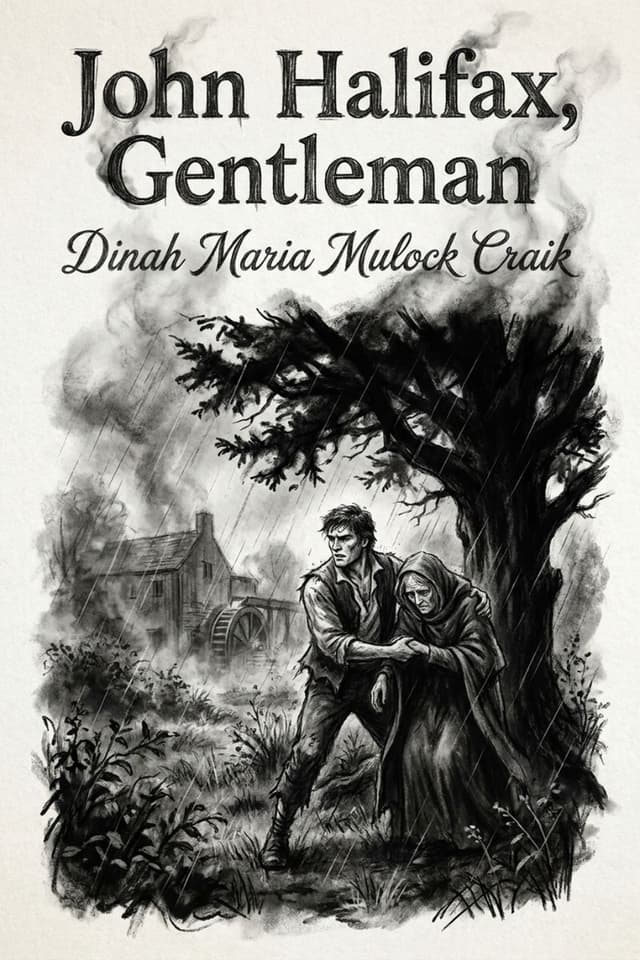
John Halifax, Gentleman
Read John Halifax, Gentleman by Dinah Maria Mulock Craik for free on Novelhalla, and try out our easy-to-read modern edition of this classic book. You can also download the EPUB and read it on any device if you prefer!
The Plot
The story opens in the late 18th century in Norton Bury, a small market town in Gloucestershire. Phineas Fletcher, a frail and disabled young man, first encounters John Halifax on a rainy day when both seek shelter under an awning. John is fourteen years old, ragged and hungry, but carries himself with unmistakable dignity. Though clearly destitute, he refuses charity, insisting he will work for anything he receives.
Phineas's father, Abel Fletcher, is a Quaker tanner who recognizes something remarkable in the boy's character. He offers John work at his tan-yard, and despite the lowly position, John accepts with gratitude. A deep friendship forms between John and Phineas, the robust orphan and the invalid son finding in each other what they lack. Phineas gains a window into active life through John, while John finds in Phineas the education and refinement he craves.
John rises steadily through hard work and integrity. When a bread riot threatens Abel Fletcher's property during a famine, John defuses the mob not through force but through practical compassion, arranging for the hungry workers to receive grain. His ability to lead men and solve problems earns him increasing responsibility.
Years pass, and John becomes a young man of promise though still of humble station. While staying in the countryside for Phineas's health, they meet Ursula March, a gentle young woman caring for her dying father. John falls deeply in love but believes his low position makes him unworthy of a gentleman's daughter. When Mr. March dies, Ursula is revealed to be an heiress, making the gulf between them seem even wider. But Ursula, recognizing John's true worth, accepts his proposal despite society's disapproval and her guardian's refusal to release her inheritance.
John and Ursula marry and build a life together on modest means. They have children, including a blind daughter named Muriel whose sweetness touches everyone around her. John eventually acquires a cloth mill and introduces steam power, navigating the tensions between progress and tradition, between workers' fears and industrial necessity. Through honesty and fair dealing, he builds prosperity while maintaining his principles.
The family faces sorrows as well as joys. Their blind daughter dies young, a loss that shadows John's remaining years. Their son Guy quarrels with his brother over a woman and exiles himself to America, causing his parents years of anguish. But reconciliation comes at last, and the family is reunited before John, worn out by a life of labor and care, dies peacefully surrounded by those he loves. Ursula, unable to live without him, dies the same night, and they are buried together.
About the Author: Dinah Maria Mulock Craik
Difficult Beginnings
Dinah Maria Mulock was born on April 20, 1826, in Stoke-on-Trent, Staffordshire. Her father, Thomas Mulock, was a charismatic but unstable Baptist preacher whose erratic behavior and eventual mental breakdown cast a long shadow over her childhood. When she was six, her father was briefly committed to an asylum, and the family never recovered financial stability.
Early Responsibility
After the family moved to Newcastle-under-Lyme, Dinah helped her mother run a small school to support the household. She began writing poetry at ten and was teaching Latin by thirteen. When her mother inherited money in 1840, the family traveled through Europe, and Dinah studied French, Italian, Latin, and Greek. But her father's abandonment of the family in 1844, followed by her mother's death in 1845, left the nineteen-year-old responsible for herself and her two younger brothers.
Literary Career
Mulock moved to London around 1846, determined to earn her living by writing. She began with children's stories and gradually worked her way up to adult fiction. Her first novel, "The Ogilvies," appeared in 1849, dedicated to her late mother. She published steadily through the early 1850s, building a reputation for earnest, morally serious fiction.
Triumph with John Halifax
"John Halifax, Gentleman" appeared in 1856 and became a sensation. The novel captured the aspirations of the Victorian middle class, presenting a hero whose gentility came from character rather than birth. The book remained in print for decades and made Mulock one of the most popular novelists of her era.
Marriage and Later Life
In 1865, at thirty-nine, Mulock married George Lillie Craik, a partner in the publishing house Macmillan and Company. He was eleven years her junior. In 1869, they adopted an abandoned baby girl, Dorothy, an unusual act for the time. Craik continued writing novels, children's stories, essays, and poetry until her death.
Death
Craik died of heart failure on October 12, 1887, at her home in Shortlands, Kent, while preparing for her daughter's wedding. Her last words were reportedly, "Oh, if I could live four weeks longer! But no matter, no matter!" She was buried at Keston, and a memorial was erected in Tewkesbury Abbey near the setting of her most famous novel.
Fun Facts About the Book
The Tewkesbury Connection
Norton Bury is a fictionalized version of Tewkesbury in Gloucestershire, and many locations in the novel correspond to real places in and around the town. The abbey, the river, and the surrounding countryside are all recognizable to those familiar with the area.
A Victorian Bestseller
"John Halifax, Gentleman" was one of the most popular novels of the Victorian era, remaining in print continuously for decades. It was translated into multiple languages and adapted for the stage. A BBC television series based on the novel aired in 1974.
The Self-Help Ethic
The novel appeared the year before Samuel Smiles published "Self-Help," the famous guide to personal improvement through hard work and moral character. Both works captured the Victorian belief that individual effort and integrity could overcome any obstacle.
Critics and Admirers
While the novel was enormously popular with general readers, some literary figures found it too idealized. George Eliot may have been thinking of John Halifax when she insisted that her own character Tom Tulliver was not molded on "the spoony type of the Industrious Apprentice." Yet the book's very earnestness was precisely what made it beloved.
Quaker Influence
The Fletcher family's Quaker faith shapes much of the novel's moral atmosphere. The plain speech, the emphasis on integrity over display, and the commitment to treating workers fairly all reflect Quaker values. Abel Fletcher's use of "thee" and "thou" marks him as a Friend.
Historical Backdrop
The novel spans roughly 1780 to 1835, encompassing the French Revolution, the Napoleonic Wars, bread riots, parliamentary reform, and the early Industrial Revolution. Craik uses these events to illustrate both the challenges and the opportunities facing her protagonist.
The Question of Gentility
The novel's central argument is that a gentleman is defined by character, not birth. This was a radical claim in an era when social position was largely inherited. John Halifax proves his gentility through honesty, courage, and compassion rather than through family connections or inherited wealth.
The Friendship Theme
Some Victorian critics noted the intensity of Phineas's devotion to John, comparing it to the biblical friendship of David and Jonathan. Modern readers have observed homoerotic undertones in Phineas's admiring descriptions of John's physical strength and beauty.
Themes
Self-Made Success
The novel celebrates the Victorian ideal of rising through one's own efforts. John begins with nothing but his name and his character, yet through hard work and integrity achieves prosperity and respect. His success validates the belief that merit matters more than birth.
The True Gentleman
Craik redefines gentility as a matter of conduct rather than class. John Halifax is a gentleman not because of his ancestry but because of how he treats others. His honesty, courage, and compassion demonstrate that noble character can exist in anyone.
Friendship and Devotion
The friendship between John and Phineas forms the emotional heart of the novel. Each gives the other what he lacks: John provides strength and action, Phineas provides education and sensitivity. Their bond endures through decades and all of life's trials.
Faith and Morality
Religious faith pervades the novel, though it is more ethical than doctrinal. Characters are judged by their conduct rather than their creeds. The Quaker values of plainness, honesty, and fair dealing shape the moral framework within which all events unfold.
Class and Social Change
The novel traces England's transformation from an aristocratic to a middle-class society. The decline of characters like Lady Caroline Brithwood and the rise of men like John Halifax illustrate the shifting balance of power. Industry and commerce create new paths to respectability.
Family and Domesticity
The Halifax household represents the Victorian ideal of domestic happiness. Despite their sorrows, John and Ursula create a home filled with love, mutual respect, and shared purpose. Their marriage demonstrates that happiness depends not on wealth but on character and devotion.
Progress and Tradition
John's introduction of steam power to his mill dramatizes the tensions of industrialization. He must balance efficiency against workers' fears, progress against tradition. His success lies in managing change humanely, respecting both innovation and the people affected by it.
The Book's Legacy
"John Halifax, Gentleman" defined the Victorian ideal of the self-made man for generations of readers. Its influence extended beyond literature into the broader culture, reinforcing values of hard work, integrity, and moral seriousness that shaped middle-class identity throughout the English-speaking world.
The novel's reputation declined in the twentieth century as literary tastes shifted away from didactic fiction. Critics found it too idealized, too moralistic, too certain of its own values. Yet it remains a valuable document of Victorian aspirations and beliefs, a window into how the era understood success, class, and character.
Recent scholarly interest has focused on the novel's treatment of disability, gender, and friendship. Phineas Fletcher's narrative voice, so often overlooked, offers a perspective on masculinity and able-bodiedness that complicates simple readings of the novel as a straightforward success story.
For readers willing to enter its world on its own terms, "John Halifax, Gentleman" still offers considerable rewards: vivid characters, a richly detailed historical setting, and a sincere engagement with questions about what makes a life worth living.