Novelhalla
Middlemarch
Read Middlemarch by George Eliot for free on Novelhalla, and try out our easy-to-read modern edition of this classic book. You can also download the EPUB and read it on any device if you prefer!
The Plot
A Woman Too Big for Her World
Dorothea Brooke is young, brilliant, and burning with the desire to do something that matters. She doesn't care about jewels or parties. She wants to build cottages for the poor, to learn, to be useful. But this is 1829 in provincial England, and the world has no idea what to do with a woman like her.
So when she meets Edward Casaubon, a dry, aging scholar working on a grand intellectual project he calls "The Key to All Mythologies," Dorothea convinces herself she's found her purpose. She'll marry him. She'll assist his great work. She'll dedicate her life to something larger than herself.
Everyone around her can see the mistake she's making. Her sister Celia sees it. The kindly Sir James Chettam, who hoped to marry Dorothea himself, sees it. But Dorothea is certain. She walks into the marriage with her eyes wide open and her heart pointed in exactly the wrong direction.
The Honeymoon in Rome
It doesn't take long. In Rome, surrounded by the beauty and weight of centuries of art, Dorothea begins to feel the walls closing in. Casaubon is cold. His great work may not be so great after all. She is not a partner in his intellectual life. She is a convenience.
And then she meets Will Ladislaw, Casaubon's young cousin. Will is everything Casaubon is not: warm, passionate, alive with ideas and feeling. He and Dorothea share an instant connection, a recognition that unsettles everyone, especially Casaubon, whose jealousy begins to curdle into something darker.
The Young Doctor
Meanwhile, another idealist has arrived in Middlemarch. Tertius Lydgate is a brilliant young doctor with bold plans to reform medicine through science. He's going to bring modern research to this provincial backwater. He's going to make a difference.
He also has no idea what he's walking into.
Lydgate catches the eye of Rosamond Vincy, the most beautiful woman in town. Rosamond is polished, elegant, and absolutely certain that marrying a well-connected doctor will elevate her in society. Lydgate sees a graceful, refined woman who will make his domestic life easy. Neither of them is seeing the other clearly, and by the time they realize it, they'll be bound together by vows that can't be undone.
Tangled Fortunes
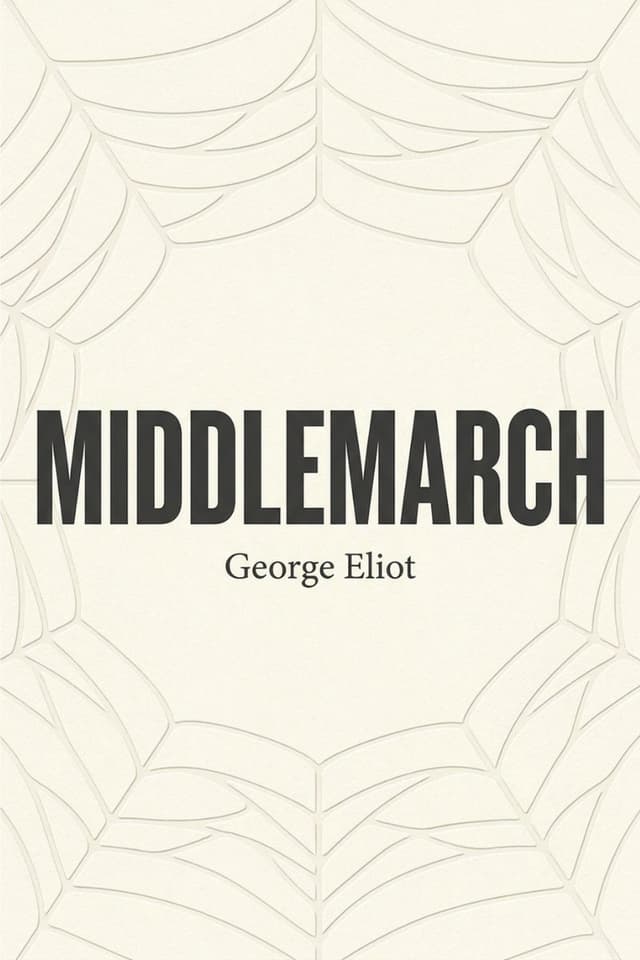
The town of Middlemarch is a web. Pull one thread and everything shifts.
There's Fred Vincy, Rosamond's reckless brother, who has been spending money he doesn't have because he expects to inherit a fortune from his wealthy uncle Featherstone. There's Mary Garth, the practical, sharp-witted woman Fred loves, who refuses to marry a man she can't respect. And there's the question of what old Featherstone will actually do with his money when the time comes.
There's Nicholas Bulstrode, the pious banker who funds the new hospital and wraps himself in religious respectability. But Bulstrode has a past. And the past, in a town like Middlemarch, has a way of sending messengers.
The Tightening Web
Casaubon's health is failing, and his jealousy of Will Ladislaw is growing into something that could reach beyond the grave. Lydgate's medical ambitions are colliding with the petty politics and suspicion of a town that doesn't trust outsiders or new ideas. Rosamond's expensive tastes are dragging her husband toward financial ruin. And a stranger named Raffles has arrived in Middlemarch, carrying secrets that could destroy the town's most powerful man.
Dorothea is trapped in a marriage that is slowly suffocating her. Lydgate is trapped in a marriage that is slowly bankrupting him. Fred is trapped by his own carelessness. Bulstrode is trapped by his own past. And the whole town is watching, gossiping, judging, and tightening the net around every one of them.
What Happens When Everything Breaks
The question isn't whether things will fall apart. They will. The question is what these people will do when the structures they've built, the marriages, the reputations, the careful plans, start crumbling under the weight of choices they made when they thought they knew what they were doing.
Will Dorothea find a way to live a life that matches the size of her soul? Will Lydgate save his career, or will love and debt destroy everything he came to Middlemarch to build? Will the truth about Bulstrode come to light, and if it does, who else will it take down?
In Middlemarch, everyone is connected. And everyone has something to lose.
About the Author: George Eliot
The Girl from Warwickshire
George Eliot was born Mary Ann Evans in 1819 in Nuneaton, Warwickshire. She was the daughter of a land agent and grew up in rural England, surrounded by the farms, villages, and social hierarchies that would later fill her novels. She was intensely intelligent from childhood, devouring books and excelling at school. When her mother died, sixteen-year-old Mary Ann left school to run the household and care for her father.
The Intellectual Awakening
After moving to Coventry in 1841, Evans fell in with a circle of freethinkers who challenged her strict evangelical upbringing. She began questioning her faith, a rupture that nearly destroyed her relationship with her father. She translated major works of German theology and philosophy, and after her father's death in 1849, she moved to London, where she became the de facto editor of the prestigious Westminster Review. She was one of the most brilliant intellectuals in England, and almost no one knew it.
Love and Scandal
In 1854, Evans made the decision that would define her personal life. She entered into a relationship with George Henry Lewes, a philosopher, writer, and married man. Lewes could not obtain a divorce under English law, but they lived together openly as partners for over twenty years. Victorian society was scandalized. Her brother Isaac cut off all contact with her. But the relationship gave Evans the stability, encouragement, and love she needed to begin writing fiction.
Becoming George Eliot
She adopted a male pen name partly to ensure her work was judged on its merits, and partly to keep her controversial private life from overshadowing her art. Her first novel, Adam Bede, was a sensation. The books that followed, including The Mill on the Floss, Silas Marner, and finally Middlemarch, established her as one of the towering figures of English literature.
Final Years
Lewes died in 1878, and Evans was devastated. In 1880, she surprised everyone by marrying John Walter Cross, a friend twenty years her junior. The marriage finally reconciled her with her brother Isaac. She died in December 1880 at age sixty-one and is buried at Highgate Cemetery in London, beside Lewes.
Fun Facts About the Book
Two Books Became One
Middlemarch didn't start as a single novel. Eliot began writing a story about the doctor Lydgate in 1869, then set it aside. Separately, she started a novella called "Miss Brooke" about Dorothea. At some point, she realized these two stories belonged in the same world and fused them together. The result was one of the most intricately woven novels in the English language.
Published in Installments
The novel was too long for the standard three-volume format of the era, so Eliot's publisher tried something unusual: they released it in eight installments over the course of 1871 and 1872. Readers had to wait months to find out what happened, not unlike following a prestige television series today.
Virginia Woolf's Famous Praise
Virginia Woolf called Middlemarch "one of the few English novels written for grown-up people." It's one of the most quoted endorsements in literary history, and it captures something essential about the book: this is a novel that trusts its readers to handle complexity, ambiguity, and the uncomfortable truth that good people make terrible decisions.
The Coventry Connection
The fictional town of Middlemarch is almost certainly based on Coventry, where Eliot lived as a young woman. Like Middlemarch, Coventry was a silk-ribbon manufacturing town navigating the upheaval of industrialization, political reform, and social change. Eliot drew on her memories of the place to build one of the most convincing fictional communities ever created.
A Massive Research Project
Eliot was famously rigorous in her preparation. She kept detailed notebooks while writing Middlemarch, filling them with medical facts for Lydgate's storyline, historical details about the Reform Act, and notes on everything from horse-dealing to hospital politics. She compiled hundreds of literary quotations in eight different languages. The novel reads like life because Eliot insisted on getting the details right.
The Longest of the Six
At over 300,000 words, Middlemarch is one of the longest novels in the English language. It took Eliot nearly three years to write. Despite its length, readers consistently describe the experience of reading it as one they wish would never end.
Never a Feature Film
Middlemarch has been adapted for television multiple times, most memorably the acclaimed 1994 BBC series starring Juliet Aubrey and Rufus Sewell. But it has never been made into a feature film. Director Sam Mendes reportedly considered it, but the novel's sprawling scope and ensemble cast may simply be too vast for a single movie.
The Pen Name's Origin
Evans chose "George" as a tribute to George Henry Lewes, the man she loved. "Eliot," she later said, was simply "a good mouth-filling, easily pronounced word." The name became so famous that even after her identity was publicly revealed, the world continued to call her George Eliot.
Themes
The Tragedy of Good Intentions
Nearly every major character in Middlemarch starts out wanting to do something admirable. Dorothea wants to serve a higher purpose. Lydgate wants to advance medicine. Even Bulstrode convinces himself his wealth serves God's work. The novel traces how idealism collides with reality, how the world bends noble ambitions into shapes their owners barely recognize.
Marriage as Discovery
Middlemarch is one of the most penetrating novels ever written about what happens after the wedding. Eliot shows how short courtships built on fantasy lead to marriages built on misunderstanding. Dorothea and Casaubon, Lydgate and Rosamond: both couples discover too late that the person they married is not the person they imagined. The novel doesn't just depict unhappy marriages. It dissects exactly how and why they go wrong.
Women and the Limits of Ambition
Dorothea Brooke has the intelligence, the passion, and the moral seriousness to achieve great things. But she lives in a world that offers women exactly two paths: marriage or dependent spinsterhood. The novel is quietly furious about this. Dorothea's story is a study of what happens to extraordinary women when society refuses to give them room to be extraordinary.
The Power of Small Communities
Middlemarch the town is almost a character in itself. Gossip travels fast. Reputation is everything. A single misstep can ruin a career. Eliot shows how the social pressure of a small community can be both a safety net and a trap, how the people around us shape our choices in ways we don't fully understand until it's too late.
The Past Is Never Dead
Secrets have a half-life in Middlemarch, and it's shorter than anyone thinks. Bulstrode's buried past, Casaubon's jealous provisions, old debts and old promises: they all surface at the worst possible moment. The novel insists that we cannot outrun the consequences of our choices, no matter how carefully we try to bury them.
Idealism vs. Compromise
The central tension of the novel is the gap between who we want to be and who the world allows us to become. Every character must negotiate this gap. Some bend gracefully. Some break. And the novel suggests that the truest measure of a person isn't the size of their ambitions, but what they do when those ambitions meet the stubborn, complicated, uncooperative reality of other people.
The Book's Legacy
Middlemarch is regularly cited as one of the greatest novels ever written in English. Martin Amis and Julian Barnes have both called it the finest in the language. It appears on virtually every list of essential literature and has never gone out of print.
The 1994 BBC television adaptation, written by Andrew Davies, is widely considered one of the best literary adaptations ever produced for the screen. It brought new generations of readers to the novel and proved that Eliot's characters still feel startlingly alive more than a century later.
But Middlemarch's deepest legacy may be its influence on how novels work. Eliot's method of weaving multiple storylines together, her psychological realism, her refusal to offer easy resolutions: these techniques became foundational to modern fiction. D.H. Lawrence, Virginia Woolf, and countless others learned from what Eliot built here.
Modern readers often describe Middlemarch as a book that understands them. Its characters struggle with the same things we do: choosing the wrong partner, sacrificing ideals for security, wanting to matter in a world that doesn't make it easy. It is a novel about the quiet heroism of ordinary life, and more than 150 years after it was written, it still has the power to change how you see yourself and the people around you.