Novelhalla
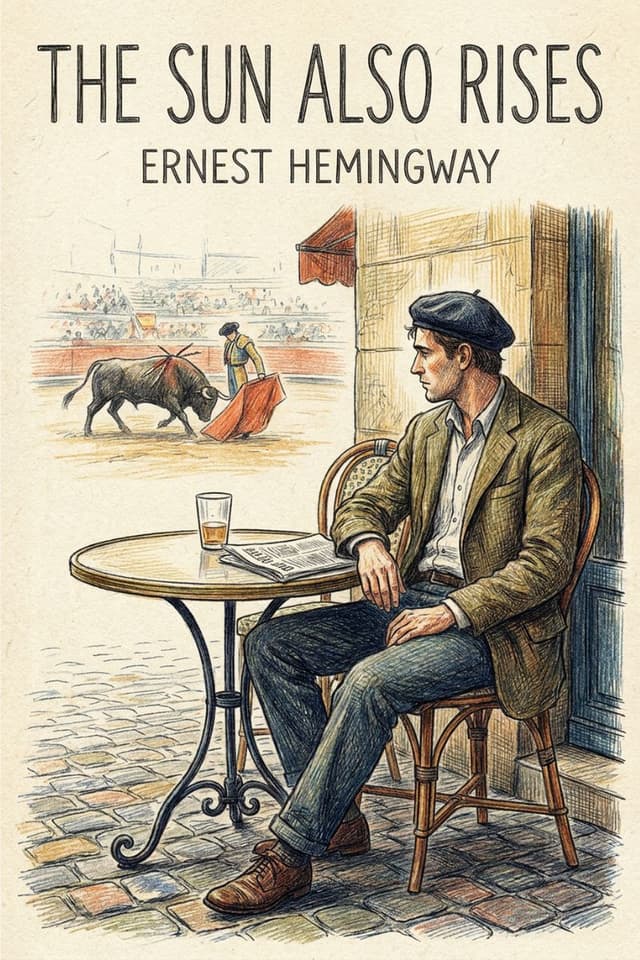
The Sun Also Rises
Read The Sun Also Rises by Ernest Hemingway for free on Novelhalla, and try out our easy-to-read modern edition of this classic book. You can also download the EPUB and read it on any device if you prefer!
The Plot
The Wound
Jake Barnes is an American journalist living in Paris in the 1920s. He fought in the Great War and came home with an injury that took something from him that he can never get back. It's never stated outright, but you understand: the wound left him unable to be with a woman. And the woman he loves, Lady Brett Ashley, is very much a woman who needs to be with someone.
Brett is magnetic. She's divorced, reckless, funny, beautiful, and restless in a way that draws every man in her orbit closer while she spirals further from anything that might actually make her happy. She and Jake love each other. They both know it. But their situation is impossible, and they both know that too.
So they drink. Everyone in this book drinks. Jake's circle of expatriate friends moves through the cafes and bars of 1920s Paris in a haze of wine and whiskey and conversation that never quite says what anyone actually means. It's glamorous on the surface and hollow underneath.
The Friends
Robert Cohn is Jake's friend, sort of. He's a wealthy Jewish writer, a former college boxing champion, and the only one in the group who didn't go to war. He's also a hopeless romantic in a crowd of people who've had the romance beaten out of them. When Cohn meets Brett, he falls hard. Jake watches it happen and says nothing useful, because what is there to say?
Brett, meanwhile, is engaged to Mike Campbell, a cheerful Scottish drunk who is broke and loud and entertaining right up until he isn't. Bill Gorton, a writer and Jake's war buddy, rounds out the group. He's the closest thing the novel has to someone having a good time.
These people orbit each other in Paris. They go to parties. They talk about nothing. They avoid talking about everything. And then they make a plan to go to Spain.
The Escape
Jake and Bill travel ahead to the Spanish countryside for a fishing trip, and for a few perfect days the novel opens up and breathes. The trout streams of the Pyrenees are cold and clear. The wine is good. The friendship is easy. It's the one stretch of the book where nobody is performing and nothing is broken.
It can't last. The group reassembles in Pamplona for the Festival of San Fermin: the running of the bulls, the bullfights, the days and nights of celebration that blur together into one long fever dream of noise and alcohol and danger.
The Fiesta
In Pamplona, everything that was simmering in Paris boils over. Brett captivates a young bullfighter named Pedro Romero, a nineteen-year-old prodigy who moves in the ring with a grace and courage that makes everyone else in the novel look like exactly what they are: tourists. Jake, who has earned real respect among the Spanish bullfighting community, is asked to make an introduction he knows he shouldn't make.
Cohn, who has been following Brett around like a man sleepwalking toward a cliff, reaches his breaking point. Mike gets mean. Jake gets pulled apart by loyalties he can't reconcile. The fiesta becomes a pressure cooker of jealousy, humiliation, and violence.
The bulls run through the streets every morning. The fights happen every afternoon. And among the friends, a different kind of destruction is playing out in hotel rooms and bars and on the dark streets after midnight.
After the Music Stops
The fiesta ends. It always ends. And what's left when the music stops and the wine runs out is a set of relationships that may not survive what happened in Pamplona.
Jake tries to find some peace on his own. But Brett has a way of pulling him back, and she's not done needing him yet. A telegram arrives. And Jake has to decide, again, what he's willing to do for a woman he loves but can never have.
The final pages of this novel are among the most devastating in American fiction. Not because anything dramatic happens, but because of everything that doesn't. And can't.
About the Author: Ernest Hemingway
The Oak Park Kid
Ernest Hemingway was born in 1899 in Oak Park, Illinois, a comfortable Chicago suburb. His father was a doctor who taught him to hunt and fish in northern Michigan. His mother was a musician. He was one of six children in a household that valued propriety and achievement. He wrote for his high school newspaper, played football, and couldn't wait to leave.
War and Paris
After graduating in 1917, Hemingway skipped college and became a reporter for the Kansas City Star. Within months, he'd enlisted as a Red Cross ambulance driver and shipped out to the Italian front. He was eighteen years old. In July 1918, he was hit by mortar fire at Fossalta di Piave, taking over two hundred pieces of shrapnel to his legs. He was not yet nineteen.
While recovering in a Milan hospital, he fell in love with a nurse named Agnes von Kurowsky. She turned down his proposal. He went home wounded in more ways than one.
By 1921, newly married to Hadley Richardson, Hemingway moved to Paris as a foreign correspondent. There he fell in with the expatriate literary scene: Gertrude Stein, Ezra Pound, F. Scott Fitzgerald, James Joyce. They drank together, argued together, and pushed each other's work. It was the most creatively productive period of his life, and also, by his own account, the happiest.
The Writer Emerges
His first major short story collection, In Our Time, appeared in 1925. Then came the trip to Pamplona that summer, the disastrous week with friends that handed him his first novel on a platter. He wrote the draft in about eight weeks. When it was published in 1926, it made him famous.
A Farewell to Arms followed in 1929, cementing his reputation. He married four times, lived in Key West and Cuba, covered the Spanish Civil War and World War II as a correspondent, hunted big game in Africa, fished for marlin in the Gulf Stream, and cultivated a public persona as large and complicated as his prose was spare.
The End
The Old Man and the Sea won the Pulitzer in 1953. The Nobel Prize in Literature came in 1954. But Hemingway's body was failing. Plane crashes in Africa had left him badly injured. He struggled with depression, high blood pressure, and liver disease. He was hospitalized and treated with electroshock therapy. On July 2, 1961, at his home in Ketchum, Idaho, he took his own life. He was sixty-one.
Fun Facts About the Book
Written in Eight Weeks
Hemingway started writing the novel on his birthday, July 21, 1925, just days after the Pamplona trip that inspired it. He finished the first draft by September. The speed is staggering, but Hemingway always maintained that a writer should write about what he knows. He had just lived every page.
Fitzgerald's Edit
F. Scott Fitzgerald read an early draft and told Hemingway to cut the first two chapters, which were essentially backstory and warm-up. Hemingway took the advice. The novel now opens with the sharp, almost offhand introduction of Robert Cohn, and the improvement is enormous. Hemingway rarely credited Fitzgerald publicly, but the edit was a significant one.
A Real Cast of Characters
Almost every character in the novel maps to a real person from Hemingway's circle. Lady Brett Ashley is based on Lady Duff Twysden, a British socialite living in Paris. Robert Cohn is modeled on Harold Loeb, a writer who rivaled Hemingway for Twysden's affections. Mike Campbell is drawn from Pat Guthrie, Twysden's lover. The young bullfighter Pedro Romero is based on Cayetano Ordonez, a real matador whose brilliance in the ring that summer made a deep impression on Hemingway.
The real people were not happy about being immortalized this way. Loeb in particular felt betrayed by his portrayal, which is unflattering at best.
The Film Rights Went to His Ex-Wife
Hemingway gave the film rights to Hadley Richardson, his first wife, as part of their divorce settlement. So when Hollywood came calling, she collected the check. Hemingway never personally profited from the film adaptation.
Hemingway Hated the Movie
The 1957 film starred Tyrone Power as Jake and Ava Gardner as Brett, with Errol Flynn as Mike. Hemingway saw it and walked out after twenty-five minutes. He complained that Pamplona had been shot in Mexico, the bulls looked too small, and the only good thing about the picture was Errol Flynn.
The Title Came from the Bible
The novel's title is drawn from Ecclesiastes: "One generation passeth away, and another generation cometh: but the earth abideth for ever. The sun also ariseth." Hemingway told his editor that the book was really about the idea that the earth endures even when the people on it feel like they've been broken beyond repair.
It Put Pamplona on the Map
Before the novel, the Festival of San Fermin was a regional celebration. After it, Pamplona became an international destination. Hemingway himself later worried about the impact, noting the tens of thousands of tourists who flooded the city each July. In 2023, a Pamplona writers' association held a mock trial to debate whether Hemingway's popularization of the festival had done more harm than good.
Themes
The Wound You Can't See
Jake's physical injury is the most literal wound in the novel, but everyone in the book is damaged. The war broke something in these people that can't be fixed with time or drink or travel. Hemingway never lets anyone deliver a speech about it. He just shows you people trying to have a good time and failing, over and over, in ways that make the silence louder than any confession would be.
Love Without Consummation
Jake and Brett love each other. It's real and it's deep and it's completely hopeless. The novel asks what love even means when the one thing that might make it work is the one thing that's been taken away. Brett keeps looking for satisfaction elsewhere, and Jake keeps watching, and neither of them can stop circling back to each other.
Drinking as Coping
The characters drink constantly. It's not glamorous, even when it looks like it is. The alcohol is a tool for avoidance, a way to keep the conversation light and the feelings buried. Hemingway, who knew something about drinking, renders it without judgment but also without illusion. You can feel the hangovers.
Authenticity vs. Performance
The novel draws a sharp line between people who are genuine and people who are playing a role. The Spanish characters, particularly Romero, live with a directness and courage that the expatriates can only admire from the outside. Jake's status as a true aficionado of bullfighting gives him credibility in Pamplona, but his willingness to compromise that standing for Brett's sake is one of the book's quiet tragedies.
Masculinity in Crisis
Every man in the novel is trying to prove something. Jake can't perform sexually. Cohn uses his fists when his feelings are hurt. Mike uses cruelty. Romero puts his life on the line in the ring every afternoon. The novel doesn't offer a simple answer about what it means to be a man, but it's deeply interested in the question, and in the gap between bravery and bravado.
The Lost Generation
Hemingway popularized Gertrude Stein's phrase with this novel, but he also pushed back against it. He told his editor that the characters might be battered, but they weren't lost. The novel holds both ideas at once: yes, the war destroyed something essential in these people. And yes, the sun comes up again tomorrow. Whether that's hopeful or just relentless depends on how you read it.
The Book's Legacy
When it was published in 1926, the novel divided critics. Some were appalled by the drinking and the sex. Others recognized that something new had arrived in American literature. They were both right.
Hemingway's style in this book changed the way English-language fiction was written. The short sentences. The stripped-down dialogue. The enormous weight of what goes unsaid. Writers have been imitating it, reacting against it, and learning from it ever since.
The novel helped define the idea of the Lost Generation for the reading public and made the 1920s expatriate lifestyle in Paris feel both romantic and doomed. It launched Hemingway from promising young writer to literary celebrity almost overnight.
It also permanently tied Hemingway's name to Pamplona. The city erected a statue of him outside the bullring. Bars he frequented became pilgrimage sites. The running of the bulls went from local tradition to global spectacle, for better or worse.
A 1957 film adaptation brought the story to a wider audience, and the novel has never gone out of print. Nearly a century later, it remains one of the essential American novels, a book that captures a specific time and place while saying something universal about what it feels like to want something you can't have, to keep going when the reason for going has been taken away, and to sit in a taxi next to someone you love while knowing that the distance between you is everything.