Novelhalla
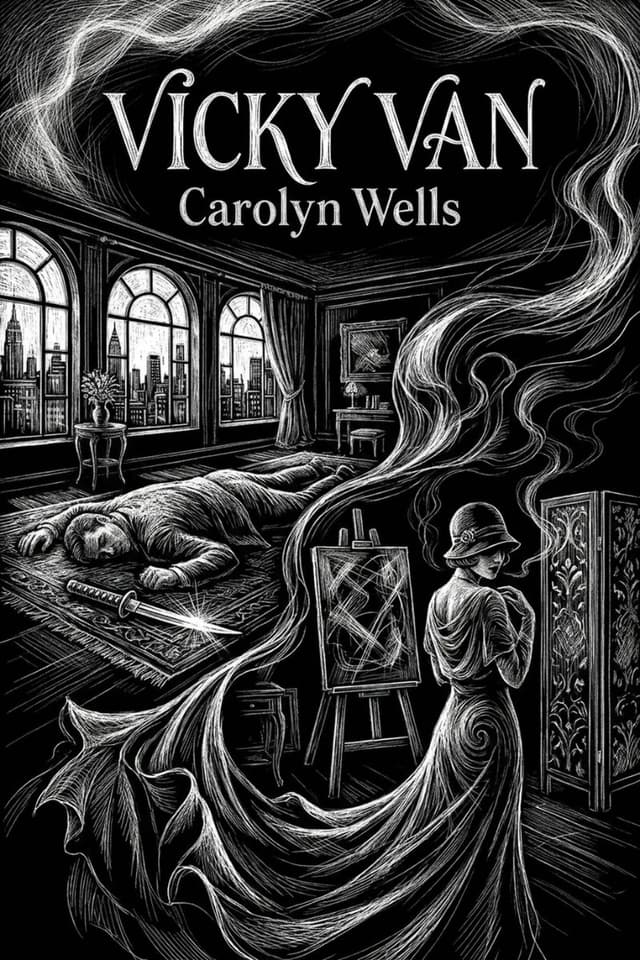
Vicky Van
Read Vicky Van by Carolyn Wells for free on Novelhalla, and try out our easy-to-read modern edition of this classic book. You can also download the EPUB and read it on any device if you prefer!
The Plot
The House Just Off Fifth Avenue
Chester Calhoun is twenty-seven, a junior partner at a respectable New York law firm, and the man of a very proper household in the East Sixties, where he looks after his teenage sister Winnie and lives under the raised eyebrows of his Aunt Lucy. He's a sensible fellow. He does sensible things.
And then, several nights a week, he crosses the street.
Directly opposite, in a narrow little house near the corner, lives Victoria Van Allen, who everybody calls Vicky Van. She's young, she's dark-haired, she's dazzling, and she throws the best parties in the neighborhood. Her rooms are done in French gray and rose. There are always flowers. The bridge games run for real money, the dancing runs until dawn, and the supper is catered because Vicky keeps exactly one live-in servant, a watchful woman named Julie who runs the whole house like a small hotel.
Nobody knows where Vicky's money comes from. Nobody knows who her people are. Nobody knows where she goes when she disappears for a week at a time, which she does, cheerfully and often. Her friends adore her and can't tell you a single fact about her. She flirts with everyone and belongs to no one. Chester privately files her under touch-me-not and keeps crossing the street anyway.
The Uninvited Guest
One night in February, a club friend named Norman Steele shows up at Vicky's with a man nobody has ever met. Steele hasn't asked permission, which isn't done, but the stranger seems harmless enough: a heavy, white-mustached millionaire in the fifties, expensively dressed, a little too pleased with himself, introduced simply as Mr. Somers.
It happens to be Vicky's birthday. She hasn't told anyone, because she doesn't want gifts. There's a surprise supper waiting behind the dining room doors, and a Jack Horner Pie in the middle of the table stuffed with little jokes and trinkets for her guests.
Somers is delighted with her. He's a bit too delighted. He watches her play cards, corrects her hand, rests his fingers on her shoulder. She stands up and walks out toward the dining room to check the seating.
He follows her.
A few minutes later a caterer's waiter appears in the doorway, white-faced and clinging to the curtain, begging for a doctor. Somers is on the dining room floor by the sideboard with a boning knife in his heart. It's a knife from the caterer's own kit, left in the pantry an hour earlier, which means somebody picked it up well before they used it.
Vicky Van is not in the room. She isn't upstairs. She isn't in the basement or the yard or the attic. Neither is Julie. Two women have walked out of a lit, crowded house in evening dress, without hats or wraps, and not one guest saw them go.
The Waiter's Story
Luigi has worked for the caterer longer than any of their men and has never told his employer a lie. He says he pushed the pantry door open a crack. He says he saw Miss Van Allen standing over the body, reaching toward the knife and then not touching it. He says she looked down at the blood on the gold fringe of her gown, and then she ran.
The police find no letters, no cards, nothing in the dead man's pockets to say who he is. Only the initials R. S. on his handkerchiefs and his ring and the crown of his hat. It takes the patrolman on the beat about four seconds to identify him, because the man had given a false name at a house four doors from his own front steps. His name is Randolph Schuyler, and he's one of the richest men on Fifth Avenue.
Which turns a scandal into a sensation, and turns a missing hostess into the most wanted woman in New York.
The Widow and the Sisters
Because his firm handles the Schuyler estate, Chester is the one who has to knock on that door at three in the morning and tell them. He finds a household frozen in amber: two elderly, iron-spined Schuyler sisters who want a reward posted and an arrest made and a hanging arranged, and a young widow, Ruth, married seven years to a man decades her senior, who had no idea her husband kept a life she wasn't allowed to see.
Ruth is gentle, pale, badly outnumbered in her own home, and asks Chester a question nobody else in the house is asking: could the girl possibly be bought off, quietly, so the family name stays out of the papers?
Chester finds himself in an impossible position. He's the widow's lawyer and, increasingly, her friend. He's also the only person in Manhattan still insisting out loud that Vicky Van didn't do it.
And then the notes start arriving. Little messages, in her handwriting, cheerful as ever, from a woman half the city is hunting.
Stone and Fibsy
The Schuyler sisters get their way eventually and hire Fleming Stone, the most famous private detective in the country, with instructions to find Miss Van Allen and see her convicted. Stone brings along Terence McGuire, better known as Fibsy, a red-headed Irish kid with a mouth full of street slang and a genuinely alarming talent for noticing what grown men walk right past.
Which leaves Chester Calhoun holding something heavier than he can carry: he knows more about where Vicky Van is than he's told anyone, and every day he stays quiet he gets a little further from the man his Aunt Lucy thinks he is.
Somebody in this story is lying beautifully. The question is who, and about what, and for how long they've been doing it.
About the Author: Carolyn Wells
A Very Loud Silence
Carolyn Wells was born in Rahway, New Jersey, in 1862, and by all accounts was an unbearably precocious child who could read before she was four. When she was six, an aunt visited the house straight from another sick child's bedside, and both Carolyn and her three-year-old sister came down with scarlet fever. Her sister died. Carolyn survived with a hearing loss that deepened for the rest of her life.
She later wrote, without much self-pity, that her deafness had cost her a marriage proposal, invitations abroad, gifts, and airplane rides. It also pushed her sideways into books. She graduated valedictorian, refused to go to college, studied privately instead, and went to work at the Rahway Library Association, eventually becoming head librarian for twelve years. Being the person who ordered the books turned out to be an excellent education.
The Nonsense Years
Her first published book, in 1896, was a collection of verse charades. What followed was a torrent of light verse, parody, limericks, humor anthologies, and children's series with names like the Patty books and Dick and Dolly. She was funny for a living, published in Punch and half the American magazines, and she was very good at it.
Then, sometime around 1910, she heard Anna Katharine Green's mystery "That Affair Next Door" read aloud, and something clicked over permanently. Her first detective novel came out in 1909 and introduced Fleming Stone. By 1913 she felt qualified enough to publish a full instructional manual on how to build a mystery, which remains one of the earliest American books ever written on the subject.
The Machine
From there she simply did not stop. Wells produced more than 170 books in her life, roughly half of them mysteries, including sixty-one Fleming Stone novels, one of the longest-running detective series anybody has ever attempted. Reviewers sometimes complained she was formulaic. Readers bought her anyway, in enormous numbers, for thirty straight years. She was called the Dean of American Mystery Writers and she rather enjoyed it.
She was also one of the great book collectors of her era. She decided on a whim to buy Walt Whitman and then bought essentially all of him: first editions, manuscripts, letters, photographs, two copies of everything. She co-wrote a Whitman bibliography in 1922 and eventually concluded there was no Whitman item she didn't own. The collection went to the Library of Congress.
Late Marriage, Long Ending
In April 1918, at fifty-five, she married Hadwin Houghton of the Boston publishing family. He died the following year. She moved into a hotel overlooking Central Park and stayed there, writing, for the next two decades. She died in New York in 1942 at seventy-nine and was buried back in Rahway, and then, remarkably fast for someone who had sold that many books, she was forgotten almost completely.
Fun Facts About the Book
It Was Written by the Woman Who Wrote the Rulebook
Five years before this novel, Wells published a book-length technical guide to constructing detective fiction, dissecting Poe, Doyle, Gaboriau, and Leroux for aspiring writers. So when you catch her setting up a clue in plain sight, she isn't doing it by instinct. She literally taught the course.
The Famous Detective Shows Up Late
Fleming Stone doesn't appear until the book is roughly half over, which is a strange choice for a series novel and a large part of what makes this one work. For most of the story you're stuck with an amateur, and the amateur is compromised, and that's the point.
Fibsy Was a Breakout
Terence "Fibsy" McGuire debuted in 1917 as a nosy office boy in another Wells mystery and was popular enough that she promoted him to Fleming Stone's legman for the next several books. In this one he does an unusual amount of the actual detecting, which readers at the time noticed and enjoyed.
Hollywood Moved Fast
Paramount had a film version in theaters by May 1919, less than a year after publication. It starred Ethel Clayton, was directed by Robert G. Vignola, and was shot under the working titles "Vicky" and "The Girl Next Door" before being released as "The Woman Next Door." Some newspaper ads still ran it under the original name. No print of it is known to survive.
The Geography Is the Whole Joke
Chester notes that the mansions on Fifth Avenue and the little houses on the side streets just off it might as well be in separate towns. That's why a man with one of the best-known faces in New York felt safe walking four doors from his own house under a fake name. It's a very specific piece of 1918 Manhattan social physics, and the entire plot rests on it.
A Jack Horner Pie
The centerpiece of the murder-night supper table is a giant decorative pie packed with favors and gag gifts for the guests to pull out. They were a real Edwardian party fad, mostly for children's birthdays, and the coroner is faintly baffled to find one at a grown woman's dinner.
Bridge for Real Money
Wells was a serious bridge enthusiast who once published a book of comic verse about the game, and it shows. The card scenes are written by somebody who knows exactly what it means when a player admits she led into the wrong hand.
The Author Vanished Too
Wells sold millions of books and then dropped out of literary memory so thoroughly that a 2024 biography about her is titled around her disappearance. There's a certain grim symmetry in the fact that her most durable novel is about a woman who walks out of a room and cannot be found.
Themes
Nobody Actually Knows Anybody
Every single one of Vicky's devoted friends says the same thing when pressed: I adore her, and I know nothing about her. The book keeps returning to how easy it is to be intimate with someone and completely ignorant of them, and how much of what we call knowing a person is really just liking them.
The Double Standard, Stated Out Loud
A rich married man may keep a secret life, and his butler will politely decline to discuss it. A single woman who hosts parties and doesn't explain where her income comes from is an adventuress. The novel puts these two judgments side by side on purpose and lets you sit with the arithmetic.
Loyalty Against the Law
Chester is an officer of the court with a duty to disclose, a client whose husband is dead, and a friend he refuses to condemn. The book is at its best when it stops being a puzzle and becomes a straightforward question about what you owe people, and what you're willing to become in order to pay it.
Marriage as a Small Locked Room
Ruth Schuyler was ruled by a husband who wouldn't let her hire a secretary, and now she's ruled by his sisters, who inform her that she isn't really a Schuyler. Her grief and her relief are tangled together in a way that Wells handles with more subtlety than the genre usually bothers with.
Who Gets Believed
An Italian waiter and an Irish charwoman give the most useful testimony in the case, and the fashionable people in the room spend a great deal of energy explaining why that testimony must be mistaken. Wells was writing for a comfortable audience, and the period's casual slurs are on the page, but she also quietly makes the servants the reliable narrators.
The Cost of Being Charming
Vicky's gift is that everyone likes her instantly. That gift is also exactly what makes her impossible to defend, because charm reads as calculation the moment anything goes wrong.
The Book's Legacy
Fleming Stone ran for sixty-one novels across three decades, which puts Carolyn Wells in rare company with the longest-running series detectives in the language, and this is the one that gets recommended first. Modern readers consistently rank it near the top of her mysteries, partly for the misdirection and partly because the narrator's divided loyalties give it real emotional stakes instead of just a puzzle to unlock.
It sits at an interesting hinge point in the genre. It's post-Sherlock and pre-Christie, written by an American woman in 1918 who had already codified the rules and was now cheerfully bending them. The gentle drawing-room murder, the small closed circle of suspects, the amateur who gets in over his head, the sidekick who outshines the great detective: you can draw a straight line from this book to the entire cozy mystery shelf.
The screen version came and went in 1919 and is now lost, one of the roughly three-quarters of American silent features that no longer exist anywhere.
And Wells herself has been having a small revival. After decades as a footnote, she's been the subject of a full biography, new editions, and a fair amount of argument about how a woman who wrote nearly two hundred books and outsold most of her contemporaries could evaporate from the record so completely. If you want to understand why she was worth a million dollars in 1937 and why she deserved better afterward, this is the book to start with.