Novelhalla
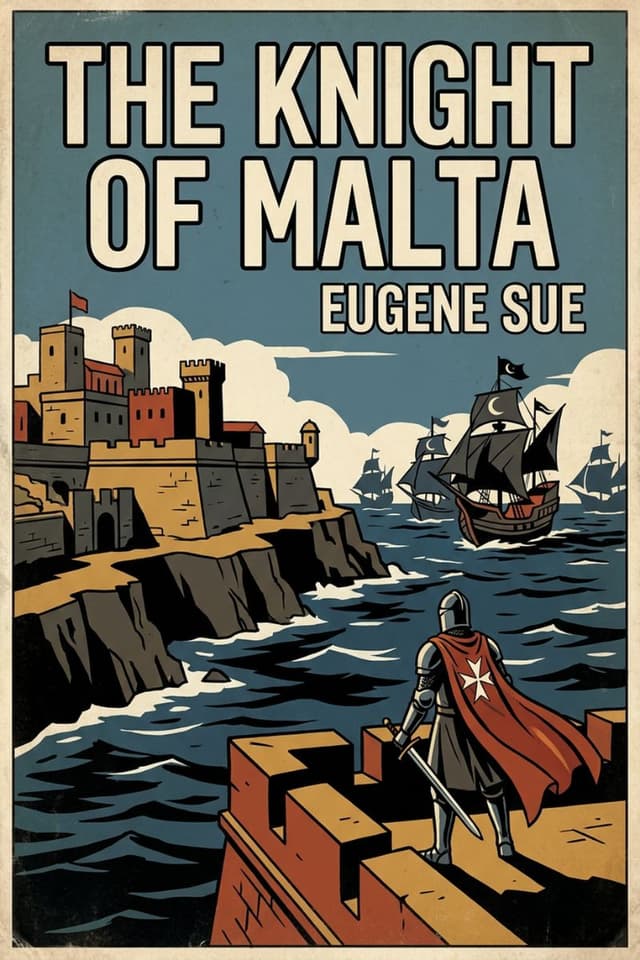
The Knight of Malta
Read The Knight of Malta by Eugène Sue for free on Novelhalla, and try out our easy-to-read modern edition of this classic book. You can also download the EPUB and read it on any device if you prefer!
The Plot
The Coast of Terror
The year is 1633, and the sun-drenched shores of Provence are anything but peaceful. Barbary pirates from Algiers and Tunis raid the coast almost daily, capturing merchant vessels, burning villages, and dragging men, women, and children into slavery. Cardinal Richelieu has sent inspectors to survey the defenses, but their reports make grim reading: forts manned by a single porter, cannons unmounted and rusting, entire communities abandoning the coast to flee inland. The Mediterranean, perfumed by orange groves and blessed by gentle winds, has become a sea of terror.
On a rocky promontory called Cape l'Aigle, overlooking the gulf of La Ciotat, an old watchman named Bernard Peyrou keeps his lonely vigil. It is his duty to scan the horizon for pirate sails and light the signal fires that will warn the coast of approaching danger. Peyrou is no ordinary watchman. For twenty years he served as a seaman on the galleys of the Knights of Malta, never leaving the side of Commander Pierre des Anbiez. Now wounded and unable to sail, he lives in his stone cabin with only an eagle for company, reading the weather and the stars, dispensing wisdom to the fishermen and peasants who climb the steep path to seek his counsel.
The Mysterious Strangers
Three travelers arrive in Marseilles from distant Russia. They are clearly men of rank, received by the Marshal of Vitry himself, but there is something unsettling about them. The eldest, called Pog, is cold and sardonic, his face hard as carved stone. The second, nicknamed Trimalcyon after a character from Petronius, is fat and sensual, forever making crude jests in Latin. But it is the youngest who draws every eye.
He is called Erebus, and at twenty years old he is startlingly beautiful, with black eyes that glitter like diamonds and features that shift between nobility and insolence depending on which of his companions holds sway over him. In Trimalcyon's company he becomes coarse and mocking. Under Pog's influence he grows bitter and contemptuous. But when left to himself, his face reveals something finer: a soul still capable of generosity and honor, not yet entirely corrupted by the men who have shaped him.
The Rescue
On the road through the mountain gorge of Ollioules, the strangers encounter a small caravan. Baron Raimond V des Anbiez, patriarch of one of Provence's oldest noble houses, is riding home with his daughter Reine and her betrothed, the Chevalier Honorât de Berrol. Reine is singing, her voice so pure that the echoes seem to answer her in harmony. Then, impossibly, a male voice joins hers from somewhere among the rocks.
In that moment of distraction, the Baron's horse bolts toward a precipice. The animal is wild, the reins have slipped, and Raimond des Anbiez has only seconds to live. But Erebus, watching from above, acts without hesitation. He leaps across a chasm, rolls beneath the horse's hooves, and seizes the bloody bridle with his bare hands, dragging the animal to a halt mere steps from the edge of the abyss.
The Baron embraces his savior with tears of gratitude. Reine gazes at the beautiful stranger with wonder and admiration. For a moment Erebus seems transformed by the warmth of their thanks, his eyes glistening, his heart opened by this taste of honest affection.
Then his companions call out in their foreign tongue. Trimalcyon leers at Reine. Pog makes some cutting remark. And Erebus changes. His face hardens into insolence. When the Baron asks how he might repay such a service, Erebus demands a kiss and the silver pin from Reine's bodice. Before anyone can react, he has stolen both and leaped back across the chasm, vanishing with his companions into the wilderness.
The House of Anbiez
The Baron's fortified manor, Maison-Forte, stands near the shore, armed and ready to repel any pirate raid. Here Raimond lives with his daughter, his brother's memory hanging over them both. For the Commander Pierre des Anbiez, Knight of Malta, is a man wrapped in perpetual melancholy. He sails a black galley with black sails, manned by sailors as grim as monks. When he visits his brother and niece, his smile is more sorrowful than other men's tears. Something weighs upon him, some secret burden that only the old watchman Peyrou seems to share.
Reine is engaged to Honorât de Berrol, a kind and honorable young gentleman who loves her deeply. Their wedding approaches. The household should be happy. But the strange encounter on the mountain road has left its mark. Who was that beautiful, maddening young Russian? Why did he save a man's life only to insult his daughter? And why does his face haunt Reine's dreams?
Gathering Storms
The coast remains under siege. Pirates grow bolder. Political intrigues swirl around the Baron, who has made enemies of powerful men, including the Governor of Provence himself. Meanwhile, the commander of the galleys of Malta prepares for a new campaign against the corsairs of Barbary, the endless holy war that has consumed his life.
Into this volatile world the Russian strangers will return. Erebus carries within him the seeds of both destruction and redemption, shaped by the malign influences of his companions but not yet beyond saving. The old watchman sees more than he tells. The Commander carries secrets that could shatter everything. And Reine des Anbiez, caught between her gentle betrothed and the memory of a stolen kiss, stands at the center of a storm she does not yet understand.
On the coast of Provence, where Barbary pirates hunt Christian souls and Knights of Malta sail forth to battle the enemies of the Cross, a tale of passion, treachery, and impossible love is about to unfold.
About the Author: Eugène Sue
The Surgeon's Son
Marie-Joseph Eugène Sue was born in Paris on January 26, 1804, into a family of distinguished physicians. His father, Jean-Joseph Sue, served as a surgeon in Napoleon's army. His godmother was none other than Empress Joséphine herself. Young Eugène was expected to follow the family tradition, and he did, at least for a time. He served as a naval surgeon during the French expedition to Spain in 1823 and witnessed the Battle of Navarino in 1827, where combined British, French, and Russian fleets destroyed the Ottoman navy.
These years at sea gave Sue the material for his early novels: tales of pirates, naval battles, and maritime adventure that he published throughout the 1830s. But when his father died in 1829, leaving him a considerable fortune, Sue abandoned medicine entirely. He settled in Paris and became, for a time, one of the most flamboyant dandies in the city.
The Dandy and the Democrat
The young Sue was famous for his extravagance. He kept magnificent carriages, a stable of fine horses, a pack of beagles for hunting. He was a founding member of the exclusive Jockey Club. His clothes, his parties, his displays of wealth made him the talk of fashionable Paris. He wrote novels about aristocratic intrigue and high society romance, elegant entertainments for drawing-room readers.
Then something changed. Exposure to the slums of Paris while researching a novel opened his eyes to the suffering of the poor. Socialist ideas, particularly the doctrines of Fourier, captured his imagination. The dandy became a democrat, and his fiction transformed into a weapon of social criticism.
The Master of the Serial Novel
Sue's masterpiece, The Mysteries of Paris, appeared in newspaper installments from 1842 to 1843. It was a sensation that changed the French publishing industry forever. Readers from every class waited breathlessly for each new episode, following the adventures of a nobleman who disguises himself to explore the criminal underworld of Paris. The novel exposed the misery of the poor, the corruption of the rich, and the failures of a society that permitted such inequality to flourish. Victor Hugo's Les Misérables owes much to Sue's pioneering work.
The Wandering Jew followed in 1844, a Gothic melodrama attacking the Jesuits. Les Mystères du Peuple, an ambitious series of historical novels tracing the struggles of the French working class through the centuries, occupied his later years. These books were controversial, violent, and politically incendiary. They were also enormously popular.
Exile and Death
Sue's fame brought him into politics. In 1850 he was elected to the National Assembly as a Socialist delegate. When Louis-Napoleon seized power in the coup of 1851, Sue was among those who protested. He was forced into exile, fleeing to Savoy, then part of the Kingdom of Sardinia.
He continued writing until the end, producing novels at a furious pace. He died in Annecy-le-Vieux on August 3, 1857, at the age of fifty-three. He was buried in the non-Catholic section of the local cemetery, a final mark of his break with the established order. A street in Paris, the Rue Eugène Sue in the 18th arrondissement, still bears his name.
Fun Facts About the Book
Written from Experience
Sue served as a naval surgeon in the Mediterranean, and his maritime novels draw heavily on what he witnessed during those years. The Knight of Malta (originally Le Commandeur de Malte, published in 1841) reflects his intimate knowledge of ships, sailing, and the culture of seamen. The technical details of galley warfare and Mediterranean navigation are rigorously accurate, praised even by readers who found the romance excessive.
The Real History
The novel is set against a meticulously researched historical backdrop. The opening chapters quote directly from the 1633 report of M. de Séguiran, an inspector sent by Cardinal Richelieu to survey the defenses of Provence. Every detail about the pirate raids, the sorry state of the coastal forts, and the terror of the population comes from actual historical documents. Sue wanted his readers to understand that the dangers facing his characters were not invented.
La Ciotat Connection
Sue lived for a time in La Ciotat, the Provençal town where much of the novel takes place. Local tradition holds that he wrote the book while lodging at 32 Quai Stalingrad, overlooking the harbor that figures so prominently in the story. The house later became a pharmacy for the naval shipyards.
Part of a Larger Project
The Knight of Malta was written during Sue's transition period, after his early maritime adventures but before his great social novels. It combines his knowledge of the sea with his growing interest in the conflicts between classes and the abuse of power. The novel criticizes not only pirates but also corrupt officials, scheming nobles, and the rigid social hierarchies of seventeenth-century France.
The Knights of Malta
The Knights Hospitaller of St. John of Jerusalem, known as the Knights of Malta after they settled on that island in 1530, were a military religious order that waged constant war against the Ottoman Empire and the Barbary pirates. They were warrior monks, bound by vows of poverty and chastity but also trained for combat. Their galleys, crewed partly by slaves captured in battle, patrolled the Mediterranean hunting Muslim ships. Sue depicts both their valor and their melancholy, the weight of perpetual holy war upon men who have sacrificed everything for their cause.
Lost in Translation
The novel has been published in English under two titles: The Knight of Malta and The Commander of Malta. Both translate the French "commandeur," which refers specifically to a senior rank within the Knights of Malta, a commander being the head of a local commandery or estate belonging to the order.
Themes
Honor and Corruption
Erebus embodies the central tension of the novel: a soul born noble but twisted by bad influences. His companions Pog and Trimalcyon represent cynicism and sensuality, the forces that corrupt young men of promise. The novel asks whether such corruption is permanent or whether redemption remains possible. Can a single act of heroism reveal the man Erebus might have been? Can love save what cruelty has damaged?
The Cost of Holy War
The Commander Pierre des Anbiez is a man consumed by his vocation. The endless war against the infidel has drained him of joy, leaving only duty and sorrow. Sue does not condemn the Knights of Malta, but he shows what their perpetual crusade costs them: the possibility of ordinary happiness, of family, of peace. The commander's black galley with its black sails is a floating symbol of the death-in-life that holy warfare demands.
Terror and Civilization
The novel opens with documentary evidence of the Barbary pirate raids, establishing that the violence to come is not melodrama but history. Sue wanted his readers to feel how fragile civilization was on the Mediterranean coast, how quickly a prosperous village could become a smoking ruin, how easily a free person could become a slave. The fortified manor, the watchman's signal fire, the armed escort through mountain passes: these are the desperate measures of people living under siege.
Class and Power
Even in this early novel, Sue shows his interest in social criticism. The Baron des Anbiez is an honorable nobleman, but not all aristocrats in the story share his virtues. The Marshal of Vitry, the governor of Provence, is corrupt and dangerous. Officials abuse their positions. The powerful prey upon the weak. The systems that should protect ordinary people instead oppress them.
Love Against the Odds
Reine des Anbiez is betrothed to a good man, but fate has thrown a stranger across her path. The novel explores the dangerous territory between duty and desire, the question of whether the heart can be commanded. Sue was always interested in women trapped by circumstance, and Reine's dilemma foreshadows the heroines of his later, more political novels.
The Book's Legacy
The Knight of Malta represents an important stage in Eugène Sue's development as a writer. It demonstrates his mastery of historical research and maritime adventure while hinting at the social consciousness that would flower in The Mysteries of Paris. The novel was popular in its time and helped establish Sue's reputation as a storyteller capable of combining romance, action, and historical authenticity.
The book also preserves a vivid picture of seventeenth-century Provence that historians have found valuable. Sue's use of primary documents, his attention to the details of daily life under the threat of pirate raids, and his accurate portrayal of the Knights of Malta and their galleys all contribute to a novel that is as informative as it is entertaining.
For modern readers interested in the Knights of Malta, in the age of Mediterranean piracy, or in the roots of the French serial novel, The Knight of Malta offers a window into a world where Christendom and Islam clashed on every wave, where honor and treachery sailed side by side, and where a young man's soul hung in the balance between the influences that would damn him and the love that might save him.