Novelhalla
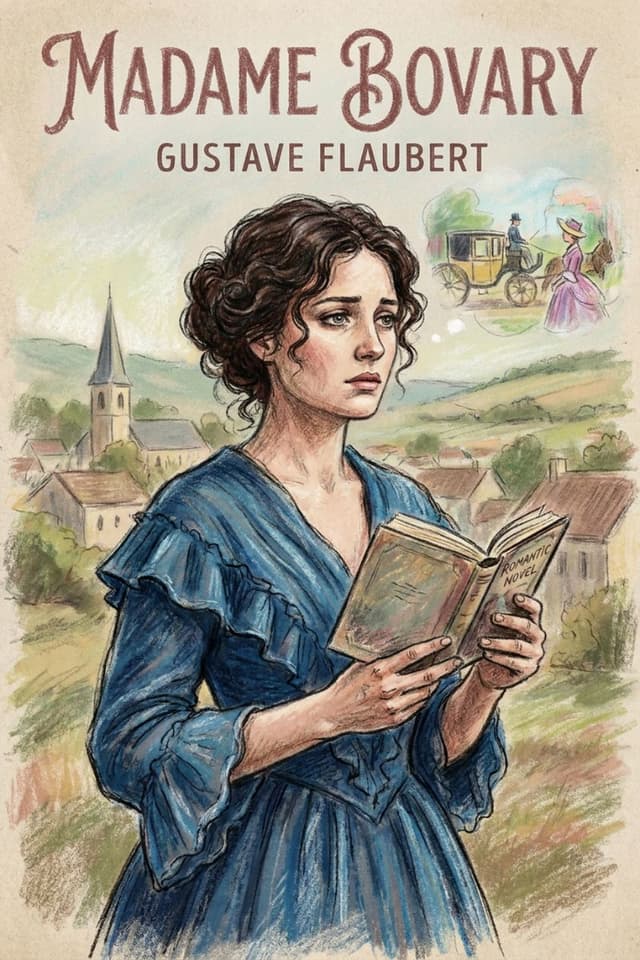
Madame Bovary
Read Madame Bovary by Gustave Flaubert for free on Novelhalla, and try out our easy-to-read modern edition of this classic book. You can also download the EPUB and read it on any device if you prefer!
The Plot
A Country Doctor's Wife
Emma Rouault grows up on a farm, educated at a convent where she devours romantic novels and dreams of passion, luxury, and a life that shimmers with meaning. When Charles Bovary, a plodding but kind country doctor, comes to set her father's broken leg, she sees a way out. He sees a beautiful woman. They marry.
It takes almost no time for Emma to realize the mistake.
Charles adores her. He is also spectacularly boring. He chews loudly at dinner. He has no ambition. His conversation is flat. Their house in the village of Tostes is small and dull, and the days repeat themselves with a sameness that makes Emma want to scream. She had imagined marriage as the beginning of everything. Instead, it feels like the end.
Then an invitation arrives to a ball at a grand estate, and for one glittering evening, Emma tastes the life she believes she was meant for. Candlelight. Champagne. Elegant men. The memory of that single night will poison every ordinary day that follows.
Yonville
Charles, worried about Emma's declining health and deepening unhappiness, moves the family to a new town. Yonville-l'Abbaye. A fresh start. Emma is pregnant, and there is hope that everything might improve.
It doesn't.
In Yonville, Emma meets two men who will change everything. The first is Leon, a young law clerk who shares her love of music, literature, and yearning for something more. They circle each other with a mutual attraction neither will admit to. The second is Homais, the town pharmacist, a blowhard and social climber who represents everything tedious about provincial life.
Emma gives birth to a daughter. She had wanted a son. A son, she thinks, could at least be free. A daughter will be trapped in the same way she is.
The Affairs
Then comes Rodolphe. He is wealthy, handsome, experienced, and he recognizes Emma immediately for what she is: a bored wife ripe for seduction. He pursues her at an agricultural fair, whispering declarations of love while a bureaucrat drones on about livestock in the background. It is one of the most brilliantly constructed scenes in all of fiction, and it is devastating, because the reader can see what Emma cannot. Rodolphe has done this before.
Emma throws herself into the affair with the desperation of someone who has been drowning and finally found air. She is alive again. She is romantic. She is reckless. She buys gifts, makes plans, begs Rodolphe to run away with her, to take her somewhere, anywhere.
Rodolphe's response to this will break your heart, whether you love Emma or want to shake her.
The Spiral
What happens next is not a single catastrophe but a slow tightening. Emma's desires keep escalating. The gap between what she wants and what she has grows wider. Leon reappears in her life, now a young man in Rouen, and what was once a shy almost-romance becomes something else entirely.
Meanwhile, a merchant named Lheureux has noticed Emma's weakness for beautiful things. He extends credit. He is generous. He is patient. He is also the most dangerous person in the novel, and he operates with a quiet precision that makes Rodolphe look like an amateur.
The debts pile up. The lies multiply. Emma moves between lovers and creditors and the husband who suspects nothing, spinning faster and faster, and the reader watches with the sick certainty that this cannot hold.
The Reckoning
There comes a point where all of Emma's escapes close at once. Every door she tries is locked. Every person she turns to for help reveals exactly how much she is worth to them.
The final act of this novel hits like a train. Not because it's melodramatic, but because Flaubert has built it with such patience and precision that when everything collapses, it feels both shocking and inevitable. And the last pages, which extend beyond where you'd expect the story to end, are among the most quietly brutal in literature.
About the Author: Gustave Flaubert
Early Life
Gustave Flaubert was born in 1821 in Rouen, France. His father was the chief surgeon at the city hospital, and the family lived on the hospital grounds. Young Gustave grew up with the amphitheater of human suffering literally visible from his garden. He later recalled watching dissections from behind the trellis with his sister as a child, while flies buzzed between the flowers and the corpses.
He was writing stories by his early teens and already hated school, getting himself expelled at one point for organizing a petition against a punishment he considered unjust. At fifteen, he fell hopelessly in love with a married older woman he met at the beach. He never really got over it.
The Hermit of Croisset
Sent to Paris to study law, Flaubert was miserable. Then in 1844, he suffered a severe nervous collapse, likely epilepsy, and seized upon it as his escape. He abandoned law, returned to Normandy, and settled at the family estate at Croisset, where he would spend most of the rest of his life writing.
His father and beloved sister died within months of each other in 1846, leaving him alone with his grieving mother and his infant niece to raise. He had a stormy love affair with the poet Louise Colet, conducted mostly through letters, because Flaubert generally preferred the idea of people to their actual company.
He traveled to Egypt and the Middle East with his friend Maxime Du Camp, contracted syphilis, collected experiences, and returned home to begin the five-year ordeal of writing Madame Bovary.
The Writing Life
Flaubert was a perfectionist of almost pathological intensity. He would spend days on a single page, sometimes weeks. He read every sentence aloud in what he called his "shouting room," testing the rhythm and sound. He searched obsessively for what he called "le mot juste," the exact right word, and accepted no substitutes.
He wrote to Louise Colet during the composition of Madame Bovary: "Last week I spent five days on one page." He once described writing as something atrociously delicious, a torment he could not imagine living without.
Later Years and Death
After Madame Bovary, Flaubert published Salammbo, a sprawling historical novel set in ancient Carthage, then Sentimental Education, and the short story collection Three Tales. He worked on each with the same grinding perfectionism.
His later life was marked by loneliness and loss. Prussian soldiers occupied his home during the Franco-Prussian War. His mother died in 1872. His niece's husband's business failures dragged him into financial ruin. His health deteriorated from the venereal diseases he had carried for decades.
He died of a cerebral hemorrhage on May 8, 1880, at the age of fifty-eight. He had been working on Bouvard and Pecuchet, an unfinished satire on the futility of human knowledge. He was buried in the family vault in Rouen.
Fun Facts About the Book
The Obscenity Trial
When Madame Bovary was serialized in 1856, French prosecutors charged Flaubert with offending public morals. The novel's frank depiction of adultery and its refusal to moralize about Emma's behavior were considered scandalous. Flaubert was acquitted in February 1857, and the publicity from the trial turned the novel into a bestseller when it was published in book form two months later. The government's attempt to suppress the book did more to promote it than any advertisement could have.
Five Years, One Novel
Flaubert began writing Madame Bovary in 1851 and didn't finish until 1856. He wrote over 4,400 pages of drafts and kept fewer than 500 in the final version. For a novel about the boredom of provincial life, it required a staggering amount of labor.
"Madame Bovary, C'est Moi"
Flaubert supposedly said "Madame Bovary is me," a quote so famous it's become almost a cliché. But the accuracy is disputed, and in his letters he actively distanced himself from the novel, writing to one friend that everything he loved was absent from it. The quote likely speaks to a shared sensibility rather than shared biography. Like Emma, Flaubert was a romantic temperament trapped in a world that disappointed him. Unlike Emma, he had writing.
Based on a True Story (Maybe)
The novel may have been inspired by the story of Delphine Delamare, the young wife of a country doctor named Eugene Delamare, who ran up enormous debts, took lovers, and died young. The parallels are striking enough that locals reportedly recognized the story. Flaubert always denied any real-life inspiration.
The Agricultural Fair
The scene where Rodolphe seduces Emma at the agricultural fair, cutting between his romantic whispers and a government official's speech about livestock and manure, is considered one of the greatest set pieces in fiction. Flaubert interweaves the two voices so that each makes the other absurd. It took him months to write.
The Magazine Censored It
Even before the trial, the editors of La Revue de Paris cut passages they considered too racy. Flaubert was furious and insisted on a disclaimer noting that the text had been published against his wishes. This editorial meddling may have actually contributed to the prosecution, since the censored gaps made the remaining content seem more provocative.
Themes
The Danger of Fantasy
Emma's tragedy begins with books. She grows up reading romantic novels that fill her head with visions of passion and grandeur that real life can never match. Flaubert isn't mocking reading itself. He's showing what happens when fantasy becomes a substitute for reality rather than a complement to it. Emma doesn't just want love. She wants love as described in the novels. The real thing, in all its imperfection, will never be enough.
The Prison of Provincial Life
Yonville is a cage. The same faces, the same conversations, the same pharmacist holding forth about the same topics. For Emma, provincial life isn't just boring. It's a kind of death. Flaubert renders the suffocating sameness of small-town existence with such precision that the reader understands, viscerally, why Emma is desperate to escape, even as they can see her methods of escape are destroying her.
The Exploitation of Desire
Everyone around Emma profits from her unhappiness. Rodolphe exploits her romantic hunger. Lheureux exploits her material hunger. Even the Church offers only platitudes when she reaches out for spiritual help. The novel is merciless about how systems and individuals feed on vulnerability, particularly the vulnerability of women with no economic independence and no socially acceptable outlet for their intelligence or ambition.
The Failure of Language
Flaubert was obsessed with the gap between words and meaning. Rodolphe speaks the language of love, but it's hollow. Emma uses the same romantic vocabulary she learned from novels, but it can't capture what she actually feels. Charles loves Emma with total sincerity and can barely articulate it. The novel suggests that the words we use to describe our deepest experiences are hopelessly worn out, borrowed from other people's stories, never quite our own.
The Cost of Being a Woman
Emma has intelligence, passion, and ambition. In another life, with another set of options, she might have been remarkable. Instead, she is a doctor's wife in a provincial town. Her only avenues for self-expression are love affairs, shopping, and fantasy. The novel doesn't excuse her choices, but it makes devastatingly clear how few choices she actually has.
The Book's Legacy
Madame Bovary essentially invented the modern novel. Before Flaubert, novels told you what to think about their characters. Flaubert showed you the world through his characters' eyes and let you draw your own conclusions. His technique of matching prose style to a character's emotional state, making the language itself feel bored when Emma is bored and ecstatic when she is ecstatic, influenced virtually every serious novelist who came after him.
The novel has been adapted for film and television dozens of times, in multiple languages, from a 1949 Hollywood version starring Jennifer Jones to numerous French and international productions.
"Bovarysme," a term coined from the novel, entered the French language to describe a chronic dissatisfaction with reality and a tendency to escape into fantasy. It remains a useful word.
Writers from Henry James to Vladimir Nabokov to Julian Barnes have praised the novel in the most extravagant terms. Nabokov called Flaubert's prose poetry achieved through the medium of fiction. Barnes called it simply the best novel ever written.
What makes Madame Bovary endure isn't just its technical brilliance. It's that Emma Bovary herself remains so recognizable. Her hunger for a life that matches her imagination, her refusal to accept the ordinary, her terrible choices made from a desperate need to feel something, these are not nineteenth-century problems. They are permanent ones.