Novelhalla
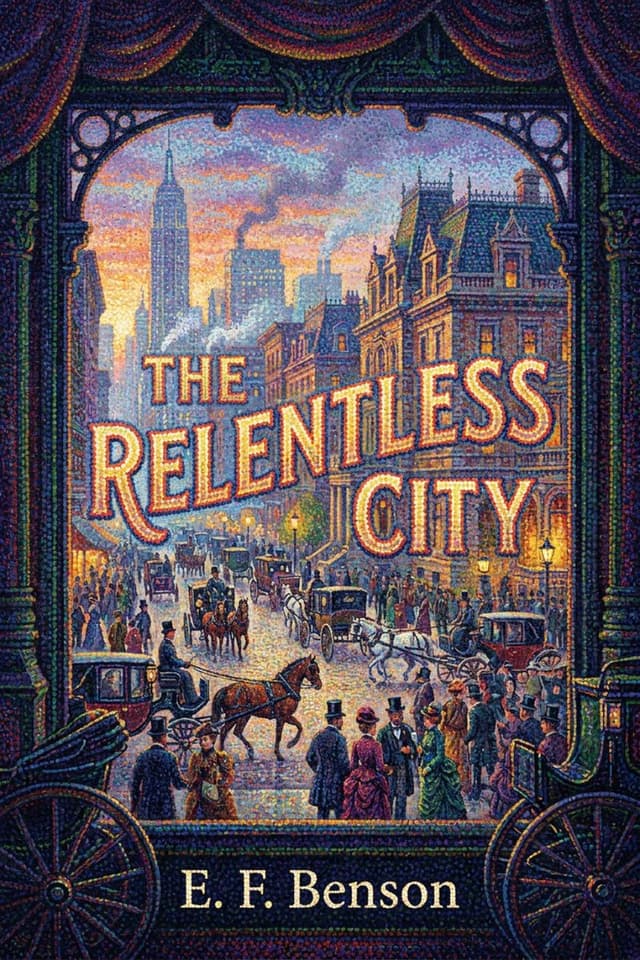
The Relentless City
Read The Relentless City by E. F. Benson for free on Novelhalla, and try out our easy-to-read modern edition of this classic book. You can also download the EPUB and read it on any device if you prefer!
The Plot
The Marquis's Son Has a Problem
Bertie Keynes is going to be a marquis one day. He's also going to inherit Molesworth, an enormous and beautiful estate that is mortgaged up to the hilt and has been let to strangers for years because his father can't afford to live in it. The family strategy, delivered to Bertie by his father with perfect calm and perfect logic, is this: royalty can't marry commoners, so royalty marries royalty. Bertie can't marry a poor woman, because if he does the whole thing goes smash. Therefore Bertie must go courting in the only class available to him, which means he's going to America in the autumn to find an extremely wealthy girl willing to marry him.
He says all this out loud, over whisky and soda at one in the morning, to his oldest friend Charlie Brancepeth. He doesn't pretend it's anything other than what it is. The Americans, he points out, know perfectly well why English peers keep turning up looking for wives. They just choose not to recognise it, the way you choose not to recognise a man you'd rather not meet. They look it in the face and cut it dead.
Charlie thinks the whole business is damnable, and says so. Bertie tells him he's old-fashioned. He is, and he knows it, and he's just been told the same thing by the woman he's in love with.
The Prettiest Widow in London
Sybil Massington is twenty-five, widowed two years, and privately certain that she hasn't got the faculty of falling in love. She tells her sister Judy, the wisest and ugliest spinster in London, exactly why she believes that, in a confession she has never made to anyone, and it's a genuinely chilling little scene dropped into the middle of a comedy.
Charlie Brancepeth has asked her to marry him, and she has turned him down, and he's asked one last time, and she's turned him down again. She likes him enormously. That, she says, is precisely the problem.
So Sybil is going to America too. Not to be sold, exactly. Because she likes rich people, and she likes energy, and she wants to see the thing everyone keeps telling her is the future. Judy, who sees through her completely and adores her anyway, points out that she's going in order to meet people who are rich. Sybil sees no reason why not.
The Steam Siren
Both of them are going as guests of Mrs. Lewis S. Palmer, who has spent the London season being the loudest phenomenon in it. She wears what appears at a distance to be a garment made entirely of diamonds. She talks without pausing to breathe. Her laugh has been mistaken, at a hundred yards, for a peacock announcing rain, and her scream of delight starts somewhere around the note an express train uses going through a station and climbs from there.
She is also, and Benson is scrupulous about this, immensely kind. Her generosity is real, her heart is good, and she has not the faintest idea that such a thing as culture exists. Charlie, watching her, thinks that if this is the barbarian invasion, then England has fallen into the hands of remarkably pleasant enemies.
Her husband is the point. Lewis S. Palmer began as a railway porter. He is now railways, and steamships, and anything else he chooses to put his hand on and call his own. And in the middle of the vast gaudy chateau he has paid for on Long Island there's a small green baize door under the stairs with three brass initials on it, opening on a bare room with a drugget floor, an almanac, a glass of milk, and a telegraph key ticking in the next room. He sits in there and moves the money of a continent around on scraps of paper three inches by one, while his wife spends it on the most extraordinary parties the world has ever seen.
Benson lets you look at him once, through his eyes, and the whole gilded house outside the baize door suddenly looks like a tie pin.
Two Loose Ends Crossing the Atlantic
Bertie has one complication, and Charlie names it for him before either of them leaves London.
Two years ago Bertie was madly in love with Dorothy Emsworth, an actress, and wrote her a letter of illimitable adoration at exactly the moment she stopped being interested in him. She told him she'd burned it. She hadn't. It was too funny to burn.
Mrs. Emsworth is now opening in New York, brought over by an impresario named Bilton who owns three theatres there, and she is coming down to stay at the Palmers' place on Long Island, and she is enormously interested to learn that Bertie has arrived in America to get married. She says she doesn't mean a word of it. She likes teasing him. She likes the way he wrinkles his forehead.
The second complication has no idea it is one. Bilton is a hard, quick, entirely amoral man of business who never stops moving because stopping means being left behind. Sybil met him once in London and found him fascinating, partly because of the force in him and partly because of something odder: he is the absolute physical double of Charlie Brancepeth. Same height, same face, same unhurried way of moving. Only, as she puts it, Bilton gets there.
And in a room in Twenty-sixth Street, alone, waiting, Bilton happens to glance into a grate and finds a letter torn once in half.
The Relentless City
What Sybil and Bertie walk into is New York in a September heat wave, which Benson describes with something close to awe: the elevated trains roaring overhead, the streets torn up for a new tunnel, half a block of building vanishing overnight to make room for something taller, millionaires and milliners stewing side by side in the same cars because there's no first class on anything, a man shoving past you without apology because feeling aggrieved wastes time and apologising wastes energy. Nobody stops. Nobody can stop. Tomorrow everyone will be a little richer than today, and that is the whole business and duty of every person in the street.
Then the train to Long Island and Mrs. Palmer's, where the trees have been felled and the roots dynamited for a quarter mile in every direction to make room for a stone chateau with a theatre and a swimming bath grafted onto it, an Italian terrace shipped over whole from a needy palace, and a bicycle track around the edge where Lewis S. Palmer rides his ten miles a day with black hatred in his heart at the waste of time.
Her last party involved fifty guests eating dinner on horseback in a new stable. The one before that turned her ballroom into a dairy. The one coming up next week is a secret so closely held that the workmen wading about in the lagoon below the house have been threatened with the loss of the contract if a word reaches the papers, and the yachts of her dearest friends cruise past with opera glasses trained on the shore, and nobody can work out what on earth she's building.
Bertie is here to find a rich girl. Sybil is here to be delighted by everything. Charlie is three thousand miles away, waiting, having promised to leave the door open. Bilton has a torn letter in his pocket and a very clear idea of what he wants next. And somewhere in the ledgers, an old and beautiful English estate is quietly becoming interesting to people who have noticed that there's coal underneath it.
Ginger, Bertie's younger brother, gave them all fair warning on a Sunday afternoon in Hampshire, lying on the grass with a hat over his eyes. Go to America, he said, and you'll get what you want faster than you'd get it anywhere else on earth, and you'll come back cast iron. Everything that used to be a pleasure will be a business. You'll never sit still again.
Sybil laughed and said she'd come back exactly as she went.
About the Author: E. F. Benson
A Very Strange Family
Edward Frederic Benson was born in July 1867 at Wellington College in Berkshire, where his father was the headmaster. That father, Edward White Benson, went on to become Bishop of Truro and then Archbishop of Canterbury, which meant Fred spent part of his youth living at Lambeth Palace.
The children were extraordinary and the household was not a happy one. His elder brother Arthur wrote the words to "Land of Hope and Glory." His younger brother Hugh converted to Catholicism, became a priest, and wrote bestselling novels of his own. His sister Margaret was a pioneering Egyptologist. Not one of the six Benson children ever had a child. Their mother, a formidably intelligent woman who had been thoroughly subdued by her husband, moved in with a female companion after his death and appears by all accounts to have been considerably happier.
Archaeology, Then Fame
Fred went to Marlborough and then King's College, Cambridge, took firsts in both parts of the classical tripos, and went off to dig. He worked for the British School of Archaeology in Athens and then in Egypt, and expected that to be his life.
Then in 1893 he published Dodo, a satire of high society built around a brilliant, amoral, wildly charming woman, and it went off like a bomb. London spent months deciding which real society hostess she was based on. The book made him famous and financially independent at twenty-six, and from that point he published roughly a book a year until the day he died, well over a hundred of them in total: novels, satires, biographies, histories, memoirs, and ghost stories.
Rye
In 1918 he moved to Rye in East Sussex and eventually took over Lamb House, which had been Henry James's home. He served three terms as mayor of the town in the 1930s, was made a Freeman of it, paid for the restoration of the church organ, and gave the town a viewing platform over the marshes.
Rye also became Tilling, the setting of the Mapp and Lucia novels he wrote in his fifties and sixties, which are the books most people know him for now: a merciless, affectionate, endlessly quotable comedy about small-town social warfare that has never gone out of print and has been adapted for television twice.
The End
He was diagnosed with throat cancer after his last term as mayor. He finished his autobiography, sent the manuscript to his publisher, and died ten days later in a London hospital in February 1940. He was buried in Rye after a civic funeral.
Fun Facts About the Book
The Horseback Dinner Really Happened
In the novel, a young millionaire named Reginald Armstrong describes throwing a party where fifty guests ate dinner on horseback in his new stable, with tables fitted to the horses' shoulders and the animals eating out of a circular manger in the middle.
On 28 March 1903, months before this book was published, the American millionaire C. K. G. Billings threw a dinner on horseback to celebrate his new trotting stable. It ended up in the ballroom at Sherry's on Fifth Avenue, with turf laid on the floor, thirty-odd horses brought up in the freight elevator, dining trays strapped to the saddles, and champagne drunk through tubes from iced bottles in the saddlebags. It cost fifty thousand dollars and was photographed, and the photographs went everywhere.
Benson set his own party scene at Sherry's too. He was not exaggerating. He was reading the newspapers.
The Dog's Funeral
A guest mentions, in passing, that Mrs. Palmer spent nearly thirty thousand dollars on a funeral for her dog. That number lands as absurdist comedy, and it's the kind of thing Newport society was actually doing, right down to the celebrated dinner parties thrown in honour of people's pets.
It Sits Between His Two Famous Things
Published in 1903, this comes a decade after the sensation of Dodo and two decades before Lucia. You can see both in it: the scalpel work on a social set, and the beginnings of the comic voice that would eventually produce Tilling. Readers who only know the Mapp and Lucia books are usually surprised by how sharp and how bleak this one can turn.
He Knew That Hillside
The English chapters unfold on the lawn of a house on the hills above Winchester, looking down over the water meadows of the Itchen. Benson had lived in Winchester with his mother and sister after his father's death. The loving precision of that landscape, right down to the hollyhocks and the church bell coming up through the heat haze, is not invention.
His Father Gave Henry James a Ghost Story
Archbishop Benson once told Henry James a half-remembered tale about the ghosts of dead servants corrupting the children of a household. James wrote it down and turned it into The Turn of the Screw. Years later, Fred Benson moved into James's house in Rye and lived there for the rest of his life.
The Critics Thought He Was Using a Shaving Mirror
The Spectator reviewed the book in October 1903 and complained, in an image too good not to repeat, that Benson holds a mirror up to society but that the mirror in question is the magnifying kind men shave in. The reviewer's real objection was that Benson had looked at one tiny set of American multimillionaires and written as though he'd seen the whole country.
He Also Wrote Some of the Best Ghost Stories in English
The same man produced "The Room in the Tower," "Caterpillars," and "Negotium Perambulans," which turn up in horror anthologies to this day. Satire, social comedy, biography, archaeology, and genuine nightmare fuel, all from one person, at a rate of about a book a year for forty-seven years.
Themes
The Marriage Market, Named Out Loud
The transatlantic trade in coronets for cash is the engine of the plot, and what makes the book bracing is that nobody in it pretends otherwise. Bertie's father sets it out as a simple problem in supply and demand: America has more money than it knows what to do with, England has discovered that titles are worth nothing at home, so the titles go abroad for distribution. Charlie's response is to ask what the price list looks like. Marquises come rather high.
Utility Against Beauty
The novel keeps staging the same quiet war. Water meadows that could be running dynamos. Elms that could be faggots. An estate that's worth more for what's under it than for what's on it. A branch-line engine labours up a hill outside a beautiful garden and Sybil hears it saying brutality, brutality all the way up. Benson doesn't pretend the useful side is wrong. He just keeps showing you what it costs.
Energy as a Virtue and a Disease
Nobody in the American chapters can stop, and the book takes that seriously rather than just laughing at it. Mrs. Palmer works at being gay exactly as hard as her husband works at being rich, and neither of them enjoys it, and neither of them can sit still. Against this, Ginger offers the English counter-proposal, which is that the power of doing nothing at all may be the last valuable thing his country has left. The book never quite decides which of them is right.
Not Inferior, Just Different
Bertie eventually says out loud that American culture isn't beneath English culture, only unlike it. Whether the rest of the novel earns that line is something readers still argue about, because the comic energy is overwhelmingly on the side of laughing at Mrs. Palmer's dairy ballroom. What's undeniable is that Benson keeps giving his Americans the thing his English characters conspicuously lack: kindness that costs something, offered without being asked for.
Not Being Able to Love
Running under the satire is a much colder book about people who are charming, self-aware, thoroughly likeable, and unable to feel what they're supposed to feel. Sybil has diagnosed it in herself and refuses to lie about it. Bilton has watched his own capacity for passion cool over two years and is cynically amused by it. Mrs. Emsworth is the only one who seems to be in actual pain, and she covers it by being funny.
The Double
The physical resemblance between Charlie and Bilton is not a coincidence Benson mentions once and forgets. It's a thesis. Two men with the same face, one of whom waits and one of whom takes, and the reader is invited to work out what the difference is actually made of.
Historical Context
Coronets for Dollars
Between about 1870 and 1914, several hundred American heiresses married into the British aristocracy, and the transaction was understood on both sides. Consuelo Vanderbilt's marriage to the Duke of Marlborough in 1895 came with a settlement that saved Blenheim. Jennie Jerome's money went into the Churchill family. Meanwhile, British agriculture had been in a long depression since the 1870s as cheap grain arrived from America, land rents collapsed, and a whole class of families discovered that their vast estates had become liabilities. Benson's readers in 1903 would have recognised Bertie's situation instantly, and known several real families in it.
The Age of the Party
The American scenes exaggerate very little. This is the era of the Bradley Martin ball that cost a reported fortune and drew such public anger that the hosts left the country, of monkey dinners and dog dinners at Newport, of society figures competing to invent the one entertainment nobody could top. The public read about it obsessively in the same newspapers that Benson was reading in London.
The Book's Legacy
This isn't the Benson people quote. Lucia took that job, and the ghost stories took the rest. But the novel has had a long second life as one of the sharpest outside looks at Gilded Age America written while the Gilded Age was still going on, sitting on a shelf alongside Wharton and James and coming at the same material from a wholly different angle: not from inside the New York drawing rooms, but from the point of view of the English visitors who were arriving with their titles polished and a price in mind.
It also captures something about 1903 that turned out to be exactly right. The book's argument is that the centre of gravity of the world has moved west, that England has had its turn in the way Rome had its turn, and that whatever replaces it will be faster, richer, uglier, kinder in some ways and colder in others, and completely unstoppable. Benson wrote that eleven years before the war that proved it.
And underneath the jokes there's a much harder novel than the cover promises. The comedy is genuinely funny. The parties are absurd. The ending is not.