Novelhalla
The Iron Heel
Read The Iron Heel by Jack London for free on Novelhalla, and try out our easy-to-read modern edition of this classic book. You can also download the EPUB and read it on any device if you prefer!
The Plot
A Voice from the Future
The story reaches us through an unusual frame. A scholar named Anthony Meredith, writing from around the year 2600 AD in an era called the Brotherhood of Man, has discovered a manuscript hidden for seven centuries. The document was written by a woman named Avis Everhard, and it chronicles the turbulent years between 1912 and 1932 when America transformed into something unrecognizable.
Meredith's footnotes throughout the text offer commentary from his utopian future, adding layers of meaning and dramatic irony as Avis tells her story from the inside.
Avis and Ernest
Avis Cunningham is the daughter of a respected university professor in Berkeley, California. Her comfortable middle-class life is upended when she meets Ernest Everhard, a self-educated blacksmith turned intellectual revolutionary. At first, she finds him rough and unsettling. He shows up at her father's dinner parties and systematically demolishes the arguments of ministers, businessmen, and academics alike.
But Ernest backs his provocations with evidence. When Avis investigates a case he mentions about a factory worker named Jackson who lost his arm in a mill accident and was abandoned by the company, she discovers a system designed to crush working people while protecting the wealthy. Her investigation leads nowhere because lawyers, newspapers, and institutions all close ranks to protect corporate interests.
Avis falls in love with Ernest and his cause. She converts to socialism. They marry. Her father, convinced by the evidence his daughter uncovers, joins them.
The Oligarchy Rises
Ernest sees what others refuse to acknowledge. The great trusts and monopolies are consolidating power. Small businesses are being squeezed out. The middle class is sinking into poverty while a tiny plutocracy accumulates unprecedented wealth.
He predicts that when the socialist movement grows strong enough to threaten real change, the ruling class will not simply allow itself to be voted out of power. They will fight back with everything they have.
Ernest is elected to Congress along with other socialists. For a moment, hope seems possible. Workers organize. An international general strike shakes the foundations of capitalism.
But Ernest is right about the backlash. The Oligarchy, as Avis calls it, deploys a brutal counterattack. They bribe labor leaders. They create a privileged caste of workers in essential industries like steel and rail, giving them decent wages and turning them against their fellow workers. They form a private army called the Mercenaries, soldiers who answer to wealth rather than to the people.
The Iron Heel Descends
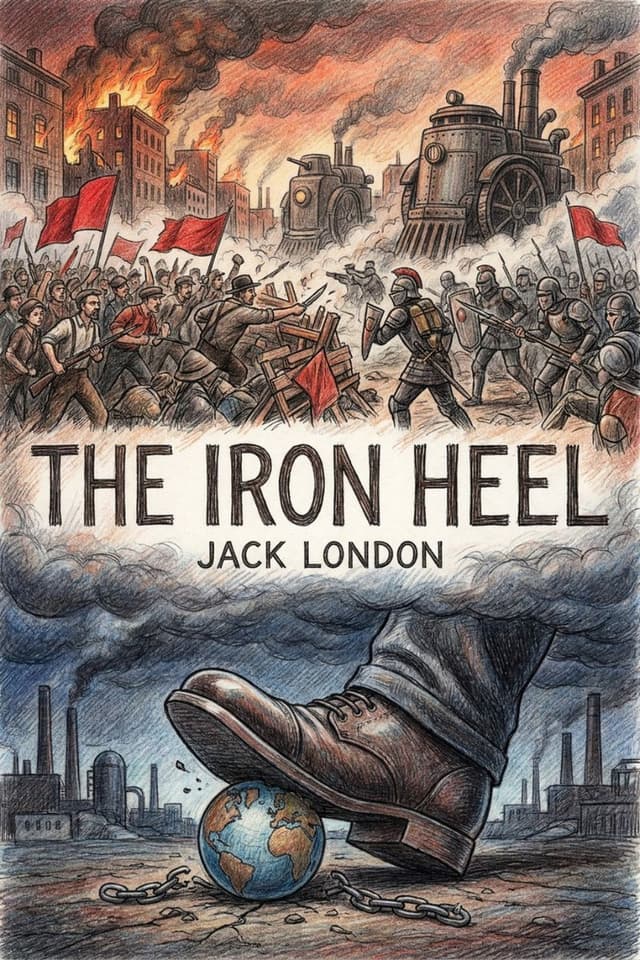
The name comes from a confrontation early in the story. When Ernest warns a group of businessmen about the coming conflict, one of them snarls that the capitalists will grind the revolutionaries down under their heel and walk upon their faces. Ernest responds that this will be the perfect name for their despotism.
The Iron Heel moves systematically to crush all opposition. Socialist congressmen are imprisoned on false charges. Ernest himself is framed for a terrorist bombing. Newspapers that tell the truth are shut down. Books disappear. Bishop Morehouse, a clergyman who begins preaching about social justice after witnessing poverty firsthand, is declared insane and committed to an asylum.
Avis's father loses his university position. His published work vanishes from stores. The family is reduced to living in four cramped rooms in a San Francisco slum.
Underground
Ernest and other leaders are eventually freed from prison through an elaborate scheme involving socialist agents who have infiltrated the Iron Heel's own organizations. He and Avis go into hiding, living under false identities, working as secret agents within the system they are trying to destroy.
They spend years preparing for what they call the Second Revolt, building networks, gathering intelligence, and waiting for the moment to strike back against the Oligarchy.
Avis writes with complete faith that the revolution will succeed. She believes that the forces of justice and equality will triumph. But Anthony Meredith's footnotes from the distant future hint at a more complicated story, one that will take far longer to unfold than Avis could possibly imagine.
About the Author: Jack London
From Poverty to Fame
Jack London was born in San Francisco in 1876 into circumstances that would shape everything he wrote. His mother, Flora Wellman, was unmarried, and his biological father, an astrologer named William Chaney, abandoned the family before Jack was born. Flora soon married John London, a Civil War veteran, and Jack took his stepfather's name.
The family was poor. By age ten, Jack was selling newspapers on the streets of Oakland. By fifteen, he was working in a cannery, sometimes putting in eighteen-hour shifts. He became an oyster pirate in San Francisco Bay, then joined the other side and worked for the fish patrol. At seventeen, he shipped out on a sealing schooner bound for Japan.
The Education of an Outlaw
London's formal schooling was minimal, but he educated himself ferociously at the Oakland Public Library. He read voraciously, everything from Darwin and Marx to Nietzsche and Kipling. A thirty-day stint in jail for vagrancy during the economic depression of 1894 radicalized him. He saw how the system treated those at the bottom and never forgot it.
He joined the Socialist Labor Party in 1896 and became known as the "Boy Socialist of Oakland," giving speeches on street corners. He briefly attended the University of California at Berkeley but dropped out to seek his fortune in the Klondike Gold Rush of 1897. He found no gold but gathered the experiences that would make him famous.
A Literary Meteor
London's breakthrough came quickly once he committed to writing. His Klondike stories began appearing in magazines, and his first book, The Son of the Wolf, was published in 1900. By 1903, when The Call of the Wild appeared, he was an international celebrity, the highest-paid author in America.
He wrote at a furious pace, producing over fifty books in sixteen years. The Sea-Wolf, White Fang, Martin Eden, and John Barleycorn followed in rapid succession. He also worked as a journalist, covering the Russo-Japanese War and writing about poverty in the slums of London's East End.
London married twice, first to Bess Maddern, with whom he had two daughters, then to Charmian Kittredge, his intellectual partner and adventuring companion. Together they sailed the South Pacific on a yacht called the Snark and built a grand ranch in Sonoma County, California, where London dreamed of practicing scientific agriculture.
The Final Years
London's health deteriorated badly in his final years. He suffered from kidney disease and used morphine to manage the pain. On November 22, 1916, he died at his ranch in Glen Ellen. He was forty years old.
His death certificate listed uremia from kidney failure as the cause. Some biographers have speculated about suicide, but the evidence remains inconclusive. What is certain is that he burned out fast, living with an intensity that matched his famous declaration: "I would rather be ashes than dust."
Fun Facts About the Book
The First Modern Dystopia
The Iron Heel is widely considered the first modern dystopian novel. Published in 1908, it predates Yevgeny Zamyatin's We by more than a decade and Aldous Huxley's Brave New World by nearly a quarter century. The structural innovations London pioneered, particularly the found manuscript with scholarly annotations from a future society, would be adopted by George Orwell in 1984 and Margaret Atwood in The Handmaid's Tale.
Trotsky's Astonishment
In 1937, Jack London's daughter Joan sent a copy of the novel to Leon Trotsky, then living in exile in Mexico. Trotsky was stunned by what he read. He wrote that London had described "precisely the picture of fascism, of its economy, of its governmental technique, its political psychology" decades before fascism actually emerged. He praised London's vision as surpassing that of the leading socialist thinkers of his time.
Orwell's Tribute
George Orwell called The Iron Heel "a very remarkable prophecy of the rise of Fascism" and praised London as "a better prophet than many better-informed and more logical thinkers." Orwell attributed London's foresight to "the streak of brutality which he had in himself." Having grown up fighting for survival, London understood that the ruling class would not surrender power peacefully.
The Prophetic Details
London predicted with eerie accuracy many features of twentieth-century totalitarianism: the use of agents provocateurs, false flag terrorist attacks to justify repression, the co-opting of labor leaders, the creation of privileged worker castes to divide the working class, mass surveillance, censorship, and the imprisonment of political opponents on fabricated charges. He even anticipated something like the Reichstag fire decades before it happened.
A Personal Manifesto
London drew heavily on his own experiences for the novel. The character of Ernest Everhard is widely seen as an idealized self-portrait, embodying London's vision of the perfect socialist revolutionary. Avis Everhard's adoring portrayal of her husband closely mirrors Charmian London's devotion to Jack.
The Russian Connection
The novel has had particular resonance in Russia. It was adapted into a Soviet film in 1919, immediately after the October Revolution, and again in 1999 when a new class of oligarchs had come to dominate post-Soviet Russia. The timing of both adaptations speaks to the novel's ongoing relevance to questions of wealth, power, and revolution.
Plagiarism Controversy
Portions of Chapter 7 are almost verbatim copies of an ironic essay by journalist Frank Harris. London's publisher suggested only one deletion before publication: a footnote deemed libelous. The book's blend of fiction, polemic, and borrowed material reflects London's urgency to get his political message across by any means necessary.
Themes
The Consolidation of Power
The novel's central warning is about what happens when wealth concentrates in too few hands. London depicts a world where the top fraction of one percent controls the majority of resources and uses that control to dominate politics, media, and the law. The middle class, believing itself secure, discovers too late that it has been systematically destroyed.
The Failure of Reform
London was skeptical of gradual reform and electoral politics as paths to real change. In the novel, even when socialists win elections and pass legislation, the Oligarchy simply ignores the laws, bribes officials, and uses violence when necessary. The message is that those with power will not give it up voluntarily.
The Betrayal of Labor
One of the novel's most striking predictions is the division of the working class against itself. The Iron Heel creates a labor aristocracy, workers in essential industries who receive privileges in exchange for their loyalty. These favored unions break solidarity with other workers and become enforcers of the system. London was warning his fellow socialists that working-class unity could not be taken for granted.
Violence and Counter-Violence
London does not flinch from depicting revolutionary violence. The novel includes graphic scenes of street fighting, assassinations, and mass casualties. But he frames this violence as a response to the far greater violence of the system itself, the daily grinding brutality of poverty, workplace injuries, and state repression.
The Long View of History
Through the framing device of Anthony Meredith's footnotes, London offers a perspective that extends centuries beyond the immediate struggle. This structure allows the novel to balance immediate tension with a broader meditation on historical change and the persistence of hope across generations.
Love in the Time of Revolution
Beneath the political arguments, the novel is also a love story. Avis and Ernest's relationship provides the emotional core, showing how personal devotion and political commitment can reinforce each other. Avis's transformation from comfortable daughter of privilege to underground revolutionary is driven as much by love as by ideology.
The Book's Legacy
The Iron Heel occupies a unique position in literary history. It was largely ignored or dismissed by mainstream critics when it appeared, and the reformist socialists of London's day considered it too pessimistic and violent. But history vindicated its warnings in ways that shocked even sympathetic readers.
The novel directly influenced the development of dystopian fiction as a genre. Its structural innovations, particularly the found manuscript with future annotations, became standard tools for writers imagining oppressive societies. The line runs clearly from London through Zamyatin to Orwell to Atwood.
Beyond literature, the book has served as a political text, read by activists and revolutionaries seeking to understand the mechanisms of oppression. Its analysis of how ruling classes maintain power, through division, co-optation, propaganda, and force, remains relevant to political movements around the world.
Modern readers often find the novel uncomfortably prescient. Its depiction of extreme wealth inequality, corporate control of politics, the erosion of democratic norms, and the potential for authoritarian backlash against progressive movements resonates with contemporary anxieties. What seemed like dark fantasy in 1908 can feel like documentary in the twenty-first century.
The Iron Heel is not London's most polished work. The characterization can be thin, the political arguments sometimes overwhelm the narrative, and Ernest Everhard's perfection strains credibility. But as a work of political imagination, as a warning about where unchecked power can lead, it remains essential reading, a book that sees further than its author could have known.