Novelhalla
The Female Quixote
Read The Female Quixote by Charlotte Lennox for free on Novelhalla, and try out our easy-to-read modern edition of this classic book. You can also download the EPUB and read it on any device if you prefer!
The Plot
A Girl Raised on Stories
Arabella is beautiful, intelligent, wealthy, and completely delusional.
Raised in a remote English castle by her widowed father, the Marquis, she has spent her entire young life devouring French romance novels. Epic tales of princesses courted for years by impossibly devoted suitors. Stories where love is the most powerful force in the universe, where heroes slay rivals and cross continents for a single glance from the woman they adore, where a lady's honor is worth dying for.
Arabella believes every word of it. Not as fiction. As history.
She is convinced that these romances are factual accounts of real events. And she fully expects her own life to follow the same pattern. She is, after all, a noblewoman of extraordinary beauty. Surely every man who sees her will fall desperately in love. Surely they will suffer, pine, and possibly die for her. Surely kidnapping attempts will come. That's just what happens to women like her.
The problem is that Arabella lives in 18th-century England, not a 17th-century French epic. And no one around her has read the script.
The Cousin
When her father dies, Arabella's world shifts. His will declares that she must marry her cousin, Mr. Glanville, or lose a significant portion of her estate. Glanville arrives, and he's actually a decent match. He's sensible, good-looking, and genuinely falls for Arabella almost immediately.
But Arabella is appalled. In her romances, a proper lover would never dare to kiss a lady's hand without years of devoted service first. Glanville greets her with a casual kiss on the cheek, as cousins do, and she is scandalized. He tries to have a normal conversation, and she reads it as either a shocking breach of decorum or a declaration of passion that must be punished with banishment.
Glanville is baffled. He loves her. She's brilliant when she talks about anything other than romance novels. But every interaction gets filtered through her fantasy world, and the results are increasingly chaotic.
Everyone Is in Love with Her (According to Her)
This is where the comedy catches fire. Arabella is convinced that every man she encounters has been struck by a violent passion for her. A stranger glances at her in church? He is dying of love and will certainly attempt to abduct her. A gardener lingers near her window? He must be a nobleman in disguise, driven mad by desire.
She commands men to live when they fall ill, fully believing their sickness is lovesickness caused by her beauty. She banishes suitors from her presence with grand speeches borrowed from her novels, leaving everyone around her bewildered. Her maidservant Lucy is expected to narrate Arabella's "adventures" in the elaborate style of a romance heroine's attendant, a task poor Lucy is spectacularly unqualified for.
Meanwhile, Glanville watches the woman he loves humiliate herself in front of his family and desperately tries to steer conversations away from dangerous territory. His sister Charlotte is jealous of Arabella's beauty but also genuinely horrified by her behavior. His father, Sir Charles, wonders openly if his nephew's intended bride has lost her mind entirely.
The Schemer
Then there's Sir George Bellmour. Unlike Glanville, who tries to gently nudge Arabella toward reality, Sir George realizes that her delusions are the key to her heart. He's after her fortune, and he knows exactly which buttons to push.
Sir George has actually read the same romances Arabella loves. He speaks to her in the flowery, grandiose language of those novels, and she is thrilled. Finally, someone who understands how the world truly works. He invents an elaborate fictional history for himself, full of star-crossed affairs and noble suffering, and Arabella swallows every word.
Glanville sees exactly what Sir George is doing. But how do you expose a liar to someone who can't tell the difference between fiction and reality in the first place?
Bath, London, and Escalation
The action moves from the countryside to Bath, where Arabella's peculiar behavior collides with fashionable society. She shows up dressed in a style decades out of fashion, insists on being treated like a romance heroine, and assumes every man in the assembly rooms is there because of her. Some people are charmed. Others think she's insane. Mr. Tinsel, a man she's certain adores her, actually believes she belongs in an asylum.
In London and its surroundings, things get worse. Arabella encounters a weeping woman who claims to be a princess searching for her lost lover. It's the kind of story Arabella has been waiting her whole life to hear. She throws herself into the drama with absolute conviction.
But the real world has consequences that romance novels don't. Arabella's delusions are no longer just embarrassing. They're becoming dangerous. And the distance between the stories in her head and the ground beneath her feet is narrowing in ways that threaten to hurt her badly.
Whether she can survive the collision between her beautiful fantasy and unforgiving reality is a question the book isn't willing to answer easily.
About the Author: Charlotte Lennox
A Transatlantic Childhood
Charlotte Lennox was born Barbara Charlotte Ramsay around 1729 or 1730, most likely in Gibraltar, where her father was a captain in the British Army. She spent her earliest years in England before the family moved to Albany, New York, when her father received a military posting there in 1738. The colonial landscape and its people made a lasting impression on her, shaping both her first and last novels.
Her father died around 1742, and the teenaged Charlotte was sent back to England alone to live with relatives. The arrangement fell apart almost immediately, and she found herself without reliable support in London, dependent on the kindness of aristocratic patrons.
Actress, Poet, Novelist
Lennox tried acting first, performing at Drury Lane and the Haymarket Theatre with limited success. She published her first poetry collection at around seventeen and married Alexander Lennox in 1747, a union that proved unhappy. Her husband's only known employment was a minor customs post, reportedly obtained as a reward for his wife's literary reputation.
She turned to writing in earnest, publishing her first novel in 1750. Samuel Johnson, the most influential literary figure of the age, adored her. He threw a legendary party to celebrate the book, complete with a laurel wreath and an apple pie stuck with bay leaves. Johnson considered her superior to his other celebrated female literary friends, including Frances Burney and Hannah More.
The Female Quixote appeared in 1752 and was an immediate success, praised by Johnson, Henry Fielding, and Samuel Richardson. It established Lennox as one of the leading novelists of her generation.
A Career Beyond One Novel
Lennox was far more than a one-book author. She published Shakespear Illustrated in 1753, one of the earliest critical studies of Shakespeare's source material, in which she boldly argued that Shakespeare had botched many of the stories he borrowed. She edited a women's magazine called The Lady's Museum, which she filled with literature, botany, history, and theology, calling it "a course in female education." She translated works from French, wrote plays, and pioneered the serialization of novels in magazines.
Final Years
Despite a prolific career spanning over forty years, Lennox never achieved financial stability. She separated from her husband in the early 1790s. Her daughter died young. Her son emigrated to America. She spent her final years in poverty, dependent on small grants from the Royal Literary Fund. She died on January 4, 1804, in Westminster and was buried in an unmarked grave.
The woman Samuel Johnson once crowned with laurels, whose novel had been ranked alongside Clarissa and Tom Jones, left no monument behind. Her rediscovery would take nearly two centuries.
Fun Facts About the Book
The Don Quixote Connection
The title makes the debt explicit. Just as Cervantes's Don Quixote is driven mad by reading chivalric romances and goes out to live as a knight-errant, Arabella is driven to absurdity by reading French heroic romances and tries to live as their heroine. But Lennox made a crucial change: her Quixote is a young woman, and her madness isn't about swords and windmills. It's about love, courtship, and the rules of desire.
Samuel Johnson's Fingerprints
There's a longstanding debate about whether Samuel Johnson wrote the novel's final chapter. The style shifts noticeably, becoming more philosophical and Johnsonian in its phrasing. Some scholars are convinced it's his work. Others argue the evidence is purely subjective. Johnson definitely wrote the book's dedication, and he promoted the novel energetically. Either way, his involvement adds a fascinating layer to the text.
Jane Austen's Blueprint
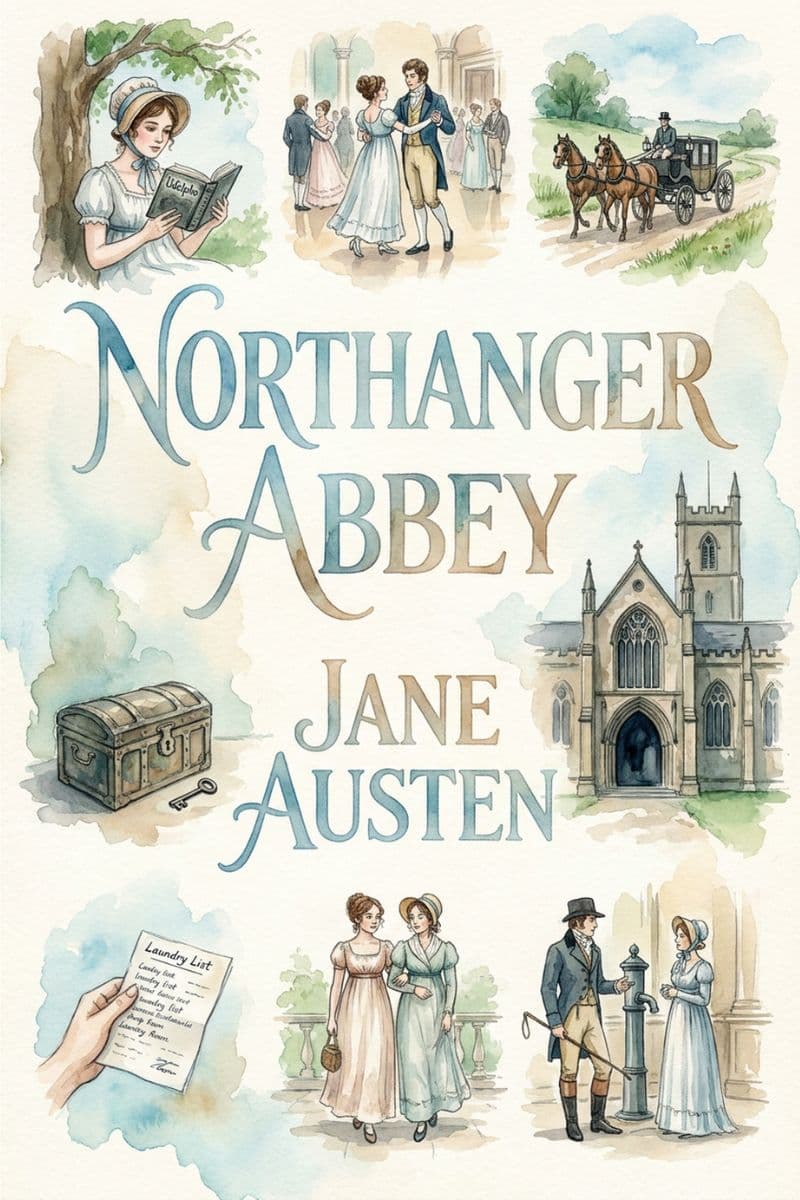
Austen admired Lennox's work, and the influence is unmistakable. Northanger Abbey, in which a young woman interprets the world through the lens of Gothic novels, is essentially The Female Quixote updated for a new century and a new literary obsession. Lennox's novel is also credited with influencing Sense and Sensibility.
Published Anonymously
Like many novels by women in this period, The Female Quixote appeared without Lennox's name on the title page. The authorship was an open secret, however. Her subsequent works were advertised as being by "the author of The Female Quixote," but no edition published during her lifetime bore her name.
The Romances Arabella Reads
Arabella's literary diet consists of real French heroic romances from the 17th century, particularly the massive works of Madeleine de Scudéry and Gautier de Costes de La Calprenède. These novels were enormous, often running to ten volumes apiece, and were wildly popular in their day. By 1752 they were already old-fashioned, which is part of the joke. Arabella is living by rules that were outdated even before she was born.
A Lavish Launch Party
When Lennox published her first novel, Samuel Johnson threw what may be the most literary party in 18th-century history. He served a "magnificent hot apple pie" decorated with bay leaves and crowned her with a laurel wreath after invoking the muses "by some ceremonies of his own invention." The party reportedly lasted until eight in the morning.
Themes
The Power of Stories
At its heart, this is a novel about what happens when fiction gets inside your head and rewires how you see the world. Arabella isn't stupid. She's brilliant, eloquent, and passionate. But she has no framework for reality because she's never been given one. The romances filled a vacuum, and now they control everything.
Women and Power
Arabella's delusions give her something 18th-century women almost never had: agency. In her fantasy world, she is the center of the universe. Men orbit her. She commands, banishes, and forgives on her own terms. The comedy of the novel keeps asking a serious question underneath the laughter: is Arabella's fantasy version of female power really so much worse than the powerlessness reality offers her?
Education and Isolation
Arabella's father loved her but failed her. He kept her isolated, gave her access to his library without guidance, and never equipped her to navigate the real world. The novel is a quiet indictment of how women were educated, or rather, how they weren't.
Appearance vs. Reality
Nearly every scene in the book plays on the gap between what Arabella thinks is happening and what's actually going on. A casual glance becomes a declaration of love. A coincidence becomes a kidnapping plot. A sick man is dying of passion. The comedy depends on this gap, but so does the pathos. Arabella is always wrong about the facts, but she's not always wrong about the feelings underneath them.
The Rules of Courtship
Lennox uses Arabella's absurd expectations to throw a spotlight on the real rules of courtship in her era. Arabella's version is ridiculous, sure. But the actual conventions, where women had to perform modesty, suppress desire, and surrender autonomy to whichever man their family selected, aren't exactly rational either.
Side Characters
Mr. Glanville
The long-suffering hero of the novel. Glanville genuinely loves Arabella and sees past her delusions to the remarkable woman underneath. He spends the entire book trying to protect her from embarrassment while somehow not losing his mind. His patience is both admirable and occasionally hilarious, especially when Arabella commands him to commit murder on her behalf and he has to politely decline.
Sir George Bellmour
The villain who figured out the cheat code. Sir George realizes that the way to Arabella's heart is through her romances, and he plays the part of a lovelorn hero to perfection. He's charming, manipulative, and genuinely dangerous because he's the only person willing to exploit Arabella's weakness rather than try to cure it.
Miss Charlotte Glanville
Glanville's sister and Arabella's foil. Charlotte is everything Arabella isn't: practical, socially aware, and deeply envious. She represents the "normal" 18th-century woman, concerned with fashion and flirtation rather than epic romance. Her constant exasperation with Arabella provides some of the book's sharpest comedy.
Lucy
Arabella's loyal but utterly confused maidservant. Arabella expects Lucy to serve as her romance-style confidante, narrating her mistress's history in elevated prose and interpreting events through the lens of heroic fiction. Lucy has no idea what Arabella is talking about most of the time, and her fumbling attempts to play along are delightful.
The Book's Legacy
The Female Quixote was a hit in its own time. Henry Fielding praised it. Samuel Johnson championed it. Samuel Richardson admired it. It was translated into French, German, and Spanish, and remained moderately popular throughout the 19th century.
But its deepest legacy is as a precursor. Jane Austen read Lennox carefully, and her influence runs through Northanger Abbey and beyond. Lennox helped establish the satirical novel of female experience as a legitimate literary form, paving the way for Austen, Frances Burney, and the entire tradition of women writing sharply and wittily about the collision between expectation and reality.
Feminist scholars rediscovered the novel in the late 20th century and recognized what earlier readers had missed: beneath the comedy, Lennox was asking radical questions about women's education, women's power, and the stories a patriarchal society tells women about themselves.
Today, The Female Quixote reads as startlingly modern. Anyone who has ever built an identity around the books they love, who has ever confused the narrative in their head with the world as it actually is, who has ever been a little too certain that life should work the way stories say it does, will recognize Arabella immediately. She's ridiculous. She's also not entirely wrong. And that tension is what makes the novel impossible to forget.