Novelhalla
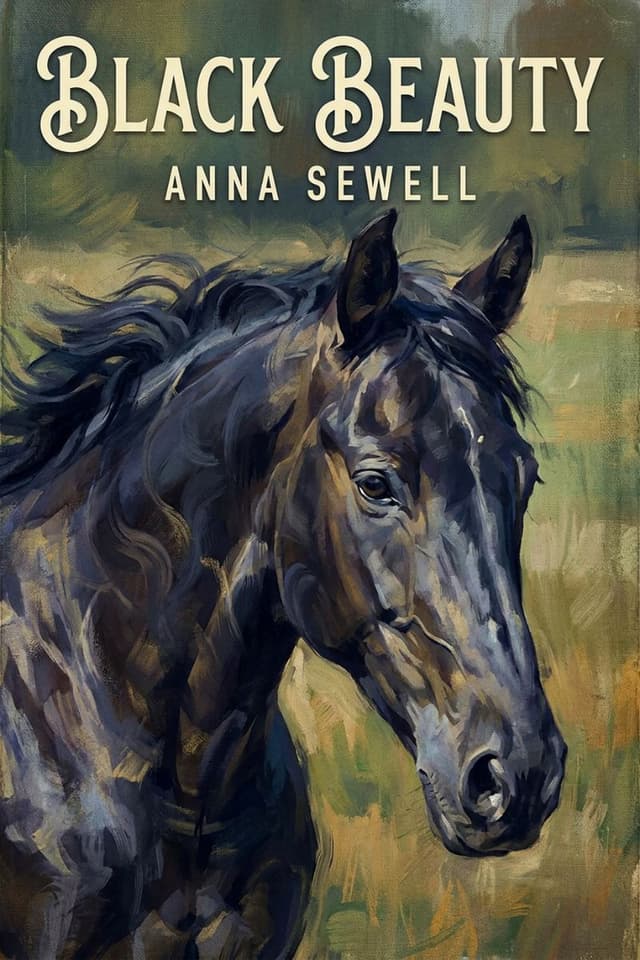
Black Beauty
Read Black Beauty by Anna Sewell for free on Novelhalla, and try out our easy-to-read modern edition of this classic book. You can also download the EPUB and read it on any device if you prefer!
The Plot
A Colt in a Peaceful Meadow
The story is told by a horse, in his own words, and it opens in the happiest place imaginable. A handsome black colt spends his early days running through a meadow with a pond shaded by trees, nursing at his mother's side and racing the other young colts. His mother, Duchess, is a gentle, wise mare who gives him one piece of advice he'll carry for the rest of his life: be good-tempered, work willingly, and never bite or kick, even in play.
His kind owner, Farmer Grey, trains him patiently. The bit, the saddle, the iron shoes, the harness: it's all strange and uncomfortable at first, but he learns. And when he's old enough, he's sold to a wealthy family and given the name that will follow him everywhere: Black Beauty.
Friends in the Stable
At Birtwick Park, Beauty finds a good home with a caring master and a coachman named John Manly who treats horses like they matter. He also meets two stablemates who become his closest friends. Merrylegs is a cheerful little pony who carries the children around and has plenty of opinions about them. Ginger is a tall chestnut mare with a reputation for biting and snapping.
Beauty can't understand why Ginger is so angry, until she tells him her story. Hers wasn't a childhood of soft meadows and gentle hands, and as she describes what people have done to her, Beauty begins to realize that not every human is like the ones he's known.
A World That Doesn't Always Listen
Life at Birtwick has its share of danger, from a raging storm on a flooded road to a night when Beauty smells smoke in a stable full of terrified horses. Through it all, he trusts the people around him, because they've always earned that trust.
But a horse doesn't get to choose his owners. He can be sold, traded, rented out, and handed from one master to the next, and each new pair of hands might be kind or cruel, wise or careless. Beauty has heard the stories now, about the bearing rein that forces a horse's head painfully high for fashion's sake, about drivers who whip and owners who overwork, about horses who simply wear out and disappear.
His whole world depends on the character of whoever happens to be holding the reins. And Beauty is about to find out just how wide the world really is.
About the Author: Anna Sewell
Early Life
Anna Sewell was born in 1820 in Great Yarmouth, Norfolk, into a devout Quaker family. Her mother, Mary Wright Sewell, was a popular writer of children's books and moral verse, and for most of Anna's life her mother was by far the more successful author in the family. Anna was largely educated at home, with a strong emphasis on kindness, plain living, and treating every creature with respect.
A Life-Changing Injury
When Anna was about fourteen, she slipped and fell while running home from school in the rain and badly injured both ankles. The injury never healed properly, and she was lame for the rest of her life. She couldn't walk far, so she relied on horse-drawn carriages to get around, and she became an expert driver who knew horses intimately. She was known for guiding them with her voice and a light touch on the reins rather than a whip.
Writing Through Illness
Anna's health got steadily worse as she aged, and for long stretches she was confined to the house. The family eventually settled in Old Catton, a village near Norwich. In 1871 she was reportedly told she had only about eighteen months to live. By the end of that year she'd started writing Black Beauty.
She worked on it for six years, often too weak to hold a pen. She'd write in pencil on scraps of paper or dictate passages to her mother, who copied them out.
Final Months
Black Beauty was published in November 1877, when Anna was 57. It was the only book she ever wrote. She lived just long enough to see it begin to succeed, and died in April 1878, about five months after publication. She never married and had no children. She's buried in a Quaker burial ground at Lamas in Norfolk.
Fun Facts About the Book
The Full Title Is Delightful
The complete title is Black Beauty: His Grooms and Companions, the Autobiography of a Horse, Translated from the Original Equine. Anna Sewell presented herself not as the author, but as the translator.
It Wasn't Written for Children
Although it's now shelved as a children's classic, Anna Sewell wrote it for adults, especially the grooms, cab drivers, and stable hands who worked with horses every day. She said her goal was to inspire kindness, sympathy, and a real understanding of how horses should be treated.
Sold for a Pittance
Anna sold the book outright to the Norwich publisher Jarrold & Sons for a single flat payment. Accounts disagree on whether it was £20 or £40, but either way, she received no royalties on what became one of the best-selling books in history.
More Than 50 Million Copies
Black Beauty has sold over 50 million copies in around 50 languages, which places it among the best-selling books ever written.
It Helped Kill the Bearing Rein
The bearing rein was a strap that held a horse's head unnaturally high to make carriages look fashionable. It was painful and made it harder for horses to pull. The book's vivid description of it fueled public outrage, and it's widely credited with turning opinion against the device.
Spread by Animal Rights Campaigners
In America, George Angell, founder of the Massachusetts Society for the Prevention of Cruelty to Animals, was so impressed by the book that he printed and gave away hundreds of thousands of copies, especially to people who worked with horses.
A Pioneer of the Animal Narrator
Stories told from an animal's point of view weren't brand new, but Black Beauty revived the form and made it hugely popular. Generations of animal narrators that followed owe it a debt.
Written in Fragments
Because she was so ill, much of the novel was composed in short bursts on loose slips of paper. The book's short, self-contained chapters partly reflect the way it was written.
Themes
Kindness
The book's biggest idea is simple: kindness matters, and it changes everything. Horses treated gently work willingly and trust deeply, while cruelty breaks something that's hard to repair. The same lesson quietly applies to how people treat each other.
Seeing the World Through Someone Else's Eyes
By letting a horse tell the story, Sewell forces readers to experience things they'd never stopped to think about. A tight rein, a heavy load, or a careless whip becomes something you feel rather than just observe.
Powerlessness
Beauty has no control over who owns him or what happens to him. The novel is full of quiet suspense because every sale could mean a better life or a much worse one, and he has no say either way.
Fashion Versus Wellbeing
The book takes aim at practices done purely for appearances, like the bearing rein, tight blinkers, and docked tails, and asks what kind of person would cause suffering just to look stylish.
Character and Responsibility
The best people in the book aren't always the richest or most powerful. They're the ones who take responsibility for the lives in their care. Wealth and status mean nothing if they come with carelessness.
Friendship and Memory
Beauty's bonds with Ginger, Merrylegs, and the people who treat him well run through the whole story. Even when circumstances pull friends apart, those connections shape who he is.
The Book's Legacy
Black Beauty is one of the most influential animal books ever written. It changed how ordinary people thought about horses at a time when horses powered nearly all transport and labor, and it helped push the animal welfare movement into the mainstream on both sides of the Atlantic.
It essentially created the modern horse story. Countless books for young readers, from My Friend Flicka to The Black Stallion to War Horse, follow in its hoofprints.
The book has been adapted many times, including films in 1946, 1971, and 1994, the popular British TV series The Adventures of Black Beauty in the 1970s, and a 2020 Disney+ film with Kate Winslet as the voice of Beauty.
Nearly 150 years after it was published, it's still being read, assigned, and passed down, and it still has the power to make readers look at the animals around them a little differently. Not bad for a first book written on scraps of paper by a woman who was told she didn't have long to live.