Novelhalla
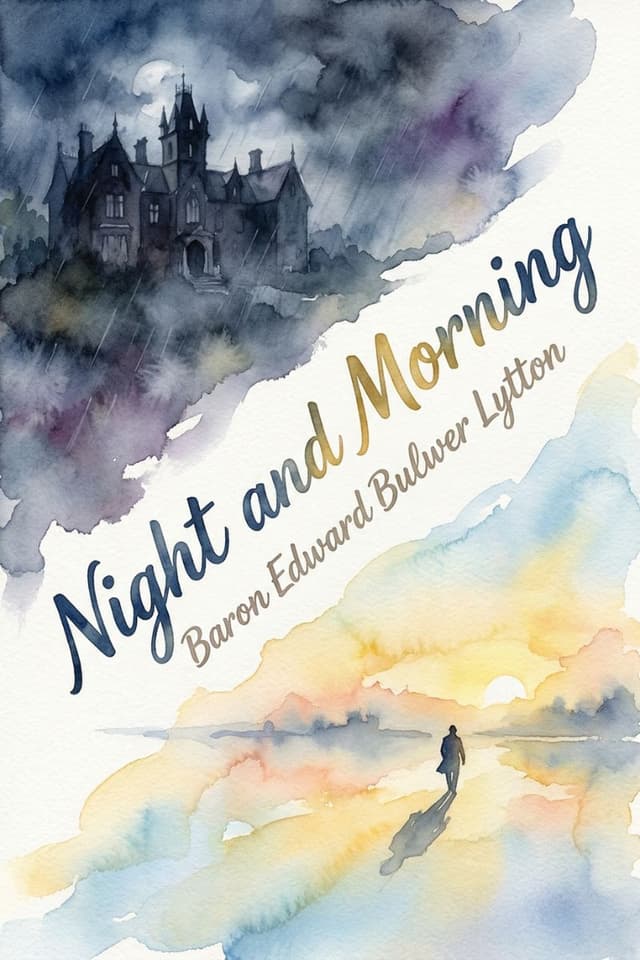
Night and Morning
Read Night and Morning by Baron Edward Bulwer Lytton for free on Novelhalla, and try out our easy-to-read modern edition of this classic book. You can also download the EPUB and read it on any device if you prefer!
The Plot
A Secret Marriage
In a small Welsh village, a gentleman arrives to arrange a clandestine wedding. Philip Beaufort, heir to a great fortune, has fallen in love with Catherine Morton, a tradesman's daughter. His wealthy uncle would never approve of such a match, so Philip marries her in secret, with only the local vicar and a servant as witnesses.
For years, Philip and Catherine live quietly together at a cottage called Fernside, raising two sons: young Philip and Sidney. They are happy, though Catherine remains hidden from society, never acknowledged as Philip's wife. She trusts that one day the marriage will be made public and her children will take their rightful place.
Then Philip's uncle dies, leaving him one of the largest fortunes in England. Philip prepares to finally legitimize his family. But before he can act, he falls suddenly and gravely ill. On his deathbed, he tries to tell his brother Robert about the marriage, about the proof that exists in the parish register. Robert, a cold and calculating man who has always resented being passed over, pretends not to understand.
Philip dies. And the nightmare begins.
Disinherited
Robert Beaufort moves swiftly. He claims the entire estate. When Catherine produces witnesses to her marriage, Robert sets about destroying them. The vicar who performed the ceremony is dead. The servant who witnessed it has vanished. The parish register has been conveniently damaged by fire, and the copy that should exist has mysteriously disappeared.
Catherine takes her case to court, but without documentary proof, she cannot establish that she was ever married. In the eyes of the law, her sons are illegitimate. They have no claim to their father's name, his estate, or their place in society.
Catherine, broken by grief and injustice, does not survive long. Before she dies, she extracts a promise from young Philip: he will one day restore the family honor and prove his parents' marriage.
The two boys are separated. Sidney, the younger, is taken in by relatives who find him tractable and charming. Philip, proud and defiant, refuses charity from those who have wronged him. He is cast out into the world with nothing.
The Descent
Philip's journey takes him through the dark underworld of nineteenth-century society. He falls in with William Gawtrey, a charming rogue who becomes something like a father figure. Gawtrey is a counterfeiter by trade, though at heart a generous man who shows Philip kindness when no one else will.
Philip travels with Gawtrey through England and France, living on the margins of respectable society. He sees poverty, crime, and the desperate measures people take to survive. He learns how thin the line is between respectability and ruin, how a missing piece of paper can transform an heir into a beggar.
Meanwhile, Sidney grows up comfortable but ignorant of his true history. He has been told his brother is lost, perhaps dead, certainly disgraced. The brothers' paths diverge completely.
Years pass. Philip reinvents himself abroad, adopting a new identity and eventually achieving some measure of success. But he never forgets his promise to his dying mother. Somewhere, the proof of that marriage must still exist. And someone must know what happened to it.
The Return
Philip returns to England under an assumed name, determined to uncover the truth. The task is complicated by the passage of time and by powerful enemies who have much to lose if the marriage is proven.
Chief among these enemies is Lord Lilburne, a nobleman of wealth and influence who is connected to the Beaufort family and who has his own reasons for keeping the truth buried. Lilburne is the novel's true villain: not a man of crude wickedness but of refined, calculating selfishness, a man who commits no crimes that the law can touch while destroying lives with perfect impunity.
Philip must also contend with his own brother, Sidney, who has been raised to believe in Robert Beaufort's version of events. And there is the question of Fanny, a young woman connected to the past in ways Philip does not at first understand, whose fate becomes bound up with his own.
The search for the missing marriage certificate becomes a race against time, involving hidden documents, dangerous confrontations, and the gradual revelation of old secrets..
About the Author: Edward Bulwer-Lytton
Early Life
Edward George Earle Lytton Bulwer was born in London in 1803, the youngest son of a general and an heiress. His father died when he was four, and he was raised by his mother, who encouraged his precocious literary interests. By age seven he was writing poetry, and at fifteen his mother paid to have his first volume of verse published.
He attended Cambridge, where he won the Chancellor's Gold Medal for English verse. A handsome, fashionable young man, he moved easily in London's literary and social circles. In 1827, against his mother's wishes, he married Rosina Doyle Wheeler, a spirited Irish woman. His mother promptly cut off his allowance, forcing him to write for a living.
Literary Career
Bulwer-Lytton became one of the most prolific and popular writers of the Victorian era. His second novel, Pelham (1828), established his reputation and set fashion trends. When his protagonist wore black evening dress, real gentlemen followed suit, establishing a custom that persists today.
He wrote in nearly every genre: crime novels, historical romances, domestic dramas, occult fiction, and early science fiction. His 1834 novel The Last Days of Pompeii became an international sensation and remains his most famous work. He also wrote successful plays, including Money (1840) and Richelieu (1839), from which comes the famous line "The pen is mightier than the sword."
Night and Morning was published in 1841, during one of his most productive periods. He wrote it in the wake of his legal separation from Rosina, which had become a public scandal. The novel reflects his ongoing interest in social justice, the law, and the gap between respectability and true virtue.
Political Career
Writing was not Bulwer-Lytton's only occupation. He served in Parliament twice: first as a Liberal from 1831 to 1841, then as a Conservative from 1852 to 1866. He served briefly as Secretary of State for the Colonies in 1858-59, during which time he selected the site for British Columbia's capital. In 1866 he was elevated to the peerage as Baron Lytton of Knebworth.
Later Years and Legacy
Bulwer-Lytton's marriage ended badly. Rosina, from whom he separated in 1836, spent decades publicly attacking him, eventually being briefly committed to an asylum after denouncing him at a political rally. Their son, Robert, became Viceroy of India.
Bulwer-Lytton died in 1873, leaving behind dozens of novels, plays, poems, and essays. Charles Dickens was a close friend, and Bulwer-Lytton famously convinced him to revise the ending of Great Expectations.
Today he is perhaps best known for the opening line of his 1830 novel Paul Clifford: "It was a dark and stormy night." This sentence inspired the Bulwer-Lytton Fiction Contest, an annual competition for terrible opening lines that has unfairly overshadowed his genuine achievements. In his own time, he was one of the most respected and widely read authors in the English language, and his influence on Victorian literature was considerable.
Fun Facts About the Book
The Law and the Novel
Bulwer-Lytton was so concerned about legal accuracy that he submitted the entire plot of Night and Morning to an eminent lawyer for review. The legal case at the heart of the novel was written according to his counsel's opinion and revised by the lawyer's own pen. Bulwer-Lytton was amused to learn later that other legal experts disagreed with his consultant's conclusions.
A Novel of Social Purpose
In his preface, Bulwer-Lytton declared his intention to "deal fearlessly with the universal unsoundness in social justice" and "lift the mask from the timid selfishness which too often wears the name of Respectability." The novel was part of his broader effort to use fiction as a vehicle for social reform, following his earlier crime novel Paul Clifford.
Less Wordy Than Usual
Contemporary readers noted that Night and Morning was more streamlined than Bulwer-Lytton's other novels. One reviewer remarked that it "completely lacks the out-of-control sentences that occasionally mar Paul Clifford." The novel sticks to a relatively focused plot rather than the sprawling multiple storylines typical of Victorian fiction.
Poe's Review
Edgar Allan Poe reviewed Night and Morning for Graham's Magazine in 1841. While generally positive, Poe characteristically found fault with some of the novel's contrivances, particularly the way every minor character turned out to be connected to the main plot. He did praise the characterization of Lord Lilburne as "amazingly good."
Crime Without Punishment
One of the novel's most striking features is its villain, Lord Lilburne. Unlike the criminals in the story, Lilburne never breaks the law. He is a man of vice without being a man of crime. The novel contrasts him with William Gawtrey, the counterfeiter, asking which is truly the worse man: the felon who shows kindness, or the respectable lord who destroys lives within the bounds of legality.
The Pen and the Sword
Night and Morning was published just two years after Bulwer-Lytton's play Richelieu, which gave the world the phrase "the pen is mightier than the sword." His belief in the power of literature to change society is evident throughout the novel.
Themes
Legitimacy and Identity
The central question of the novel is what makes a person legitimate. Philip and Sidney are the same people whether their parents' marriage can be proven or not. Yet without that scrap of paper, they lose their name, their inheritance, and their place in the world. The novel explores how arbitrary legal distinctions can determine a person's entire fate.
Respectability vs. Virtue
Bulwer-Lytton draws a sharp distinction between social respectability and genuine moral worth. Robert Beaufort is respectable: he commits no crimes, maintains appearances, and prospers. William Gawtrey is a criminal. Yet the novel suggests that Gawtrey, for all his crimes, possesses more true virtue than many who never break the law. The most damning portrait is of Lord Lilburne, a man of perfect respectability and complete moral bankruptcy.
Class and Justice
The novel exposes the ways that wealth and class determine access to justice. Catherine cannot prove her marriage because she lacks the resources to fight a wealthy opponent. Philip survives only by descending into the criminal underworld. The law, supposedly blind, proves remarkably attentive to the interests of the powerful.
The Making of Criminals
Night and Morning shows how society manufactures its own criminals. Philip does not choose a life among rogues; he is driven to it by circumstances. The novel asks readers to consider how many criminals are created by injustice rather than inherent wickedness.
Family and Duty
The novel is fundamentally about family: the duties parents owe children, siblings owe each other, and children owe their parents' memory. Philip's entire quest is driven by his promise to his dying mother. The tragedy begins because his father failed to fulfill his duty to legitimize his family.
Night and Morning
The title suggests the novel's structure and philosophy. The characters pass through darkness before reaching light. The "night" of poverty, injustice, and exile gives way to the "morning" of restoration. But the novel does not sentimentalize this journey: the night is long, and not everyone survives to see the dawn.
The Book's Legacy
Night and Morning was well received in its time and remained popular throughout the nineteenth century. It contributed to ongoing debates about legal reform, particularly regarding marriage law and the rights of children born to disputed unions.
The novel's influence can be seen in later Victorian fiction dealing with questions of inheritance, legitimacy, and lost heirs. Its portrait of the criminal underworld anticipated elements of Dickens's later novels, and its critique of respectable villainy found echoes in the sensation fiction of the 1860s.
Modern readers approaching Bulwer-Lytton for the first time may be surprised by the novel's readability and moral seriousness. While his reputation has suffered from the mockery of the Bulwer-Lytton Fiction Contest, Night and Morning demonstrates why he was once considered one of England's finest novelists: a skilled storyteller with a sharp eye for social hypocrisy and a genuine commitment to using fiction as a force for justice.