Novelhalla
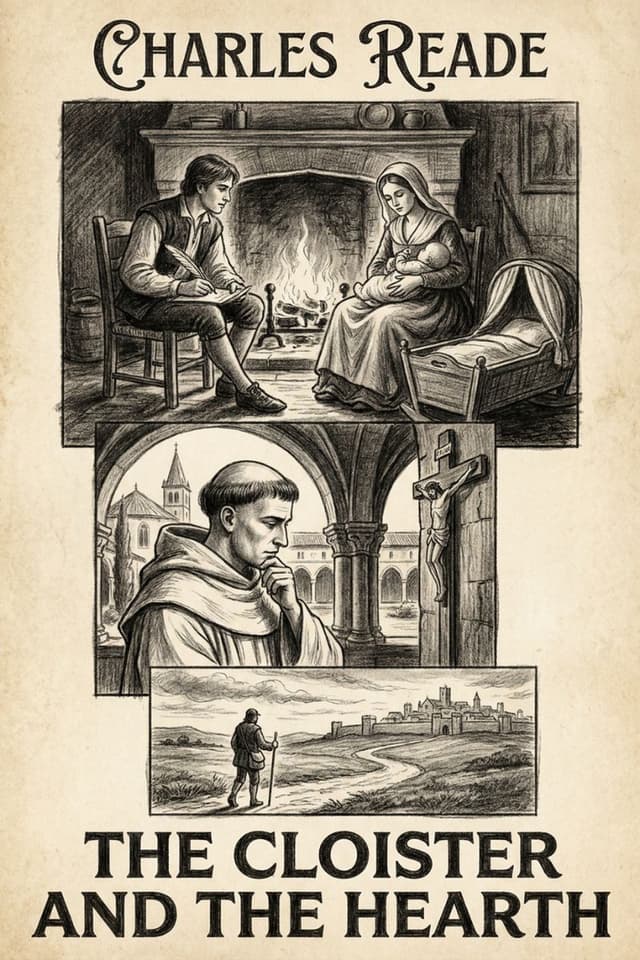
The Cloister and the Hearth
Read The Cloister and the Hearth by Charles Reade for free on Novelhalla, and try out our easy-to-read modern edition of this classic book. You can also download the EPUB and read it on any device if you prefer!
The Plot
A Young Man's Divided Heart
In fifteenth-century Holland, Gerard Eliassoen is the son of a merchant with too many children and not enough ambitions for any of them. Gerard is different. He is a gifted scribe and illuminator, a young man who can make parchment glow with gold leaf and color. His family has marked him for the Church, where they expect him to quietly disappear into holy orders and stop costing them money. But Gerard has other ideas, and those ideas have everything to do with Margaret Brandt.
Margaret is the daughter of a physician who has fallen on hard times. She is clever, resourceful, and beautiful, and when she and Gerard meet at a local festival, the connection between them is immediate and overwhelming. They fall in love with the kind of reckless certainty that terrifies everyone around them.
Gerard's family is furious. His father wants him bound for the clergy. His brothers, jealous and greedy, see his talent as a threat to their inheritance. And the local burgomaster, Ghysbrecht Van Swieten, has his own dark reasons for wanting to keep Gerard and Margaret apart, reasons tangled up in a stolen fortune and documents that could expose his corruption.
The Escape
When Gerard is thrown into prison by forces conspiring against him, it takes the courage of Margaret herself, along with Gerard's crippled sister Kate and his dwarf brother Giles, to break him free. Gerard escapes with something unexpected in his pockets: papers stolen from the burgomaster's strongbox that will prove to be far more dangerous and valuable than he realizes.
With no way to stay safely in Holland, Gerard sets out on foot for Rome, the great center of art and learning, hoping to make his fortune as a scribe and return to claim Margaret as his wife. What he does not know is that Margaret is already carrying their child.
The Road to Rome
The journey south is where the novel becomes a sprawling, wild, and sometimes terrifying adventure. Gerard is young, bookish, and utterly unprepared for the medieval road, which is crawling with bandits, wolves, con artists, and worse. His salvation comes in the form of Denys of Burgundy, a tough, irreverent, womanizing crossbowman with a heart of gold and a talent for getting into and out of trouble. The friendship between the earnest, devout Gerard and the cheerfully godless Denys is one of the great odd-couple partnerships in fiction.
Together they survive ambushes at remote inns, encounters with bears, shipwrecks, and the constant menace of a Europe where the roads between cities are lawless and brutal. They argue, they laugh, they save each other's lives, and they form a bond that neither distance nor time will break.
The Lie That Changes Everything
Gerard reaches Italy and begins to thrive. His skills as an illuminator earn him patrons and admirers. Rome is alive with the first stirrings of the Renaissance, and Gerard finds work, friendship, and a growing reputation. He writes to Margaret. He plans for their future.
But back in Holland, his enemies have not forgotten him. His jealous brothers conspire with the burgomaster to send Gerard a devastating message: Margaret is dead.
The news destroys him. Gerard, shattered by grief, abandons his art, his ambitions, and his sense of self. He spirals into despair and eventually takes vows as a Dominican friar, becoming Brother Clement. The man who wanted nothing more than to build a life with the woman he loved now pledges himself to a life of celibacy and renunciation.
Margaret, of course, is very much alive. She has given birth to their son and is desperately waiting for Gerard to come home.
The Question
The novel's great tension becomes whether the truth can undo what the lie has done. Can Gerard and Margaret find each other again? And if they do, what happens when the man she loves has already given himself to God? The cloister and the hearth of the title are not just settings. They are the two forces pulling Gerard apart: devotion to the Church and devotion to the family he does not yet know he has.
About the Author: Charles Reade
Early Life
Charles Reade was born on June 8, 1814, at Ipsden House in Oxfordshire, the youngest of eleven children in a prosperous family. His father was a country squire, his mother a devout evangelical who hoped Charles would enter the clergy. He was educated at home by tutors, which left him socially unprepared when he arrived at Magdalen College, Oxford, at seventeen. He earned his degree in 1835 and was elected a fellow of the college, a position he held for the rest of his life.
The Fellowship Trap
The Magdalen fellowship paid Reade a comfortable income and gave him handsome rooms at Oxford, but it came with a condition: he could not marry. This peculiar arrangement shaped his entire adult life. He was called to the bar in 1843 but never practiced law. He studied medicine but never became a doctor. He traveled Europe, collected violins, and around 1840 fell deeply in love with a Scottish woman whose identity remains uncertain. Their engagement was broken off, and when Reade later returned to Scotland to find her, he learned she had died. The parallels with the novel he would eventually write are hard to miss.
The Dramatist Who Became a Novelist
Reade settled in London in 1849 and threw himself into the theater. He wanted to be a playwright above all else, and even specified that "dramatist" should appear first on his tombstone. His breakthrough came with the comedy Masks and Faces in 1852, co-written with Tom Taylor. It was the actress Laura Seymour who urged him to turn the play into a novel, and the result, Peg Woffington (1853), launched his career in fiction.
Seymour became Reade's closest companion, managing his household from 1854 until her death in 1879. The exact nature of their relationship was a source of Victorian gossip. They lived together, they were devoted to each other, and yet Seymour publicly insisted they were "partners, nothing more." Reade never married, never gave up his fellowship, and always introduced her as "the lady who keeps my house for me." He was buried beside her in Willesden churchyard.
The Social Crusader
Reade was a restless, combative, generous man who used his novels as weapons against injustice. It Is Never Too Late to Mend (1856) attacked the cruelty of Victorian prisons. Hard Cash (1863) exposed abuses in lunatic asylums. Put Yourself in His Place (1870) took on corrupt trade unions. He was friends with Charles Dickens and Wilkie Collins, and like them, he believed fiction should change the world.
He kept enormous scrapbooks of newspaper clippings, court records, and research notes, which he mined for his novels. He called his books "matter-of-fact romances" and insisted that fiction must be grounded in evidence. For The Cloister and the Hearth, he read seventy-nine books on medieval life and filled vast notebooks with research on everything from hermits to printing presses.
Final Years
Laura Seymour's death in 1879 broke something in Reade. His health declined, and though he continued to write, he never regained his old energy. He kept a menagerie of dogs, hares, and gazelles at his London home, and remained generous to the poor and unfortunate who sought him out. He died on April 11, 1884, at age sixty-nine, leaving behind a completed novel and a reputation that was already beginning to fade.
Fun Facts About the Book
Built from Almost Nothing
The entire novel grew from a handful of sentences. The great Renaissance scholar Erasmus of Rotterdam wrote a brief account of his own parents' lives, and Reade seized on those few lines as the seed for an epic. Almost everything in the novel beyond the names of Erasmus's parents and the basic circumstances of their separation is Reade's invention.
Arthur Conan Doyle's Favorite Novel
The creator of Sherlock Holmes considered The Cloister and the Hearth the greatest novel in the English language. Doyle said he would give it all three of his votes if he could, praising its combination of intellectual and emotional power. When asked to name his favorite heroine in all of fiction, he answered simply: "Margaret."
Kipling Measured Himself Against It
Rudyard Kipling, while writing Kim, confessed he had wanted to produce something "worthy to lie alongside" The Cloister and the Hearth. Unable to achieve this, he said, he "dismissed the ambition as beneath the thinking mind. So does a half-blind man dismiss shooting and golf."
Oscar Wilde's Backhanded Compliment
In his essay "The Decay of Lying," Oscar Wilde called the novel Reade's "one beautiful book," then added that Reade "wasted the rest of his life in a foolish attempt to be modern."
The Serialization Disaster
The novel began life as a serial called "A Good Fight" in the magazine Once a Week in 1859. When the editors objected to the storyline involving Margaret's unmarried pregnancy, Reade was furious. He slapped a false happy ending on the serial, walked away, and spent two years expanding it to five times its original length. The published novel was a completely different and vastly superior work.
George Orwell Disagreed with Everyone
Not everyone loved it. George Orwell wrote that Reade "wrote several dull books, and The Cloister and the Hearth is one of them," preferring Reade's contemporary social novels instead. The book has always divided readers: those who love it tend to love it passionately, and those who don't find it long and old-fashioned.
Real People Walk Through the Story
Reade wove actual historical figures into the narrative alongside his fictional characters. The medieval poets Froissart, Villon, and Gringoire appear, as do references to the painter Jan Van Eyck and, of course, the young Erasmus himself, who appears as a precocious child near the novel's end.
A Personal Parallel
Reade's own life mirrored his hero's dilemma in uncomfortable ways. Like Gerard, Reade was bound by institutional rules that prevented him from marrying. His Oxford fellowship required celibacy, and his lost Scottish love affair, followed by decades of devoted but ambiguous companionship with Laura Seymour, gave him firsthand knowledge of the ache between duty and desire.
Seventy-Nine Books of Research
Reade was obsessive about accuracy. He read seventy-nine books on medieval history, art, customs, and religion, filling massive notebooks with details he then wove into the novel. Contemporary critics praised the result as a portrait of fifteenth-century life more vivid and faithful than anything in Walter Scott.
A Comic Book Too
In December 1949, the Gilberton Company published a graphic novel adaptation of The Cloister and the Hearth as issue No. 66 of their Classics Illustrated series, condensing the sprawling epic into a format accessible to young readers.
Key Characters
Gerard Eliassoen
A gifted young scribe and illuminator torn between his love for Margaret and the forces pushing him toward the Church. He is passionate, artistic, devout, and ultimately broken by a lie that reshapes his entire life.
Margaret Brandt
Clever, strong, and endlessly resourceful, Margaret endures separation, poverty, and the burden of raising a child alone while waiting for a man who has been told she is dead. She is the emotional anchor of the novel.
Denys of Burgundy
A Burgundian crossbowman and soldier of fortune who becomes Gerard's traveling companion and dearest friend. Denys is irreverent, brave, loyal, and frequently hilarious. He is widely considered one of the most memorable characters in Victorian fiction.
Ghysbrecht Van Swieten
The corrupt burgomaster of Gerard's village, a villain who has stolen Margaret's family fortune and will go to extraordinary lengths to keep his crimes hidden, including conspiring to destroy Gerard and Margaret's relationship.
Kate and Giles
Gerard's siblings who come to his aid when he is imprisoned. Kate is physically disabled but fierce in spirit, and Giles is a dwarf with unexpected courage. Both defy their family to help their brother.
Elias and Catherine
Gerard's parents. His father, Elias, is a merchant who initially opposes his son's relationship with Margaret but eventually comes around. His mother, Catherine, is a spirited, sharp-tongued woman who becomes one of the novel's most vivid domestic presences.
Themes
The Cloister vs. the Hearth
The novel's title captures its central conflict. The cloister represents religious devotion, celibacy, and spiritual discipline. The hearth represents home, family, and human love. Gerard is forced to choose between them, and the novel argues, with passionate conviction, that this choice should never have been required.
Institutional Cruelty
The Catholic Church's demand that its priests remain celibate is treated not as a spiritual ideal but as a source of immense human suffering. The novel shows how an institution's rules can crush the people trapped within them, separating lovers and orphaning children in the name of holiness.
The Power of Lies
A single forged letter destroys two lives. The novel is deeply concerned with how easily truth can be manipulated and how devastating the consequences of deception can be, especially when the deceived have no way to verify what they have been told.
Friendship and Loyalty
The bond between Gerard and Denys is one of the novel's purest pleasures. In a world full of treachery and danger, their friendship stands as proof that loyalty, humor, and mutual devotion can survive anything the road throws at them.
Art and Ambition in a Brutal World
Gerard's talents as a scribe and illuminator place him at the edge of the Renaissance, a moment when art and learning were beginning to transform Europe. The novel captures both the excitement of that transformation and the brutal medieval world that still surrounded it.
The Heroism of Ordinary People
Reade opens the novel with a declaration that ordinary men and women perform great deeds and suffer noble sorrows every day, most of which will never be recorded. The entire book is an attempt to honor that truth, telling the story of two obscure people whose lives, though lost to history, produced one of the greatest scholars the world has ever known.
The Book's Legacy
The Cloister and the Hearth was Charles Reade's masterpiece, and for decades after its publication it was considered one of the finest historical novels ever written in English. Sir Walter Besant called it "the greatest historical novel in the language." Swinburne praised its construction. Doyle, Kipling, and Wilde all paid it tribute in their own ways.
The novel's reputation faded in the twentieth century, partly because its length and archaic dialogue put off modern readers, and partly because Reade himself fell out of literary fashion. George Orwell's dismissal captured a common attitude: most people had heard of the book but few had actually read it by choice.
Yet those who do read it tend to find something extraordinary. The friendship between Gerard and Denys remains one of the great literary partnerships. The portrait of medieval Europe, drawn from Reade's obsessive research, is alive with color, violence, humor, and detail. And the love story at the novel's center, with its forced separations, its devastating lie, and its painful, hard-won resolution, carries an emotional weight that has moved readers for over a century and a half.
The novel also occupies a unique place in literary history as a kind of origin story for Erasmus of Rotterdam, one of the most important thinkers of the Renaissance. By imagining the lives of his obscure parents, Reade gave human weight to the idea that great figures emerge from ordinary love, ordinary suffering, and the quiet heroism of people whose names the world has forgotten.