Novelhalla
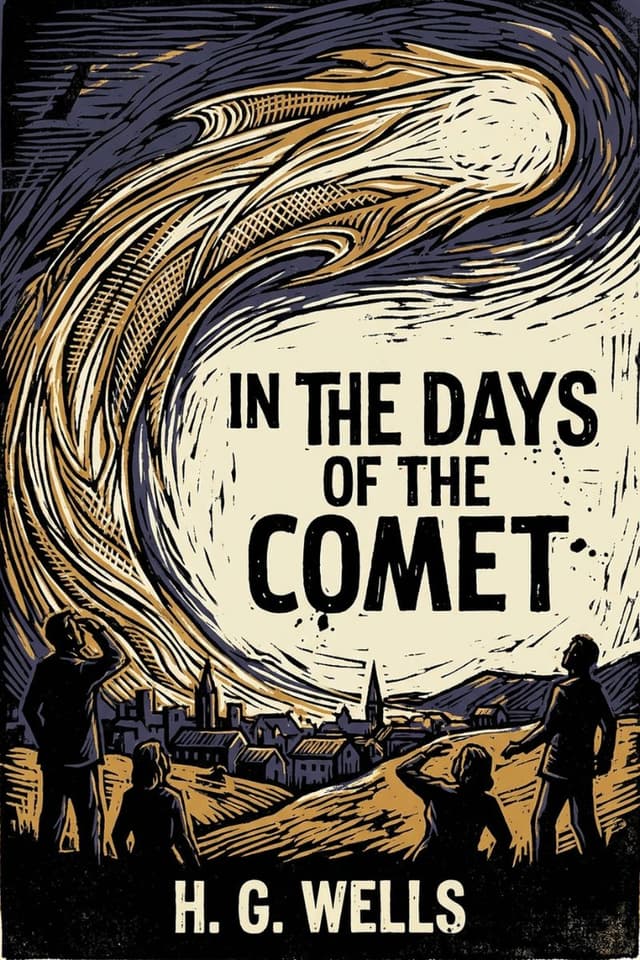
In the Days of the Comet
Read In the Days of the Comet by H. G. Wells for free on Novelhalla, and try out our easy-to-read modern edition of this classic book. You can also download the EPUB and read it on any device if you prefer!
The Plot
A Young Man on Fire
William Leadford is angry. He's angry at his dead-end job in a pottery factory in a grim industrial town. He's angry at the squalid house where he and his widowed mother live, with its leaking roof and a landlord who won't fix anything. He's angry at a class system that keeps people like him ground into the dirt while the wealthy live in sprawling country estates a few miles away. He's read the socialist pamphlets. He's attended the meetings. He knows exactly who to blame for the state of the world.
But the thing that's really burning him alive? That's Nettie.
Nettie Stuart is beautiful, clever, and the only bright thing in Leadford's gray existence. They've been sweethearts since they were teenagers, their mothers old friends. She's the daughter of a gardener on a grand estate, and Leadford has loved her with the kind of fierce, possessive intensity that young men mistake for devotion.
Then she leaves him for someone else. Not just anyone. Edward Verrall, the wealthy young heir to the very estate where her father works. The class enemy. The man who represents everything Leadford despises.
Something inside him snaps.
The Revolver
Leadford buys a gun. He doesn't think of it as murder, exactly. He thinks of it as justice. He's going to find Nettie and Verrall, and he's going to end them both, and then himself. The rage feels righteous. The plan feels inevitable.
Meanwhile, the world around him is falling apart in its own way. Britain is sliding toward war with Germany. Factories are shutting down. Strikes are erupting. Politicians are posturing. Nobody in power seems to care about the people being crushed at the bottom. Leadford barely notices. His hatred has narrowed to a single point.
And above it all, night after night, a comet is growing brighter in the sky.
The Comet
Leadford's friend Parload is an amateur astronomer, the kind of earnest young man who cares more about spectroscopy than socialism. He's been tracking the comet for weeks. It has an unusual green band in its light signature, something no one has seen before. Scientists are debating what it means. Most people ignore it. They're too busy with their own wars, their own grudges, their own collapsing lives.
The comet grows. It fills the night sky, brighter than the moon, trailing luminous green vapor across the heavens. Nations are mobilizing for battle. Leadford is stalking his victims across the English countryside. The world is running on hate and fear and momentum, hurtling toward a dozen different catastrophes at once.
And then the comet arrives.
The Green Vapors
Leadford has tracked Nettie and Verrall to a coastal town. He's close. The revolver is loaded. War has officially broken out. And then the comet enters Earth's atmosphere, and the sky turns green, and a strange fog rolls across the planet, and every person on Earth falls unconscious.
The world goes dark.
The Awakening
When Leadford opens his eyes, everything is different. Not the landscape. Not the buildings. Him. The rage is gone. Not suppressed, not buried. Gone, like a fever that's broken. He can see the beauty in the grass, in the sky, in the curve of a broken wall. He can think clearly for the first time in his life. He looks at the revolver in his hand and feels a deep, bewildered shame.
It's not just him. Everyone who wakes up is changed. The soldiers stop fighting. The factory owners look at their workers and actually see them. The politicians sit down and begin, haltingly, to talk about what really matters. Something in the comet's gases has altered the chemistry of the air itself, and with it, the chemistry of the human mind.
They call it the Change.
And now the real story begins. Because Leadford, Nettie, and Verrall are all still alive. The feelings haven't disappeared. The history hasn't been erased. The old world is gone, but the people who lived in it still have to figure out how to live in the new one.
What does love look like when jealousy is no longer possible? What does justice look like when rage no longer drives it? And can a man who was ready to kill yesterday build something worth living for tomorrow?
About the Author: H.G. Wells
Early Life
Herbert George Wells was born in 1866 in Bromley, on the outskirts of London, to a family barely clinging to respectability. His father was a failed shopkeeper and part-time cricket player. His mother was a former domestic servant. When the family business collapsed, young Bertie (as he was known) was pulled out of school at fourteen and apprenticed to a draper, a job he despised. He escaped through reading, devouring books in the library of a country house where his mother had gone to work as a housekeeper.
The Scientist Who Became a Writer
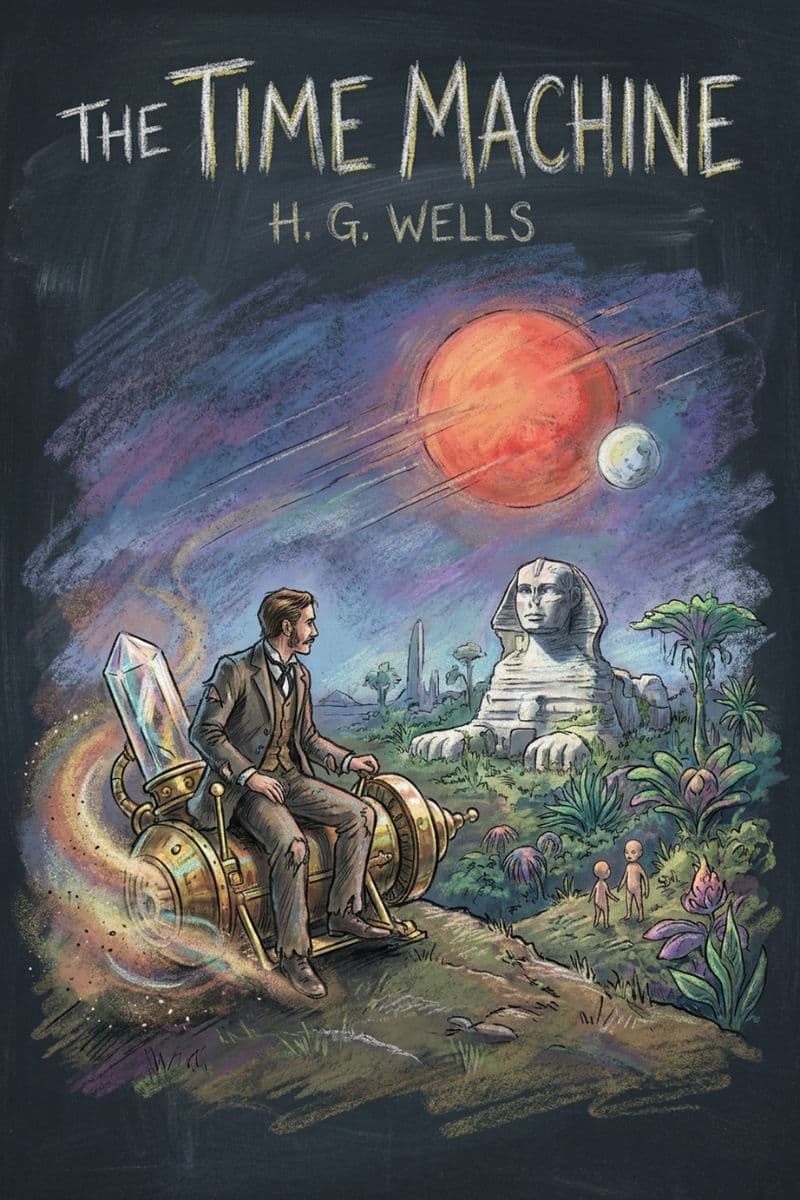
At eighteen, Wells won a scholarship to the Normal School of Science in London, where he studied biology under T.H. Huxley, one of the great champions of Darwin's theory of evolution. The experience transformed him. He graduated from the University of London and became a science teacher, but writing was already pulling him away. In 1895, he published The Time Machine, and his life changed overnight. Over the next decade, he produced an extraordinary run of novels: The Island of Doctor Moreau, The Invisible Man, The War of the Worlds. He essentially invented modern science fiction.
The Socialist and the Scandal
Wells was a passionate socialist who joined the Fabian Society in 1903, then spent several years trying to radicalize it before storming out. He was equally passionate about what he called "free love," conducting a series of affairs that were messy, public, and sometimes produced children outside his marriage. His second wife, Amy Catherine Robbins, whom he married in 1895, tolerated his behavior with remarkable composure. In the Days of the Comet, with its frank endorsement of non-traditional relationships, caused a public scandal and further strained his standing with the Fabians.
Later Years
Wells spent the second half of his career moving away from fiction and toward political writing, history, and prophecy. His Outline of History became one of the best-selling books of the early twentieth century. He met with world leaders, ran for Parliament, and wrote The Rights of Man, a book that helped lay the groundwork for the United Nations' Universal Declaration of Human Rights. He grew more pessimistic with age, watching the world stumble into two global wars despite all his warnings. He died in 1946 at the age of 79, still writing, still arguing, still believing that humanity could do better if it would just think clearly.
Fun Facts About the Book
The Scandal
The novel's ending, which depicts the main characters settling into a polyamorous arrangement, caused an uproar when it was published in 1906. The YWCA, the Salvation Army, and anti-vice campaigners all spoke out against it. The Times Literary Supplement sneered that under socialism, wives would apparently be held in common like goods. Beatrice Webb, a leading Fabian, wrote in her diary that Wells was "merely gambling with the idea of free love" without taking responsibility for the consequences. The controversy damaged Wells's reputation and contributed to his eventual split with the Fabians.
A Personal Novel
Willie Leadford is one of Wells's most autobiographical characters. Like Wells, Leadford is a working-class young man with intellectual ambitions, socialist convictions, and a volatile emotional life. Wells had been an angry, impoverished youth in the industrial Midlands, had studied shorthand, and had experienced the grinding frustration of being intelligent in a society that didn't care. The novel's depiction of class resentment and romantic obsession draws directly from Wells's own early experiences.
The War Prophecy
The novel includes a war between Britain and Germany that breaks out just as the comet arrives. Wells wrote this in 1906, eight years before World War I actually began. He was one of several writers who foresaw the coming European conflict, and his descriptions of naval engagements and mass casualties proved uncomfortably prescient.
The Three Books
The novel is structured in three distinct sections, each with its own tone. Book I ("The Comet") is a dark, angry social realist novel about poverty and jealousy. Book II ("The Green Vapours") is apocalyptic science fiction. Book III ("The New World") is utopian speculation about what a transformed humanity might look like. The shifts in style are deliberate, reflecting Wells's belief that the world needed a radical break from its existing patterns, not gradual reform.
Wells's Utopian Phase
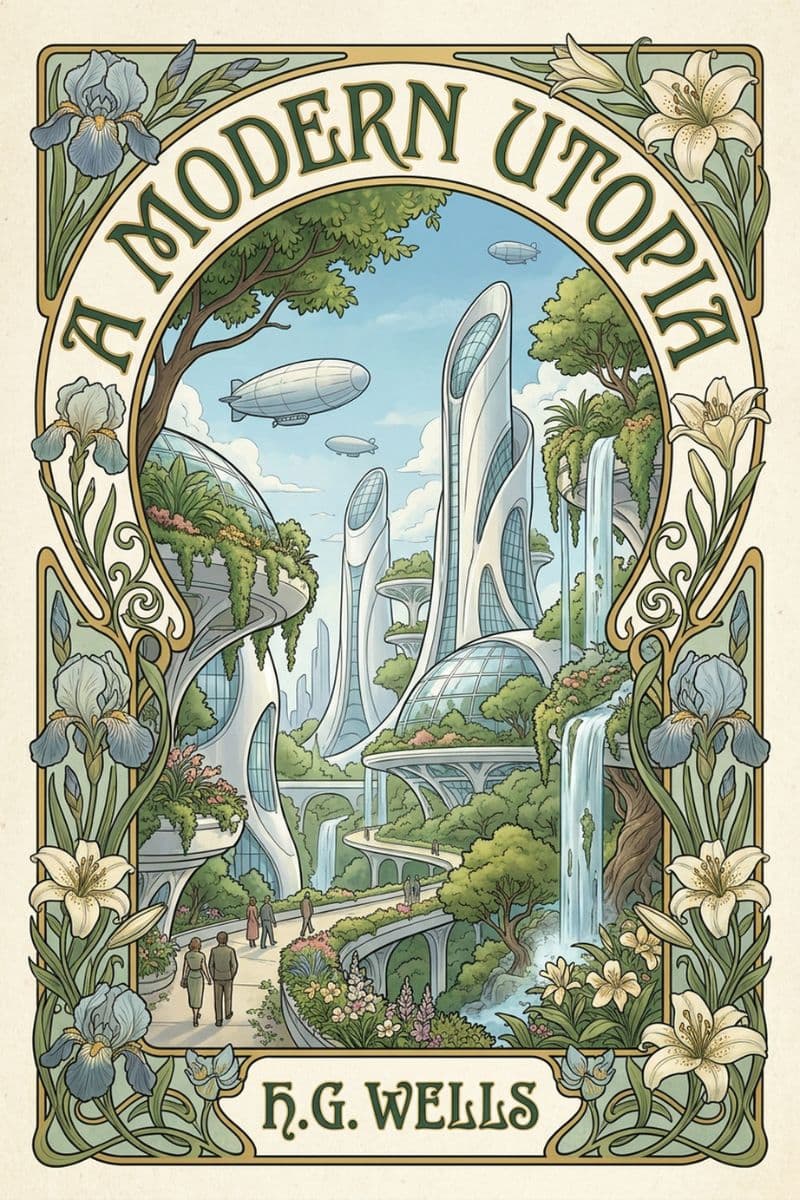
In the Days of the Comet belongs to a cluster of books Wells wrote in the early 1900s exploring utopian ideas, including Anticipations, A Modern Utopia, and The Food of the Gods. He was moving away from the pure science fiction of his early career and toward using fiction as a vehicle for social and political argument. Not everyone loved the shift. Some readers wanted more Martian invasions and fewer lectures about socialism.
Themes
The Prison of Class
Leadford's fury isn't abstract. It grows directly from the material conditions of his life: the terrible housing, the dead-end work, the knowledge that people like the Verralls live in comfort while people like him barely survive. Wells paints industrial England as a machine designed to keep the poor in their place, and Leadford's violence as a logical, if horrifying, product of that machine.
Jealousy as a Kind of Madness
The novel treats romantic jealousy the way it treats industrial squalor and warmongering: as a symptom of a sick civilization. Leadford's obsession with Nettie isn't presented as romantic. It's presented as a disease, a possessiveness that mirrors the hoarding instincts of the capitalist class he claims to despise. The Change doesn't just end wars. It ends the idea that one person can own another.
What Would It Take?
The comet is a thought experiment. Wells isn't really asking whether a celestial object could alter human brain chemistry. He's asking a much harder question: what would it actually take to make people stop being cruel? Not better laws. Not better education. Not revolution. Something so fundamental it would have to come from outside humanity entirely. It's a deeply pessimistic premise dressed up as optimism.
The Possibility of Transformation
For all its darkness, the novel is genuinely hopeful about what humans could be if they could get out of their own way. The post-Change world isn't a vague paradise. Wells describes people tearing down the ugly old cities and building beautiful new ones, reorganizing society around cooperation instead of competition, learning to love without possessing. It's specific, vivid, and surprisingly moving.
Historical Context
Edwardian England on the Brink
Wells wrote In the Days of the Comet during a period of intense social tension in Britain. The gap between rich and poor was staggering. Industrial cities were choking on pollution. Labor strikes were growing more frequent and more bitter. Britain's military rivalry with Germany was escalating, and many intellectuals feared a European war was inevitable. The novel captures all of this with a journalist's eye for detail and a prophet's sense of dread.
The Book's Legacy
In the Days of the Comet has always lived in the shadow of Wells's more famous early novels. It lacks the pure thriller energy of The War of the Worlds or the conceptual brilliance of The Time Machine. What it has instead is emotional rawness. Leadford's anger, his class resentment, his consuming jealousy, all feel uncomfortably real, and the utopian vision that follows the Change is more detailed and more personal than anything Wells attempted elsewhere.
The novel is also historically significant as one of the earliest works of fiction to seriously explore polyamory and non-traditional relationships as a social ideal rather than a scandal. Wells paid a price for that honesty in 1906, but the conversation he started hasn't stopped.
For readers who know Wells only as the man who wrote about time machines and Martians, this book is a revelation. It's angrier, stranger, and more intimate than his famous works, a novel about what it feels like to be young and furious in a world that seems determined to destroy itself, and what it might feel like if the world suddenly, impossibly, got better.