Novelhalla
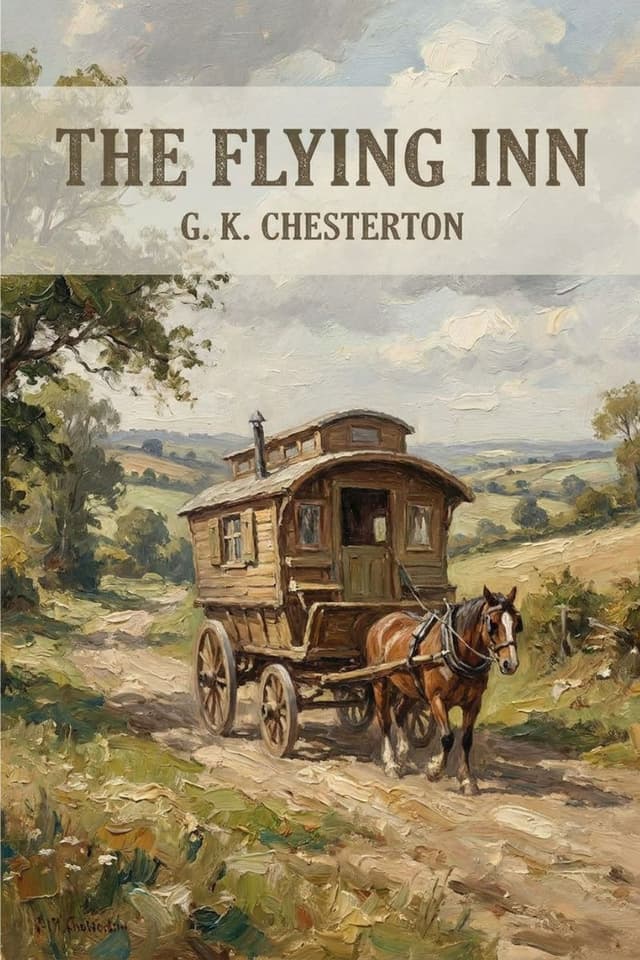
The Flying Inn
Read The Flying Inn by G. K. Chesterton for free on Novelhalla, and try out our easy-to-read modern edition of this classic book. You can also download the EPUB and read it on any device if you prefer!
The Plot
The Treaty
It begins with a peace treaty. England and her allies have concluded a war with the Ottoman Empire, and Lord Philip Ivywood, the handsomest man in Parliament, has negotiated the terms. The terms are, on the surface, equitable. Beneath the surface, something else is happening. The Turks have won more than anyone realizes.
Lord Ivywood is a cold man, a man of ideas rather than appetites. He believes in Progress. He believes that the old, muddled, beer-soaked customs of England are holding back the march of civilization. He has looked to the East and found what he considers a superior model: the clarity and discipline of Islam, with its prohibition on alcohol, its geometric beauty, its submission to a higher law.
The first step is modest. Parliament will not ban alcohol outright. That would be too obvious, too democratic, too open to debate. Instead, the new law will simply regulate inn signs. Public houses that display their signs may continue to serve drink. But the signs themselves require licenses, and the licenses, through a series of administrative complexities, become impossible to obtain.
One by one, the inn signs come down across England. The pubs close their doors. The rich, of course, can still obtain alcohol through medical certificates. The poor cannot. The temperance movement has achieved through bureaucracy what it could never achieve through persuasion.
The Old Ship
In the fishing village of Pebblewick, there stands an inn called The Old Ship. Its proprietor is Humphrey Pump, a man who knows every lane and hedgerow of the English countryside, every local legend and half-forgotten custom. He is a small man, quiet and capable, the sort of Englishman who has kept the country running for centuries while lords and politicians made speeches.
Pump is waiting for someone: his old friend Captain Patrick Dalroy, a giant red-haired Irishman who has been off having adventures in the East. Dalroy is a man of enthusiasms and contradictions. He resigned from the British Navy over England's treatment of Ireland, then somehow ended up leading a ragtag band of Christian rebels against the Turks, becoming briefly and absurdly the King of Ithaca. He writes poetry. He drinks. He falls in love easily and suffers for it.
When Dalroy returns to England, he finds a country he barely recognizes. The inn signs are coming down. A Turkish mystic named Misysra Ammon is preaching on the beaches, claiming that every English pub name derives from Islamic origins. Lord Ivywood's influence is everywhere. And Lady Joan Brett, the woman Dalroy loves, has fallen under Ivywood's cold spell.
The authorities arrive at The Old Ship with orders to remove the sign.
Dalroy does something characteristically mad. He tears the sign from the ground himself. He rolls out the last barrel of good rum from Pump's cellar. He loads them onto a cart with a great wheel of cheese, commandeers a donkey, and announces his intention to defy the law.
The Loophole
Here is the beautiful absurdity at the heart of the story: the new regulations state that alcohol may be served at any establishment displaying an inn sign. The legislators assumed that once the permanent signs came down, that would be the end of it. They did not account for a mobile sign.
Wherever Dalroy plants the sign of The Old Ship, there, for that moment, stands a legal public house. He and Pump become outlaws of a peculiar sort, roaming the English countryside in their donkey cart, appearing in unexpected places, serving rum to grateful common folk, and vanishing before Lord Ivywood's men can catch them.
It is a lark. It is a protest. It is, in Chesterton's vision, something close to a sacrament.
The Flying Inn is born.
The Chase
What follows is a picaresque adventure through an England gone slightly mad. Dalroy and Pump encounter a series of cranks and enthusiasts: vegetarians who live in a commune called Peaceways, where they drink only milk; theosophists seeking Eastern wisdom; progressive politicians who have lost all connection to the people they claim to serve; a poet named Dorian Wimpole who has forgotten how to write poetry until he meets our heroes and finds his voice again.
Lord Ivywood pursues them with the patience of a man who believes history is on his side. Each time they exploit a loophole, he closes it. Each time he closes it, Dalroy finds another. The chase becomes a battle of wits between two visions of England: Ivywood's rationalized, purified, Oriental-influenced utopia versus Dalroy's messy, drunken, singing, cheese-eating reality.
And through it all, the songs. Chesterton fills the novel with drinking songs and comic verses, composed on the spot by his characters as they flee through the countryside. There is "The Song of Right and Wrong," "The Song of Quoodle," "Wine and Water," "The Logical Vegetarian," and, most famously, "The Rolling English Road":
Before the Roman came to Rye or out to Severn strode, The rolling English drunkard made the rolling English road...
The poems are not great literature. They are the sort of thing you would sing while drunk in a cart, fleeing from the police with your friends, and that is exactly their point.
The Darkness Beneath
But this is Chesterton, and beneath the comedy lies something darker. Lord Ivywood is not merely a fool or a tyrant. He is a man in the grip of an idea, and the idea is consuming him. His stately home is being transformed, piece by piece, into something resembling a Turkish palace. His obsession with the East goes deeper than politics. There is talk of a harem. There are hints of madness.
Lady Joan Brett, caught between these two men, must choose what kind of England she believes in. There is also Lady Enid Wimpole, Lord Ivywood's cousin, who sees clearly what he is becoming. The women of the novel are not passive prizes; they are witnesses to a struggle for England's soul.
Meanwhile, the "Prophet of the Moon," Misysra Ammon, is working on the populace, attempting to convince them of the superiority of Islamic civilization. He finds his best audience not among the poor but among the elite, who are always hungry for something new and foreign to believe in.
The common people, meanwhile, are growing restless. They want their pubs back. They want their songs. They want the England they remember, the one that was built not by bureaucrats but by drunkards stumbling home through crooked lanes. The Flying Inn has become more than a joke. It has become a symbol.
Something is building toward confrontation. Lord Ivywood's plans go deeper than anyone suspects. The question is whether Dalroy and Pump, with their rum and cheese and donkey, can stop what is coming.
About the Author: G.K. Chesterton
The Prince of Paradox
Gilbert Keith Chesterton was born on May 29, 1874, in Kensington, London, into a comfortable middle-class family. His father was an estate agent with a passion for literature and amateur theatricals. Young Gilbert inherited both the business sense (which he promptly ignored) and the love of performance (which he refined into a career of public argument).
He was not a good student. At St. Paul's School, his teachers considered him an underachiever, though he showed talent for writing and debate. He went on to the Slade School of Art, intending to become an illustrator, but found himself drifting toward journalism. It was the right drift. Chesterton's visual imagination informed his prose, filling it with concrete images that made abstract ideas vivid and memorable.
By his mid-twenties, he was writing columns for the Daily News and would soon add a weekly column for the Illustrated London News that he would continue for thirty years. He wrote essays, reviews, biographies, poetry, plays, and fiction at a pace that astonished his contemporaries. Over his lifetime, he would produce roughly eighty books, two hundred short stories, four thousand essays, and hundreds of poems. He edited his own newspaper. He debated publicly with George Bernard Shaw, H.G. Wells, and Bertrand Russell. He was one of the most famous writers in the English-speaking world.
The Mountain That Walked
Physically, Chesterton was impossible to miss. He grew to be enormously fat, well over six feet tall and nearly three hundred pounds, often seen on London streets wearing a cape, carrying a swordstick, and sporting a crumpled hat. He was famously absent-minded, once sending his wife a telegram reading "Am at Market Harborough. Where ought I to be?" He laughed at his own jokes, caught buns in his mouth at children's parties, and cultivated an image of jovial chaos that masked a sharp and disciplined mind.
His style was paradox. He delighted in turning conventional wisdom inside out, arguing that the modern world had everything backward. Progressives, he claimed, were the true conservatives, clinging to the dying faith of the nineteenth century, while Christians were the true radicals, standing against the drift of their age. He distrusted experts, politicians, and anyone who claimed to know what was good for ordinary people better than ordinary people did.
The Conversion
Chesterton was raised in a vaguely liberal, vaguely agnostic household, lost his faith as a young man, and spent years finding his way back. His book Orthodoxy (1908) described this journey: not a rejection of doubt but an embrace of the Christian story as the only one that made sense of both the glory and horror of existence.
For years he remained an Anglican, but his thought was moving steadily toward Rome. In 1922, at age forty-eight, he was received into the Catholic Church. His wife, Frances, whom he had married in 1901 and adored for the rest of his life, followed him four years later.
Catholicism gave Chesterton a framework for his political and social views. With his friend Hilaire Belloc, he developed Distributism, an economic theory that rejected both capitalism and socialism in favor of widely distributed property ownership. Small shops, small farms, small communities: these were the foundations of a free and human society. Big business and big government were equally dangerous.
The Priest-Detective
Chesterton's most enduring creation is Father Brown, a small, shabby Catholic priest who solves crimes through his understanding of human nature rather than forensic brilliance. Based loosely on a real priest named John O'Connor (who would later receive Chesterton into the Church), Father Brown appeared in fifty-three short stories between 1911 and 1936. The character has been adapted for film, radio, and television countless times.
The Father Brown stories are deceptively simple. Beneath the puzzle-solving lies Chesterton's conviction that crime is ultimately a spiritual problem, that criminals are not monsters but human beings who have made terrible choices, and that forgiveness is always possible. Father Brown never hands his culprits over to the police if he can help it; he would rather save their souls.
The Last Years
Chesterton continued writing at his furious pace into the 1930s, though his health was failing. He and Frances had no children. His brother Cecil, with whom he had been close, had died in 1918 from illness contracted during the First World War. The optimistic England of his youth had been shattered by that war and seemed unlikely to recover.
He died on June 14, 1936, at his home in Beaconsfield. He was sixty-two years old. His body was buried in the Catholic cemetery there, but his literary remains filled libraries. His influence extended far beyond his own readers: C.S. Lewis credited The Everlasting Man with his conversion to Christianity; Michael Collins drew inspiration from The Napoleon of Notting Hill; Gandhi claimed that a Chesterton essay had influenced his thinking about Indian independence.
The Catholic Church has opened a cause for his canonization. Whether or not he becomes a saint, he remains the "prince of paradox," a man who made argument into entertainment and made joy into a form of rebellion.
Fun Facts About the Book
Prohibition Prophecy
The Flying Inn was published in January 1914, six years before Prohibition came to the United States. Chesterton's satire of a world where the rich can obtain alcohol through "medical certificates" while the poor go thirsty proved eerily accurate: during American Prohibition, doctors wrote millions of prescriptions for "medicinal" whiskey.
Chesterton's Favorite
Chesterton said that The Flying Inn was one of the books he most enjoyed writing, alongside Orthodoxy and Heretics. He apparently took great pleasure in composing the drinking songs, the farcical chase scenes, and the satirical portraits of cranks and utopians.
The Marconi Scandal
Chesterton began writing The Flying Inn shortly after his brother Cecil was sued for libel in connection with the Marconi Scandal, a financial corruption case involving several prominent politicians. The novel's portrait of Lord Ivywood and his circle reflects Gilbert's fury at what he saw as a political class that had lost all connection to the people it claimed to serve.
The Rolling English Road
The poem "The Rolling English Road" first appeared under the title "A Song of Temperance Reform" in The New Witness, the political weekly edited by the Chesterton brothers. It has since become one of Chesterton's most frequently anthologized poems, often appearing in collections of English verse without any indication that it comes from a comic novel about bootleggers.
The Humphrey Pump
Chesterton named his character "Humphrey Pump" after an actual device: the Humphrey pump was a water pumping system invented in the early twentieth century. The joke is that the character pumps beer rather than water.
Critical Reception
Critics at the time complained that The Flying Inn glorified drunkenness. Chesterton responded that they had missed the point entirely: he was defending not alcohol but community, the pub as a gathering place where working men could talk and argue at the end of the day. Temperance, he insisted, meant moderation, not abstinence. Self-control was an act of freedom; prohibition was not.
Too Unrealistic?
The most common criticism of The Flying Inn when it was published was that its premise was absurd. England would never ban pubs. The political class would never fall under the spell of Islamic influence. Modern readers have noted that this criticism has not aged well.
Themes
The Defense of the Ordinary
Chesterton's great theme is the holiness of common things: bread, wine, cheese, song, the crooked road, the village pub. His villains are always reformers who want to improve humanity by taking away its simple pleasures. His heroes are those who recognize that these pleasures are not distractions from the good life but essential components of it.
Bureaucratic Tyranny
Lord Ivywood never declares himself a dictator. He simply regulates. The genius of his scheme is that it appears reasonable at every step. Each new rule closes a loophole, addresses a concern, fixes a problem. By the time anyone realizes what has happened, the pubs are closed and the protests are illegal. Chesterton saw this coming: the tyranny of the future would wear the mask of helping.
The Danger of Ideas
Lord Ivywood is not corrupt in the ordinary sense. He does not want power for its own sake or money for his pleasures. He wants to remake England according to an abstract vision of purity and order. This makes him far more dangerous than any common tyrant. A man who wants only wealth can be bought off; a man possessed by an idea will sacrifice everything, including himself.
The Wisdom of the Common People
Dalroy is Irish and educated; Pump is English and unlettered. But Pump knows things Dalroy does not: the back lanes, the local customs, the way the land lies. Chesterton trusted the instincts of ordinary people more than the theories of experts. The people know what they want. The question is whether their rulers will let them have it.
The Sacramental Vision
For Chesterton, the inn sign that creates a pub wherever it stands is a kind of sacrament, a visible sign that brings an invisible reality into being. The Flying Inn is a comic novel, but its comedy rests on a serious idea: that material things can be holy, that eating and drinking together is a form of worship, that the opposite of Islam's rejection of alcohol is Christianity's transformation of wine into something sacred.
The Book's Legacy
The Flying Inn is not Chesterton's most famous novel. That honor belongs to The Man Who Was Thursday, with its nightmare logic and metaphysical vertigo. It is not his most influential: The Napoleon of Notting Hill inspired real political movements. It is not his most beloved: the Father Brown stories have been adapted endlessly and remain in print worldwide.
What The Flying Inn offers is Chesterton at his most exuberant and most angry. It is a novel written in a mood of "great mirth and high anger," as one critic put it, a book that wants to make you laugh and make you furious and make you thirsty all at once. It is a defense of beer and cheese and friendship and singing, against all the forces of the modern world that want to make us efficient and healthy and alone.
The novel has found new readers in recent decades, partly because its satire of progressive elites imposing their values on an unwilling populace seems less fantastical than it once did, and partly because its drinking songs are simply fun to read aloud. It is the sort of book that makes you want to find some friends, open a bottle, and toast to the rolling English road.
The story ends, as Chesterton's stories often do, with a confrontation between the forces of life and the forces of theory. Whether the Flying Inn survives, whether England remembers what it means to be England, whether Dalroy wins back his lady and Ivywood gets his comeuppance, these questions the reader must discover for themselves.
But there is good news yet to hear and fine things to be seen.