Novelhalla
In the Bishop's Carriage
Read In the Bishop's Carriage by Miriam Michelson for free on Novelhalla, and try out our easy-to-read modern edition of this classic book. You can also download the EPUB and read it on any device if you prefer!
The Plot
Nance on the Run
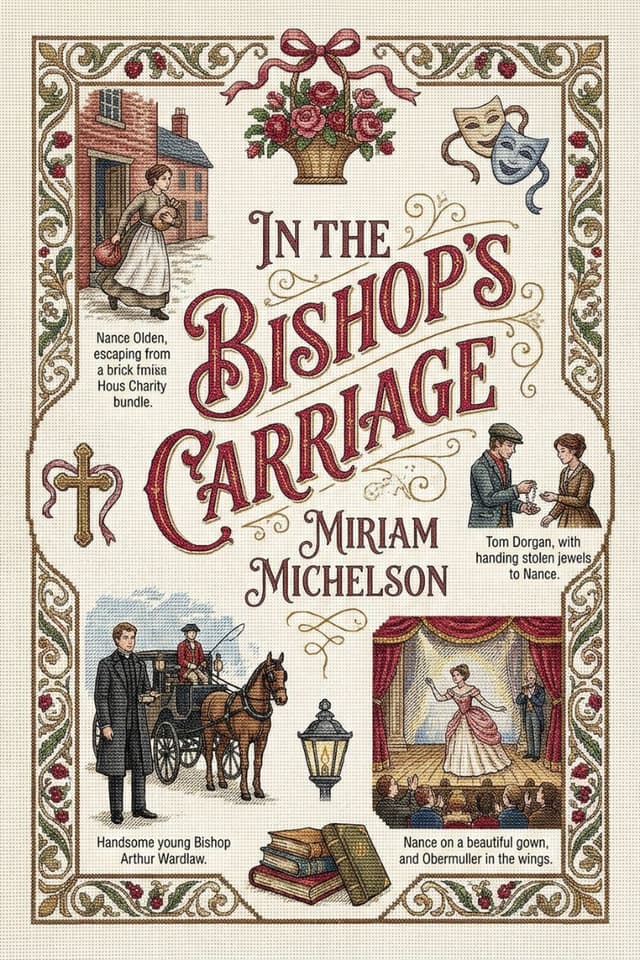
Nancy "Nance" Olden is a thief. A very good one, most of the time. Raised in a brutal orphanage its inmates call "the Cruelty," she escaped into the only life available to a girl with no family, no money, and no prospects: crime. When the novel opens, Nance is in trouble. She and her partner, a pickpocket named Tom Dorgan, have just pulled a job at the train station, and something has gone wrong. She has stolen goods on her person, the police are closing in, and she needs to disappear.
What follows is a breathless sequence of quick thinking and outrageous lies. Nance ducks into a women's waiting room, swipes a red coat to change her appearance, and slips out into the night. She spots a fine carriage waiting at the curb and climbs in, hoping to hide. The carriage, as it turns out, belongs to a bishop.
When the Bishop discovers her, Nance improvises a tearful story about mistaking it for her father's carriage, then fakes a sudden illness. The kind-hearted Bishop, completely taken in, brings her to the home of a respectable family to be looked after. It is a wildly improbable stroke of luck, the kind that will keep finding Nance throughout the story, though she usually has to help it along with her wits.
A Natural Performer
Nance's talent is not really thievery. It is performance. She can talk her way into and out of anything. She can become whoever the situation requires: a pitiful orphan, a society lady, a grieving daughter, a charming innocent. She has been doing it her whole life, and she is spectacular at it.
This skill catches the eye of Fred Obermuller, a theatrical agent who stumbles into her path during one of her narrow escapes from the law. When Nance bursts into his office with police on her heels, Obermuller shoves a script into her hands and tells the officers she is an actress studying a part. The lie saves her. But Obermuller sees something more than a clever criminal. He sees genuine acting talent, raw and untrained but unmistakable, and he offers Nance an opportunity: a real role on a real stage.
The Pull of Two Lives
The rest of the novel follows Nance as she tries to leave her criminal past behind and build a legitimate life in the theater. It is not a smooth transformation. Tom Dorgan is still out there, still part of her old world, and the pull of easy money and familiar habits does not let go easily. Nance is also carrying secrets and stolen goods that have a way of catching up with her.
Meanwhile, the stage opens up a world Nance never imagined. She discovers that the skills she developed as a con artist translate beautifully to acting, and she finds people who believe in her potential: Obermuller, who sees her talent; a society woman named Mrs. Ramsay, who sees her character; and others who offer kindness she has rarely experienced and does not quite know how to accept.
The novel's central tension is whether Nance can truly reinvent herself. She wants to go straight, but the past keeps pulling at her sleeves. She owes debts, literal and moral. There are people she has wronged and people she still cares about on the wrong side of the law. The question is whether a girl raised in the Cruelty, trained by criminals, and wanted by the police can shed that life and become someone new, or whether the world will simply not allow it.
About the Author: Miriam Michelson
Gold Rush Roots
Miriam Michelson was born in 1870 in Murphy's Camp, a Gold Rush mining town in Calaveras County, California. She was the seventh of eight children of Samuel and Rosalie Michelson, Polish Jewish immigrants who had fled anti-Semitic persecution in 1855 and eventually settled in Virginia City, Nevada, where they made their living as merchants selling supplies to miners. It was a rough, colorful upbringing on the Western frontier, and Michelson would draw on it for the rest of her career.
Her family was remarkable by any measure. Her eldest brother, Albert Abraham Michelson, became the first American citizen to win a Nobel Prize in the sciences, for his work in physics measuring the speed of light. Her youngest brother, Charles Michelson, became a prominent journalist and close political advisor to Franklin D. Roosevelt. And Miriam herself, in her prime, was so famous that when Albert won his Nobel Prize in 1907, newspaper reports identified him as "Miriam Michelson's brother."
The Girl Reporter
Michelson began her career in journalism in the 1890s, writing for the San Francisco Call and later the San Francisco Bulletin. At a time when women reporters were almost exclusively limited to the "Women's Page," covering fashion, food, and society events, Michelson shattered those expectations by reporting on crime, politics, and social justice. She covered police corruption in San Francisco's Chinatown, profiled suffrage leaders including Susan B. Anthony, and wrote fearless opinion pieces on imperialism, racism, and women's rights.
Her writing was vivid, personal, and bracingly honest. She became one of the most widely read journalists in San Francisco, and her work as a "girl reporter" pioneered a type of gutsy female journalist character that would influence writers for decades.
From Journalism to Fiction
In 1903, the first chapter of In the Bishop's Carriage appeared as a short story in Ainslee's Magazine. It attracted the attention of the Bobbs-Merrill Company, which offered her a deal to expand it into a full novel. Published in 1904 with illustrations by the popular artist Harrison Fisher and a cover designed by the celebrated Margaret Armstrong, the book became a sensation. It ranked fourth on the Publishers Weekly bestseller list for the year and generated controversy for its morally ambiguous heroine.
Michelson went on to write several more novels, including A Yellow Journalist (1905), a barely fictionalized account of her own experiences in the newsroom that inspired a young Edna Ferber to pursue a career in journalism. She also published The Awakening of Zojas (1910), a collection of novellas that earned her a place among early science fiction writers.
Later Years
Michelson continued writing and working as a journalist through the First World War, when she was active in San Francisco social organizations. Her last novel, Petticoat King, about Elizabeth I, was published in 1929. Her final book, The Wonderlode of Silver and Gold (1934), was a history and memoir of Virginia City, returning to the mining towns of her childhood. She died on May 28, 1942, in San Francisco.
Fun Facts About the Book
A Blockbuster of 1904
In the Bishop's Carriage ranked fourth on the Publishers Weekly annual bestseller list for 1904, making it one of the most commercially successful novels of the year. For a debut novel by a woman journalist, this was an extraordinary achievement. The book caused a stir for presenting a female criminal as its charming, sympathetic protagonist at a time when fictional heroines were expected to be models of virtue.
A Controversial Heroine
Critics and readers were divided over Nance Olden. Some praised her as a refreshingly unconventional character: smart, tough, and self-reliant. Others were scandalized by a novel that asked readers to root for a thief and a liar. One description of the era called it "a tale of a college girl gone bad," which is not even remotely accurate but gives a sense of how disorienting the character was for some audiences.
The Artful Dodger in Skirts
Reviewers and modern readers alike have compared Nance Olden to Charles Dickens's Artful Dodger: a young pickpocket raised in institutional cruelty who survives by charm and quick wits. But where the Artful Dodger remains in the criminal world, Nance gets a chance to escape it. The comparison highlights just how unusual it was in 1904 for a female character to occupy this kind of roguish, picaresque role.
Harrison Fisher's Illustrations
The original edition featured illustrations by Harrison Fisher, one of the most popular illustrators of the era, famous for his glamorous "Fisher Girl" portraits. The cover was designed by Margaret Armstrong, a renowned book cover artist whose decorative designs are now collectors' items. First editions with both Fisher's plates and Armstrong's distinctive binding are highly sought after by antiquarian book collectors.
From Bestseller to Broadway
The novel was adapted into a play by Channing Pollock, which opened at the Grand Opera House on Broadway in February 1907. Pollock, who would go on to write for the Ziegfeld Follies, saw stage potential in Nance's theatrical transformations and fast-talking escapes. The play had a brief run, but it set the stage for an even bigger adaptation.
Mary Pickford Starred in the Film
In 1913, the Famous Players Film Company produced a silent film adaptation starring Mary Pickford, then at the start of what would become one of the most legendary careers in cinema history. In the Bishop's Carriage was among the first feature-length films Pickford made for Adolph Zukor's company, and its success helped establish her as the irresistible screen presence who would soon be called "America's Sweetheart." The film is now considered lost. A second film version, titled She Couldn't Help It, was made in 1920 with Bebe Daniels in the lead.
Nance Tells Her Own Story
The novel is written in the first person, with Nance addressing her story directly to people from her life, first to Tom Dorgan and later to her old orphanage friend Mag Monahan. This narrative technique gives the book an immediacy and intimacy that was unusual for the period and makes Nance's distinctive, streetwise voice the engine of the whole novel.
The Wonder Woman Connection
Michelson's later novella, The Superwoman (1912), published in The Smart Set magazine, imagined a utopian matriarchal island society. Scholars have identified it as source material for the Wonder Woman comics, predating both Charlotte Perkins Gilman's similar novel Herland (1915) and the creation of Wonder Woman by nearly three decades. So the woman who created Nance Olden, literature's charming female pickpocket, also helped lay the groundwork for one of the most iconic superheroines in popular culture.
Freely Available
In the Bishop's Carriage is in the public domain and available for free through Project Gutenberg and LibriVox, where it has been recorded as a full audiobook.
Themes
Reinvention and Identity
Nance Olden is a woman made up of performances. She has been playing roles since childhood, becoming whoever she needs to be to survive. The novel asks whether such a person can ever become "real," whether a life built on lies and disguises can be reconstructed on honest foundations. The theater becomes the perfect metaphor: on stage, the skills that made Nance a criminal become art.
The Making of a Criminal
Michelson does not romanticize crime, but she refuses to moralize about it either. Nance was raised in a horrific orphanage and turned to theft because no other path was available. The novel quietly insists that its readers consider how much of Nance's character was shaped by circumstance rather than nature, and how thin the line is between a con artist and a survivor.
Kindness and Its Power
Throughout the story, acts of unexpected kindness change the course of Nance's life. The Bishop's charity, Obermuller's faith in her talent, Mrs. Ramsay's trust: each of these gifts creates a new possibility that Nance's previous life never offered. Michelson suggests that redemption is not something people achieve alone. It requires someone willing to extend a hand, even when the risk is considerable.
A Woman's Wit in a Man's World
Nance survives by her intelligence, her tongue, and her nerve. She is smarter than most of the men around her and more resourceful than the respectable women who have never had to be. Michelson, a journalist who had clawed her own way into the male-dominated newsrooms of San Francisco, understood viscerally what it meant to be a woman relying on nothing but her wits. Nance Olden is her most vivid expression of that understanding.
The Limits of Respectability
The novel questions what "respectability" actually means. The respectable world that judges Nance so harshly has produced the orphanage that brutalized her and the society that gave her no options. Meanwhile, Nance, for all her criminal history, displays loyalty, courage, and a kind of rough honesty that many of her "betters" lack. Michelson complicates the easy division between good society and the criminal underworld.
The Book's Legacy
In the Bishop's Carriage was a genuine phenomenon of early twentieth-century American publishing. It proved that a novel with a morally complex female protagonist could not only sell but sell spectacularly, and it helped establish a tradition of roguish, fast-talking heroines in American fiction. Michelson's Nance Olden arrived decades before the "bad girl" became a familiar figure in popular culture.
The novel's cross-media success was remarkable for its era. It jumped from magazine serialization to bestselling novel to Broadway play to a Mary Pickford film within less than a decade, a trajectory that demonstrated the hunger audiences had for a story about a clever woman outwitting the system.
Miriam Michelson herself has faded from public memory far more than her work's influence would suggest. During her lifetime, she was one of the most prominent women in American letters, a pioneering journalist and bestselling novelist whose work inspired Pulitzer Prize-winning author Edna Ferber and anticipated feminist literary traditions that would not fully develop for decades. Recent scholarly work, particularly Lori Harrison-Kahan's 2019 collection The Superwoman and Other Writings by Miriam Michelson, has begun to recover her reputation and recognize her contributions to American literature, journalism, and the women's suffrage movement.
For modern readers, In the Bishop's Carriage remains a surprisingly fresh and entertaining read. Nance's voice is as sharp and winning today as it was in 1904, and the questions the novel raises about identity, second chances, and what society owes the people it fails are as relevant as ever.