Novelhalla
The Clockwork Man
Read The Clockwork Man by E. V. Odle for free on Novelhalla, and try out our easy-to-read modern edition of this classic book. You can also download the EPUB and read it on any device if you prefer!
The Plot
A Saturday Afternoon in Great Wymering
Doctor Allingham is having a bad season. He's forty, he can't make runs anymore, and his name keeps appearing in the local paper as having been dismissed for a mere handful. He's at the crease and finally settled, the bowling is broken, and he only has to hit now.
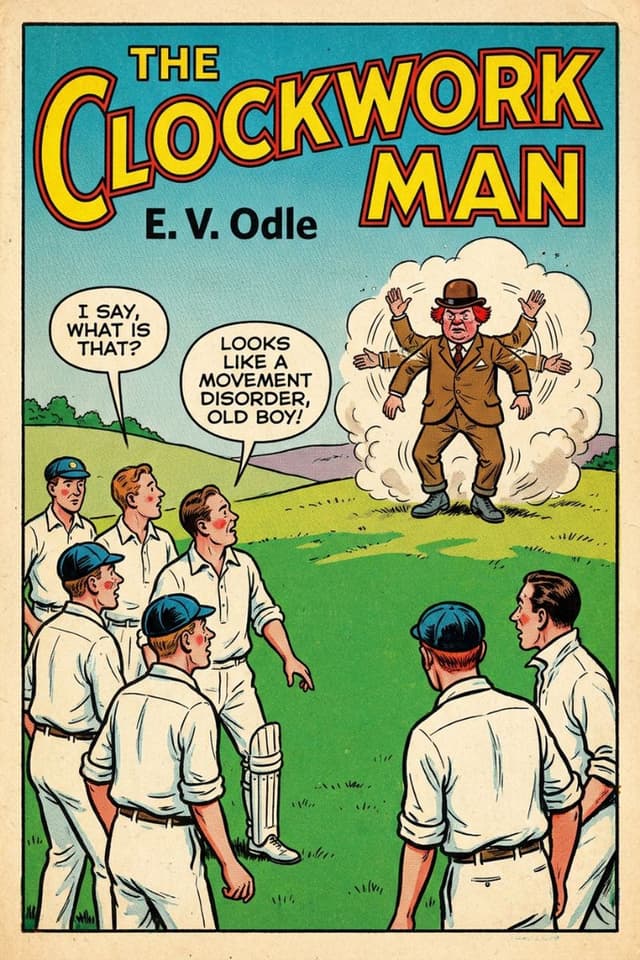
And then something appears on the hill behind the sightscreen. It looks at first like a scarecrow that's been dumped there. Its arms revolve like windmill sails. Its legs shoot out in all directions in a cloud of dust. It seems, infuriatingly, to be imitating a man in the act of bowling.
Allingham's wicket goes down. He walks back to the pavilion in a black rage and tells the captain that some idiot with a lot of extra arms and legs has just cost him his innings.
But when he looks out of the pavilion window, the thing is still there. It's come closer. It's hanging on the fence at the edge of the ground, and it's gone completely, unnaturally still.
The Thing on the Fence
Arthur Withers is the other person watching. Arthur is a bank clerk, a bit of a fool by general agreement in Great Wymering, and he's spent the whole afternoon lying in the long grass praying that something will happen to save him from having to bat.
So he wanders over for a look, and finds a man in a snuff-coloured suit and leaden-looking boots, wearing a very red wig with a brown bowler jammed on top of it, and a face whose features seem to melt into one another so that all you can really say is that you're looking at a face.
The man is flapping his ears. Not twitching them. Flapping them, backwards and forwards, faster than any human ear has moved in the history of the species.
Arthur, out of sheer politeness, asks whether the gentleman wanted to speak to him. The gentleman opens his mouth and says "Wallabaloo. Wallabaloo. Bompadi. Bompadi. Wum. Nine and ninepence."
Then, after a good deal of grinding and creaking and several failed attempts, he manages a complete sentence, which is a denial that he's an escaped lunatic. And then, all at once, he brightens, hauls himself up on the fence, tells Arthur to listen, and asks whether he can hear it.
Arthur can. It sounds like about a hundred alarm clocks going off at once, somewhere inside the man's chest.
"It's only my clock," the stranger explains, and climbs over the fence.
The Wonderful Cricketer
He wants to play. Great Wymering is a man short, so they let him.
He won't take centre. He holds the bat in the air at an angle nobody recognises and refuses to put it down. Then the demon bowler sends one down and there's an ear-splitting crack and nobody actually sees the shot, but the ball is last observed as a dot in the sky heading toward the brewery. The next one goes toward a line of poplars on the horizon. The one after that appears to be aimed at the church flagstaff in the High Street. One of them turns up three weeks later in a disused yard three miles away.
He also refuses to run when he's called, laughs at an injured batsman with a noise like a hundred cracked bells, and, when he finally does run, doesn't stop at the wicket, or at the wicketkeeper, or at the fielders, and has to be turned around by hand like a wind-up toy that's got itself stuck against a wall.
The village finds all this hilarious. It's the funniest thing that's happened in Great Wymering in years.
Then the umpire puts a hand on his shoulder to explain that he's out, and something flashes in the air, and the umpire goes down like a log. The fielders rush him in a body and go over one after another like ninepins. And when it's finished and the field is full of prone men in flannels, the stranger throws the bat away, runs at the fence, and floats over it without touching it.
By the time anyone can speak, he's a dot on the horizon.
What Was Written Inside the Hat
The town spends the evening deciding that the Devil has come to Great Wymering, which given the goings-on since the war doesn't surprise anybody. The police borrow Allingham's car and go looking. They don't find him.
What they find is a boy from the next village who pulled a pair of kicking legs out of a chalk pit and, in the process, got a good look at the back of the man's head, where the back of a head ought to be. He describes what he saw by pointing at the clock on the doctor's mantelpiece and explaining that it was like that one, only with more hands, and going very fast.
They also find the hat and the wig, which had rolled to the bottom of the pit.
Gregg, the young captain, tells Allingham to look inside them. There's a maker's label in the hat, from a firm any Londoner in 1923 would know, and it says the company has been established over two thousand years. There's a tab in the wig from a wigmaker any theatregoer would know, describing himself as supplier to the Seventh International.
Allingham tries very hard to laugh. He can't quite manage it.
Two Men Arguing About the Future
The argument at the centre of this book is between two men in a sitting room over a delayed tea.
Gregg is twenty-four, fresh from Cambridge, and cheerfully certain that time is relative, that the future has already happened, and that the man they saw this afternoon is what human beings are going to do to themselves when their bodies stop being able to take the strain of the world they've built.
Allingham is forty, engaged to a clever woman whose letters have lately turned into rather good essays that he'd honestly rather not read, and he has spent twenty years quietly settling for a smaller version of himself. He wants a stable universe. He has an explanation for everything: a machine in the man's pocket, some kind of electric shoe, locomotor ataxia in an advanced form. His most cherished weapon against the impossible is the ability to make a joke out of it.
And the novel is very interested in that, because everyone who meets the Clockwork Man laughs first, and laughing turns out to be a wonderfully effective way of not having to think about what you've just seen.
The Man from Nowhere
Meanwhile the visitor is loose in Great Wymering, working the silencer, getting stuck against a lamp post, being moved along by a constable who ends up begging him to stop it because the wife will never believe him, helping himself to the vicar's hat off the vicar's head as he passes, and being mistaken by a flustered curate for the conjurer who was booked for the children's entertainment.
He's also beginning to come round. His speech steadies. His sentences get longer. And he starts to explain a few things: that the clock in his head is a regulating mechanism, that when it works properly he can move not only somewhere but somewhen, that only about half of it is functioning at present, and that as far as he can make out he's slipped back about eight thousand years.
He's perfectly willing to tell them what the clock does, who fitted it, and why it was thought necessary.
That's the part nobody in Great Wymering is ready for.
About the Author: E. V. Odle
The Odles of Bloomsbury
Edwin Vincent Odle was born in 1890, and almost everything about him is hard to pin down. He was a playwright, a critic, and a writer of short stories, and he lived in Bloomsbury through the 1910s, which put him within a few streets of most of the people who were reinventing English prose at the time.
His older brother Alan was the family's famous one: an illustrator with a grotesque, spidery, almost surrealist line, a thoroughgoing bohemian who ran with Augustus John and Jacob Epstein and Wyndham Lewis. In 1917 Alan married Dorothy Richardson, who had written the first stream-of-consciousness novel in English and who had spent several years as H. G. Wells's lover before settling down with him.
So Edwin's route into publishing ran through his sister-in-law. Richardson's own mentor was J. D. Beresford, the author of two significant early scientific romances, and Beresford appears to have helped Odle get his first book into print and quite possibly his second as well.
The War
Between the Bloomsbury years and the novels there's a detail worth pausing on. During the First World War, Odle managed a munitions factory.
Nobody has written much about what that was like for him. But it's not a small thing that the man who wrote the first novel about a machine-augmented human being had spent the war running a plant devoted to the industrial production of things designed to take human bodies apart.
Two Books, One Career
His first novel was a picaresque published in 1922. The second came out from Heinemann in April 1923, sank without much trace, and turned out to be the only thing anyone would remember him for.
From about 1926 he became the founding editor of The Argosy, a British short-story magazine, and he stayed in the chair for roughly the next decade. He seems to have been a good editor. He published very little of his own after that.
He died in 1942, aged fifty-two.
The Book Nobody Read for Seventy Years
He wasn't finished writing, though. Over the last decade or so of his life he worked on a second science fiction novel, about an inventor and manufacturer whose automata evolve into sentient beings, acquire a new source of atomic power, and more or less finish off civilisation.
It never found a publisher in his lifetime. The typescript survived, and it was finally printed in 2016, seventy-four years after his death.
Fun Facts About the Book
The Word Didn't Exist Yet
The term cyborg was coined in September 1960, by Manfred Clynes and Nathan Kline, in an article about adapting the human body for long-duration space travel rather than hauling an earthly environment along with it. Odle got there thirty-seven years earlier without a vocabulary for it, which is why his hero has to keep resorting to phrases like "I am a clockwork man" and hoping people will work it out.
It Was Buried by a Robot
1923 was also the year English-speaking audiences met Karel Čapek's play R.U.R., the sensation that gave the world the word robot and an image of mechanical revolt that stuck immediately. Čapek's machines rise up and destroy their masters, which is a story people knew how to be frightened by. Odle's machine turns up at a cricket match and asks the way. One of those got a century of adaptations and the other got out of print.
The Labels Are the Best Joke in the Book
Both firms named inside the hat and the wig were real, and both were going concerns in 1923. The hatters were a well-known London chain. The wigmaker was the most famous theatrical wig and costume house in the country, run from a florid building in Wardour Street whose foundation stone had been laid by Sarah Bernhardt and whose coping stone had been laid by Henry Irving.
Odle's joke is that both are still trading eight thousand years later, one of them advertising a two-thousand-year pedigree and the other supplying an International that has apparently reached its seventh iteration. It's a throwaway gag, and it's also the sharpest idea in the novel: the future doesn't abolish the past, it just preserves it forever, letterhead and all.
The Epigraph Is a Dare
The book opens with a line from the psychologist C. Lloyd Morgan, to the effect that consciousness in a mere automaton is a useless and unnecessary extra. Everything that follows is an argument with that sentence, since the Clockwork Man is quite obviously conscious, quite obviously miserable about it, and quite obviously an automaton.
A Virginia Woolf Hoax
At some point the story got about that E. V. Odle was a pen name Virginia Woolf used for writing scientific romances. It's an elaborate spoof, it has been comprehensively debunked, and it refuses to die. The genuinely strange thing is that Odle really did live a few streets from Woolf in Bloomsbury during exactly the right years, which is presumably why the story has legs.
The Dedication
The book is dedicated, without explanation, to Rose Isserlis. It's one of the very few personal traces Odle left anywhere. A Rose Odle published a family memoir in 1972 which remains one of the only sources anybody has for what these people were actually like.
Themes
Laughing as a Way of Not Looking
The most modern thing in the book is the observation that a genuinely new idea arrives looking ridiculous, and that a society's first and most effective defence against it is comedy. Everyone in Great Wymering laughs at the Clockwork Man. The crowd laughs when he can't stop running. The constable decides it was the gin. The village decides it was the Devil, which is at least an attempt at explanation. Only Arthur, who's too simple to be embarrassed, and Gregg, who's too young to be frightened, actually look at the thing in front of them.
Odle knew his readers would snort. He wrote the snorting into the book.
Efficiency
Allingham hates the word, and the novel keeps circling it. The clock makes a man perfectly efficient at whatever the clock has been set to do, which is why the Clockwork Man can hit a cricket ball three miles and cannot understand why he's expected to run afterwards. Competence without comprehension. Perfect execution of one task, total blankness about everything around it.
It's worth remembering that this was written in the decade when industrial time-and-motion study was reorganising human beings on factory floors all over Britain and America, by a man who'd managed a munitions plant.
Time and Space as Problems to Be Abolished
The Clockwork Man's real complaint about 1923 isn't the people. It's the physics. He can't grasp the idea of a thing being in a place. He keeps bumping into objects that oughtn't to be there. Where he comes from, the clock made humanity independent of both time and space, and the whole business of one thing at a time in one spot at a time has been engineered out of existence.
Arthur, shaving, thinking about paths worn across a meadow and about the moment when a star becomes visible, arrives at the same subject from the other end. He's the only person in Great Wymering doing metaphysics, and he doesn't know that's what it's called.
Getting Older and Closing Up
The portrait of Allingham is unexpectedly good and unexpectedly cruel. A man who once had gleams of original research, gave it up for a comfortable country practice, and now finds his opinions have become as automatic as his morning exercises. He's engaged to a woman who thinks, which he finds admirable in principle and exhausting in fact. He believes in a stable universe mainly because he's built a life inside one.
He's the human argument against the future, and Odle gives him more dignity than you'd expect.
The Aim of Man Is Convenience
The Clockwork Man says this flatly, as a statement of historical fact, and it may be the most quietly alarming line in the novel. Everything follows from it. Every improvement is a convenience. Every convenience removes a friction. And the frictions turn out to include most of what the people in this book are living for.
Two Couples
Arthur and Rose are engaged. Allingham and Lillian are engaged. They're at opposite ends of the same road, one pair at the beginning of everything and the other pair rather further along, and the novel keeps cutting back to them while the visitor from the future explains what happened to all of that.
Historical Context
1923
The war had been over for five years, and Britain had spent it discovering exactly what mechanised humanity could do. The men who came back had been through an industrial process. The word robot was about to enter English. Mass production, the assembly line, and the stopwatch were reorganising work.
And Einstein had become, since the 1919 eclipse observations, the most famous scientist alive, which is why a village cricket captain in this book can casually assert that time is relative and the future has already happened and be understood by a country doctor who admits he isn't quite up to date on abstruse speculations. Odle is writing for readers who'd been reading about the fourth dimension in the newspapers.
The Clockwork Man's world isn't a prophecy plucked from nowhere. It's what 1923 looked like if you drew the line forward and didn't flinch.
The Book's Legacy
For most of a century, this book's legacy was that it didn't have one.
It came out in April 1923, was overshadowed by a Czech play about mechanical men, and then went out of print for about ninety years. Brian Stableford, the leading historian of British science fiction, eventually named it the single work he'd most like to see rediscovered, which is a peculiar sort of fame: celebrated specifically for being forgotten.
The rediscovery has finally happened. A small press brought it back in 2013. The Washington Post went looking into it when the book entered the American public domain. And in 2022 MIT Press reissued it in a series devoted to the neglected science fiction of the early twentieth century, with an introduction by a contemporary novelist and science journalist.
What people find when they get there is stranger than the historical footnote suggests. The claim to be the first cyborg novel is real, and it's the least interesting thing about it. This is a comic novel. It's built out of village cricket, embarrassed curates, boarding-house landladies, and a policeman who'd rather not have to explain any of this at the station. The prose is light and quick, the characters are drawn with real affection, and the book is under 200 pages.
Jonathan Lethem has described it as a missing link between Lewis Carroll and the later absurdists of science fiction, and argued that it suggests a whole alternate ancestry for the genre, one owing as much to Chesterton as to Wells. That's about right. It's what you'd get if a serious idea about the mechanisation of human life were handed to somebody whose instincts were fundamentally comic rather than apocalyptic, and who understood that the truly frightening thing about the future is that we'll probably find it funny.