Novelhalla
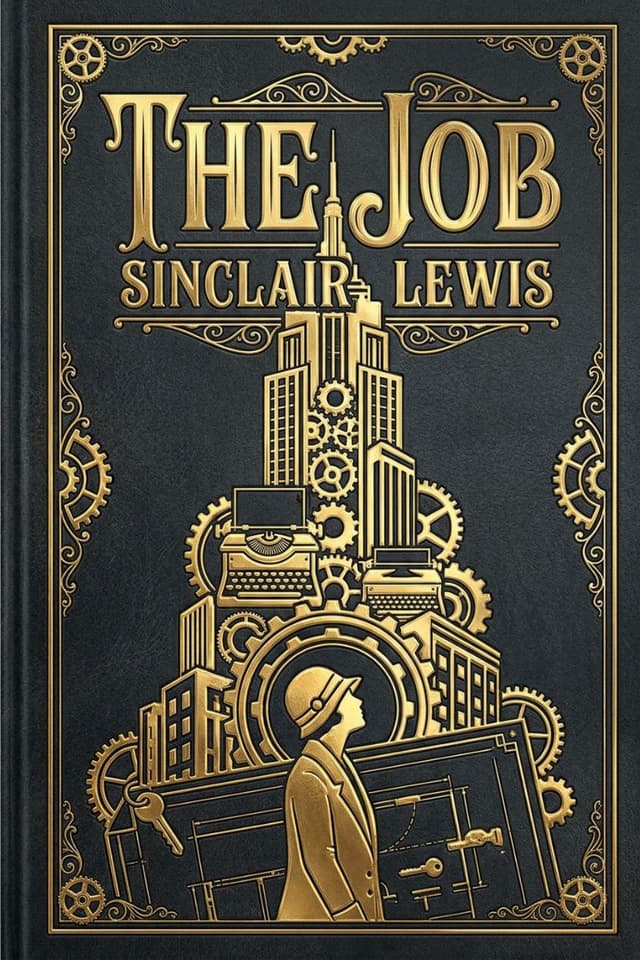
The Job
Read The Job by Sinclair Lewis for free on Novelhalla, and try out our easy-to-read modern edition of this classic book. You can also download the EPUB and read it on any device if you prefer!
The Plot
A Small Town With No Room
Una Golden is twenty-four years old and trapped. She lives in Panama, Pennsylvania, a town so small and airless that her entire list of career options fits on one hand, and none of them are good. She can teach at the district school, where old Miss Mattie Pugh has been withering behind a desk for seventeen years. She can marry Henry Carson, a widower with a bald spot, three children, and catarrh. Or she can stand behind a counter at the Hub Store and lose whatever social standing her family has left.
Her father has just died, leaving behind a good name, a stack of debts, and eleven hundred dollars in lodge insurance. After the creditors are paid, there's almost nothing. Una's mother is gentle and sweet and completely useless in a crisis. She writes poetry about spring, vaguely believes in Christian Science, and suggests, with moist eyes, that perhaps Una could go back to teaching.
Una does not want to go back to teaching.
Then a letter arrives from a family friend who has moved to New York. A single suggestion, casually made: why not come to the city and learn stenography?
Within hours, Una has made the biggest decision of her life.
The City That Promises Everything
New York in 1905 is enormous and indifferent and thrilling. Una enrolls in a commercial college on the Upper West Side, learning shorthand and typing alongside rows of other young people who are all, in their own way, desperate for a foothold. She is not a genius. She is not beautiful. She is a thoroughly ordinary small-town girl with good common sense and a quiet hunger to become something more than what Panama, Pennsylvania, had planned for her.
She meets people who expand her world. Sanford Hunt, a clean-cut young man devoted to his paint company with an almost religious fervor. Sam Weintraub, a sharp, red-headed Brooklyn kid who wears his clothes well and talks about playing tennis at the Prospect Athletic Club. And Julius Edward Schwirtz, a Manhattan salesman with a big personality who takes her and Sanford to lunch at a German restaurant and makes her feel, for the first time, like she is touching the real machinery of American business.
But then her mother's health declines, and the money runs thinner, and the commercial college course ends, and Una is spit out into the job market with a certificate and not much else.
The Grind
What follows is the part they don't put in the advertisements for commercial schools. Una takes a stenography position in a dreary office, pounding a typewriter under flickering lights while office managers bark at her and fellow clerks gossip and the days blur together into weeks and months of soul-crushing routine. She learns what millions of working women before and after her will learn: that the office is not a stepping stone. It is a treadmill.
She moves from job to job. She types, she takes dictation, she files. She is competent and undervalued. The men around her are promoted; she is patted on the head. The city that once promised everything now feels like a machine designed to grind down anyone without money, connections, or a Y chromosome.
And yet. Something in Una refuses to quit. She has a talent she doesn't fully understand yet, a natural instinct for business that her bosses notice even when they won't reward it. She begins to work in the world of commercial real estate, and for the first time, she is doing something that uses her mind instead of just her fingers. She becomes her firm's first female agent. She is good at it. Possibly better than the men who outrank her.
The Men
Then there is the question of love. Because in 1910, a woman cannot simply have a career. The world demands she also have a man, or at least explain why she doesn't.
Walter Babson enters her life like a breath of decent, slightly boring air. He is kind. He is earnest. He is the sort of man a sensible woman should want. But he doesn't set her blood racing, and in a moment of restlessness, she lets him drift away.
Eddie Schwirtz is something else entirely. He is a salesman in every sense of the word. Big, loud, charming, full of stories and confidence and the intoxicating illusion of excitement. He makes Una feel chosen. He makes her feel like a woman instead of a stenographer. He sweeps her into a marriage that begins with champagne promises and curdles fast.
Because Eddie Schwirtz is not what he sold her. And the marriage that was supposed to rescue Una from loneliness becomes its own kind of prison, one that threatens to destroy everything she has built.
The Choice
Una stands at a crossroads that no one in 1912 wants to acknowledge exists. She can stay in a marriage that is slowly poisoning her. Or she can do the unthinkable for a woman of her time and class: she can leave.
But leaving means scandal. Leaving means starting over with nothing, again, in a city that has already shown her exactly how little mercy it has for women alone. Leaving means choosing herself over everything society says she should want.
The office is still there, with its fluorescent hum and its petty hierarchies. The men who run things are still watching. And somewhere out there, the city is waiting to see what Una Golden is actually made of.
About the Author: Sinclair Lewis
The Outsider From Main Street
Sinclair Lewis was born in 1885 in Sauk Centre, Minnesota, the youngest of three sons of a country doctor. His mother died when he was six, and his father remarried the following year. By all accounts, Lewis was an awkward, lonely child, tall and thin with red hair and a face that would grow more striking with age, though never handsome. He buried himself in books while his peers played baseball and fished. The small-town life that surrounded him would later become the raw material for his greatest novels, but as a boy it mostly made him miserable.
The Restless Student
Lewis left Minnesota at seventeen, first for Oberlin Academy and then for Yale, where he edited the literary magazine, wrote romantic poetry, and never quite fit in. He was too strange for the social clubs, too restless for the lecture halls. In 1906, he dropped out entirely to work as a janitor at Helicon Hall, the utopian socialist colony run by Upton Sinclair in New Jersey. The experiment lasted only a month before Lewis returned to Yale. He graduated in 1908 and spent the next several years drifting through editorial and journalism jobs, selling story plots to Jack London on the side, and writing fiction that attracted polite reviews and almost no readers.
The Breakthrough
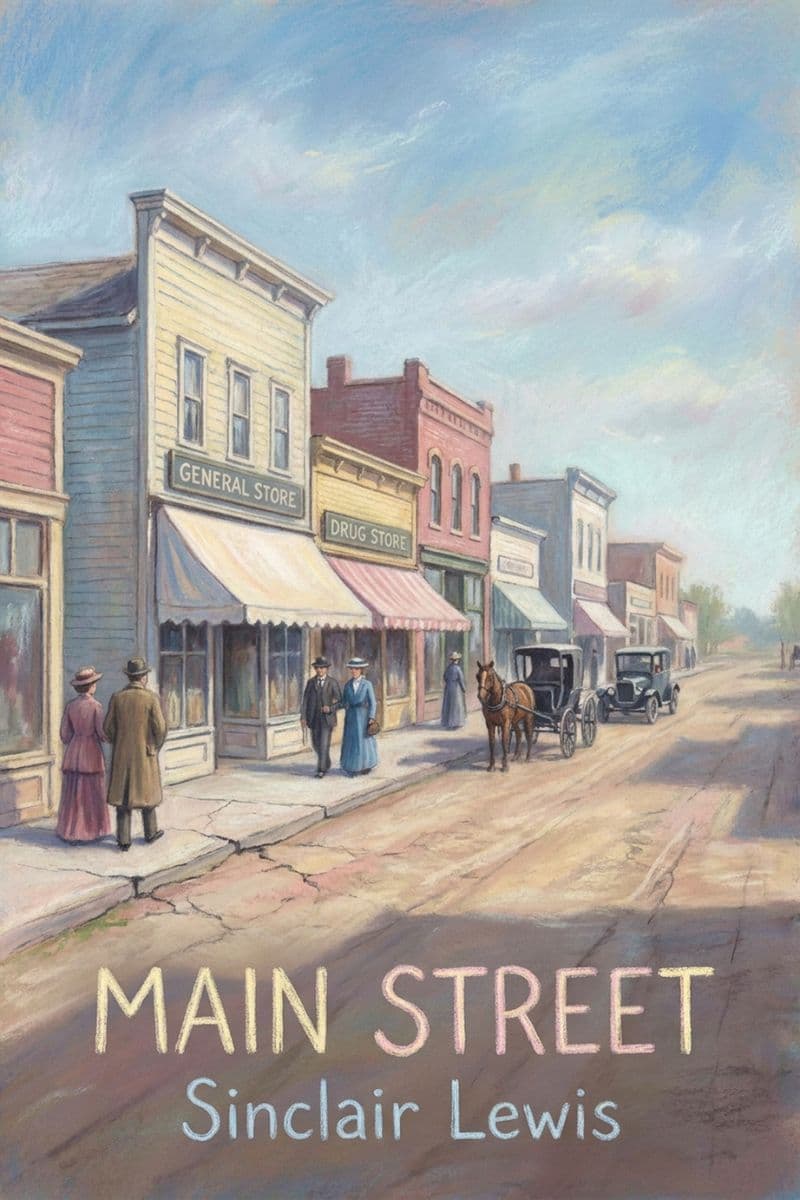
Everything changed with Main Street in 1920. The novel about a young woman chafing against the provincialism of a small Minnesota town sold half a million copies and made Lewis one of the most famous writers in America virtually overnight. He followed it with Babbitt (1922), a devastating portrait of American conformity, and Arrowsmith (1925), a novel about medical idealism crushed by institutional corruption. He won the Pulitzer Prize for Arrowsmith and turned it down, publicly criticizing the award's criteria.
Then came Elmer Gantry (1927), a scorching satire of religious hypocrisy, and Dodsworth (1929), a tender novel about a marriage dissolving during a European tour. In 1930, Sinclair Lewis became the first American to receive the Nobel Prize in Literature.
The Decline
The Nobel marked the peak. Lewis's later novels never matched the power of his great decade. His personal life was turbulent. His first marriage, to Grace Livingston Hegger, an editor at Vogue, ended in divorce. His second, to the celebrated journalist Dorothy Thompson, lasted longer but was no happier. His son from his first marriage, Wells, was killed in action in France during World War II.
Lewis wandered through his final years, living in various American cities and spending long stretches in Europe. He struggled with alcoholism that ravaged his health and his work. He died in Rome on January 10, 1951, at the age of sixty-five. His ashes were returned to Sauk Centre, the small town he spent his life both fleeing and writing about.
Fun Facts About the Book
Lewis's First Serious Female Protagonist
While Lewis would become famous for characters like George Babbitt and Elmer Gantry, Una Golden was one of his earliest attempts at centering a novel entirely on a woman's experience. The Nobel committee would later specifically praise Lewis for his portrayals of working women, and this novel is where that instinct first showed up in force.
A Rehearsal for Main Street
Many readers see direct lines between Una Golden and Carol Kennicott, the restless heroine of Main Street. Both are intelligent women trapped by the limitations their world places on them. Both leave small towns. Both struggle against institutions that don't know what to do with ambitious women. Writing Una's story may have been Lewis's way of working out ideas that would later make him famous.
The Real Panama
The fictional town of Panama, Pennsylvania, is classic Lewis, a barely disguised version of the kind of small American town he knew intimately from his own childhood. Lewis peppered the novel with thinly veiled versions of real New York landmarks as well: "Wanamacy's" for Wanamaker's, and other renamed businesses that contemporary readers would have recognized instantly.
Published in the Shadow of War
The novel appeared in February 1917, just two months before the United States entered World War I. The timing meant it was largely overshadowed by world events, though critics who did notice it praised its realism and its unusually sympathetic treatment of a working woman's inner life.
Lewis's Third Novel
This was only Lewis's third book published under his own name. He had been writing potboilers and magazine fiction to pay the bills, but this novel represented his first real attempt at the social realism that would define his career. Critics at the time called it his first distinguished work of fiction.
Themes
The Office as Battlefield
Long before cubicle culture and corporate satire became literary staples, Lewis mapped the territory of white-collar drudgery with startling precision. The typing pools, the petty office politics, the soul-deadening repetition of clerical work, it all reads like a dispatch from inside the machine. Una's office isn't just a setting. It is the antagonist.
A Woman's Right to Work
In 1917, a novel built entirely around a woman's professional ambitions was radical. Lewis doesn't treat Una's desire for meaningful work as a phase or a placeholder before marriage. He treats it as the central fact of her life, as worthy of serious examination as any man's career would be. The novel makes the quiet, devastating argument that women's work matters, period.
Marriage as Transaction
The novel strips away the romance of marriage and examines what it actually means, economically and socially, for a woman with limited options. Marriage in Una's world is not just about love. It is about survival, security, and social standing. And when it fails, the cost falls almost entirely on the woman.
Class and the American Dream
Una arrives in New York believing the advertisements. Work hard, be smart, get ahead. The novel systematically tests that promise against reality. Lewis shows how class, gender, and sheer luck determine outcomes far more than talent or effort, without ever quite giving up on the idea that determination might still count for something.
Loneliness in the Crowd
New York is full of people and utterly empty of connection. Una moves through boarding houses and offices and lunch counters surrounded by thousands and profoundly alone. Lewis captures the specific urban loneliness of being visible to no one, needed by everyone, and known by almost nobody.
The Book's Legacy
For decades, this novel lived in the shadow of Main Street and Babbitt, read mostly by Lewis completists and scholars interested in early feminist fiction. But it has found new readers in recent years, partly because its themes feel startlingly contemporary. The gender pay gap, the impossible choice between career and marriage, the grinding indignity of office work, Una Golden's struggles in 1910 map uncomfortably well onto problems that haven't gone away.
The novel is also a fascinating time capsule of pre-World War I New York City, capturing the physical details of tenement life, subway commutes, commercial colleges, and the emerging culture of white-collar work with a documentary precision that historians value as much as literary critics do.
Lewis scholars increasingly see it as a crucial early work, the novel where his signature style of sympathetic social realism first clicked into place. Without Una Golden, there might never have been Carol Kennicott or Leora Arrowsmith or any of the other complicated, stubborn, fully human women who populate his greatest books.