Novelhalla
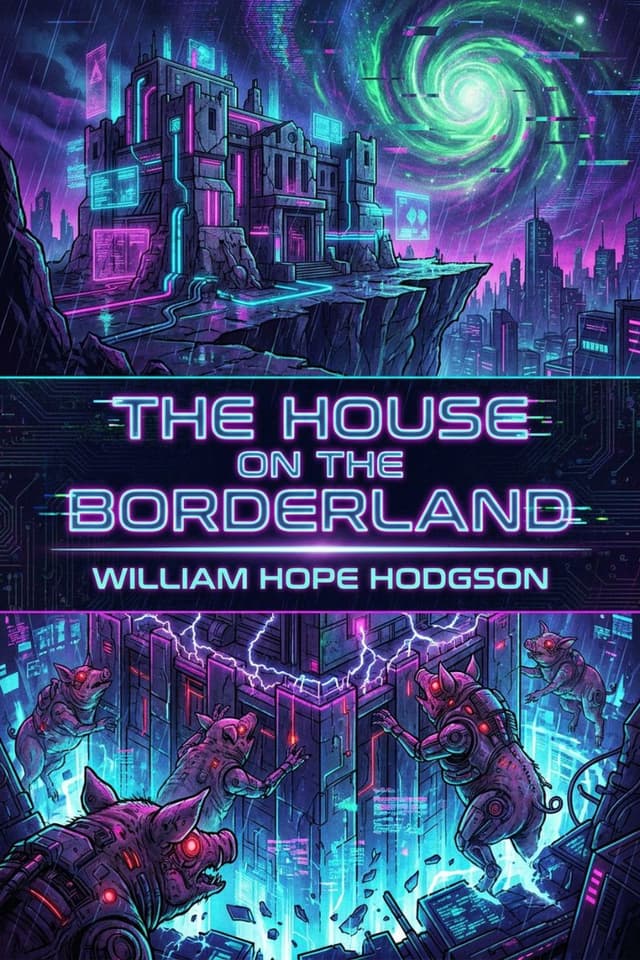
The House on the Borderland
Read The House on the Borderland by William Hope Hodgson for free on Novelhalla, and try out our easy-to-read modern edition of this classic book. You can also download the EPUB and read it on any device if you prefer!
The Plot
The Manuscript
Two friends on a fishing holiday in the remote west of Ireland stumble upon something they were not meant to find. Near a strange, bottomless chasm in the earth, they discover the ruins of an ancient house. Buried in the rubble is a handwritten journal, water-stained and reeking of the pit below. They begin to read. What follows is the testimony of a man who lived in a place that should not exist.
The author of the journal is an unnamed recluse, an old man who has lived for years in a crumbling, ancient house perched above a vast gorge. His only companions are his sister Mary, who keeps house for him in near silence, and his loyal dog Pepper. The nearest village wants nothing to do with them. The locals avoid the house entirely. Supplies arrive once a month from a man who does not linger.
For a long time, the days pass in quiet isolation. Then something changes.
The Visions
It begins with a green glow in the recluse's study. Without warning, his consciousness is ripped from his body and flung across an impossible distance. He finds himself floating over a vast, silent plain ringed by colossal mountains. In the center of this alien landscape sits a building he recognizes instantly: a jade-green replica of his own house.
The mountains are alive with enormous figures, monstrous shapes that seem to be the original forms behind every god and demon humanity has ever worshipped. And among them, circling the green house, is something with the face of a pig. Something trying to get in.
The recluse snaps back to his study. He tells himself it was a hallucination. He is wrong.
The Siege
They come up from the pit.
Grotesque, humanoid creatures with the bodies of men and the heads of swine pour out of the gorge and swarm toward the house. They move upright, pale and luminous in the dark, clawing at walls and windows with terrible intelligence. The recluse barricades himself inside and fights them with his rifle through the night. They are strong. They are patient. And they know the house has a cellar with a trapdoor that opens onto the abyss below.
The siege lifts after days of terror, but the recluse knows they have not gone. He explores the pit with Pepper and discovers it connects to a vast underground chasm directly beneath the house. The darkness down there feels alive. The creatures are waiting somewhere in it.
The Acceleration
Then something stranger than monsters begins. The recluse notices a whirring sound. His clock is running fast. Not minutes fast. Days fast. The seasons begin to flicker outside his window. Day and night strobe in rapid alternation. Years compress into moments.
Time itself is accelerating, and the recluse can only watch from his study as the world outside begins to change in ways no human being was ever meant to witness.
Between Worlds
The house sits on some kind of boundary. Between dimensions, between realities, between the living and the dead. As the recluse is pulled deeper into experiences that defy explanation, he begins to encounter things that are not all terrifying. In a place he calls the Sea of Sleep, he finds something he lost long ago. But even tenderness comes with a warning in this place.
The swine-creatures have not forgotten about the house. The pit has not closed. The cellar trapdoor is still down there. And the journal has a lot of pages left.
What the recluse discovers about the true nature of his home, and what is ultimately waiting for him in the dark beneath it, makes the monsters outside look like the least of his problems.
About the Author: William Hope Hodgson
A Restless Youth
William Hope Hodgson was born in 1877 in Blackmore End, Essex, the second of twelve children in the family of an Anglican priest. Three of his siblings died in infancy, and the family moved constantly as his father transferred between parishes, serving eleven different churches in twenty-one years. One of those postings took them to County Galway in western Ireland, a landscape that would later become the setting for his most famous novel.
At thirteen, Hodgson ran away from boarding school to become a sailor. He was caught and sent home, but his father eventually relented and apprenticed him as a cabin boy. His father died of throat cancer shortly after, leaving the family impoverished. Hodgson spent the next several years at sea.
Sailor, Bodybuilder, Photographer
Life aboard merchant vessels was brutal. Hodgson was short and fine-featured, which made him a target for bullying by older sailors. His response was to remake himself physically. He took up bodybuilding with ferocious dedication, following the training methods of Eugene Sandow, the most famous strongman of the era. He became powerfully built and opened a physical culture school in Blackburn after leaving the sea.
In 1898, he was awarded the Royal Humane Society Medal for diving into shark-infested waters to rescue a fellow sailor who had fallen overboard.
Hodgson was also an avid photographer, documenting cyclones, lightning, sharks, and the daily miseries of life at sea. He gave paid lectures illustrated with colorized slides of his photographs. His relationship with the ocean was complicated. He had gone to sea out of romantic longing, but years of hardship turned that love into something closer to dread. That transformation powered nearly everything he wrote.
The Writing Years
When his gym failed to turn a profit, Hodgson turned to writing full time. His first published story appeared in 1904. Over the next decade he produced an extraordinary body of work: sea horror stories set in the Sargasso Sea, supernatural detective tales featuring the occult investigator Carnacki, and four visionary novels that defied easy classification.
His fiction was well reviewed but sold poorly. He married Betty Farnworth in 1913 but was never financially secure, always scrambling to sell the next story. Despite the modest commercial response, he was building something that would outlast him. He was inventing cosmic horror before the term existed.
Death in the War
When the First World War broke out, Hodgson was living in the south of France. He returned to England and volunteered for the Royal Field Artillery, receiving a commission as a lieutenant. In 1916, he was thrown from a horse and suffered a broken jaw and head injury. He was discharged.
Most men would have stayed home. Hodgson fought to pass the medical board again and was recommissioned in March 1917. He returned to the front at Ypres, one of the most devastating killing fields of the war.
On April 17, 1918, Hodgson volunteered for forward observation duty at Mont Kemmel. He was killed by German artillery fire. He was forty years old. There was nothing left of his body to send home. His name is inscribed on the Tyne Cot Memorial at Passchendaele.
Legacy
Hodgson's reputation grew slowly but steadily after his death. H.P. Lovecraft discovered his work in 1934 and praised it at length, calling his second novel "a classic of the first water." Clark Ashton Smith, Jack Vance, and generations of weird fiction writers drew from the well Hodgson had dug. Terry Pratchett called the novel "the Big Bang in my private universe as a science fiction and fantasy reader and, later, writer."
Today Hodgson is recognized as one of the founding voices of cosmic horror and a writer whose imagination ran decades ahead of his time.
Fun Facts About the Book
The Irish Connection
Hodgson's father served a parish in Ardrahan, County Galway, during William's childhood. The wild, remote landscape of western Ireland left a deep impression on him. The novel's setting, an isolated house perched above a mysterious gorge in the Irish countryside, draws directly from this experience. The sense of ancient, brooding landscape is not invented. Hodgson had walked that ground.
A Forerunner of Cosmic Horror
Published in 1908, the novel predates H.P. Lovecraft's first major stories by more than a decade. Its vision of humanity as insignificant against vast, incomprehensible cosmic forces, its blending of supernatural horror with scientific speculation, and its atmosphere of existential dread all anticipate what Lovecraft would later develop into an entire literary movement. Many scholars consider Hodgson's novel a direct ancestor of the Cthulhu Mythos.
The Time Sequence
The extended passage in which the narrator watches time accelerate was inspired by H.G. Wells's The Time Machine, published thirteen years earlier. But Hodgson pushed the concept further than Wells ever did, taking the reader on a journey through deep time that remains one of the most extraordinary sequences in all of horror fiction. This passage in turn influenced Jack Vance's Dying Earth stories and countless other visions of entropy in science fiction.
Found Manuscript
The novel uses a framing device as old as literature itself: the discovered document. The entire story is presented as a water-damaged journal found by two fishermen in the ruins of the house. Hodgson uses this structure not just for atmosphere but to create genuine uncertainty. The manuscript is incomplete. Pages are missing. We never get tidy explanations. This deliberate ambiguity was radical for 1908 and remains one of the book's most unsettling qualities.
The Punctuation Problem
Hodgson's original prose style was, to put it charitably, heavily punctuated. Commas, semicolons, and elaborate sentence structures made the 1908 text a challenge for modern readers. Terry Pratchett himself noted how "wearisome the excessive punctuation could be." Several modern editions have lightly edited the punctuation to improve readability while preserving the story and voice. One publisher joked that they took "The Comma House on the Semicolon Borderland" and turned it into the novel readers deserve.
The Graphic Novel
In 2000, legendary comic artist Richard Corben adapted the novel as a graphic novel for DC/Vertigo. Corben's lush, surreal artwork brought the swine-creatures and cosmic visions to vivid life. The adaptation was nominated for an International Horror Guild Award, introducing Hodgson's story to a new generation of horror fans.
A BBC Dramatization
In 2007, BBC Radio produced a two-hour dramatization of the novel spread across four episodes, demonstrating that Hodgson's tale of cosmic dread could still unsettle audiences nearly a century after its publication.
The Doom Metal Connection
English doom metal band Electric Wizard recorded a song titled after the novel for a 2008 split EP. The band Into Another featured a track called "William" on their 1994 album, with lyrics expressing solidarity with Hodgson and including the line "truth lives in a house on the borderland." The novel's atmosphere of creeping dread and cosmic scale has made it a natural touchstone for heavy music.
Themes
The Fragility of Reality
The house exists on a border between worlds, between dimensions, between the known and the unknowable. The recluse's experience suggests that the walls separating our reality from something vast and terrible are thinner than we imagine. One crack in the foundation, one trapdoor left unlatched, and everything we take for granted about the world might come apart.
Cosmic Insignificance
Long before Lovecraft codified the idea, Hodgson presented a universe that is not hostile to humanity so much as utterly indifferent to it. The time acceleration sequence strips away every human certainty, every comforting assumption about permanence. The horror is not that something is coming for us. The horror is that the universe does not notice us at all.
Isolation and Siege
The recluse has chosen to live apart from other people, but isolation turns out to be a trap rather than a refuge. When the swine-creatures come, there is no one to call for help. The house that was supposed to be a sanctuary becomes a prison, and the man who wanted to be left alone gets his wish in the worst possible way.
The Subconscious and the Pit
The novel is rich with psychological symbolism. The bottomless pit beneath the house, the trapdoor in the cellar, the creatures rising from below: these can be read as images of repressed fears and desires surging up from the depths of the mind. The house itself becomes a map of consciousness, with the study representing intellect and the cellar representing everything the intellect tries to keep locked away.
Love Beyond Time
Amid all the horror, the novel contains a quiet love story. The recluse's encounters in the Sea of Sleep suggest that some connections transcend physical reality. It is a small, strange tenderness at the heart of a very dark book, and it makes the surrounding horror feel more personal and more devastating.
The Unknowable
The novel refuses to explain itself. We never learn what the swine-creatures truly are. We never understand the relationship between the house and its jade-green double. We never know whether the cosmic visions are real or hallucinatory. Hodgson understood that the most frightening things are the ones that resist understanding, and he had the courage to leave his greatest mysteries unsolved.
The Book's Legacy
Published in 1908, this novel broke the mold of Gothic horror and pointed toward something entirely new. Where Victorian ghost stories dealt in ancestral curses and haunted mansions, Hodgson wrote about creatures that existed beyond the boundaries of human comprehension and forces that operated on scales no one had imagined in fiction before. He was not updating the ghost story. He was replacing it with something far stranger and far larger.
H.P. Lovecraft, the writer most associated with cosmic horror, openly acknowledged his debt to Hodgson. The novel's influence runs like an underground river through twentieth-century weird fiction, surfacing in the work of Clark Ashton Smith, Jack Vance, Brian Lumley, and China Miéville. Its vision of deep time and entropy anticipated an entire subgenre of science fiction.
Modern readers coming to the novel for the first time often find themselves startled by how contemporary it feels. The blend of siege horror and cosmic dread, the unreliable narrator, the refusal to provide tidy answers: these are techniques that feel cutting-edge in twenty-first century horror fiction, yet Hodgson was doing them more than a hundred years ago.
The novel also carries the weight of its author's biography. Hodgson, the bullied sailor who turned himself into a strongman, the man who dove into shark-filled waters to save a stranger, the writer who could not stay away from the front lines even after being injured: his life had the same quality of stubbornness in the face of overwhelming forces that defines his recluse. He wrote about a man besieged by things beyond his control, fighting to hold his ground in a house on the edge of oblivion. Then he went out and lived it.