Novelhalla
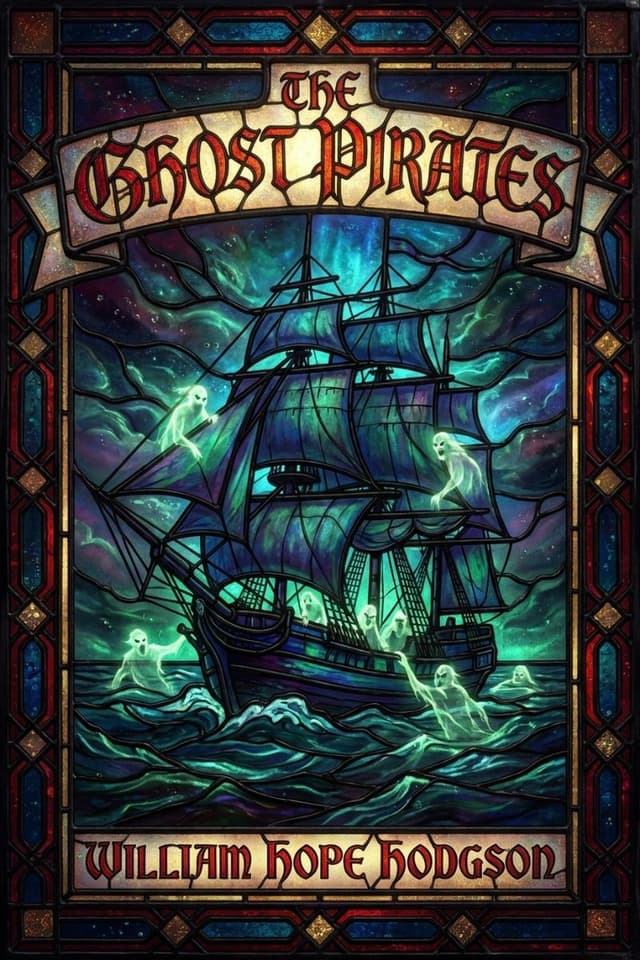
The Ghost Pirates
Read The Ghost Pirates by William Hope Hodgson for free on Novelhalla, and try out our easy-to-read modern edition of this classic book. You can also download the EPUB and read it on any device if you prefer!
The Plot
The Berth Nobody Wanted
Jessop is broke in San Francisco and needs a ship. He hears the yarns before he signs on, the sort of talk that follows certain vessels around the docks, but he's close enough to the beach that a bad reputation seems like a small price for three meals and a bunk. The Mortzestus feeds her crew well enough. The officers are fair enough. On paper there's nothing wrong with her at all.
Then, on a quiet night with the moon up and nothing but open water for hundreds of miles in every direction, Jessop is on watch and sees the shape of a man climb over the rail out of the sea.
He tells himself he didn't. That's the easier thing to do, and the sea plays tricks, and a sailor who talks like that gets a name he can't shake. So he says nothing, and the ship sails on, and a few nights later somebody else sees something too.
The Ship That Isn't Empty
What Hodgson does next is the reason people still read this book. There are no rattling chains and no moaning figures in white. There's just a working ship at sea, described by a man who clearly spent years on one, and inside that ordinary routine the wrongness starts to accumulate. Footsteps on a deck where nobody is standing. A sail that fights back. Something up the mast that shouldn't be up the mast, on a night when the whole watch is on deck and can account for every man aboard.
The crew splits the way crews do. Some men go quiet and superstitious. Some get loud and angry about it, because being angry is easier than being frightened. Tammy, the young apprentice, sees more than a boy his age should have to see, and he's the only one who believes Jessop without argument. The officers want none of it. There's a voyage to run, and the mate isn't interested in ghost stories from the fo'c's'le.
The Argument Nobody Can Win
Half the terror here is social. Jessop knows what he saw. He also knows exactly what happens to a man who insists on it in front of the Second Mate, and Hodgson wrings enormous tension out of that gap between what the men know and what they're allowed to say. Work still has to be done. Sails still have to be set. When the order comes to go aloft in the dark, you go aloft in the dark, and every man on the yard is thinking about the same thing and not one of them will name it.
Meanwhile Jessop starts building a theory. Not a comfortable one. He wonders whether the ship has drifted into some region where the ordinary boundary between our world and another has worn thin, and whether what's coming aboard was ever human at all.
The Mist
Then comes the fog, and it doesn't behave like fog. The sea goes strange and still. Shapes appear in the water alongside, big ones, moving with purpose. Other vessels are sighted on a stretch of ocean where there shouldn't be any, and the men who look at them longest wish they hadn't.
By this point the Mortzestus is a long way from help, the crew is down to nerve and habit, and whatever has been coming aboard a few at a time is no longer bothering to be subtle. Jessop has a theory, a boy who believes him, and a watch to stand.
Whether any of that is worth anything depends on what's waiting in the fog.
About the Author: William Hope Hodgson
The Boy Who Ran Off to Sea
William Hope Hodgson was born in 1877 in Blackmore End, a hamlet in Essex, the second of twelve children born to an Anglican clergyman and his wife. Three of his siblings died in infancy. His father was moved from parish to parish constantly, eleven of them in twenty-one years, including one in County Galway, so Hodgson grew up without much in the way of a settled home.
At thirteen he ran away from boarding school to go to sea. He was caught and brought back, but he wore his family down, and in 1891 he began a four year apprenticeship as a cabin boy. He hated it. The work was brutal, the food was rotten, and the treatment of apprentices was worse. Eight years on ships gave him an encyclopedic knowledge of sail and a lasting anger about how sailors were used, both of which turn up all over his fiction.
He wasn't only miserable, though. He photographed everything: lightning, cyclones, the aurora, sharks, and the maggots in the ship's food. In 1898 he was awarded the Royal Humane Society medal for going into shark infested water off New Zealand to save a shipmate who'd fallen from the topmast.
The Strongman
Hodgson came ashore for good in 1899 and, at twenty-two, opened W. H. Hodgson's School of Physical Culture in Blackburn, advertising himself as the inventor of a system that would cure indigestion. He built himself into a serious bodybuilder, partly because he'd been small and bullied as a young apprentice and had decided that was never happening again. Members of the Blackburn police force were among his clients.
The gym never made real money. He started giving paid lantern slide lectures about life at sea using his own photographs, wrote articles attacking the apprenticeship system, and drifted into fiction almost by necessity. His first story sold in 1904.
The Novels
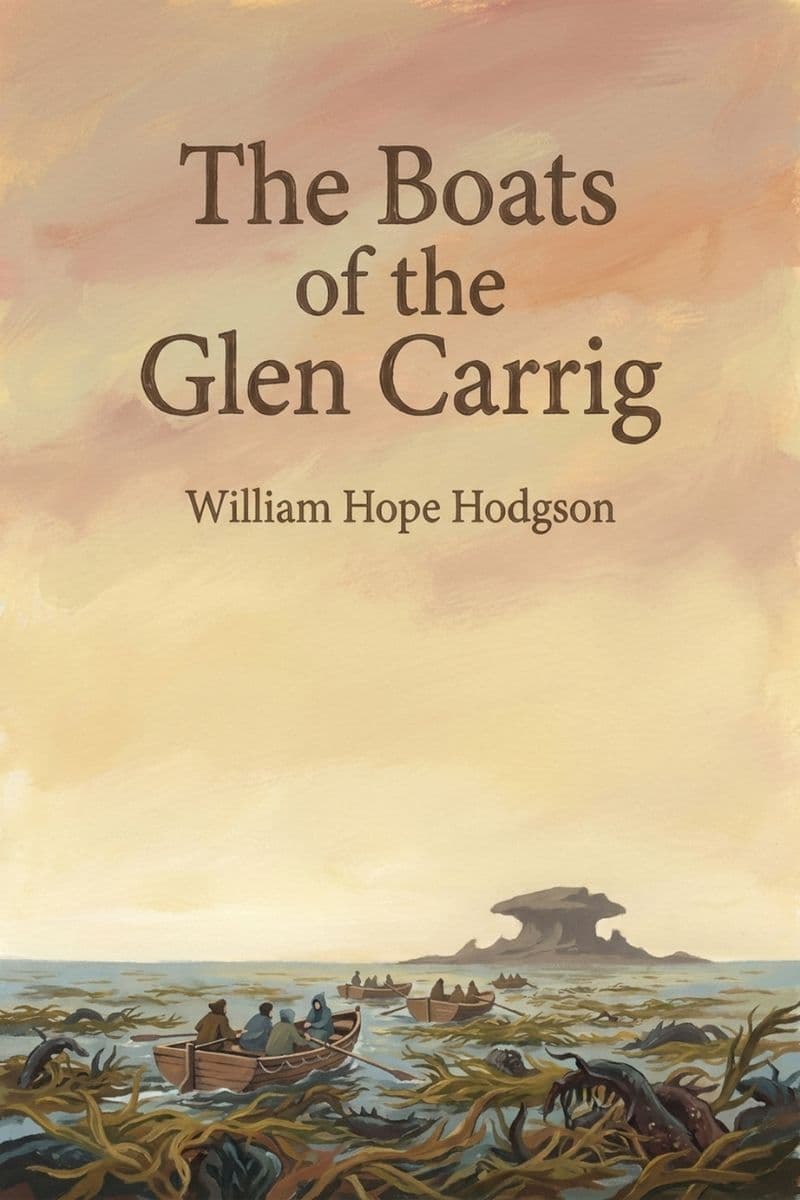
The books came fast. The Boats of the "Glen Carrig" in 1907, The House on the Borderland in 1908, this one in 1909, and The Night Land in 1912, along with the Carnacki ghost detective stories and dozens of short tales. He also wrote a great deal of poetry, most of which nobody would publish. In 1906 he wrote a bitter little article suggesting poets could at least make a living writing tombstone inscriptions.
Critically he did all right. Financially he never got comfortable, and the constant pressure to produce and sell shows in how much he wrote.
The War
When the First World War came, Hodgson enlisted in spite of his age and eight years of maritime experience that the Navy never used. He was injured, discharged, recovered, and re-enlisted rather than sit it out. He was killed by an artillery shell near Ypres in April 1918, aged forty. Accounts differ on whether it was the 17th or the 19th. The Times ran a eulogy for him in May, and his widow's account, reprinted in an American magazine he'd written for, described him leading a group of NCOs to safety under heavy fire.
His reputation nearly died with him. Two people mostly saved it: his widow, who kept getting his work into print, and an American fan named H. C. Koenig, who spent years in the 1930s pressing Hodgson's books on anyone who'd listen, including H. P. Lovecraft and Clark Ashton Smith.
Fun Facts About the Book
It Closes a Trilogy Nobody Notices Is a Trilogy
Hodgson opens the book with a short preface saying that this is the last of three, after The Boats of the "Glen Carrig" and The House on the Borderland, and that although the three books are very different in scope, they share what he called an elemental kinship. He added that with this one he believed he was closing the door on a particular phase of constructive thought. The three novels have no characters, setting, or plot in common. Readers have been arguing about what he meant ever since.
The Author Had Actually Done the Job
Almost every scary thing in the book happens during ordinary work: setting a sail, taking a wheel, going aloft to fix a jammed line. Hodgson knew exactly how long those tasks take and exactly where a man's hands and eyes are while he does them, and that's what makes the horror land. Lovecraft singled out this command of maritime knowledge as the thing that gives the book its power.
It Opens With a Sea Shanty
Before chapter one there's a full chaunty of Hodgson's own invention, the call and response kind, with the shanty man's lines and the crew's answers laid out down the page. He wrote a lot of verse he couldn't sell, and he kept smuggling it into his novels as dedications and epigraphs.
The Mystery Dedication
The book is dedicated to Mary Whalley, followed by a few lines of verse about old memories shining against death's night. Who she was doesn't come up in the standard accounts of Hodgson's life, which is a strange gap for a man whose biography is otherwise well picked over.
There's an Alternate Ending
A revised version of the book's conclusion was published separately as a short piece called "The Silent Ship," and it still shows up as an appendix in some editions and collected volumes. Read it after, obviously, not before.
Lovecraft Called Them Sea-Devils
In his long essay on supernatural horror, Lovecraft described the book as an account of a doomed and haunted ship and of the terrible sea-devils that besiege it, creatures of roughly human shape that might be the spirits of old buccaneers. That phrase has stuck to the book for a century, even though Hodgson himself never commits to what the things are.
The Title Is a Beautiful Lie
Anyone picking this up expecting cutlasses in teeth and skeleton crews is in for a surprise. There are no pirates in any sense you'd recognize, and calling the things ghosts is a stretch. Hodgson's narrator floats the idea that they might be inhabitants of a dimension that occupies the same space as ours while remaining ordinarily invisible to it, which is a startlingly modern thought for 1909.
A Handsome, Scarce First Edition
Stanley Paul published it in London in 1909 at 276 pages, with a frontispiece by the great fantasy illustrator Sidney H. Sime. It appeared in red cloth, and also in green and blue variants, and good copies are rare and expensive today.
The Jargon Is Part of the Design
The text is thick with sailing terms and with dialect spelled out phonetically, which can be heavy going at first. Push through the first chapter or two. The unfamiliarity is doing work: you're being dropped into a closed world with its own language, where you don't quite know what's normal, which is exactly the position the reader needs to be in.
Themes
Nobody Believes You
The most frightening thing in the book isn't the figure at the rail. It's what happens when you report it. Jessop's real problem is that the truth is unsayable, that saying it makes him a fool or a liar or a madman, and that the men with authority have every reason not to hear it. Anyone who has ever been the one person in the room insisting something is wrong will recognize the whole miserable shape of it.
The Sea Is Thin
Hodgson's ocean isn't a setting so much as a boundary. Out there, hundreds of miles from any coast, the ordinary rules feel provisional, and the book keeps suggesting that the world has edges and that a ship can sail up against one. He does this without a single line of explanation, which is why it still unsettles people.
The Work Goes On
There's a bleak comedy running underneath the horror. Whatever is happening, the sails still need trimming and the watches still need standing. Nobody gets to stop. The ordinary discipline of the ship, which is what keeps everyone alive, is also what keeps sending men into the dark on schedule.
Fear Moves Through a Crew
The book is a fine study of how dread spreads through a small closed group: the silences, the men who overcompensate with bravado, the ones who go quiet, the way an unspoken thing becomes obvious to everyone at once. The ship's company changes long before anything is proven.
The Refusal to Explain
Hodgson never tells you what the things are, where they come from, or what they want. Jessop offers a theory and admits he can't support it. Modern horror has largely learned this lesson, but in 1909 it was unusual, and it's a big part of why the book has aged better than a lot of its contemporaries.
The Book's Legacy
Hodgson was nearly forgotten within a decade of his death. The revival came through anthologies in the 1930s, through H. C. Koenig's evangelism, and through Lovecraft, whose praise brought a generation of American weird fiction readers to a dead English sailor they'd never heard of. Arkham House gathered the four novels into an omnibus in 1946, and the paperback reissues of the 1960s and 70s put him back into circulation for good.
Among people who know his work, this book is a quiet favorite. The bibliographer E. F. Bleiler called it one of the great sea novels and argued that while The House on the Borderland and The Night Land are more spectacular, this one is the finer piece of craft. The horror writer Robert Weinberg called it one of the finest examples of the tightly written novel ever published.
Its real legacy is a mood. Every claustrophobic story about a small crew trapped in a vessel with something that shouldn't be there owes a debt to this structure, whether the vessel is a ship, an expedition, or a spacecraft. Hodgson worked out how to escalate dread on a stage nobody can leave, and how to make the monster more frightening by refusing to show it.
Strangely, for a book with such a marketable title, it's never had a proper screen adaptation. It remains what it was in 1909: a man telling you, plainly and without preamble, about the voyage he took on a ship that had a reputation.