Novelhalla
Frankenstein
Read Frankenstein by Mary Wollstonecraft Shelley for free on Novelhalla, and try out our easy-to-read modern edition of this classic book. You can also download the EPUB and read it on any device if you prefer!
The Plot
A Stranger on the Ice
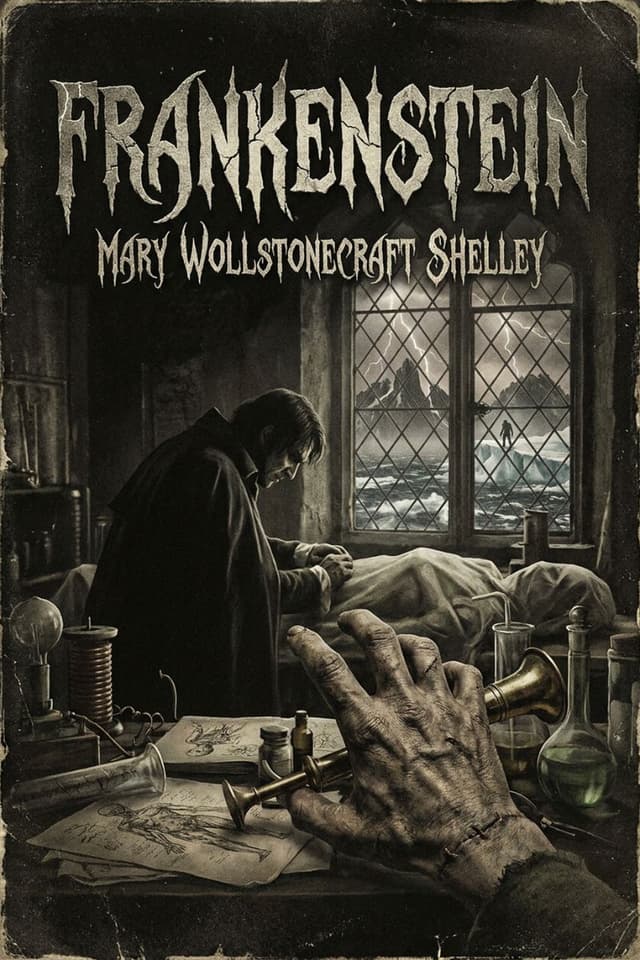
Robert Walton is an ambitious young explorer who has sailed toward the North Pole, hoping to be the first to reach it. His ship gets trapped in the ice, and one morning his crew spots something strange in the distance: a huge figure driving a dog sled across the frozen sea. Hours later, they find a second traveler, half dead from cold and exhaustion, drifting on a slab of ice.
The rescued man is Victor Frankenstein. He's educated, gentle, clearly brilliant, and utterly broken. He's also chasing something across the Arctic. When he realizes Walton shares his hunger for discovery and glory, Victor decides to tell him his story as a warning.
The Boy Who Wanted to Know Everything
Victor grew up in Geneva in a loving, comfortable family, with a devoted adopted sister named Elizabeth and a loyal best friend named Henry Clerval. As a boy he became obsessed with old alchemists who claimed they could unlock the secrets of life itself. When he heads off to university in Ingolstadt, his professors dismiss those old books as nonsense, but they also show him what modern chemistry and science can do. Something in Victor catches fire.
He throws himself into his studies with a frightening intensity. He stops writing home. He stops sleeping properly. He starts spending his nights in charnel houses and dissecting rooms, studying how the human body decays, because he's convinced that if he understands death, he can figure out how to reverse it.
A Dreary Night in November
After nearly two years of secret, feverish work, Victor succeeds. He brings a body to life. It's the moment he's sacrificed everything for, and the second he sees his creation open its eyes, he's overwhelmed with horror and disgust. He runs.
What Victor doesn't consider is that the being he made is alive, alone, and has no idea what it is or why its maker fled from it. Victor tries to put the whole thing behind him and return to normal life. But a letter from home brings devastating news, and when Victor travels back to Geneva, he catches a glimpse of a familiar figure in a lightning storm. His creation has not forgotten him.
The Creature Speaks
High in the Alps, Victor finally comes face to face with the being he abandoned. It's articulate, intelligent, and furious, and it has a story of its own to tell about what the world has done to it since that night in Ingolstadt. It also has a request for Victor, one that could either end this nightmare or make it infinitely worse.
Victor has to decide whether he owes anything to the life he created, and what it might cost the people he loves if he chooses wrong.
About the Author: Mary Wollstonecraft Shelley
A Famous Family
Mary was born in London in 1797 to two of the most famous radical thinkers of the day. Her mother, Mary Wollstonecraft, was a celebrated writer and philosopher, and her father, William Godwin, was a well-known political philosopher and novelist. Her mother died just days after Mary was born, and Mary grew up reading her mother's books and visiting her grave, where she reportedly learned to read by tracing the letters on the headstone.
Running Away with a Poet
As a teenager, Mary fell for Percy Bysshe Shelley, a young poet and admirer of her father who was already married. In 1814, when Mary was just sixteen, the two ran off together to Europe, causing a massive scandal and a long rift with her father. They married in late 1816 after Percy's first wife died.
The Summer That Changed Everything
In 1816, Mary and Percy spent the summer near Lake Geneva, neighbors to Lord Byron, who was staying at the Villa Diodati with his doctor, John Polidori. Terrible weather kept everyone indoors, and after reading ghost stories together, Byron challenged the group to each write a horror story of their own. Mary struggled for days until a vivid waking dream gave her the image of a scientist kneeling beside the thing he'd brought to life. She was eighteen. The novel came out anonymously on January 1, 1818, when she was twenty.
Grief and a Writing Life
Mary's life was marked by staggering loss. Three of her four children with Percy died young, and in 1822 Percy himself drowned in a sailing accident off the Italian coast. She was twenty-four and a widow. She supported herself and her surviving son by writing, producing novels including Valperga, The Last Man (an early apocalyptic novel about a plague wiping out humanity), and Lodore, along with travel writing, biographies, and stories. She also worked hard to edit and publish Percy's poetry and build his reputation.
Final Years
Mary died in London in 1851 at age 53, likely from a brain tumor. After her death, her family found a small packet in her desk containing locks of her dead children's hair and what's believed to be the remains of Percy's heart, wrapped in a page of one of his poems.
Fun Facts About the Book
Born in the Year Without a Summer
The stormy weather that kept everyone indoors at Lake Geneva wasn't a fluke. In 1815, the Mount Tambora volcano in Indonesia erupted, throwing so much ash into the atmosphere that 1816 became known as the "Year Without a Summer." Crops failed across Europe, and the gloomy, freezing weather set the stage for one of the most famous horror stories ever written.
The Other Monster from That Night
Mary wasn't the only one who came out of Byron's ghost story contest with a classic. John Polidori wrote The Vampyre, which helped create the image of the vampire as a pale, seductive aristocrat, decades before Dracula.
Frankenstein Is the Scientist
It's one of the most common mix-ups in pop culture: Frankenstein is Victor, the creator, not the creature. In the novel, the creature never gets a name at all. Victor calls it things like "the wretch," "the fiend," and "the daemon," which says a lot about how he sees it.
Two Versions
Mary revised the novel significantly for an 1831 edition, adding a new introduction where she described the famous dream and making changes that some scholars say shift the story's meaning. Most modern copies use the 1831 text, but many scholars prefer the original 1818 version. Percy also made edits to the original manuscript, and scholars still debate how much he contributed.
Real Science Behind the Horror
Victor's experiments weren't pure fantasy to readers of the time. Scientists were experimenting with "galvanism," using electricity to make muscles twitch. In 1803, Giovanni Aldini famously ran electric current through the body of an executed criminal in London, making its jaw quiver and one eye open. The idea that electricity might hold the spark of life was very much in the air.
A Well-Read Creature
The creature teaches himself to read and discovers three books that shape how he understands the world: Milton's Paradise Lost, Plutarch's Lives, and Goethe's The Sorrows of Young Werther. His reading of Paradise Lost in particular, where he compares himself to both Adam and Satan, is one of the most fascinating parts of the novel.
Stories Inside Stories
The novel is built like a set of nesting dolls. Walton's letters to his sister contain Victor's story, and Victor's story contains the creature's story. You're hearing a monster's account through a scientist's retelling, written down by an explorer. It makes you wonder how much each narrator is shading the truth.
The Name's Origin
There's a real Castle Frankenstein near Darmstadt in Germany, which Mary may have passed on her travels along the Rhine. Legends connected it to an alchemist named Johann Konrad Dippel, who supposedly experimented with bodies there. Whether Mary knew any of this is still debated.
Themes
Dangerous Ambition
Victor and Walton are mirror images: brilliant men who want to be first, to be remembered, to push past the limits of human knowledge. The novel asks what happens when the desire to achieve something great outruns any thought about whether you should.
The Responsibility of a Creator
Victor makes a living being and then walks away the moment it disappoints him. The whole novel circles the question of what a creator owes to what he creates, and it's hard not to read it as a story about parents and children too.
Isolation and the Need for Connection
Nearly every major character is lonely in some way. Victor cuts himself off from everyone while he works. Walton writes to his sister complaining that he has no friend to share his ambitions with. And the creature, more than anyone, is desperate for someone, anyone, to accept him.
Nature Versus Nurture
Was the creature born a monster, or did the world make him one? The novel gives him a voice and lets him argue his own case, and readers have been debating the answer for two hundred years.
Judging by Appearance
Again and again, people react to the creature with instant terror and violence based on how he looks, before he says a single word. The novel shows how cruelty can grow out of rejection.
The Power of Nature
Mary fills the book with mountains, glaciers, storms, and frozen seas. Nature is sometimes a source of comfort and healing for Victor and sometimes something vast and indifferent, a reminder of forces humans can't control.
The Book's Legacy
It's hard to overstate how much this novel changed storytelling. Many critics, including novelist Brian Aldiss, consider it the first true science fiction novel, since its horror comes not from ghosts or the supernatural but from science. Every story about a creation turning on its creator, from robots to artificial intelligence to genetic engineering, owes something to Mary's nightmare.
The story hit the stage almost immediately. An 1823 play called Presumption was a hit in London, and Mary herself went to see it. Thomas Edison's studio made a short silent film version in 1910. But the image most people picture comes from James Whale's 1931 film starring Boris Karloff, with its flat-topped head, neck bolts, and lurching walk, none of which appear in the book. The novel's creature is fast, agile, and eloquent.
Since then there have been countless adaptations and riffs, from Mel Brooks's comedy Young Frankenstein to Kenneth Branagh's 1994 film to Guillermo del Toro's 2025 version. The story has inspired everything from Blade Runner to Poor Things.
The name itself has entered the language. People talk about "Frankenfood" and warn about "creating a Frankenstein" whenever technology seems to be getting out of hand. Two centuries after a teenager dreamed it up on a stormy night in Switzerland, it still feels like it was written about the future.