Novelhalla
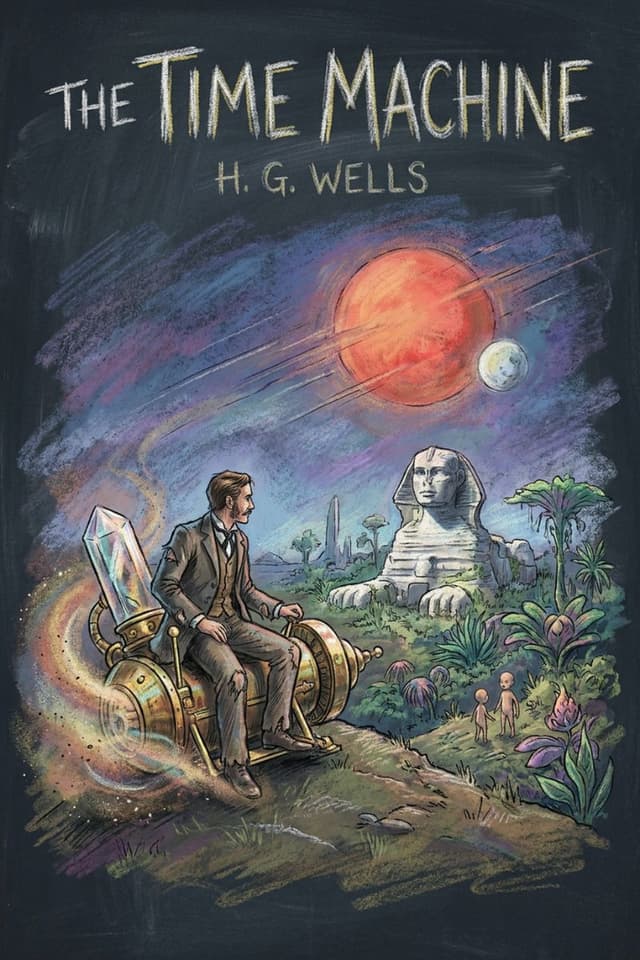
The Time Machine
Read The Time Machine by H. G. Wells for free on Novelhalla, and try out our easy-to-read modern edition of this classic book. You can also download the EPUB and read it on any device if you prefer!
The Plot
The Dinner Party
A group of educated Victorian gentlemen are gathered after dinner in a comfortable London home. Their host, known only as the Time Traveller, is making an extraordinary claim. He says that time is simply another dimension, like length or width, and that with the right machine, a person could move through it the way one moves through space. He produces a small brass and ivory model, no bigger than a clock, and in front of his skeptical guests, he sends it spinning into the future. It vanishes.
They think he's a conjurer. They think it's a trick.
A week later, they return for another dinner. The Time Traveller arrives late, limping, filthy, and visibly shaken. He asks for food and wine, and then he tells them where he has been.
The Year 802,701
He built the machine. He sat in it. He pulled the lever. And time began to accelerate around him. Day and night flickered past like the beating of a wing. Buildings rose and crumbled. The landscape shifted and reformed. He hurtled forward through centuries, watching the sun arc across the sky in a stuttering blur, until he finally stopped the machine and the world went still.
He has landed in the year 802,701 AD, in what was once London.
At first it looks like paradise. The landscape is lush and beautiful, dotted with strange, decaying palaces and overgrown gardens. Small, graceful creatures approach him. They are barely four feet tall, with delicate features, large eyes, and the attention span of children. They eat fruit. They play. They sleep in clusters in the ruined halls of buildings they did not build and cannot maintain. They seem to have no technology, no language worth the name, no curiosity.
The Time Traveller calls them the Eloi.
He thinks he has arrived in a utopia. Humanity has solved all its problems, and with nothing left to struggle against, it has gently declined into this soft, simple existence. It's disappointing but peaceful.
He is wrong about almost everything.
The Machine Vanishes
When the Time Traveller returns to the spot where he landed, his machine is gone. Something has dragged it inside the pedestal of a massive white sphinx. The doors are sealed. He cannot get in. He is stranded eight hundred thousand years from home with no way back.
Panic sets in. Then determination. He begins to explore more carefully, and what he finds changes everything he thought he understood about this world.
There are wells scattered across the landscape, deep shafts that drop into darkness. Machinery hums somewhere far below. And at night, pale shapes move in the shadows. The Eloi are terrified of the dark, and now the Time Traveller begins to understand why.
The Morlocks
There is a second species. They live underground, in vast subterranean warrens lit by the glow of machines they still operate out of some dim, inherited instinct. They are pale, ape-like, with huge colorless eyes adapted to perpetual darkness. Sunlight blinds and burns them. They surface only at night.
The Time Traveller calls them the Morlocks.
He descends into their tunnels. What he finds below the surface overturns every comforting theory he has constructed. The Morlocks are not servants. The Eloi are not masters. The relationship between these two species is something far more disturbing, something that has been hiding in plain sight since the moment he arrived.
The Morlocks have his machine. And they are not inclined to give it back.
The Fight for Home
The Time Traveller befriends Weena, a young Eloi woman he saves from drowning when none of her own kind will help her. She is the only creature in this future world who shows him any real affection, following him everywhere, tucking flowers into his pockets. In a world that has forgotten love, loyalty, and courage, Weena's small devotion is the most human thing he encounters.
But sentiment will not get him home. The Morlocks are closing in. They hunt at night, and they are patient. The Time Traveller scavenges weapons from an ancient museum, a crumbling palace of green porcelain where the artifacts of long-dead civilizations lie rusting in the dark. Matches. An iron bar. Camphor. It isn't much.
The journey back to the white sphinx becomes a running battle through darkness and fire, and not everyone who starts the trip will finish it.
The Edge of the World
If he makes it to his machine, the Time Traveller does not go directly home. He pushes further into the future, far beyond the age of the Eloi and Morlocks, to a place where the sun hangs red and enormous on the horizon and the earth has nearly stopped turning. There are no people. There are almost no living things, just the cold, the silence, and the slow dying of a world winding down to nothing.
It is the loneliest scene in all of science fiction.
He returns to his own time, to his own dining room, to his skeptical friends. He tells them what he has seen. Most of them don't believe a word of it.
The next day, he climbs back into the machine. This time he takes a camera. He has not been seen since.
About the Author: H. G. Wells
The Draper's Apprentice
Herbert George Wells was born in 1866 in Bromley, Kent, the son of a shopkeeper and former domestic servant. The family was perpetually broke. When Wells was fourteen, his schooling ended and he was apprenticed to a draper, spending long hours in a dim basement doing work he hated. He failed at that, failed as a chemist's assistant, and failed as a teaching assistant, returning each time to his mother, who worked as a housekeeper in a grand country house. The one good thing about those years was the house's library, which Wells devoured.
The Student
In 1884, Wells won a scholarship to the Normal School of Science in South Kensington, where he studied biology under Thomas Henry Huxley, the most famous defender of Darwin's theory of evolution. Huxley's teaching electrified Wells and shaped his thinking for the rest of his life. He threw himself into the school's debating society, discovered socialism, and began writing. He also began a student magazine where he published his first time-travel story, a strange piece called "The Chronic Argonauts." He left the school without completing his degree, struggled through several years of teaching and illness, and finally earned his bachelor of science from the University of London in 1890.
The Scientific Romancer
Wells married his cousin Isabel in 1891, left her in 1894 for a former student named Amy Catherine Robbins, and in 1895 published his first novel. That novel was The Time Machine, and it changed everything. He was twenty-eight years old and suddenly famous. Over the next four years, he produced an astonishing run of what he called "scientific romances": The Island of Doctor Moreau (1896), The Invisible Man (1897), The War of the Worlds (1898), and The First Men in the Moon (1901). Each one essentially invented a new subgenre of science fiction. By the turn of the century, Wells was one of the most widely read writers in the English-speaking world.
The Prophet
Wells spent the rest of his long career trying to save humanity from itself. He wrote social novels, political tracts, utopian blueprints, and massive popular histories. He predicted tanks, aerial warfare, nuclear weapons, satellite television, and something resembling the internet. He argued for world government, universal education, and socialist planning. He met with Stalin, Roosevelt, and Lenin. He was a founding voice of the Fabian Society, a tireless public intellectual, and a famously difficult man in his personal relationships, conducting numerous affairs throughout both of his marriages.
The Final Years
By the 1930s, Wells was increasingly pessimistic. The rise of fascism, the approach of war, and what he saw as humanity's stubborn refusal to learn from its mistakes darkened his outlook. His final published work, Mind at the End of Its Tether (1945), is a bleak meditation on the possibility that the human species has reached a dead end. He died in London on August 13, 1946, at the age of seventy-nine. He had written more than forty novels, dozens of short stories, and enough nonfiction to fill a library shelf. His science fiction remains in print. His prophecies keep coming true.
Fun Facts About the Book
Wells Tried to Destroy the First Version
The Time Machine evolved from a student story called "The Chronic Argonauts," published in Wells's college newspaper in 1888. After the novel made him famous, Wells was so embarrassed by the crude early version that he bought up every copy he could find and destroyed them. The original is now one of the rarest Wells collectibles in existence.
Seven Years and Five Drafts
The story went through at least five major revisions between 1888 and 1895. Two complete intermediate drafts are believed lost. The version published as a serial in The New Review in early 1895 is noticeably different from the book edition published weeks later, and scholars still debate which text should be considered definitive.
He Coined the Term
The phrase "time machine" was invented by Wells. Before this novella, no one had used that specific term for a device designed to travel through time. It has since become so universal that most people don't realize it was the invention of one particular writer in one particular book.
The Misprinted First Edition
The American first edition, published by Henry Holt in May 1895, contains a printing error on the title page: the author is listed as "H. S. Wells" instead of "H. G. Wells." The mistake was corrected in the second printing, making the error copies particularly prized by collectors.
The Basement Connection
Wells drew on personal experience for the underground world of the Morlocks. As a boy, he spent miserable hours working in dark basements as a draper's apprentice. His mother's employers housed their servants in underground quarters. A medical journal of the era documented the unhealthy conditions of these subterranean living spaces. The division between the sunlit world above and the laboring darkness below was something Wells understood from the inside.
Biblical Names
Scholars have noted that "Eloi" echoes the Hebrew word "Elohim," meaning God, and also recalls Jesus's cry from the cross: "Eloi, Eloi, lema sabachthani?" Meanwhile, "Morlock" bears a striking resemblance to "Moloch," the biblical deity associated with child sacrifice. Whether Wells intended these connections is debated, but they add a layer of mythic resonance to the story.
Wells's Self-Assessment
In a 1931 preface to his collected works, Wells called The Time Machine "a very undergraduate performance," adding that its now-mature author looked back on it without great pride but also without regret. Readers and critics have been disagreeing with that assessment ever since.
Themes
Class War, Evolved
The novel's central horror is not the Morlocks or the dying sun. It is the idea that the class divisions of Victorian England, if left unchecked, could literally split humanity into two separate species. The comfortable people above ground. The laborers below. Wells took the world he saw around him and projected it forward eight hundred millennia, and the result is a nightmare that still resonates in any society where the gap between rich and poor continues to widen.
The Trap of Comfort
The Eloi have everything and are nothing. They live in a world without struggle, without labor, without danger, and they have devolved into beautiful, helpless children. Wells is making a sharp argument: that ease, taken to its extreme, is not paradise but extinction. Without challenges, without the need to think and fight and adapt, intelligence itself atrophies. Comfort is the enemy.
The Failure of Progress
Victorian England believed in progress the way it believed in God: absolutely and without much examination. Wells, trained as a scientist by Darwin's greatest champion, knew better. Evolution has no direction. It does not march toward improvement. It responds to conditions, and if the conditions favor stupidity and brutality, that is exactly what it will produce. The Time Machine is a direct attack on the idea that the future will inevitably be better than the present.
The Loneliness of Knowledge
The Time Traveller returns from the future with a vision of humanity's fate, and no one believes him. He has seen the end of civilization and the death of the world, and he must sit in his comfortable dining room and watch his friends politely dismiss his story. There is something deeply lonely about knowing something terrible that no one else will accept.
The Dying of the Light
The journey to the far future, where the bloated red sun hangs over an empty, frozen earth, is the novel's most haunting passage. It goes beyond social commentary into something more primal: the recognition that everything ends. Not just civilizations, not just species, but the planet itself, the sun, all of it. Wells was one of the first writers to put the reader face to face with deep time, and the vertigo of that encounter has never quite worn off.
The Book's Legacy
The Time Machine is one of those rare books that is more famous than its author. The phrase "time machine" has entered the language so completely that most people have no idea it was coined by a specific person in a specific novel in 1895. The concept of using a mechanical device to travel through time, now so fundamental to science fiction that it feels like it must have always existed, was essentially Wells's invention.
The novel has been adapted into three major films: George Pal's beloved 1960 version starring Rod Taylor, a 2002 version starring Guy Pearce, and various television productions. The 1960 film won the Academy Award for Best Special Effects and cemented the visual image of the time machine, with its spinning dish and brass levers, in popular culture. The Eloi and the Morlocks have become cultural shorthand for the dangers of inequality, referenced in everything from political speeches to punk rock lyrics.
But the novel's deepest influence may be on science fiction itself. Before Wells, time travel was a fantasy, a dream, a magical occurrence. Wells made it mechanical, scientific, and terrifyingly plausible. He established the template that nearly every time travel story since has followed: the machine, the journey, the alien future, the desperate return. Doctor Who, Back to the Future, The Terminator, Interstellar: all of them owe a debt to a short novel written by a twenty-eight-year-old former draper's apprentice who had studied biology under Darwin's bulldog and emerged with a vision of the future that still gives readers chills.