Novelhalla
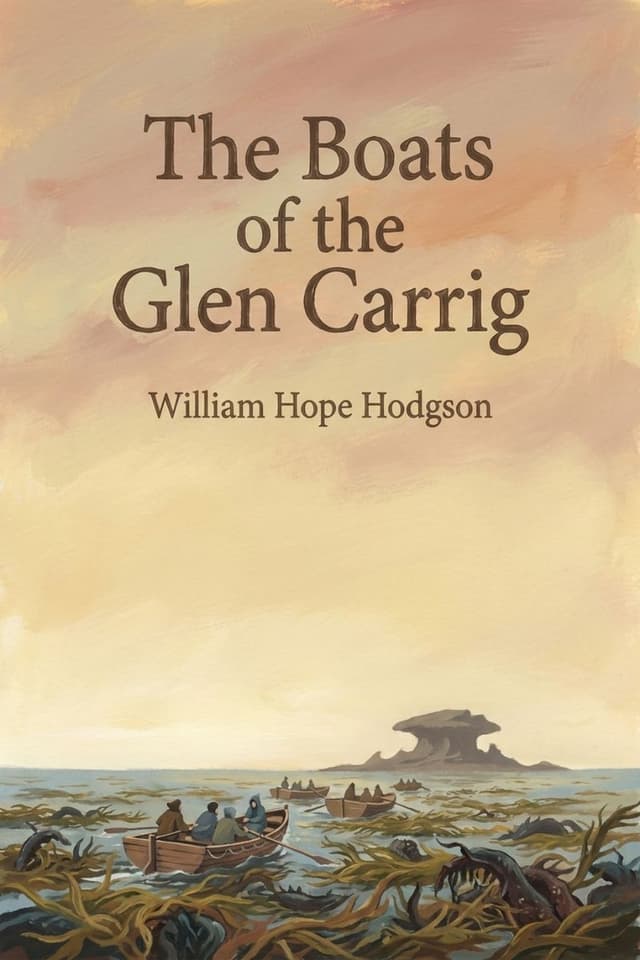
The Boats of the Glen Carrig
Read The Boats of the Glen Carrig by William Hope Hodgson for free on Novelhalla, and try out our easy-to-read modern edition of this classic book. You can also download the EPUB and read it on any device if you prefer!
The Plot
Five Days in the Boats
The book opens without any setup at all. There's no first chapter explaining the wreck, no captain's last stand, no goodbye to the ship. It begins with two lifeboats that have been at sea for five days, and men in them who haven't seen land the whole time. Whatever happened to the good ship Glen Carrig when she struck that hidden rock, you're never told. You just get the survivors, the water, and the dwindling provisions.
On the sixth morning somebody spots something low on the horizon that might be a coast. It is.
The Land of Lonesomeness
What they've found is a flat grey country of mud and creeks with no birds in it, no fish rising, no frogs, nothing. The narrator notices the silence before he notices anything else, and it bothers him more than a hostile shore would have. He calls the place the land of lonesomeness.
They row up a creek looking for firm ground and fresh water, and they come across a ship sitting abandoned in the mud. There's food aboard, which is the good news. There's also money left lying out, and clothing, and personal things nobody would walk away from. Whoever was on this vessel left in a tearing hurry and didn't stop to pack.
Deeper in they find something else: papers written by a woman who was aboard, a record of what happened to her and the people she was with. She mentions a spring not far off. The men need water badly enough to go and find it.
They find the spring. They also find what grows near it, and Hodgson's description of those trees is one of the great unpleasant surprises in early horror. The party doesn't stay to study them. They get back to the boats and get out to sea, and then the weather turns.
The Cemetery of the Oceans
The storm separates the two boats. From there the story follows one of them, and where it drifts is worse than any weather.
They come into a region where the ocean is choked with floating weed, mile upon mile of it, thick enough to hold a ship forever. Crabs the size of boats move through it. Old vessels sit rotting in the mass with their rigging still up, wrecks from decades or centuries back, ships that went missing and were mourned and forgotten while they sat right here. The narrator calls it the cemetery of the oceans and he isn't being poetic. Something with a face comes up alongside the boat in the dark and looks at him, and it isn't a crab and it isn't a man.
They find a bare island at the edge of the weed and get ashore, which feels like salvation for about a day. Then the boat turns out to be damaged. Then something comes up from the water while a man is alone. Then the nights start.
The Light in the Weed
From the high ground of the island they can see a ship, not far off, held fast in the weed. There's a light burning aboard her. Somebody is alive out there and has been for a long time, judging by the strange wooden superstructure they've built over the deck, a shell that can be shut up tight from the inside for reasons nobody on the island has to have explained to them.
Two groups of castaways, a stretch of weed between them, and no way to cross it. They start signalling with words painted on canvas. What they learn from those first exchanges is enough to tell them how bad the situation is, and how long it's been going on, and what happens on that ship after dark.
And the men on the island are learning the same lesson on their own account, because the things that live in the weed have noticed there's meat on shore now. They come at night, in numbers, and the only thing that turns them is fire, and firewood is not infinite.
The bo'sun starts figuring out how to get a rope across a quarter mile of open weed with nothing but a lifeboat's locker, a wrecked hull, and whatever the men can build with their hands. Everything now depends on whether he can.
About the Author: William Hope Hodgson
The Boy Who Ran Off to Sea
William Hope Hodgson was born in 1877 in Blackmore End, a hamlet in Essex, the second of twelve children of an Anglican clergyman. Three of his siblings died in infancy, and the family moved constantly, since his father served eleven parishes in twenty-one years.
At thirteen he ran away from boarding school to get to sea. He was brought back, but he wore his family down, and in 1891 he started a four year apprenticeship as a cabin boy. He spent roughly eight years at sea and came to loathe it: the food, the danger, the way apprentices were treated, the sheer grinding labor of working sail. Almost everything he later wrote came out of those years, which is a strange fate for a man who couldn't wait to get off the water.
He also took photographs the entire time. Lightning, cyclones, the aurora, sharks, and the maggots in the ship's provisions. In 1898 he went into shark infested water off New Zealand to pull out a shipmate who'd fallen from the topmast, and was given the Royal Humane Society medal for it.
The Strongman Years
He came ashore for good in 1899 and immediately opened W. H. Hodgson's School of Physical Culture in Blackburn, advertising a system that would cure indigestion. He'd built himself up into a serious bodybuilder while at sea, partly as an answer to having been a small and bullied apprentice, and members of the Blackburn police were among his clients.
In 1902 he took the stage with police-supplied handcuffs and restraints and applied them to Harry Houdini, who'd recently escaped from the Blackburn jail. It took Houdini over two hours to get free, after which he accused Hodgson of jamming the locks and hurting him on purpose. It made the papers. It did not make the gym profitable.
The Writer
With the school failing, Hodgson turned to lecturing about life at sea using tinted slides of his own photographs, then to articles attacking the apprenticeship system, then to fiction. His first story sold in 1906. This book, published in 1907 by Chapman and Hall while he was still living with his mother in relative poverty, was his first novel to reach print, and it got good reviews.
Three more followed fast: The House on the Borderland in 1908, The Ghost Pirates in 1909, The Night Land in 1912, along with the Carnacki ghost detective stories and a flood of short fiction. He wrote a great deal of poetry too, most of which no one would buy. He married Betty Farnworth, a magazine staffer, and they lived for a while in the south of France because it was cheap.
The War
Hodgson enlisted when the war came, despite his age and eight years of maritime experience the Navy never made use of. He was injured, discharged, recovered, and re-enlisted rather than sit out the rest of it. An artillery shell killed him near Ypres in April 1918, at forty. Accounts disagree on whether it was the 17th or the 19th. His widow's account, printed in an American magazine he'd written for, described him leading a group of NCOs to safety under fire.
He was very nearly forgotten within a decade. His widow kept his work in print, and in the 1930s an American enthusiast named H. C. Koenig started pushing Hodgson's novels on everyone who'd listen, including H. P. Lovecraft and Clark Ashton Smith. That's essentially why you can read him today.
Fun Facts About the Book
He Wrote His Novels Backwards
This was the first of Hodgson's novels to be published, but there's a well argued theory, most associated with the scholar Sam Gafford, that his four novels were written in roughly the reverse order of their publication. On that reading, the enormous and difficult Night Land came first and this adventure yarn came last, meaning the book that looks like an apprentice work may actually be the most experienced thing he wrote.
The Title Is the Blurb
The full title runs: an account of their adventures in the strange places of the Earth, after the foundering of the good ship Glen Carrig through striking upon a hidden rock in the unknown seas to the Southward, as told by John Winterstraw, Gent., to his son James Winterstraw, in the year 1757, and by him committed very properly and legibly to manuscript. That's the whole 18th century convention, and it's also the only place in the entire book where the narrator's name appears.
Readers Thought Pages Were Missing
Starting five days after the shipwreck, with no explanation of the wreck itself, was deliberate. It reads like a document with its opening leaves torn off, and plenty of early readers assumed exactly that.
There Is No Dialogue
Not a single line of quoted speech in the whole novel. Everything anyone says is reported second hand by the narrator inside his enormous, semicolon-heavy, prepositional sentences. It should be unreadable and somehow isn't, and it does something odd to the horror scenes, where you're always hearing about the terror rather than being in the room with it.
The Dedication Is a Poem to His Mother
The book opens with Hodgson's poem "Madre Mia," addressed to a mother who people say is no longer young but whose face still seems unlined to her son. He wrote a lot of verse he couldn't sell and kept tucking it into his novels as dedications and epigraphs.
The First Horror Story to Use the Sargasso Sea
The great floating weed continent became Hodgson's signature setting, and he returned to it again and again in the linked tales now known as his Sargasso Sea stories. This appears to be its first use as an engine of horror rather than a piece of nautical folklore, and every derelict-choked weed sea in fiction since owes it something.
Lovecraft Loved the First Half
In his long survey of supernatural horror, Lovecraft said the brooding menace in the earlier parts of the book couldn't be surpassed, then complained that it slides toward ordinary romance and adventure toward the end, and that the imitation eighteenth-century prose is inaccurate and hurts the effect. He forgave all of it because of the nautical knowledge on display.
The Kite Builder Is Called Jessop
A minor seaman here shares a name with the narrator of The Ghost Pirates, published two years later. Hodgson never linked the books, and the three novels he called a trilogy have no characters in common, but if you're reading all three it's a nice little coincidence to trip over.
The Bo'sun Never Gets a Name
The most important character in the book, the man whose competence everything depends on, is called the bo'sun from beginning to end. Several others are just the big seaman or the buxom woman. Hodgson gives more descriptive detail to the contents of a boat's lockers than to any human face in the story.
It Got a Metal Album
In 2015 the German funeral doom band Ahab released an entire concept album based on the novel, following its narrative track by track. It is exactly as slow and enormous as that description suggests.
Themes
Competence Is the Hero
There's no chosen one here and no magic. What saves people, when anything does, is knowing how to rig a sea anchor, how to repair a hull with salvaged timber, how to build a bow out of smaller bows, how to fly a kite in a steady wind. Hodgson spent eight years learning this stuff and the book is quietly in love with practical skill under pressure. It's one of the purest survival-engineering stories in early fantastic fiction.
The Horror Is Just Biology
Nothing in this book is a ghost. The things in the weed have eyes and beaks and appetites, and the implication running underneath is far more disturbing than a haunting: these creatures evolved. They live out there, they've adapted to a place humans can't survive, and they have been doing it for a very long time without anyone knowing. Critics have connected the book directly to Darwin, and it reads like a naturalist's field notes written by a man in a panic.
Sound in the Dark
Hodgson's great trick is noise. The wailing over the mud flats, the crashing and slithering in the night, the thing plucking at a rope you can't see the far end of. He describes the creatures as little as possible and their sounds as much as possible, which is why the scares still work more than a century later.
Class Dissolves and Then Comes Back
The narrator is a gentleman passenger. The men around him are working sailors, and in the boats and on the island those distinctions stop meaning anything, because what matters is who can do the work. It's a genuinely interesting piece of social observation for 1907, and worth watching to see what survives the voyage and what doesn't.
The Sea Keeps Everything
The weed continent is full of ships that were reported missing and grieved over and written off. They're all still there, rotting slowly with their masts up. It's the bleakest idea in the book: that the ocean doesn't destroy what it takes, it just holds onto it somewhere nobody can reach.
The Book's Legacy
The novel was rediscovered the way the rest of Hodgson was, through Lovecraft's advocacy, through the Arkham House omnibus of 1946, and then decisively in February 1971, when Ballantine reissued it as the twenty-fifth volume of the Ballantine Adult Fantasy series with an introduction by Lin Carter. That series is why a lot of readers born after the war know Hodgson's name at all.
Its influence runs wider than its readership. China Miéville has credited Hodgson with bringing tentacles into weird fiction as a serious horror device, and this is the book where the tentacles come ashore. The weed-choked graveyard sea, the derelict that's been trapped for years with people still living aboard, the creatures adapted to a place humans were never meant to reach: all of it turns up again and again in horror and science fiction, usually by writers who have never heard of the Glen Carrig.
Hodgson's own mycological nightmares had their own afterlife too. The fungus that mimics human shape recurs in his short story "The Voice in the Night," which became the 1963 Japanese film Matango, which is how a fair number of people have encountered Hodgson's ideas without ever encountering Hodgson.
Among his four novels this one is the most immediately readable and the most fun. The House on the Borderland is the visionary one and The Night Land is the endurance test. This is the one you hand to somebody who likes shipwrecks and monsters, and it's a survival story with real engineering in it, written by a man who genuinely knew how to keep a boat afloat.