Novelhalla
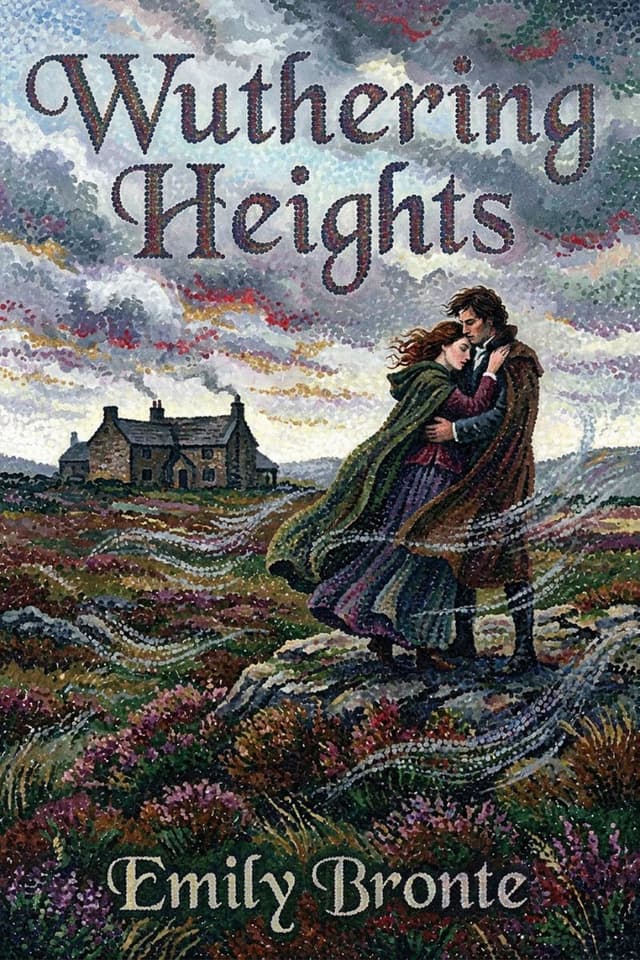
Wuthering Heights
Read Wuthering Heights by Emily Bronte for free on Novelhalla, and try out our easy-to-read modern edition of this classic book. You can also download the EPUB and read it on any device if you prefer!
The Plot
The Stranger at the Door
A man named Lockwood has just rented a grand house called Thrushcross Grange in the remote Yorkshire moors. His landlord is Heathcliff, a brooding, wealthy man who lives at a neighboring farmhouse called Wuthering Heights. Out of curiosity, Lockwood pays a visit. What he finds is a household that feels more like a prison. The people inside are hostile, miserable, and tangled together in ways he can't begin to understand.
Then, trapped by a snowstorm and forced to spend the night, Lockwood has an experience that changes everything. Something comes to the window. Something that shouldn't be there. A voice, a name, a hand reaching through the glass.
He demands an explanation. And the housekeeper, Nelly Dean, has one. But it's going to take a while.
The Boy From Nowhere
Years earlier, the master of Wuthering Heights, Mr. Earnshaw, returned from a trip to Liverpool carrying a dirty, starving child he'd found on the streets. He brought the boy home and named him Heathcliff. That's it. One name. No surname. No history. No explanation.
Earnshaw's son Hindley hated the newcomer on sight. But Earnshaw's daughter Catherine? She and Heathcliff became inseparable. They ran wild on the moors together, fierce and free and completely absorbed in each other. It wasn't the kind of bond that looked like childhood friendship. It was something deeper and stranger and more dangerous than that.
The Wedge
When Mr. Earnshaw dies, Hindley inherits the estate and wastes no time grinding Heathcliff into the dirt. He strips him of his education, demotes him to a servant, and does everything possible to humiliate him. Heathcliff endures it because of Catherine.
But then the Lintons enter the picture. Thrushcross Grange, the elegant estate down the valley, is home to Edgar and Isabella Linton, who are everything Wuthering Heights is not: polished, wealthy, civilized. Catherine is drawn into their world, and it starts to change her. She begins to see the gap between what she feels and what society expects. She loves Heathcliff with a ferocity that frightens even her. But she also wants the life that Edgar Linton can give her.
She makes a choice. And it's the wrong one. She knows it's the wrong one even as she makes it. She tells Nelly that marrying Edgar Linton would be like choosing heaven when her soul belongs somewhere else entirely. But she does it anyway.
Heathcliff overhears part of this conversation. Not all of it. Not the part that matters. He disappears into the night, and no one knows where he's gone.
The Return
Three years later, Heathcliff comes back. He's transformed. He has money, composure, and an air of controlled fury that makes everyone in the room uneasy. Where he went, how he made his fortune, what happened to him during those missing years, the novel never says. It's one of the great unexplained gaps in fiction.
Catherine is now Mrs. Linton, living at Thrushcross Grange. She's overjoyed to see Heathcliff. Edgar is not. And Heathcliff has not come back to make peace. He has come back to destroy everything and everyone who took Catherine from him.
He starts with Hindley, who has drunk himself into debt and ruin. He moves on to Isabella Linton, Edgar's sister, who makes the catastrophic mistake of falling in love with him. Heathcliff doesn't love her. He barely sees her as human. But she's useful.
The Storm
The tension between Catherine, Heathcliff, and Edgar builds to a breaking point. Catherine is caught between the two men who define her world, and the pressure of it is tearing her apart, literally. She falls into a fever, a delirium, a kind of madness. She's wasting away, and no one can reach her.
Heathcliff and Catherine have one final scene together. It is not gentle. It is not tender. It is two people ripping each other open because they can't figure out how to exist in a world that won't let them be together. It is one of the most devastating confrontations ever written.
What happens next sends Heathcliff into a spiral of grief so total it becomes indistinguishable from rage. And that rage doesn't stop. It passes down. It reaches into the next generation, to children who weren't even born when the damage began. Heathcliff's revenge isn't a plan that has an endpoint. It's a weather system.
The Next Generation
There is a second generation in this story, and their fates are being shaped by a man who wants to make the entire world pay for what he lost. Young lives are being bent and broken and trapped in arrangements they didn't choose, all because of wounds inflicted decades ago.
But here's the thing about Wuthering Heights. The moors are still there. The wind still blows. And the people who live under Heathcliff's control are not all as broken as he needs them to be. Something is stirring in the house. Something that looks a little bit like defiance. And something is happening to Heathcliff himself, something that might be worse than rage.
Whether the cycle of cruelty finally breaks, and what it costs if it does, is a question only the book can answer.
About the Author: Emily Bronte
Early Life
Emily Jane Bronte was born in 1818 in Thornton, Yorkshire, the fifth of six children. Her father Patrick was an Anglican clergyman, and her mother Maria died when Emily was just three. The children were raised by their aunt Elizabeth Branwell and their father at the parsonage in Haworth, a bleak village on the edge of the Yorkshire moors.
The moors became Emily's world. While her siblings sometimes chafed at their isolation, Emily thrived in it. She was fiercely attached to the landscape and to her home, and she resisted nearly every attempt to take her away from either.
The Imaginary Kingdoms
The Bronte children were spectacularly creative. As kids, they invented elaborate fictional worlds and wrote tiny handmade books about them. Emily and her younger sister Anne created a shared kingdom called Gondal, complete with its own history, wars, and poetry. They continued writing about Gondal well into adulthood. Almost none of the Gondal prose survives, but its poetry does, and some of Emily's finest verses come from this private, invented universe.
Attempts at the Outside World
Emily tried, repeatedly, to function outside Haworth. She attended school, she worked as a teacher, she even traveled to Brussels with Charlotte to study French and German at a private school. Every time, she was miserable. At one teaching job, she reportedly told her students that she preferred the school dog to any of them. At the Brussels school, she impressed her professor with her intellect but alarmed him with her stubbornness.
She always came back to the parsonage. Eventually, she stopped leaving.
The Poet
In 1845, Charlotte stumbled across a notebook of Emily's poems and was stunned by their quality. She convinced Emily and Anne to publish a joint collection under male pen names: Currer, Ellis, and Acton Bell. The book, published in 1846, sold exactly two copies. But the act of publishing emboldened all three sisters to try novels.
Death
Emily fell ill in late 1848, likely with tuberculosis. She refused all medical help. She refused to stay in bed. She refused to even acknowledge she was sick. On the morning of her death, December 19, 1848, she reportedly got dressed, came downstairs, and tried to carry on as normal. She was thirty years old. Her coffin was measured at just sixteen inches wide.
She died believing her only novel was a failure.
Fun Facts About the Book
The Pen Name
Emily published under the name Ellis Bell. All three Bronte sisters chose male pseudonyms with the same initials as their real names: Charlotte was Currer Bell, Emily was Ellis Bell, Anne was Acton Bell. They did this because they knew female authors would be judged differently, and they wanted their work to stand on its own. Their identities weren't revealed to the public until after Emily and Anne had both died.
The Reviews Were Brutal
Victorian critics were horrified. The novel was called coarse, disagreeable, wild, confused, and improbable. One reviewer couldn't believe a woman had written it. Charlotte Bronte herself wasn't entirely sure what to make of it, writing in a preface after Emily's death that she didn't know whether it was right to create a character like Heathcliff. Even the more positive reviews treated the book like a fascinating but disturbing specimen rather than a masterpiece.
Charlotte's Editing
After Emily's death, Charlotte edited a second edition of the novel, "correcting" Emily's punctuation, dialect, and some of her stylistic choices. Scholars have debated ever since how much Charlotte's edits altered Emily's intentions. Modern editions typically restore Emily's original text.
The Missing Second Novel
There are persistent rumors that Emily was working on a second novel when she died and that Charlotte destroyed the manuscript. No hard evidence exists either way, but the possibility has haunted Bronte scholars for over a century.
The Dog
Emily had a fierce, massive bull mastiff named Keeper. He was known for being uncontrollable, and Emily was reportedly the only person who could manage him. A well-known story claims she once punished Keeper with her bare fists after he climbed onto a forbidden bed, then led him downstairs and tended his injuries. Keeper followed Emily everywhere and lay outside her door as she was dying. He attended her funeral and spent weeks afterward lying at the door of her empty room.
The Rabid Dog Incident
In a separate animal encounter, Emily was bitten by a dog she believed might be rabid. Rather than tell anyone, she walked into the kitchen and cauterized the wound herself with a red-hot iron. She kept the incident secret until the danger of infection had passed.
The Structure
The novel's narrative structure was wildly experimental for 1847. The story is told through multiple layers of narration: Lockwood tells us what Nelly told him, and Nelly sometimes relays what other characters told her. The timeline jumps back and forth across decades. Victorian readers found this confusing. Modern readers recognize it as one of the most sophisticated narrative architectures of the nineteenth century.
Kate Bush
In 1978, a nineteen-year-old singer named Kate Bush released a song called "Wuthering Heights" as her debut single. She wrote it in a single evening after seeing the final minutes of a 1967 BBC adaptation on television. The song went to number one in the UK, making Bush the first female artist to top the British charts with an entirely self-written song. It knocked ABBA off the top spot. The song has since inspired a global annual event called "The Most Wuthering Heights Day Ever," where crowds of people in red dresses reenact the music video.
Themes
Obsessive Love
This is not a love story about tenderness. Catherine and Heathcliff's bond is primal, possessive, and borderline metaphysical. Catherine famously declares that she IS Heathcliff, not that she loves him, but that they share a soul. The novel asks whether a connection this intense can even be called love, or whether it's something more destructive that just wears love's face.
Revenge and Its Inheritance
Heathcliff's revenge doesn't burn out. It compounds. He doesn't just punish the people who wronged him. He engineers the suffering of their children. The novel traces how cruelty, once set in motion, becomes self-perpetuating, poisoning people who had nothing to do with the original wound.
Class and Social Cruelty
Heathcliff arrives as a nameless orphan and is systematically degraded because of his origins. The humiliation he suffers as a child directly fuels the monster he becomes as an adult. The novel never lets the reader forget that Heathcliff's darkness was not born in him. It was put there.
Nature as a Force
The moors aren't scenery. They're a character. The landscape in this novel is wild, indifferent, and eternal, and it mirrors the passions of the people who live on it. The civilized world of Thrushcross Grange, with its locked doors and polished surfaces, is constantly under siege from the raw, untamed energy of the Heights.
The Cycle of Abuse
The novel shows, with cold precision, how abused children become abusive adults. Hindley brutalizes Heathcliff. Heathcliff brutalizes the next generation. The pattern repeats with variations, and the question of whether anyone can break the cycle gives the second half of the novel its quiet, desperate tension.
Captivity and Freedom
Nearly every character in the novel is trapped in some way: by marriage, by debt, by grief, by manipulation, by the sheer remoteness of the setting. The moors represent a kind of freedom, but it's a freedom that exists outside society's rules, and the novel is deeply ambivalent about whether that's liberation or exile.
The Book's Legacy
When it was published in 1847, almost nobody knew what to do with it. It broke the rules of Victorian fiction so thoroughly that critics could only call it strange and savage. It took decades for readers to catch up.
Now it's one of the most widely read novels in the English language. It has been adapted into dozens of films, television series, plays, operas, and musicals, from the classic 1939 Hollywood version starring Laurence Olivier to Andrea Arnold's stark 2011 reimagining to Emerald Fennell's 2026 film starring Margot Robbie and Jacob Elordi.
The novel's influence stretches far beyond direct adaptations. Its DNA runs through gothic fiction, dark romance, and any story that treats love as a force of destruction rather than salvation. Writers from the Brontes' contemporaries to modern novelists have wrestled with the questions it raises about passion, cruelty, and whether the two can ever be separated.
It remains, nearly two centuries later, one of the most argued-about novels ever written. Readers still can't agree whether it's a love story or a horror story, whether Heathcliff is a romantic hero or a villain, whether the ending represents hope or exhaustion. The fact that the book can sustain all of these readings at once is exactly what makes it immortal.