Novelhalla
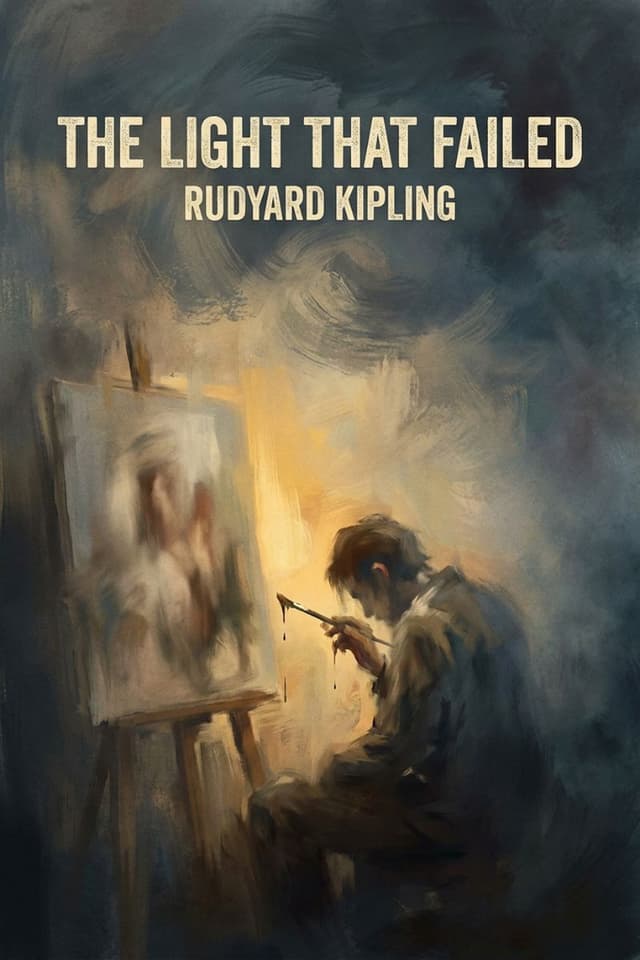
The Light That Failed
Read The Light That Failed by Rudyard Kipling for free on Novelhalla, and try out our easy-to-read modern edition of this classic book. You can also download the EPUB and read it on any device if you prefer!
The Plot
The Children of the House of Desolation
They meet as children, two orphans dumped together in a seaside boarding house run by a woman named Mrs. Jennett. She is a sadist. Her religion, self-manufactured from Scripture and spite, teaches her that children must be broken for their own good. Dick Heldar learns to lie, to hide, to absorb punishment without crying. Maisie, the gray-eyed girl who arrives one autumn with only a goat for a friend, learns something harder: to feel nothing at all.
They become allies in misery. They share beatings and pool their cunning against their tormentor. On the mudflats below Fort Keeling, where the tide runs out two miles and the air smells of dead weed, they practice shooting with a cheap Belgian revolver Dick has saved for months to buy. It is their one rebellion, their one taste of freedom.
The day before Dick leaves for school, something happens between them. A gun fires. There is an accident, or almost an accident. Maisie kisses him once, the only tenderness either of them has known. Then the years separate them, and Dick carries that kiss like a wound that will not heal.
The War Artist
Dick grows into a man with no fixed home and no family worth claiming. He drifts through the world, learning to draw, learning to paint, learning that his eye can capture things other artists miss. He ends up in Sudan, following the British campaigns against the Mahdi, sketching battles for the London newspapers.
The war teaches him what matters: truth, even ugly truth. He learns to draw what he sees, not what editors want. He watches men die. He watches the casual brutality of empire and finds it neither good nor evil but simply real. His sketches are raw, immediate, alive. They begin to attract attention.
In Sudan he meets Torpenhow, a war correspondent for the Central Southern Syndicate. Torpenhow is everything Dick is not: steady, kind, capable of easy friendship. They save each other's lives more than once. They become brothers of the sword, bound by experiences that cannot be explained to anyone who was not there.
When the campaigns end, Dick wanders through Africa and the East, always drawing, never settling. Then Torpenhow sends word: Dick's sketches have made him famous in London. There is money waiting. There is a career. Dick sails home to claim a success he never expected.
The Girl on the Embankment
London receives Dick as a celebrity. His war drawings have captured something the public craves: the romance and violence of distant conflicts, made safe for gallery walls. Commissions pour in. Critics praise him. Money flows. Dick discovers he enjoys success, perhaps too much.
Then, one foggy evening on the Thames Embankment, he sees her.
The years have turned the child into a woman, but the gray eyes are the same, the thin scarlet lips, the stubborn chin. Maisie. She is an artist now too, studying painting, struggling to make her way in a world that does not welcome women with ambition. She has a companion, a red-haired girl who watches Dick with suspicion.
Dick's heart, which he thought he had armored against all feeling, cracks open. The love he buried as a boy comes flooding back, stronger than before, impossible to control. He wants Maisie. He wants to help her. He wants to give her everything he has earned.
Maisie wants none of it.
The Coldness at the Heart
She is not cruel, exactly. She is simply incapable of giving what Dick needs. The childhood they shared taught her to survive alone, to trust no one, to protect the small hard core of herself at all costs. She likes Dick. She values his advice about painting. But love, the surrendering kind, the kind that makes two people into one, is beyond her.
Dick cannot accept this. He pursues her with the single-mindedness that made him a great war artist. He critiques her paintings with brutal honesty, trying to make her better. He offers his connections, his money, his future. He proposes marriage, again and again. She refuses, again and again, not angrily but with a cool puzzlement, as if she cannot understand why he keeps asking for something she has already explained she cannot give.
Meanwhile, Dick's work begins to change. The commercial success that once pleased him starts to feel hollow. He has been painting what sells, not what matters. His friends notice the change and warn him: he is becoming arrogant, lazy, a hack trading on his reputation. Torpenhow, loyal as ever, tells him the truth. Dick does not want to hear it.
The Model
Into this unhappy situation comes Bessie Broke, a woman from the streets who agrees to model for Dick's paintings. She is coarse, uneducated, damaged by a life Dick can barely imagine. She is also beautiful, in a hard-bitten way, and she hates Dick with an intensity that surprises them both.
Dick treats her badly. He pays her, but he also mocks her, bullies her, uses her for his art without caring what it costs her. She endures it because she needs the money, but something is building inside her, something that will eventually demand payment.
And all the while, something is happening to Dick that he does not fully understand. The wound he took in Sudan, years ago, is not as healed as he believed. The light is changing. The world is growing dim at the edges.
Dick has one great painting left in him. He calls it "Melancolia." It will be his masterpiece, the work that proves he is more than a clever illustrator of other men's wars. He begins to paint it with a desperation that frightens his friends.
The question is whether he can finish it. And whether, when it is finished, anyone will be left who cares.
About the Author: Rudyard Kipling
The Child of Two Worlds
Joseph Rudyard Kipling was born on December 30, 1865, in Bombay, India, where his father worked as an art teacher and museum curator. His early childhood was idyllic: he was surrounded by Indian servants who spoke to him in Hindi, told him folk tales, and treated him with the warmth his English parents, busy with their social obligations, could not always provide.
Then, at age six, he was sent to England.
It was standard practice for children of the British Raj to be educated in the mother country, but for young Rudyard it was a catastrophe. He and his younger sister Trix were placed with a foster family in Southsea, a couple named Holloway who ran a boarding house for children whose parents were abroad. Mrs. Holloway was a religious fanatic who believed in beating the sin out of children. For six years, Kipling endured what he later called the "House of Desolation," an experience that scarred him for life and provided the raw material for Dick Heldar's childhood in The Light That Failed.
His only escape was reading. Books became his refuge, his education, his survival. When his mother finally returned and rescued him, she found a boy on the verge of nervous collapse. She took him to a new school, the United Services College in Devon, where he began to recover. There he discovered his talent for writing and met the girl who would haunt his imagination: Florence Garrard.
The Young Journalist
At seventeen, Kipling returned to India to work as a journalist. The subcontinent welcomed him back like a prodigal son. He threw himself into the life of colonial India, roaming the streets of Lahore at night, visiting opium dens and brothels, talking to soldiers and servants and princes. He published poems and stories at a furious pace, developing the vivid, muscular style that would make him famous.
By 1889, when he left India for London, he had already published six volumes of short stories. He was twenty-three years old. The literary world was about to discover him.
In London, Kipling became a sensation. His tales of India, his barrack-room ballads celebrating the common British soldier, his confident command of exotic settings and rough characters, all struck the public as thrillingly new. Henry James called him "the most complete man of genius" he had ever known. Within a few years, Kipling was the most popular writer in the English-speaking world.
The Heartbreak
But success could not heal the wound Florence Garrard had left. They had met as teenagers, and Kipling had believed they were engaged. She broke it off, devastated him, and then reappeared in his life just as he was becoming famous. He pursued her to Paris, where she was studying art. Whatever happened between them, he never saw her again.
The Light That Failed was his revenge and his confession. He wrote it in three months, pouring his heartbreak into Dick Heldar's hopeless love for the cold, self-contained Maisie. The novel was published in 1891, his first, and it announced to the world that the cheerful chronicler of empire had darker depths than anyone suspected.
He recovered, as heartbroken young men do. He married Caroline Balestier, the sister of a friend, and moved to Vermont, where he wrote The Jungle Book and began the work that would cement his reputation. He returned to England, settled in Sussex, and became the unofficial laureate of British imperialism, celebrated and controversial in equal measure.
The Nobel and the Grief
In 1907, Kipling became the first English-language writer to win the Nobel Prize in Literature. He was forty-one years old, the youngest recipient in the prize's history. The citation praised his "power of observation, originality of imagination, virility of ideas and remarkable talent for narration."
But the triumph was shadowed by tragedy to come. The First World War destroyed Kipling's world. His only son, John, was killed at the Battle of Loos in 1915, at age eighteen. Kipling had used his influence to get the boy into the army despite his terrible eyesight. The guilt haunted him for the rest of his life.
He continued to write, but the confidence was gone. The empire he had celebrated was dying. The young men he had helped send to war were not coming back. Kipling spent his final years as a kind of monument, respected but increasingly out of step with a world that had moved beyond his certainties.
He died on January 18, 1936, and was buried in Poets' Corner at Westminster Abbey. His epitaph might have been the famous last line of his poem "If": "And, which is more, you'll be a man, my son." Or it might have been the bitter couplet he wrote after his son's death: "If any question why we died, / Tell them, because our fathers lied."
Fun Facts About the Book
Two Endings
Kipling originally wrote a tragic ending for The Light That Failed, but his mother and his American publisher convinced him to write a happy alternative for magazine serialization. The Lippincott's Magazine version ends with Dick and Maisie getting engaged. The "Standard Edition," which Kipling insisted was "the story as it was originally conceived by the writer," ends very differently. Modern editions typically use the tragic ending.
The Real Maisie
Maisie was based on Florence Garrard, Kipling's first love. Like Maisie, Florence was an art student. Like Maisie, she was cool, self-contained, and ultimately unwilling to give Kipling what he wanted. The novel is one of the most autobiographical things Kipling ever wrote, and the pain in it is clearly personal.
The House of Desolation
Mrs. Jennett, the cruel guardian of Dick's childhood, was based on Mrs. Holloway, with whom Kipling and his sister actually lived. Kipling wrote about this experience several times, most directly in the story "Baa Baa, Black Sheep." The trauma shaped his entire worldview, teaching him that cruelty was everywhere and that survival required cunning and emotional armor.
A Critical Failure
Despite Kipling's enormous popularity, The Light That Failed received poor reviews. Critics found it melodramatic and self-indulgent. Lord Birkenhead later called it "a rotten apple" among Kipling's works. George Orwell, characteristically contrarian, declared it "that excellent novel." Modern readers remain divided.
Nervous Breakdown
Shortly after publishing The Light That Failed, Kipling suffered a nervous breakdown. The combination of overwork, heartbreak over Florence Garrard, and the pressure of his sudden fame proved too much. He recovered, but the experience may have contributed to the darkness that runs through so much of his later work.
Film Adaptations
The novel was adapted for film three times: a lost 1916 silent version, a 1923 silent version that used the happy ending, and a 1939 sound version directed by William Wellman and starring Ronald Colman, which finally used Kipling's original tragic ending. The 1939 film also starred Ida Lupino as Bessie and Walter Huston as Torpenhow.
The Title
The title comes from a hymn: "The Light That Failed" refers to the light of hope, of love, of artistic vision, all of which fail Dick Heldar over the course of the novel. It also refers, more literally, to what happens to Dick's eyes.
Themes
Unrequited Love
The novel is, above all, a study in loving someone who cannot love you back. Dick's passion for Maisie is total, obsessive, and doomed. Maisie is not a villain; she simply lacks the capacity for the surrender that love requires. The novel asks whether this makes her broken or merely self-preserving, and does not provide an easy answer.
The Cost of Childhood Trauma
Dick and Maisie were both damaged by Mrs. Jennett's cruelty, but in different ways. Dick became a liar and a survivor, capable of deep feeling but unable to trust. Maisie became sealed off, unreachable, incapable of intimacy. The novel suggests that childhood shapes us in ways we can never fully escape.
Art and Commerce
Dick's struggle between commercial success and artistic integrity runs through the novel. He knows his best work comes from truth, not flattery, but the market rewards flattery. His friends warn him that he is selling out. His attempt to create one true masterpiece, the "Melancolia," is his bid for redemption.
Male Friendship
The relationship between Dick and Torpenhow is, in some ways, the novel's only healthy love. They understand each other, protect each other, tell each other the truth. Critics have noted that this friendship is depicted with more warmth than any of the romantic relationships in the book.
The Darkness of Empire
Though the Sudan campaigns provide backdrop rather than focus, the novel does not shy away from the brutality of colonial warfare. Dick witnesses atrocities and incorporates them into his art. The novel suggests that the empire Kipling elsewhere celebrated was built on violence that scars everyone it touches.
The Book's Legacy
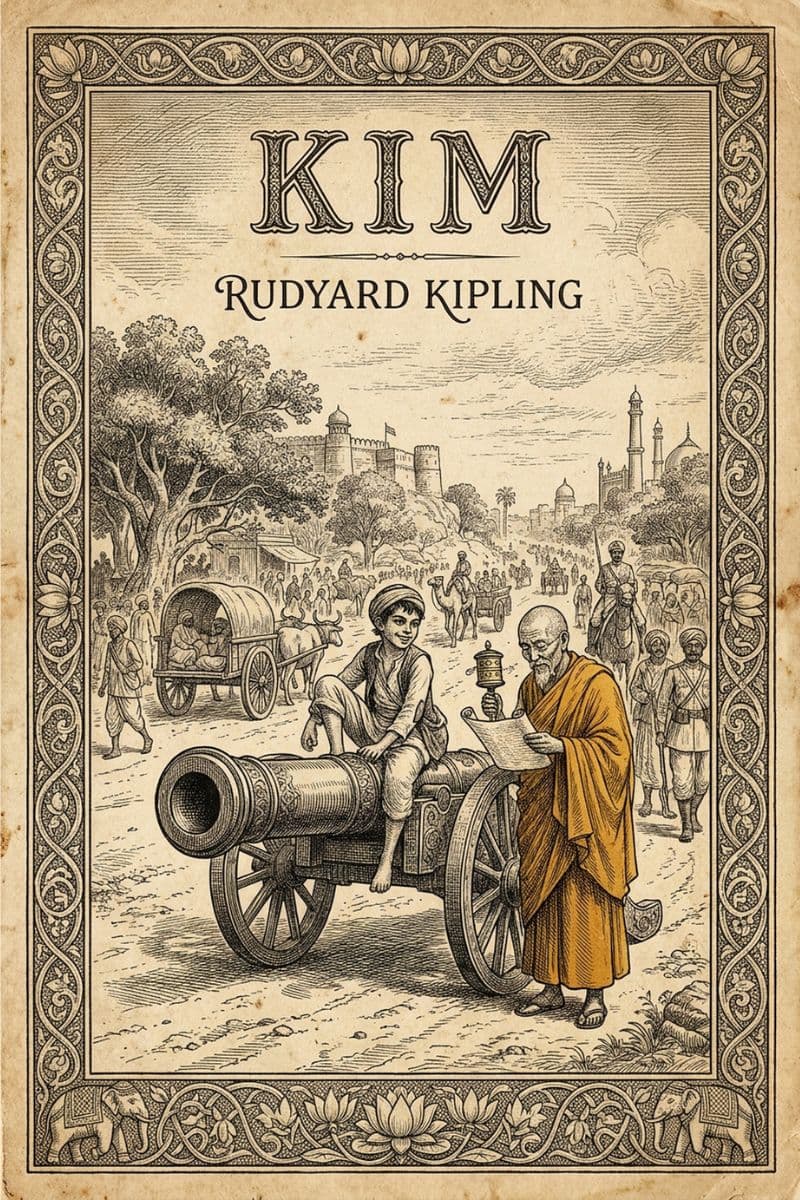
The Light That Failed is not Kipling's best-known work. It lacks the charm of The Jungle Book, the scope of Kim, the quotability of his famous poems. It is too painful, too personal, too obviously the cry of a wounded young man.
But it endures. The novel has remained in print for over a century. It has been adapted for stage, radio, and film. It continues to attract readers who want to understand the man behind "Gunga Din" and "If," who sense that the confident imperialist had depths of doubt and despair that he rarely showed.
The Light That Failed stands as a reminder that Kipling was never as simple as his reputation suggests. He could write jingoistic verse and brutal tragedy. He could celebrate the empire and mourn its victims. He could love hopelessly and transform that hopelessness into art.
The novel is, finally, about what happens when the light fails: when love is not returned, when talent is not enough, when the eyes that see so clearly begin to go dark. It is a young man's book, written in the heat of heartbreak, and it still has the power to wound.