Novelhalla
Metamorphosis
Read Metamorphosis by Franz Kafka for free on Novelhalla, and try out our easy-to-read modern edition of this classic book. You can also download the EPUB and read it on any device if you prefer!
The Plot
The Worst Morning of Your Life
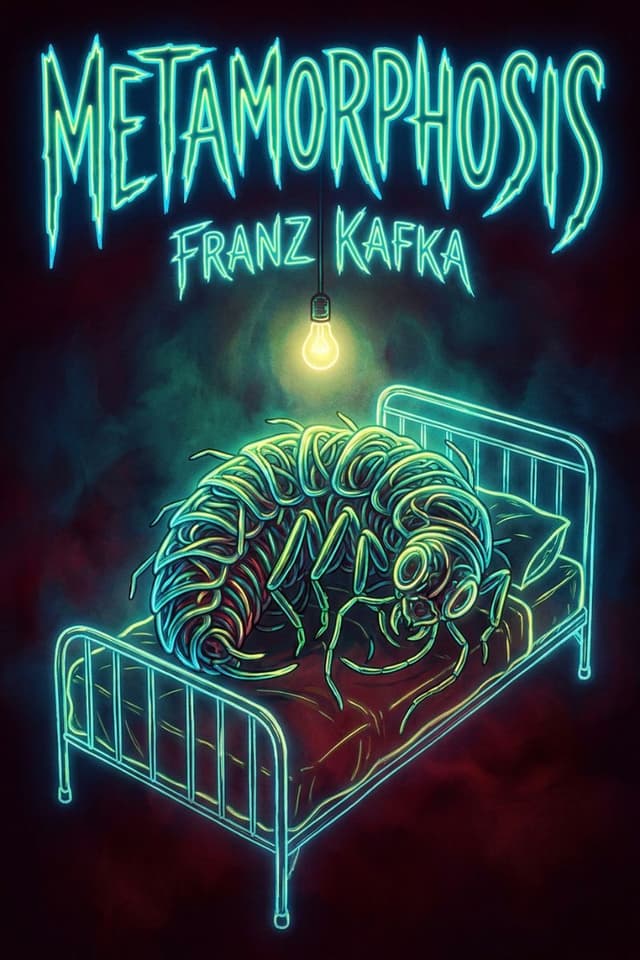
Gregor Samsa wakes up one morning and discovers he has been transformed into a monstrous insect.
That's the first sentence. There is no preamble, no explanation, no dream sequence leading up to it. One moment he is a traveling salesman who supports his entire family. The next moment he is a giant bug lying on his back in bed, his many little legs waving helplessly in the air.
And the strangest part? Gregor doesn't scream. He doesn't panic. He looks at his new body, notes the situation, and then starts worrying about how he's going to catch his morning train to work.
The Salesman
Before the transformation, Gregor was the sole breadwinner for the Samsa family. His father's business failed years ago. His mother has asthma. His younger sister Grete plays the violin and has gentle dreams. The family owes a heavy debt that Gregor has been working to pay off, trip by grinding trip, dragging fabric samples from town to town for a boss he despises but cannot leave.
He hates the job. He hates the early mornings, the bad food, the shallow connections with people he'll never see again. But the family needs him, so he works. That's who Gregor is. The provider. The good son. The one who gives everything and asks for nothing.
Now he's a bug. And within minutes, his boss's office manager is at the door, demanding to know why Gregor isn't at his station.
Behind the Door
What follows is one of the most excruciating scenes in literature. Gregor, still thinking like a man, tries to get out of bed with a body that no longer obeys human logic. His family stands outside his locked bedroom door, pleading, threatening, trying to coax him out. He can understand every word they say. But when he tries to speak, what comes out of his mouth is no longer a human voice.
When the door finally opens, the reaction of his family tells Gregor everything he needs to know about his new place in the world.
The Room
Gregor retreats to his bedroom, and the bedroom becomes his world. His sister Grete takes on the task of feeding him and cleaning his room, though she can barely stand to look at him. She experiments with different foods, trying to figure out what his new body wants. The answer is disturbing. Fresh food repulses him now. What he craves is the rotting stuff.
Slowly, Gregor's humanity begins to slip. He finds himself climbing the walls and ceiling, enjoying it. He clings to a framed picture on his wall with a desperate possessiveness he can't quite explain. He is changing in ways that go deeper than his body, and he knows it, and he can't stop it.
Meanwhile, on the other side of the door, the family is changing too.
The Family
Here is where the story becomes something more than a horror tale. Gregor's father, who had seemed broken and defeated, begins to revive. He puts on a uniform. He stands up straighter. Grete, the gentle sister, takes on responsibilities. The mother tries to hold everything together. Without Gregor's income, they must all work, and in working, they discover they are capable of more than anyone, including themselves, ever believed.
The question the story keeps circling is brutal and simple: what happens to love when the person you love becomes something you can't recognize? How long does obligation last? At what point does the creature in the bedroom stop being your son, your brother, and become simply a problem?
Grete, the one who cared for him most faithfully, is the one who will eventually have to answer that question. And her answer will break your heart.
The Reckoning
The final act is short and devastating. Three lodgers have moved into the apartment. The family's finances are desperate. And an incident involving Grete's violin forces a confrontation that has been building since the first page.
What happens to Gregor, and what happens to the family after, is told with such flat, matter-of-fact calm that it lands like a punch you didn't see coming. The last paragraph of this novella is one of the most chilling and quietly monstrous things ever written, and not because of anything to do with insects.
About the Author: Franz Kafka
Early Life
Franz Kafka was born in 1883 in Prague, then part of the Austro-Hungarian Empire. His family was middle-class and Jewish, part of a German-speaking minority in a Czech-majority city, which meant Kafka grew up belonging fully to no group at all. His father Hermann was a self-made businessman, physically imposing and emotionally domineering. Kafka was terrified of him. He later wrote a famous letter to his father, over a hundred pages long, cataloguing the damage. He never sent it.
Kafka had three younger sisters. He was a quiet, slight boy who hated school and loved reading. He later told a friend that his education had tried to make him into something other than what he was, like sawdust stuffed into a chair.
The Insurance Man
Kafka studied law and took a position at the Workers' Accident Insurance Institute in Prague, where he processed workplace injury claims and wrote annual reports his supervisors admired. He was good at the job. He also hated it, not because the work was difficult but because it consumed the hours he wanted to spend writing. He got off work at two in the afternoon and wrote deep into the night, sleeping barely at all, slowly destroying his health.
His colleagues liked him. He was charming, funny, intelligent, and neat in appearance. Almost no one at the insurance office knew he was one of the most important writers of the twentieth century. He probably wouldn't have believed it himself.
The Writer in the Night
Kafka wrote in German, though he also spoke Czech and French. He wrote in his bedroom, at night, in a state of exhaustion and intensity that he compared to a kind of fever. In September 1912, he wrote an entire story called "The Judgment" in a single eight-hour sitting and described the experience as the only right way to write. Energized, he turned to The Metamorphosis that November and completed it in about three weeks.
He was deeply critical of almost everything he produced. He abandoned novels midstream. He agonized over sentences. His friend Max Brod had to practically drag finished work out of his hands and push it toward publishers.
Love and Loneliness
Kafka was engaged twice to Felice Bauer, a woman he met at Max Brod's house in 1912. The relationship was conducted largely through letters, and both engagements collapsed. He had intense connections with other women, including the journalist Milena Jesenska and, in his final year, the young Dora Diamant, who gave him something approaching happiness.
But Kafka seemed unable to commit to the ordinary structures of adult life. Marriage, family, a settled home. He wanted these things and feared them in equal measure, circling them the way his characters circle the institutions that trap them.
Illness and Death
In 1917, Kafka was diagnosed with tuberculosis. His health deteriorated over the next seven years, forcing him into sanatoriums and eventually into early retirement. He spent some of his happiest months at his sister Ottla's farm in the countryside, free from work and family pressure.
In his final year, he moved to Berlin with Dora Diamant, trying at last to live entirely as a writer. The tuberculosis spread to his larynx. Eating became agony. He died on June 3, 1924, in a clinic near Vienna, at the age of forty. He was revising a story called "A Hunger Artist" on his deathbed, a tale about a man who starves himself as a form of performance art. He was buried in the New Jewish Cemetery in Prague.
Before he died, he asked Max Brod to burn all his unpublished manuscripts. Brod refused. The world got The Trial, The Castle, and everything else.
Fun Facts About the Book
Written in Three Weeks
Kafka wrote The Metamorphosis between November 17 and December 6, 1912, interrupting his work on the novel that would become Amerika. It was one of the most productive periods of his life, fueled by the creative breakthrough he'd experienced with "The Judgment" two months earlier. Despite the speed, he was dissatisfied with the result, particularly the ending.
Three Years to Publish
Though written in late 1912, The Metamorphosis didn't appear in print until October 1915 in the German literary journal Die Weissen Blatter. The delay was partly due to Kafka's own hesitations and partly because World War I had broken out in the interim, disrupting the publishing world.
Do Not Draw the Bug
Kafka was insistent that no illustration of Gregor as an insect should appear on the cover or anywhere in the book. In a letter to his publisher, he wrote that the insect itself must not be depicted and should not even be visible from a distance. He wanted the reader's imagination to do the work. The first edition respected this wish. Later editions did not. Clearly, we at Novelhalla didn't listen either.
What Kind of Bug?
Kafka never specifies what Gregor becomes. The German word "Ungeziefer" roughly translates to "vermin" or "monstrous creature" and deliberately avoids naming a species. Translators have wrestled with this for over a century. Some say insect, some say beetle, some say cockroach. Vladimir Nabokov, who was also a trained entomologist, spent considerable effort determining that Gregor was most likely a beetle and noted with some frustration that Gregor would have had wings under his shell and could theoretically have flown away.
The Autobiographical Thread
Kafka's father was a domineering businessman. Kafka spent years supporting his family through work he found soul-crushing. He felt invisible to the people closest to him. He once described himself in a letter as a non-person, someone condemned to die without having really lived. The parallels to Gregor Samsa are so obvious that scholars have spent decades arguing about whether the story should be read autobiographically or whether that reading is too simplistic. Kafka himself would probably have found the debate very Kafkaesque.
The Fontane Prize
After publication, The Metamorphosis helped earn Kafka the Theodor Fontane Prize for literature, one of the few significant recognitions he received during his lifetime. He accepted it with his characteristic lack of self-congratulation.
Themes
Alienation
The Metamorphosis is the purest expression of alienation ever put on paper. Gregor doesn't become alien to his family because he turns into a bug. The transformation simply makes visible what was already true. He was always the useful one, the functional one, valued for what he provided rather than who he was. The moment he can no longer provide, the family discovers how little connection actually existed.
The Burden of Duty
Gregor has spent his adult life sacrificing for his family, and nobody asked him to want it. He just did it. His identity was his usefulness. When that usefulness is stripped away, there is almost nothing left underneath. The story asks a devastating question: if you define yourself entirely by what you do for others, who are you when you can't do it anymore?
Family and Cruelty
The Samsas are not villains. That's what makes the story so uncomfortable. They are ordinary people dealing with an impossible situation, and their responses, the horror, the guilt, the slow withdrawal of empathy, and finally the relief, are entirely human. Kafka doesn't judge them. He simply shows you what happens, and lets you sit with it.
The Body as Prison
Gregor's mind remains essentially human for most of the story, trapped inside a body that disgusts everyone who sees it. He can understand his family's conversations but cannot make himself understood. He has feelings they cannot perceive. The gap between his inner life and his outward form is the story's most disturbing element, a horror that has nothing to do with insects and everything to do with the experience of being unseen.
Transformation and Identity
The title promises a metamorphosis, and Gregor's is the obvious one. But the real transformation belongs to the family. Freed from dependence on Gregor, they change in ways that are, from a certain angle, positive. They grow. They take initiative. They become more alive. The story's final image suggests a family blooming into the future, and the cost of that blooming is something Kafka leaves you to calculate on your own.
The Book's Legacy
The Metamorphosis is one of the most widely read works of fiction in any language. It is taught in high schools and universities around the world, translated into dozens of languages, and referenced so frequently in popular culture that the basic premise, man wakes up as a bug, has become a kind of cultural shorthand.
The word "Kafkaesque" entered the English language because of stories like this one, describing situations that are nightmarish, absurd, and bureaucratically oppressive in ways that feel both impossible and deeply familiar.
The novella has been adapted into films, plays, graphic novels, operas, and radio dramas. It influenced writers from Albert Camus to Gabriel Garcia Marquez to Haruki Murakami. Its opening sentence is one of the most famous in all of literature, and the debate over how to translate it has become its own small literary industry.
What keeps The Metamorphosis alive is not its weirdness. Plenty of stories are weird. It endures because the feelings underneath the insect shell are universal. The fear of being a burden. The loneliness of being misunderstood. The slow, sickening realization that the people who are supposed to love you might only love what you can do for them. Kafka found a way to make those feelings physical, visible, undeniable. You can't look away from a giant bug in the bedroom. And you can't easily forget what it means.