Novelhalla
The Good Soldier
Read The Good Soldier by Ford Madox Ford for free on Novelhalla, and try out our easy-to-read modern edition of this classic book. You can also download the EPUB and read it on any device if you prefer!
The Plot
The Saddest Story
"This is the saddest story I have ever heard."
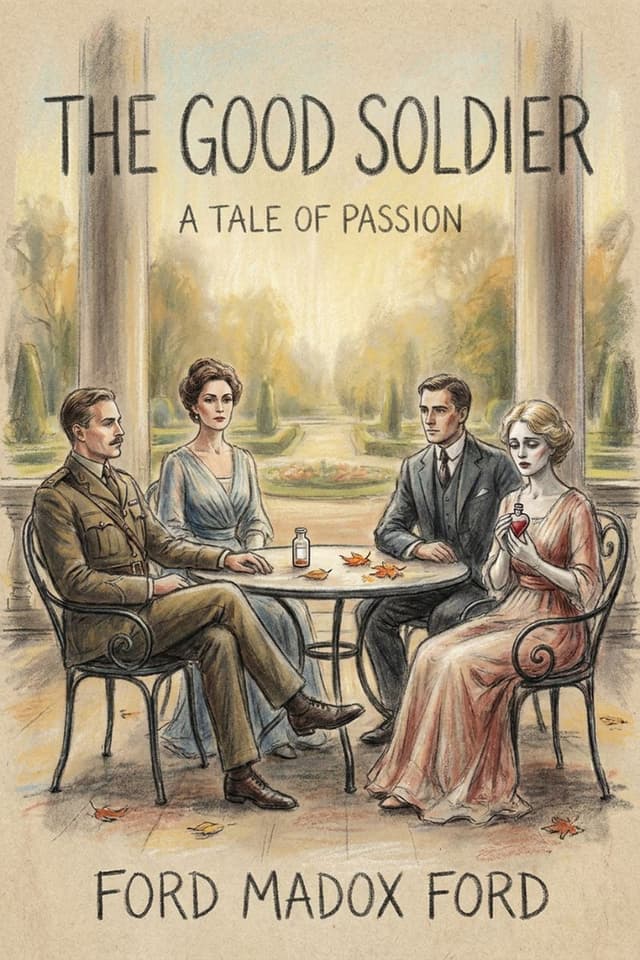
That's how John Dowell starts telling it. He's an American, wealthy and idle, and for nine years he and his wife Florence have been close friends with an English couple, Captain Edward Ashburnham and his wife Leonora. Every summer, the four of them meet at a spa in Nauheim, Germany, where Edward and Florence are being treated for their heart conditions. They dine together. They take walks. They are, by every outward measure, four perfectly respectable people living perfectly respectable lives.
Dowell believes this completely. He believes it with his whole heart.
He is wrong about everything.
The Cracks
The thing about Dowell is that he tells you what happened, but he doesn't tell it straight. He circles back. He contradicts himself. He drops a devastating piece of information like it's nothing, then spends three pages on something trivial. He's writing this all down after the fact, trying to make sense of a story that broke him, and the result is a kind of narrative vertigo where the reader starts piecing things together before Dowell does.
Florence's heart condition? It's fake. She invented it on their honeymoon to keep Dowell out of her bedroom, and it's worked for thirteen years. Their marriage has never been consummated. Florence has been having affairs the entire time, first with a low-rent artist in Paris, and then, for nine years running, with the man sitting across from her husband at dinner. Edward Ashburnham, the good soldier of the title, the upstanding English gentleman, has been sleeping with Dowell's wife.
And Dowell? He had no idea. Or did he? That's the question the novel keeps turning over like a coin. Is Dowell genuinely oblivious, or is he something stranger and darker than he appears?
The Good Soldier
Edward Ashburnham is the kind of man everyone admires. Handsome, well-bred, a decorated military officer, a generous landlord, the picture of English decency. He is also a serial philanderer whose romantic entanglements have been slowly destroying his finances and his marriage for years. There was a Spanish dancer who bled him dry. There was a married woman on a train. There have been others. Each time, Leonora has cleaned up the mess, managed the money, kept up appearances, and swallowed her rage.
Leonora is Catholic, Irish, and absolutely rigid in her sense of duty. She married Edward because their families arranged it, and she has spent their entire marriage trying to control a man who keeps falling desperately in love with the wrong women. She doesn't leave. She doesn't make scenes. She manages. And the cost of all that managing is corrosive.
The Girl in the Middle
Then there is Nancy Rufford, the Ashburnhams' young ward. She has grown up in their house, innocent and sheltered, and she adores Edward like a father. As the web of lies starts pulling tighter, Nancy gets drawn into the center of it. Edward's feelings toward her become something that can't be explained away as paternal affection. Leonora sees it happening. Florence sees it happening. And the collision of all these desires, resentments, and secrets is heading somewhere that none of them, least of all Dowell, can control.
Dowell tells you early on that people die in this story. He mentions it almost casually. But the how and the why, and the slow horrible logic of how four people who looked so perfect could end up so utterly destroyed, that's what the novel is actually about.
And whether you can trust a single word of it is entirely up to you.
About the Author: Ford Madox Ford
Born Into It
Ford Madox Ford was born Ford Hermann Hueffer in 1873 in Surrey, England, and he came into the world basically pre-loaded with artistic connections. His grandfather was the Pre-Raphaelite painter Ford Madox Brown. His father was a German music critic for The Times. He grew up around Rossettis, Swinburnes, and the whole bohemian upper crust of Victorian London's art scene. He published his first book, a fairy tale called The Brown Owl, at eighteen.
The Conrad Years
In 1894, Ford eloped with Elsie Martindale. They settled in the English countryside, where Ford became friends with Joseph Conrad, and the two collaborated on novels together. Whether Ford was the junior partner or the secret engine of that collaboration depends on who you ask. Ford would later claim he taught Conrad everything about writing English prose. This is probably an exaggeration, but Ford exaggerated most things.
The Editor
In 1908, Ford founded the English Review, one of the most important literary journals of the early twentieth century. He published unknowns like D.H. Lawrence and Wyndham Lewis alongside established figures like Henry James and Thomas Hardy. He had an extraordinary eye for talent and a generous instinct for promoting writers who were better known than he was. The journal failed financially, as brilliant journals often do.
The Mess
Ford's personal life was a disaster of his own making. His marriage to Elsie collapsed, but she refused to grant a divorce. He took up with the writer Violet Hunt, who started calling herself Mrs. Hueffer. Elsie sued for libel and won. The scandal wrecked Ford's social standing. He began dictating The Good Soldier during this period, channeling the wreckage into art. He joined the army in 1915 at age 42, apparently wanting to escape a life that had become unbearable. Some who knew him thought he wanted to die.
War and After
Ford served as an officer in the Welch Regiment, was gassed and shell-shocked at the Somme, and came back a different person. He changed his name from Hueffer to Ford (partly because having a German surname wasn't great for book sales in postwar England, partly because two women were fighting over who got to be "Mrs. Hueffer"). He tried farming in Sussex. His pigs died. He moved to Paris, founded the Transatlantic Review, and became a central figure among the expatriate literary crowd, publishing early work by Hemingway, Joyce, and Gertrude Stein. Hemingway later repaid Ford's generosity with a cruel physical description in A Moveable Feast, comparing him to an upended hogshead. Writers are wonderful people.
Final Years
Ford spent his last years teaching at Olivet College in Michigan, still writing, still promoting other people's work, still broke. He died in France in 1939 at sixty-five. He wrote more than seventy books in his lifetime. Two of them, The Good Soldier and the Parade's End tetralogy, secured his place in the canon. The rest are mostly forgotten, which is both unfair and probably inevitable for someone who wrote that much.
Fun Facts About the Book
The Title Was a Joke
Ford wanted to call the novel The Saddest Story, which is also its famous opening line. His publisher, understandably nervous about releasing a book with that title while World War I was actively killing people, asked him to change it. Ford sarcastically suggested "The Good Soldier," never expecting them to actually use it. They did. He was annoyed about it for the rest of his life.
The Best French Novel in English
The Good Soldier has been called "the greatest French novel in the English language," a backhanded compliment that actually captures something real. Ford admired the psychological precision of French novelists like Flaubert and Maupassant, and he deliberately tried to bring that tradition into English fiction. The novel's cool, dissecting gaze at sex and hypocrisy was considered shocking by English readers in 1915.
The Unreliable Narrator
Dowell is one of the most famous unreliable narrators in literature. The technique wasn't new (Henry James had played with it), but Ford pushed it further than anyone had before. The reader is forced to read against the narrator, catching lies and evasions that Dowell may not even be aware he's making. Some critics have argued that Dowell is not merely naive but quietly sociopathic, a man who watches people destroy themselves without lifting a finger to intervene.
Written During a Breakdown
Ford dictated much of the novel to Brigit Patmore, a woman he had become infatuated with, while his personal life was imploding around him. The novel about marriages collapsing was written while the author's own relationships were in freefall. He later said the book represented his attempt to work out the agony of the preceding six years.
Parts Published in BLAST
Sections of the novel first appeared in BLAST, the avant-garde magazine edited by Wyndham Lewis. This put Ford's work alongside some of the most radical experimental writing and art of the period.
Themes
Appearances and the Void Beneath
The entire novel is a study in surfaces. The four main characters look like the picture of upper-class propriety. They say the right things. They dress correctly. They perform their roles flawlessly. And underneath, every single one of them is hiding something that would blow the whole arrangement apart. Ford is deeply interested in the gap between how people present themselves and what they actually are.
The Unreliable Self
Dowell doesn't just fail to see other people clearly. He may not even see himself clearly. The novel raises the unsettling possibility that we are all unreliable narrators of our own lives, editing and rearranging events to protect ourselves from truths we can't face.
Marriage as Performance
Neither marriage in this book is a real partnership. They are arrangements, performances put on for an audience of polite society. The Dowells' marriage is built on a lie about a heart condition. The Ashburnhams' marriage is built on Leonora's relentless management of Edward's failures. Ford asks what happens when people confuse the performance for the thing itself.
Passion vs. Convention
Edward Ashburnham is genuinely passionate, and it ruins him. He keeps falling in love, and every affair is sincere in the moment, which makes it worse, not better. Leonora survives by suppressing everything she feels. Florence survives by lying. Dowell survives by not noticing. The novel suggests that in a society built on convention, genuine emotion is the most destructive force there is.
The Cost of Knowing
There's a question at the heart of this book that Ford never fully answers: Is it better to know the truth or to remain in the comfortable dark? Dowell was arguably happier when he was oblivious. Knowing the truth hasn't freed him. It's just left him alone in a big house with nothing but the wreckage to sort through.
The Book's Legacy
The Good Soldier is regularly ranked among the greatest English-language novels of the twentieth century. The Modern Library placed it at number 30 on its list of the 100 best. The BBC ranked it 13th among the greatest British novels ever written.
Its influence on the technique of fiction has been enormous. The unreliable narrator, the fragmented timeline, the slow revelation of hidden truths: these are now standard tools in literary fiction, and Ford was one of the first to use them all at once, in concert, to create a reading experience where the form itself is part of the meaning.
The novel was adapted by Granada Television in 1981, starring Jeremy Brett (who would later become the definitive Sherlock Holmes) as Edward Ashburnham.
For readers who pick it up today, The Good Soldier still works as a gut-punch. It's short, sharp, and ruthless in the way it takes apart the idea that you can ever really know the people closest to you. The famous opening line promises the saddest story. It delivers.