Novelhalla
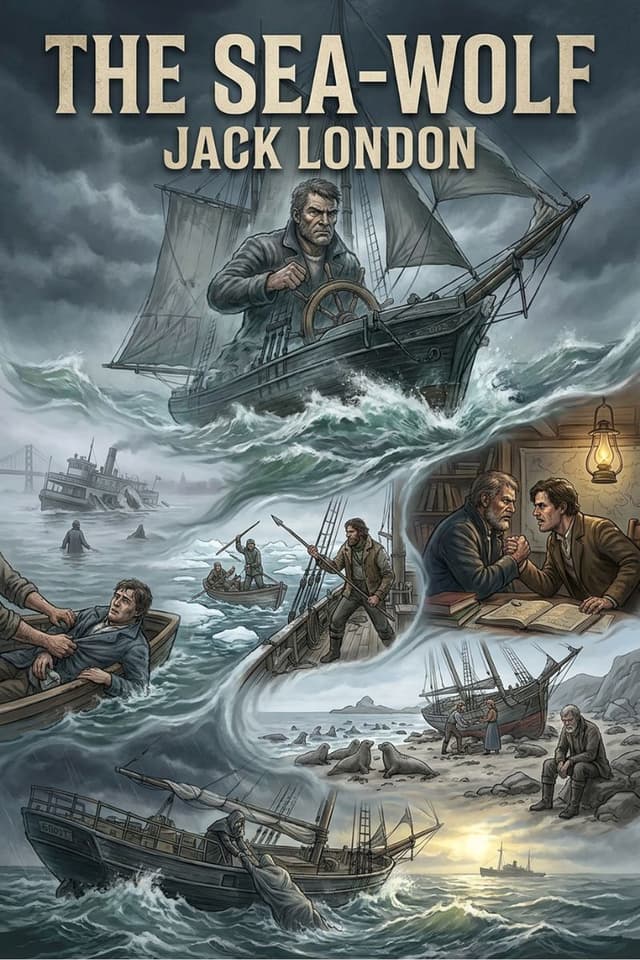
The Sea-Wolf
Read The Sea-Wolf by Jack London for free on Novelhalla, and try out our easy-to-read modern edition of this classic book. You can also download the EPUB and read it on any device if you prefer!
The Plot
A Gentleman in the Water
Humphrey Van Weyden is having an unremarkable morning. A literary critic, a man of books and drawing rooms, he's riding a ferry across San Francisco Bay to visit a friend. Then the fog rolls in, another ship collides with his, and within minutes Van Weyden is in the water, unable to swim, choking on the Pacific.
He should be dead. Instead, he's pulled aboard a seal-hunting schooner called the Ghost. When he comes to, shivering and half-drowned, he expects gratitude and a quick return to shore. What he gets is Wolf Larsen.
The Captain
Larsen is the captain of the Ghost, and there is no one else like him in all of literature. He is physically enormous, terrifyingly strong, and utterly brilliant. He has taught himself philosophy, science, mathematics, and literature from the books in his cabin. He can quote Milton and debate Nietzsche. He can also crush a man's hand in his grip without changing expression.
Larsen doesn't believe in God, doesn't believe in morality, and doesn't believe human life has any value beyond what a person can take by force. He runs the Ghost through sheer dominance. The crew fears him. Some of them hate him enough to kill him. None of them dare try.
And he has no intention of letting Van Weyden go. Instead, he puts this soft, bookish man to work as the ship's cabin boy, peeling potatoes and scrubbing pots under the thumb of a vicious cook named Mugridge. Welcome to the seal-hunting trade.
The Education of "Hump"
The crew calls him "Hump," and they mean it as an insult. Van Weyden has never done physical labor in his life. He has never been cold or hungry or afraid in any real, bodily sense. The Ghost changes all of that very quickly.
But something strange happens. Instead of breaking, Van Weyden begins to harden. He learns the ropes, literally. He earns grudging respect. He climbs the ship's hierarchy through competence and quiet determination. The man who couldn't peel a potato without cutting himself starts to become something he never imagined.
Meanwhile, Larsen takes an interest in him. Not kindness, exactly, but curiosity. The captain and the critic begin a series of conversations about life, death, meaning, and power that run through the entire novel. Larsen argues that the strong take what they want and the weak deserve what they get. Van Weyden argues for beauty, compassion, and the human soul. Neither gives an inch. And the debates are never just intellectual. On the Ghost, philosophy has consequences.
Mutiny in the Air
The crew is restless. Two sailors, Leach and Johnson, despise Larsen with a fury that's building toward something dangerous. Larsen knows it. He seems almost to enjoy the tension, the way a wolf enjoys the circling of smaller predators. Violence simmers just below the surface of every watch, every meal, every fog-blinded night.
Then the first mate disappears. Larsen says nothing about it. The crew says nothing. But everyone knows.
A Woman on the Ghost
The Ghost encounters a small boat adrift in rough seas near Japan. Among the survivors is Maud Brewster, a poet and writer, the last person who belongs on a ship like this. Larsen takes her aboard. He seems to enjoy having another intellect to spar with. He treats her with something like courtesy, at least on his good days.
But Larsen's good days are unpredictable. His moods swing between philosophical calm and savage rage. He suffers from blinding headaches that leave him incapacitated. And Van Weyden, who has been watching Larsen for months now, begins to understand that the captain is not just dangerous. He's deteriorating.
Van Weyden also realizes something else. He is falling in love with Maud Brewster. And Larsen has noticed.
The Brother
Somewhere out on the same ocean, Larsen's brother Death commands a rival sealing ship. The two Larsens despise each other with a hatred that goes deeper than competition. When their ships cross paths, the confrontation crackles with violence and history. Whatever happened between these brothers, it left scars that neither will explain.
The Edge
The Ghost is a floating powder keg. The crew wants Larsen dead. Larsen's headaches are getting worse. His brother is circling. Maud Brewster is trapped on a ship with no law and no escape. And Van Weyden, who six months ago couldn't survive a ferry crossing, is going to have to make a choice about what kind of man he really is.
The ocean is very large. The Ghost is very small. And there is nowhere to run.
About the Author: Jack London
A Rough Start
Jack London was born in San Francisco in 1876 to an unmarried mother and a father who was never part of his life. Raised in working-class Oakland by his mother and stepfather, he grew up poor. By his teens he was working in a cannery, pirating oysters in the Bay, and discovering the Oakland Public Library, which became his real education.
At seventeen he shipped out on a sealing schooner bound for Japan and the Bering Sea. The voyage was brutal and exhilarating. It gave him the raw material for some of his best fiction, including The Sea-Wolf.
The Wanderer
London rode freight trains as a hobo, joined a march of unemployed workers heading to Washington, got arrested for vagrancy, and briefly attended the University of California at Berkeley before heading north to join the Klondike Gold Rush. He didn't find gold, but he found stories. The Yukon froze itself into his imagination and never left.
The Writer
Back in California and still broke, London committed himself to writing with ferocious discipline. By 1899, magazines were buying his stories. In 1903, The Call of the Wild made him famous overnight. The Sea-Wolf followed in 1904, its first printing of 40,000 copies selling out before publication. He became one of the first American writers to earn a fortune from his work and the first to achieve genuine international celebrity.
The Final Years
London wrote at a punishing pace, producing over fifty books in sixteen years. He built a grand ranch in Sonoma County and designed an enormous stone mansion called Wolf House, which burned down before he could live in it. His health declined from years of hard living, kidney disease, and other ailments. He died on November 22, 1916, at the age of forty. He had lived more in four decades than most people manage in eight.
Fun Facts About the Book
Based on a Real Sea Captain
Wolf Larsen was inspired by Captain Alex MacLean, a real Cape Breton-born seal hunter who sailed the North Pacific and was legendary on the San Francisco and Victoria waterfronts for his toughness and daring. London heard stories about MacLean in Oakland waterfront saloons during the 1890s. London later said that while much of the novel was imagined, the basis was Alexander MacLean. Interestingly, the real MacLean was reportedly more good-natured than his fictional counterpart, though just as fiercely competitive.
London's Anti-Superman Novel
London wrote The Sea-Wolf as a deliberate attack on Friedrich Nietzsche's "superman" philosophy. Wolf Larsen is London's version of the Nietzschean ideal taken to its logical extreme: a man of supreme strength, intelligence, and will who recognizes no moral authority. The novel asks whether such a figure is admirable or monstrous, and the answer isn't as simple as you might expect.
An Instant Bestseller
The Sea-Wolf's first printing of 40,000 copies sold out before the publication date, riding the enormous wave of enthusiasm generated by The Call of the Wild the year before. It cemented London as one of the most popular authors in America.
The Sophia Sutherland Connection
London's own experiences at sea closely mirror parts of Van Weyden's story. At seventeen, London sailed aboard the sealing schooner Sophia Sutherland to Japan and the Bering Sea. The grueling voyage, the rough crews, and the harsh realities of life aboard a sealing vessel all fed directly into the novel.
Wolf Was London's Word
London's close friends called him "Wolf." He used a wolf image on his personal bookplate. He named his dream home Wolf House. The word "Wolf" appears 422 times in The Sea-Wolf, more than any other word in the novel.
One of the Most Filmed Novels in History
The Sea-Wolf has been adapted for film and television at least a dozen times, starting with a 1913 silent film in which London himself appeared as an unnamed sailor. The most celebrated version is the 1941 Warner Bros. film starring Edward G. Robinson as Wolf Larsen, directed by Michael Curtiz. Robinson had been a fan of the novel since he first read it at age eleven.
Themes
The Making of a Man
Van Weyden's transformation is the spine of the novel. He begins as someone who has never been tested by anything harder than a bad review. The Ghost strips away everything comfortable and forces him to discover what he's actually made of. London is fascinated by the question of whether civilization makes men soft, and whether hardship can reveal strength that comfort hides.
The Nietzschean Trap
Wolf Larsen is London's most complex creation because he's not simply a villain. He's brilliant, self-made, honest about what he believes, and in many ways more alive than anyone around him. But his philosophy leads him to a place of total isolation. If nothing matters except power and survival, then nothing matters at all. Larsen is trapped by his own logic, and the novel watches that trap slowly close.
The Limits of Intellect
Van Weyden is all mind and no body. Larsen is a body that has also acquired a mind. The novel suggests that neither extreme is enough. Van Weyden must learn to act. Larsen's intelligence, divorced from any sense of meaning or connection, becomes a kind of torture.
Survival and Will
The open ocean doesn't care about your philosophy or your social standing. London puts his characters in an environment where nature is indifferent and human society is stripped to its most basic elements. What keeps people alive isn't ideas. It's will.
The Corruption of Power
Larsen rules the Ghost absolutely, and absolute power has done exactly what it always does. The ship is a miniature autocracy where one man's whims become everyone's reality. London shows how tyranny doesn't just destroy the people under it. It hollows out the tyrant too.
The Book's Legacy
The Sea-Wolf remains one of the great American adventure novels and one of the most psychologically ambitious. Wolf Larsen stands alongside Captain Ahab and Captain Bligh in the pantheon of terrifying literary sea captains, but he's more intellectually alive than either of them. He's a villain you can't stop arguing with.
The novel was one of the earliest works of American fiction adapted into a feature-length film, and it has never stopped being filmed. The 1941 Edward G. Robinson version is considered a classic of Hollywood's golden age.
Beyond its adventure elements, The Sea-Wolf is a novel of ideas that still provokes. Its debates about power, morality, the meaning of life, and the nature of strength feel startlingly modern. London wrote it at the height of his powers, and it shows. The prose hits like a fist, the characters burn themselves into memory, and the Pacific Ocean has never felt more vast or more indifferent.
For readers who love survival stories, philosophical confrontation, or simply want to be trapped on a ship with one of the most magnetic and dangerous characters in fiction, The Sea-Wolf delivers.