Novelhalla
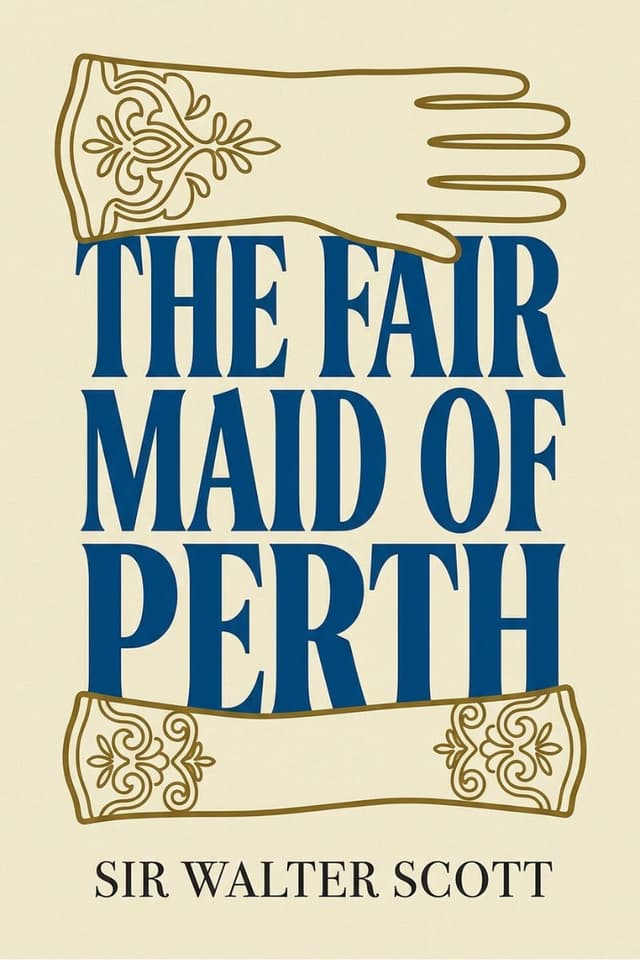
The Fair Maid of Perth
Read The Fair Maid of Perth by Walter Scott for free on Novelhalla, and try out our easy-to-read modern edition of this classic book. You can also download the EPUB and read it on any device if you prefer!
The Plot
The Eve of St. Valentine's Day
It is the end of the fourteenth century, and Perth is a city on edge. King Robert III is a gentle, well-meaning man who happens to be completely useless as a ruler. His brother, the Duke of Albany, is ambitious and scheming. His son, the Duke of Rothesay, is reckless, dissolute, and interested in exactly the wrong kind of trouble.
Into this powder keg walks Catharine Glover, the daughter of an honest glovemaker named Simon. She is the most beautiful woman in Perth. Everyone knows it. Everyone wants her. And that is going to be a very dangerous problem.
On the evening before Valentine's Day, a cloaked nobleman approaches Catharine and her father on their way to church. He wants the right to present himself at her window the next morning as her valentine. She refuses. She knows what she is, a burgher's daughter, and she knows what he is, someone far too powerful for her to safely encourage. He leaves angry.
That night, Henry Gow comes calling at the Glover house. Henry is Perth's finest armorer and its most formidable fighter. A big, warm-hearted man with fists like hammers and a temper to match. He adores Catharine. Her father adores him right back. Catharine is less certain. She cares for Henry, but his love of fighting disturbs her. She is devout, thoughtful, a woman who flinches at violence. Henry is a man who runs toward it.
Blood Before Dawn
In the dark hours before sunrise, Henry returns to the Glover house to claim his right as Catharine's valentine. What he finds instead is a gang of masked men with a ladder against her window, attempting to break in and carry her off.
Henry doesn't hesitate. He wades into them with his sword and in the struggle severs the hand of one attacker. The men scatter. The one whose hand now lies in the street is no common thief. He is Sir John Ramorny, the Duke of Rothesay's Master of Horse. The man behind the attempted abduction is the heir to the Scottish throne himself.
In gratitude, Catharine accepts Henry as her valentine for the year. But she will not promise to marry him. Not yet. Not while his hands are still warm from the fight.
Three Men and a Maid
Catharine has three men who want her, and each one represents a different world.
Henry Gow is the town's champion, beloved by the burgher class, a man of honor who keeps reaching for his sword when Catharine wishes he'd reach for peace.
The Duke of Rothesay is royalty gone rotten, a prince surrounded by dangerous followers, including the now one-handed and vengeful Ramorny, and Henbane Dwining, an apothecary whose medical skills are matched only by his appetite for cruelty.
And then there is Conachar. He was Simon Glover's Highland apprentice, a quiet, proud young man who nursed a secret love for Catharine. When he returns to the Highlands, Catharine learns the truth: Conachar is actually Eachin MacIan, the son of the chieftain of Clan Quhele. He is about to become a clan chief. And he has not forgotten her.
A Kingdom Unraveling
The personal rivalries spiraling around Catharine are mirrored by the political chaos engulfing Scotland. Rothesay and Albany maneuver against each other. The powerful Earl of Douglas, known as the Black Douglas, seethes at his son-in-law Rothesay's public humiliations of his daughter. Ramorny, now maimed and dismissed from Rothesay's service, plots revenge with the sinister Dwining, whose poisons are as elegant as they are lethal.
Meanwhile, a bitter feud between two Highland clans, the Clan Chattan and the Clan Quhele, threatens to explode into open warfare. The crown's solution is extraordinary: thirty champions from each side will meet on the North Inch of Perth, in front of the king, and fight to the death. A battle by appointment. A bloodbath with spectators.
The Glovers themselves are in danger. Catharine's confessor, Father Clement, preaches ideas that smell of heresy to the Church authorities. Association with him puts both Catharine and Simon at risk. Simon flees to the Highlands, seeking protection from his former apprentice. And Catharine is sent to the castle of the Douglas family, where she will be under the care of Rothesay's neglected wife.
But Rothesay is nearby. And Ramorny is nearby. And nobody in this story stays safe for long.
The North Inch
Everything converges on the great battle. Two clans. Thirty men each. A king in the grandstand. A city holding its breath.
One of the Clan Chattan's fighters fails to show. They need a replacement, and a town crier calls for a volunteer from among Perth's citizens. Henry Gow, believing Eachin MacIan is still his rival for Catharine, steps forward.
What follows is one of the most savage set pieces in all of Walter Scott's fiction. And somewhere on that bloody field, the question of courage, cowardice, love, and honor will finally be answered. Whether anyone will like the answer is another matter entirely.
About the Author: Sir Walter Scott
The Border Boy
Walter Scott was born in Edinburgh in 1771, the son of a solicitor. As a child he contracted polio, and was sent to recover with his grandparents in the Scottish Borders. It was there, among the rolling hills and ruined abbeys, that he fell in love with the folk tales, ballads, and legends of Scotland. That love never left him. It became his life's work.
Poet and Lawyer
Scott trained as a lawyer like his father and served as Sheriff-Depute of Selkirkshire and Clerk of the Court of Session. But his true ambitions were literary. He made his name first as a poet, with narrative verse romances like The Lay of the Last Minstrel (1805) and The Lady of the Lake (1810), which were enormous popular successes and helped put the Scottish Highlands on the tourist map.
The Inventor of the Historical Novel
In 1814, Scott published Waverley anonymously, and in doing so essentially invented the historical novel as a literary form. The book was a sensation. Over the next decade he produced an extraordinary sequence of novels including Rob Roy, Ivanhoe, The Heart of Midlothian, and The Bride of Lammermoor, all published under the pseudonym "The Author of Waverley." He became the most famous and best-selling writer in the world.
He was made a baronet in 1820 and built himself a grand baronial mansion at Abbotsford, filling it with antiquarian treasures.
The Crash
In 1825, a British banking crisis brought down Scott's publishing partners and, because he had entangled his finances deeply with theirs, Scott himself. He owed over 130,000 pounds, an astronomical sum. Rather than declare bankruptcy, he placed his home and income in trust to his creditors and resolved to write his way out of debt.
He very nearly did it. Over the next six years he produced novels, biographies, histories, and journalism at a furious pace. The Fair Maid of Perth was written during this period, in 1828. His wife Charlotte died in 1826, and his own health deteriorated after a series of strokes beginning in 1830. He died at Abbotsford on September 21, 1832, at the age of sixty-one. By 1847, the sale of his copyrights had cleared every penny of the debt.
His death was treated as an occasion for national mourning, and Edinburgh honored him with the Scott Monument, a two-hundred-foot Gothic spire that remains one of the largest monuments to a writer anywhere in the world.
Fun Facts About the Book
Based on a Real Battle
The climactic battle on the North Inch of Perth actually happened. In 1396, two Highland clans settled their feud by sending thirty champions each to fight before the king and the citizens of Perth. Which clans they actually were remains debated by historians to this day, but the event itself is well documented and was every bit as brutal as Scott describes.
Scott's Darkest Novel
Critics have called The Fair Maid of Perth Scott's most violent and morally complex novel. The usual romantic sheen that coats some of his earlier Highland fiction is largely absent here. The Highlands are wild and dangerous. The court is corrupt. The Church is persecuting its own. Even the hero can't stop getting into fights.
Written Under Pressure
Scott wrote this novel in 1827 and 1828, deep in his campaign to write off his enormous debts. He was working at a punishing pace, producing multiple books per year. Yet contemporary reviewers considered The Fair Maid of Perth one of his finest achievements, praising its plot, its characters, and especially the handling of the battle scene.
An Opera by Bizet
Georges Bizet, the composer of Carmen, wrote an opera based on the novel. La jolie fille de Perth premiered in 1867 and, while not as famous as Carmen, has been periodically revived. It takes considerable liberties with the plot, as operas tend to do.
Conachar's Cowardice
The most psychologically daring element of the novel is Scott's treatment of Conachar. Here is a young man who is handsome, noble, passionate, and a clan chief. He is also a coward. He knows it. He hates it. He cannot fix it. Scott handles this with a sympathy and complexity that reviewers at the time found remarkable and that still reads as startlingly modern.
The Fair Maid's House
A medieval building in Perth known as the Fair Maid's House still stands on North Port and is associated with the novel. It served as the headquarters of the Royal Scottish Geographical Society and remains a tourist attraction connected to Scott's story.
Themes
Violence and Conscience
Catharine loves a man whose greatest skill is killing people. Henry loves a woman who believes fighting is a sin. Neither of them is wrong. The novel takes this tension seriously, never dismissing Catharine's pacifism as naive or Henry's martial nature as simple brutality. It asks whether a violent world allows room for people who refuse violence, and it does not offer an easy answer.
Courage and Cowardice
The novel is obsessed with what it means to be brave. Henry has courage to spare but not always the wisdom to use it well. Conachar has every advantage except the one that matters most in his world. Robert III is brave enough to be kind but too weak to rule. Scott suggests that courage is not a single quality but a complicated, sometimes contradictory one, distributed unevenly and not always where you'd expect.
Power and Corruption
The Scottish crown is weak, and weakness at the top creates a vacuum that ambitious, ruthless men rush to fill. Albany schemes for the throne. Ramorny and Dwining plot murder. The Church prosecutes heretics. Everyone with power abuses it, and the ordinary citizens of Perth are caught in the crossfire.
Class and Social Boundaries
Catharine is desired by a prince, an armorer, and a clan chief. Each man represents a different social world with different rules. The novel explores what happens when those worlds collide, and how a woman with no political power navigates the space between men who have too much of it.
Highland and Lowland
Scott draws a vivid line between the orderly, prosperous, burgher life of Perth and the wild, proud, dangerous world of the Highland clans. Neither is idealized. Perth is comfortable but vulnerable. The Highlands are free but savage. The battle on the North Inch is the moment these two worlds crash together.
The Book's Legacy
The Fair Maid of Perth was one of Scott's most acclaimed novels in his lifetime, with reviewers praising its vivid characters, gripping plot, and the extraordinary battle sequence on the North Inch. It was widely read across Europe and inspired Bizet's opera as well as two silent film adaptations.
The novel helped cement Perth's identity as the "Fair City," a nickname that endures today. The Fair Maid's House remains a landmark, and the story is woven into the city's sense of itself.
Among Scott's works, The Fair Maid of Perth stands out for its willingness to portray medieval Scotland without romantic illusions. The violence is real. The politics are ugly. The heroes are flawed. It is Scott at his most unflinching, writing about a world where survival depends on the strength of your sword arm and the sharpness of your wits, and where even the bravest people can't always protect the ones they love.