Novelhalla
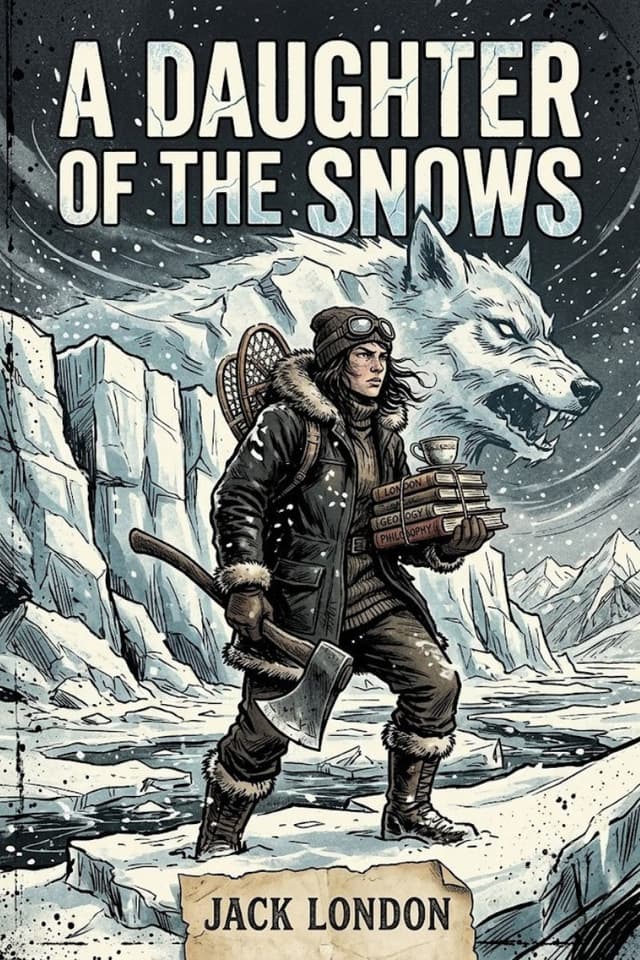
A Daughter of the Snows
Read A Daughter of the Snows by Jack London for free on Novelhalla, and try out our easy-to-read modern edition of this classic book. You can also download the EPUB and read it on any device if you prefer!
The Plot
Frona Welse is not like other women of her era. The daughter of Jacob Welse, a wealthy trading magnate who helped build the Alaskan frontier, she has been raised with an unusual philosophy: that strength, capability, and independence matter more than delicate femininity. After years of education in the civilized world, she returns to the Yukon just as the Klondike Gold Rush is exploding, determined to reach her father in Dawson City.
The Journey In
Getting to Dawson is no simple matter. The route crosses some of the most punishing terrain in North America, including the infamous Chilkoot Pass. Frona tackles it head-on, refusing to be coddled or carried. She hauls her own gear, makes her own decisions, and earns the respect of the rough men around her through sheer competence. She's not playing at being tough. She simply is.
Along the way she meets two very different men. Vance Corliss is a mining engineer from a wealthy Eastern family, educated at Yale, civilized and cultured. Gregory St. Vincent is a adventurer and writer with a murky past, charming and worldly. Both are drawn to Frona, and she finds herself drawn to both, though for different reasons.
Dawson City
Frona reaches Dawson and reunites with her father, stepping into her role as the leading woman of the mining town's rough society. She's caught between two worlds: the refined manners she learned in the States and Europe, and the raw frontier values her father instilled in her. She believes in a new kind of womanhood, one that combines strength with grace, capability with beauty.
The triangle between Frona, Corliss, and St. Vincent develops against the backdrop of the gold rush: the desperate fortune seekers, the harsh climate, the lawlessness and opportunity of a boomtown carved out of the frozen wilderness. Both men pursue her, and Frona must figure out not just which one she wants, but what kind of life she's choosing.
Questions of Character
As Frona gets to know both men better, questions arise about who they really are. Corliss seems almost too civilized for the frontier, making her wonder if he has the hardness to survive and thrive in this world. St. Vincent's charm masks something darker, and rumors swirl about his past behavior when the chips were down.
The novel builds toward a crisis that will test everyone's true character and force Frona to see the men clearly for who they are.
About the Author: Jack London
Early Life
Jack London was born in San Francisco in 1876 under uncertain circumstances. His mother was a spiritualist and music teacher; his biological father likely a wandering astrologer who abandoned the family. He grew up in poverty in Oakland, working brutal jobs from childhood: cannery work, oyster pirating, sealing ships, and manual labor.
Education and Ambition
London was largely self-educated, devouring books from public libraries while working grueling hours. He briefly attended UC Berkeley but dropped out after a semester, too restless and too broke to continue. He was fiercely ambitious, determined to escape poverty through his writing.
The Klondike
In 1897, London joined the Klondike Gold Rush, spending a winter in the Yukon. He found little gold but gathered a wealth of material. The experience transformed him as a writer, giving him the settings, characters, and themes that would make him famous. A Daughter of the Snows was his first attempt to turn this material into a novel.
Literary Success
London became one of the highest-paid and most popular writers in America. The Call of the Wild, published in 1903, made him a literary celebrity. White Fang, The Sea-Wolf, and dozens of other novels and stories followed. He wrote with incredible speed and discipline, producing over fifty books in his short career.
Later Life and Death
London lived hard and burned out fast. He built a grand ranch in California, traveled the world on a custom yacht, and threw himself into socialist politics. He struggled with alcoholism and health problems. He died in 1916 at just forty years old, possibly from an accidental overdose of morphine he was taking for kidney disease.
Fun Facts About the Book
London's First Novel
A Daughter of the Snows was Jack London's first published novel, appearing in 1902. He had already made his name with short stories set in the Klondike, but this was his first attempt at a longer form. It shows both his raw talent and his inexperience.
Not His Best Work
London himself was ambivalent about the novel. Critics then and now consider it one of his weaker efforts, overshadowed by the masterpieces that followed. The plotting is awkward in places, and the philosophical digressions sometimes overwhelm the story. But it contains flashes of the power that would soon make him famous.
The New Woman
Frona Welse was London's attempt to portray the "New Woman" of the turn of the century: educated, independent, physically capable, and unwilling to be confined to traditional feminine roles. She's a fascinating if imperfect creation, sometimes feeling more like a philosophical argument than a fully realized character.
Racial Theories
The novel contains London's ideas about race and heredity that were common in his era but are deeply uncomfortable today. He believed in Anglo-Saxon superiority and the importance of "blood" and breeding. These passages can make the book a difficult read for modern audiences.
Real Geography
London drew on his actual experiences crossing the Chilkoot Pass and living in Dawson City. The physical descriptions of the landscape and the details of frontier life ring true because he lived them. This authenticity is one of the book's real strengths.
The Love Triangle
The rivalry between Corliss and St. Vincent follows a pattern London would use again: the civilized man versus the seemingly vital but morally compromised one. London was working out his own ideas about what made a man worthy, questions that ran through much of his fiction.
Themes
The New Woman
Frona embodies London's ideas about what women could become if freed from the constraints of Victorian society. She's physically strong, intellectually serious, and refuses to pretend helplessness. The novel asks whether such a woman can find a man who's her equal, or whether she's doomed to be alone.
Civilization vs. Wilderness
London was obsessed with the tension between civilized society and the raw struggle of nature. The Yukon strips away pretense and reveals true character. Men who seem impressive in drawing rooms may crumble on the trail, while rough men may prove to have unexpected depths.
Blood and Breeding
London believed that heredity shaped character in fundamental ways. Frona's strength comes from her frontier bloodline; she's literally bred for this environment. These ideas reflect the racial theories of London's time, which he embraced enthusiastically and which mar the novel for modern readers.
True Manhood
What makes a real man? The novel tests its male characters against the unforgiving standard of the frontier. Education and culture aren't enough. What matters is how you act when survival is at stake, when no one is watching, when the easy wrong is so much simpler than the hard right.
The Gold Rush World
The Klondike serves as more than backdrop. It's a world where fortunes are made and lost overnight, where the normal rules of society are suspended, and where people reveal themselves under pressure. London captures both the excitement and the brutality of the great rush north.
The Book's Legacy
A Daughter of the Snows is mostly read today by London completists and scholars. It lacks the narrative drive of The Call of the Wild or the philosophical depth of The Sea-Wolf. But it's historically interesting as London's first extended attempt to wrestle his Klondike experiences into fiction.
Frona Welse deserves some credit as an early attempt at a capable, independent female protagonist in adventure fiction. She's not waiting to be rescued. She's doing the rescuing. Even if the execution is flawed, the ambition is notable for 1902.
The novel also shows London developing the themes he would explore throughout his career: the testing of character in extreme environments, the question of what makes someone truly strong, and the tension between the civilized self and something more primal underneath. Read as a first draft of ideas he would later perfect, A Daughter of the Snows has real value.
For readers who love London's later work, this early novel offers a glimpse of the writer finding his way. For those new to London, it's probably not the place to start. But for anyone interested in the Gold Rush, the New Woman, or the development of a major American writer, it's worth the journey.