Novelhalla
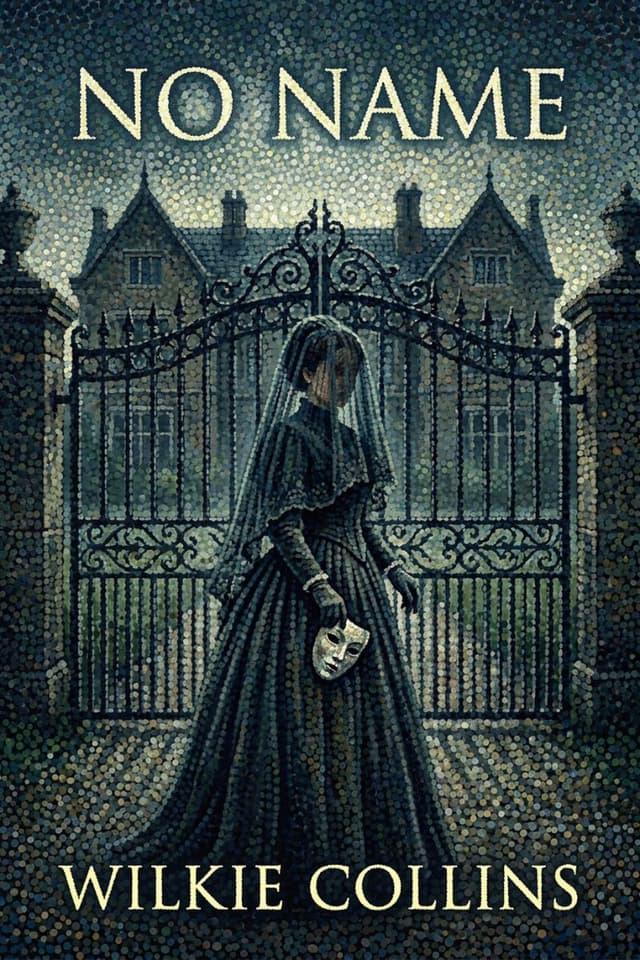
No Name
Read No Name by Wilkie Collins for free on Novelhalla, and try out our easy-to-read modern edition of this classic book. You can also download the EPUB and read it on any device if you prefer!
The Plot
A Perfect Family
The Vanstone household is one of those rare places where everything just works. Andrew Vanstone is wealthy, generous, and devoted. His wife is warm and loving. Their two daughters, Norah and Magdalen, have grown up sheltered, adored, and completely unaware that their comfortable life is built on a secret.
Norah, the elder at twenty-six, is calm and steady. Magdalen, eighteen, is something else entirely. She is beautiful, theatrical, headstrong, and fizzing with energy. She has a gift for performance that becomes obvious the moment she steps into a drawing-room play, and she has just fallen for Frank Clare, a young man with good looks and absolutely no ambition.
It is 1846. The family's country home at Combe-Raven feels permanent. Untouchable.
It is neither.
The Collapse
Andrew Vanstone is killed in a railway accident. And within days, a second blow lands. A legal revelation so devastating it rewrites everything the Vanstone sisters thought they knew about their family, their parents, and themselves.
Because of a technicality in English law, a technicality so arcane and so cruel it barely seems possible, Norah and Magdalen are stripped of everything. Their name. Their inheritance. Their place in the world. Every penny of their father's fortune passes to his estranged brother, Michael Vanstone, a man who has never met them and who refuses to share a single shilling.
Overnight, the Vanstone daughters become nobodies. Literally. Under Victorian law, they are the children of no one.
Two Sisters, Two Paths
Norah accepts her fate with quiet dignity. She takes a position as a governess and disappears into the drudgery that society expects of a respectable woman without means.
Magdalen does not accept a thing.
Something hardens in her the moment the truth comes out. She is not going to fade into poverty. She is not going to be grateful for whatever scraps the world tosses at women in her position. She is going to get her inheritance back. And she does not much care how.
The Con
Enter Captain Wragge, one of the most gloriously entertaining swindlers in English literature. He is a distant relative of the Vanstone family, a cheerful con artist who has made a career out of respectable fraud. He is charming, shameless, and exactly the kind of person a young woman with revenge on her mind should probably avoid.
Instead, Magdalen teams up with him.
Her plan is audacious. Michael Vanstone has died, and the fortune now sits with his son, Noel, a sickly, feeble, suspicious little man completely controlled by his shrewd housekeeper, Mrs. Lecount. Magdalen intends to get close to Noel. Very close. Close enough to marry him, under a false name, and take back what she believes is rightfully hers.
But Mrs. Lecount is no fool. She senses something wrong about this beautiful stranger from the start. And she has her own designs on Noel's money.
The Game
What follows is a cat-and-mouse battle between Magdalen and Mrs. Lecount that is as gripping as any thriller you will ever read. Disguises. Deceptions. A scrap of cloth snipped from a dress hem that could unravel everything. A forged letter designed to send a rival halfway across Europe. Each woman is cunning, resourceful, and utterly determined to win.
Magdalen throws herself into the performance of her life. But a performance is exactly what it is, and the longer she plays the part, the higher the cost. She is trading pieces of herself for a fortune that keeps slipping just out of reach. Every scheme she engineers brings a new complication. Every victory comes with a price she did not expect to pay.
The Stakes
There is a secret document. A hidden trust. A ticking clock and a condition that could lock the inheritance away from Magdalen forever, no matter how clever she is. The game is no longer just about money. It is about how far a person can go before they lose themselves entirely.
And somewhere in the background, a sea captain named Kirke has seen Magdalen exactly once and cannot forget her. Whether that matters depends on what happens next, and what happens next is something Magdalen herself cannot predict.
About the Author: Wilkie Collins
Early Life
Wilkie Collins was born in London in 1824, the eldest son of William Collins, a successful landscape painter and member of the Royal Academy. His childhood was shaped by two forces: his father's strict religious piety, which Wilkie quietly rebelled against, and a two-year family trip to Italy and France when he was twelve, which opened his eyes to a wider, more colorful world.
He was a small, odd-looking child with an enormous forehead and bright, curious eyes. At school, he discovered his first real talent: a bigger boy used to bully him into inventing stories every night as the price of being left alone. Collins later credited this as the beginning of his career as a storyteller.
Finding His Way
Collins spent five unhappy years as a clerk for a tea merchant before convincing his father to let him study law instead. He was called to the bar in 1851 but never practiced. Writing was the only thing that held his attention. His first published novel, Antonina, appeared in 1850, but the real turning point came a year later when he met Charles Dickens.
The two men became inseparable. They wrote together, acted together in amateur theatricals, traveled together, and pushed each other's work in new directions. Dickens helped Collins develop warmth and humor in his characters. Collins, in turn, taught Dickens about plot construction and suspense. Dickens once referred to himself as Collins's "obedient disciple" when it came to the mechanics of storytelling.
The Great Decade
The 1860s were Collins's golden age. In less than ten years, he produced four novels that cemented his reputation: The Woman in White (1860), No Name (1862), Armadale (1866), and The Moonstone (1868). The Woman in White was a sensation, boosting sales of Dickens's magazine All the Year Round and breaking publishing records in book form. The Moonstone is widely considered the first modern detective novel.
During this period, Collins was as famous as Dickens and nearly as wealthy. He earned enormous sums for his serialized fiction and commanded advances that rivaled the biggest literary names of his era.
An Unconventional Life
Collins never married, which was unusual enough for a Victorian gentleman, but his private life was genuinely scandalous. He lived openly with Caroline Graves, a widow, for most of his adult life, treating her daughter as his own. Simultaneously, he maintained a second household with a younger woman, Martha Rudd, with whom he had three children. He used the name "Mr. Dawson" for this second family.
He suffered from severe gout that attacked his eyes and joints, and he treated the pain with laudanum, a liquid opium preparation. He became deeply addicted, reportedly consuming doses that would have killed most people. He claimed to have written much of The Moonstone in an opium haze and barely recognized his own work when he read it back.
Later Years and Death
After Dickens died in 1870, Collins continued writing prolifically, but his health and his work declined together. His later novels shifted from sensation fiction to social commentary, and critics were less kind. The reading public, too, moved on. He died of a stroke in 1889 at age sixty-five, and the obituaries were polite but lukewarm, as if the literary world had already half-forgotten him.
Fun Facts About the Book
A Bestseller from Day One
When the three-volume first edition of No Name was published by Sampson Low on December 31, 1862, nearly all 4,000 copies of the first printing sold on the very first day. This was extraordinary for the era and reflected the enormous appetite readers had built up during the novel's serialization.
Dickens Thought It Was Brilliant
No Name was serialized in Dickens's magazine All the Year Round from March 1862 to January 1863. Dickens provided editorial feedback during the writing process and reportedly considered No Name superior to The Woman in White. It was the last novel Collins published through Dickens's magazine before signing with a rival publisher for his next book.
Victorian Critics Were Scandalized
While readers devoured it, many Victorian critics were appalled by No Name. They objected to both the subject matter (illegitimacy and unjust inheritance laws) and the heroine's behavior (scheming, disguises, a calculated marriage). One reviewer from The Quarterly Review was particularly indignant that Collins treated a lawful marriage as a mere accident of timing. The idea that a sympathetic heroine could be both morally compromised and emotionally compelling was deeply unsettling to respectable Victorian opinion.
The Title Has a Legal Meaning
In Victorian English law, illegitimate children were classified as "nullius filius," literally "the child of no one." They had no legal claim to their parents' names or estates. The title No Name is a direct reference to this legal status, a pointed reminder that the Vanstone sisters have been erased not just financially but legally.
Collins's Legal Training
Collins studied law at Lincoln's Inn and was called to the bar in 1851. Although he never practiced, his legal knowledge runs through No Name like a wire. The novel's plot hinges on specific technicalities of inheritance law, the legal status of illegitimate children, and the validity of marriages conducted under false names. Collins consulted lawyers to make sure every legal detail in his fiction was accurate.
The Actress Heroine
Magdalen's talent for acting is not just a character detail. It is the engine of the entire plot. Her ability to assume different identities, to perform convincingly in any role, makes her schemes possible. Collins was fascinated by the theater and by the idea that identity itself is a kind of performance, something that could be put on and taken off like a costume.
Captain Wragge
Captain Wragge is widely considered one of Collins's greatest comic creations. He is a lovable rogue, a professional confidence man who keeps meticulous records of his swindles in a notebook he calls his "moral agriculture." When Collins adapted the novel for the stage under the title The Great Temptation, the actor Wybert Reeve's portrayal of Wragge was the highlight of the production.
Written Through Pain
Collins wrote No Name while suffering from increasingly severe gout that was beginning to affect his eyesight. His growing dependence on laudanum dates to this period. By the time the serialization was complete, he was struggling to control his intake, a battle he would lose decisively over the following years.
Themes
Identity as Performance
Magdalen is a natural actress, and the novel asks what happens when performance becomes a way of life. How many disguises can you wear before you forget which face is really yours? Collins blurs the line between acting and living until the reader is never quite sure where Magdalen's schemes end and her true self begins.
The Cruelty of the Law
The entire plot springs from a legal technicality that destroys two women's lives. Collins does not let the reader forget that this is not a fictional invention. These were real laws that affected real people. The system that strips the Vanstone sisters of everything is not broken. It is working exactly as designed, and that is precisely what makes it monstrous.
Women and Power
Magdalen has no money, no legal standing, and no socially acceptable way to fight back. The only tools available to her are her beauty, her intelligence, and her willingness to break the rules. The novel watches, without flinching, as a brilliant young woman discovers that in a world designed to keep women powerless, reclaiming power means becoming someone you might not recognize.
Rebellion vs. Resignation
Norah and Magdalen represent two possible responses to injustice. Norah endures. Magdalen fights. Neither path is presented as simply right or simply wrong. The novel takes both sisters seriously and refuses to reduce their choices to a simple moral lesson.
The Cost of Revenge
Magdalen's schemes are thrilling, but they are not free. Every deception takes something from her. Every false identity requires her to suppress something real. The novel is ruthlessly honest about what it costs a person to make revenge the center of their life, even when the revenge is justified.
The Book's Legacy
No Name occupies an unusual place in literary history. It is the second of Collins's four great novels from the 1860s, sandwiched between the more famous Woman in White and Moonstone, and it has never quite received the attention those books enjoy. But readers who discover it tend to become passionate advocates. Many consider it Collins at his most daring and his most emotionally powerful.
The novel was a landmark in the portrayal of women in Victorian fiction. Magdalen Vanstone is not a passive heroine waiting to be rescued. She is resourceful, flawed, reckless, and fascinating. Critics have noted that Collins, more than almost any male novelist of his era, wrote women as complex human beings rather than angels or villains.
Collins himself adapted the novel for the stage as The Great Temptation, and it has been adapted for radio, though it has not received the screen treatment given to The Woman in White and The Moonstone. This feels less like a judgment on the novel's quality than a reflection of its complexity. No Name is long, intricate, and morally ambiguous in ways that resist easy adaptation.
The novel's critique of inheritance law and the legal status of illegitimate children was genuinely progressive for its time. The laws Collins attacked were not reformed in England until well into the twentieth century. In this sense, No Name was not just entertainment. It was an argument, wrapped in one of the most compulsively readable plots of the Victorian era.