Novelhalla
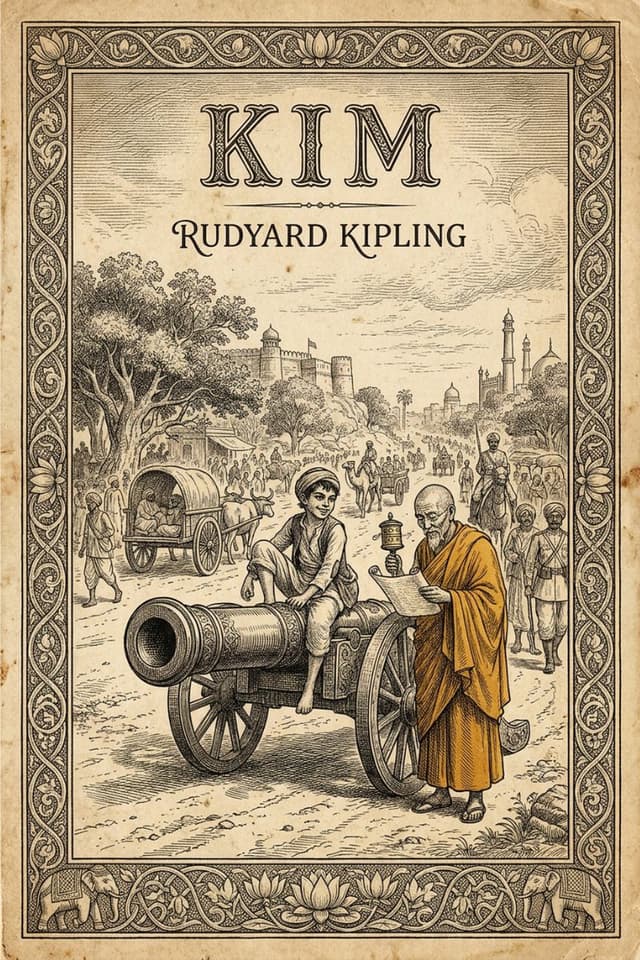
Kim
Read Kim by Rudyard Kipling for free on Novelhalla, and try out our easy-to-read modern edition of this classic book. You can also download the EPUB and read it on any device if you prefer!
The Plot
Friend of All the World
The boy called Kim lives on the streets of Lahore like he was born there. In a way, he was. Kimball O'Hara is technically white, the orphaned son of an Irish soldier, but he grew up barefoot and brown in the bazaars, speaking Hindi and Urdu, running errands for shopkeepers and horse traders, sleeping where he likes, answering to no one. The locals call him "Friend of All the World" because he belongs everywhere and nowhere. The only proof of his origins is an amulet around his neck containing his father's old papers and a prophecy: Kim's life will change when he finds a Red Bull on a green field.
Kim doesn't think much about prophecies. He's thirteen and the world is a game. Then one day, outside the Lahore Museum, he meets someone unlike anyone he's ever seen: an old Tibetan lama, a holy man who has traveled from the mountains on a spiritual quest. The lama is searching for a sacred river, the River of the Arrow, where the Buddha once shot an arrow so far it struck the earth and water sprang up. If the lama can find this river and bathe in it, he believes he will be freed from the endless cycle of existence.
Kim is fascinated. Not by the religion exactly, but by the strangeness, the seriousness, the promise of the open road. He volunteers to be the lama's chela, his disciple, to beg for them and guide the old man through a country the lama doesn't understand. They'll head south together toward Benares, the holy city.
But the night before they leave, Kim's old friend Mahbub Ali, a horse trader with dangerous friends and a taste for intrigue, hands the boy a secret message to deliver to a British officer in Umballa. Kim doesn't know exactly what the message contains. He knows it matters. He knows it's the kind of trouble he loves.
Two Roads
And so Kim walks two paths at once. He travels with the lama down the Grand Trunk Road, the ancient highway that cuts through the heart of India, teeming with soldiers and merchants and holy men and farmers and widows and wanderers. The lama meditates. Kim watches everything. He delivers the message, and when he sees British officers scrambling to deploy troops based on the intelligence he carried, something lights up inside him. This is real. This is power. A boy from the streets just moved pieces on a board that stretches across empires.
But the road has other plans. Kim stumbles across a regiment of soldiers carrying a flag with a red bull on a green background. His father's prophecy. The regiment turns out to be the Mavericks, his dead father's old unit. When the chaplains discover the papers in his amulet, they realize this street urchin is actually a white boy, a sahib's son who needs to be educated, civilized, made proper.
Kim is captured by his own heritage.
The Making of a Spy
The lama is heartbroken to lose his companion but insists on paying for Kim's schooling at St. Xavier's, a prestigious school for European boys. Meanwhile, Colonel Creighton, the British intelligence officer who received Kim's message, sees something far more valuable than a student. He sees a boy who can pass as Indian or English, who speaks multiple languages, who reads people the way other children read books. Creighton wants Kim for the Great Game, the shadow war of espionage between the British and Russian empires for control of Central Asia.
Over the next three years, Kim gets two educations. At school, he learns English subjects and European manners. On holidays, he trains with men like Lurgan Sahib, a jeweler in Simla who is actually a spymaster, and who teaches Kim the arts of observation, disguise, and deception. He learns to memorize a tray of gems at a glance. He learns to change his walk, his voice, his skin. He learns that identity itself can be a weapon.
And through it all, the lama wanders India searching for his river, faithfully sending money for Kim's education, waiting for the day his beloved disciple will return.
The Game Begins
Kim finishes school at seventeen and is set loose on the open road again, this time as a player in the Great Game. He reunites with the lama, and they travel together once more, the old man pursuing enlightenment and the young man carrying secrets. But the Game is no longer an abstract thrill. There are Russian agents moving through the Himalayas, gathering maps and alliances. There are men who will kill for the documents Kim's allies are trying to protect. The stakes are no longer theoretical, and Kim is no longer a child playing at adventure.
The question the novel keeps circling is one Kim can barely articulate: Who is he? Is he a sahib, a white man in brown skin? Is he an Indian boy with Irish papers? Is he the lama's disciple, walking toward peace? Or is he a spy, walking toward something else entirely? The lama wants to save Kim's soul. The Game wants to use Kim's gifts. And Kim, caught between the two people and purposes he loves most, is running out of road.
The mountains are getting colder. The enemies are getting closer. And somewhere ahead, the lama's river and the Game's endgame are converging on the same stretch of ground.
About the Author: Rudyard Kipling
A Child of Two Worlds
Rudyard Kipling was born in Bombay in 1865, the son of an artist and scholar who would later become curator of the Lahore Museum (the very "Wonder House" that opens the novel). His early childhood in India was, by his own account, magical. He spoke Hindi before he spoke English, explored the bazaars with his Indian nanny, and absorbed the sights and sounds and languages that would fuel everything he ever wrote.
At six years old, that world was ripped away. His parents sent him to England for schooling, leaving him with a foster family in Southsea who treated him with casual cruelty. The experience scarred him deeply. He later attended the United Services College in Devon, an inexpensive boarding school where he endured bullying but found his voice as a writer, editing the school magazine and beginning to see literature as survival.
Return to India
In 1882, at seventeen, Kipling returned to India to work as a journalist in Lahore. The country rushed back to him. He covered the North-West Frontier, roamed the streets at night, gained access to worlds most Englishmen never saw. He was a man of two societies, accepted by both the British establishment and the local population, and this double vision became the engine of his fiction.
By the time he left India in 1889, at just twenty-three, he had published dozens of short stories and was already a literary celebrity in London. The next decade brought an extraordinary run of work: the Barrack-Room Ballads, The Jungle Book, Captains Courageous, and the beginnings of Kim, much of it written from a house he built in Vermont after marrying an American woman named Caroline Balestier.
Fame, Loss, and Legacy
Kipling won the Nobel Prize for Literature in 1907, the first English-language writer to receive the honor. He was forty-one, the youngest laureate at the time. He turned down a knighthood and the poet laureateship.
His personal life was marked by tragedy. His eldest daughter, Josephine, died of pneumonia at age six during a family trip to America. His son John, whose enlistment Kipling had personally arranged through military connections, was killed at the Battle of Loos in 1915 at eighteen. John's body was not identified for decades. The guilt haunted Kipling for the rest of his life.
Kipling continued writing poetry and short stories until his final years, though nothing matched the popularity of his earlier work. He died in January 1936 at seventy, from a perforated ulcer. His ashes were buried in Poets' Corner at Westminster Abbey, next to Thomas Hardy and Charles Dickens.
A Complicated Reputation
Kipling remains one of the most debated figures in English literature. He was an unapologetic champion of the British Empire, the man who wrote "The White Man's Burden," and his work carries the assumptions of his time about race and imperial destiny. But he was also a writer of extraordinary empathy and observational power, whose love of India was genuine, deep, and unmatched by any English novelist of his era. Reading Kim means holding both of these truths at once.
Fun Facts About the Book
The Spy Novel Starts Here
Kim is widely considered one of the first espionage novels ever written, and its influence on the genre is enormous. Former CIA Director Allen Dulles kept a well-read copy on his bedside table at the time of his death. The novel's portrayal of intelligence networks, agent handling, and covert surveillance anticipated the real-world development of organizations like MI5, MI6, and the CIA by decades.
Kim's Game
In the novel, Kim trains his observation skills by memorizing trays of gemstones at a glance. This exercise became a real-world training tool. Robert Baden-Powell adapted it for the Boy Scouts in his 1908 handbook Scouting for Boys, calling it "Kim's Game." The U.S. Marine Corps Scout Sniper School still teaches it today. The military even created a backronym: "Keep In Memory."
Kim Philby
The most infamous British double agent of the Cold War, Harold "Kim" Philby, got his nickname from Kipling's novel. He was born in Ambala, India, and his father, the Arabist St. John Philby, named him after Kipling's young spy. The irony of a man named after a loyal British agent becoming a Soviet mole has not been lost on historians.
A Town in Colorado
There is a town in Colorado called Kim, named after the novel. It sits on the high plains in the southeastern corner of the state, about as far from Lahore as you can get.
Written on Two Continents
Kipling began working on Kim in the mid-1890s while living in Vermont, at a house he built called Naulakha (named after a pavilion in Lahore Fort). He continued developing the novel after returning to England in 1896. The book was serialized in McClure's Magazine from December 1900 to October 1901 before being published in book form. It had been gestating for nearly a decade.
The Grand Trunk Road
The Grand Trunk Road, which serves as the novel's central artery, is a real highway stretching over 1,500 miles across the Indian subcontinent. It dates back to at least the third century BCE and remains one of the oldest and longest roads in Asia. Kipling's descriptions of the life teeming along it are considered some of the finest travel writing in the English language.
Kipling's Father in the First Chapter
The novel's opening scene takes place outside the Lahore Museum, called the "Wonder House" by locals. The museum's kindly curator who greets the lama is a lightly fictionalized portrait of Kipling's own father, John Lockwood Kipling, who was the actual curator of the Lahore Museum. It's one of the most affectionate father-son moments in all of Kipling's work.
"Doer of Wonders" or "Plotless"?
Kipling himself described Kim as something of an indulgence, a novel driven more by atmosphere and character than by a conventional plot. Literary critics have debated this ever since. Some call it plotless and picaresque. Others call it the most perfectly constructed novel about India in the English language. The truth is probably both.
Themes
Identity and Belonging
The question "Who is Kim?" runs through the novel like a pulse. He is white by blood and Indian by upbringing. He is a sahib's son and a street urchin. He is a holy man's disciple and a spy in training. The novel never fully resolves the question, and that's the point. Kim's identity isn't a problem to be solved. It's a condition to be lived, and the tension between his worlds is what makes him extraordinary and also what threatens to tear him apart.
The Spiritual and the Worldly
The lama wants to escape the world. The Great Game wants to control it. Kim loves them both. The novel sets up a profound tension between contemplation and action, between the lama's quest for liberation from desire and the British intelligence service's appetite for information and power. Kim walks both paths simultaneously, and the novel asks whether it's possible to serve the soul and the empire at the same time.
The Great Game
The espionage plot is a backdrop, but it's also a metaphor. The Great Game refers to the real geopolitical rivalry between Britain and Russia in Central Asia, but Kipling uses it to suggest something larger about the nature of power, information, and control. Everyone in the novel is playing a game of some kind, from the spies to the holy men to the merchants on the road. The question is whether anyone ever really wins.
The Road as Teacher
The Grand Trunk Road is more than a setting. It's an education. Kim learns about India not in school but on the road, from the parade of people he encounters: soldiers, widows, farmers, priests, con men, children. Kipling presents the road as a living thing, an endlessly unspooling tapestry of human experience, and Kim's genius is his ability to read it.
Mentorship and Love
Kim's deepest relationship is with the lama, and it's one of the most unusual bonds in English literature: a Buddhist monk and a street kid, an old man seeking the end of suffering and a young man hungry for the beginning of everything. Their love for each other is genuine, selfless, and at the heart of the novel's emotional power. The lama gives Kim purpose. Kim gives the lama the world.
Empire and Its Contradictions
The novel is affectionate toward the British Raj in ways that modern readers will find uncomfortable. It presents colonial intelligence work as a grand adventure and the British presence in India as largely benign. But Kipling also fills the novel with Indian characters of extraordinary intelligence, warmth, and dignity, and his portrait of India's cultural richness is so vivid that it sometimes works against his own imperial sympathies. The novel is smarter than its politics, and that tension is part of what keeps it alive.
Historical Context
The Great Game
The Great Game was the strategic rivalry between the British Empire and the Russian Empire for influence in Central Asia, particularly over Afghanistan and the territories approaching British India. It ran roughly from the 1830s to the early 1900s and involved espionage, military expeditions, diplomatic maneuvering, and the covert surveying of unmapped territories. Kipling grew up during the height of this contest and drew on it as both a literal plot device and a governing metaphor.
The Survey of India
Colonel Creighton's cover as a member of the Survey of India reflects a real institution. The Survey employed specially trained Indian agents, known as "pundits," to gather topographical and intelligence data in regions closed to Europeans, often disguised as pilgrims or merchants. These men carried concealed instruments and counted their paces using modified prayer beads. Kipling transformed this fascinating real-world operation into the backbone of his spy network.
The Book's Legacy
Kim is regularly cited as Kipling's masterpiece and one of the greatest English-language novels of the twentieth century. In 1998, the Modern Library ranked it number 78 on its list of the 100 best English-language novels.
Its influence on the espionage genre alone would secure its place in literary history. The novel anticipated the structure and moral ambiguity of modern spy fiction decades before le Carre, Fleming, or Buchan. Real intelligence officers have cited it as formative, and its training exercises are still used by military and scouting organizations worldwide.
But the novel's greatest legacy may be its portrait of India itself. Kipling captured the sounds, smells, languages, and textures of the subcontinent with a vividness that readers and critics, including Indian scholars, have acknowledged as unmatched in English-language fiction of the period. The novel is a love letter to a country, written by a man who could never fully belong to it.
Kim has been adapted for film multiple times, most notably in a 1950 MGM production starring Errol Flynn and a young Dean Stockwell, and in a 1984 television film featuring Peter O'Toole. None of these adaptations have fully captured the novel's sprawling, sensory richness, which may be precisely the point. Some books resist the screen because the experience they offer is inseparable from the language itself.
The novel continues to generate debate about colonialism, orientalism, and the ethics of empire, and these conversations are part of its vitality. Kim is not a comfortable book. It is a magnificent one.