Novelhalla
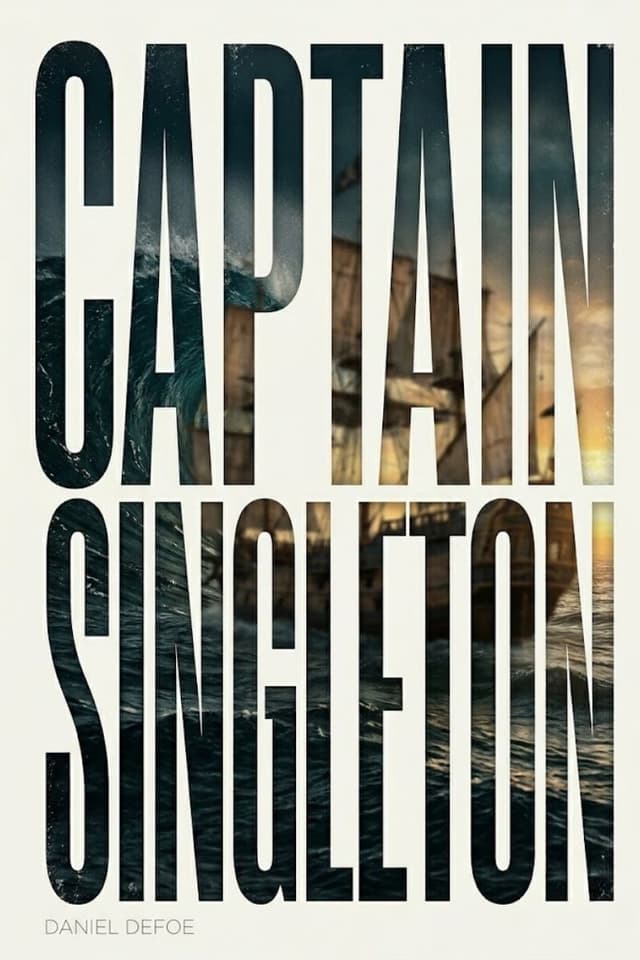
Captain Singleton
Read Captain Singleton by Daniel Defoe for free on Novelhalla, and try out our easy-to-read modern edition of this classic book. You can also download the EPUB and read it on any device if you prefer!
The Plot
A Boy Without a Home
Bob Singleton enters the world already lost. Stolen from a well-to-do English family as a small child, he is sold to a Romani woman who raises him with no education, no religion, and no moral instruction of any kind. By the time he is twelve, he is sent to sea, and from that point forward his life becomes a series of captures, escapes, and wild reversals of fortune. His ship is taken by Turkish pirates. The Turkish vessel is then seized by a Portuguese crew. He ends up ashore in Portugal, then ships out again as a cabin boy bound for the Indian port of Goa.
On the return voyage, a violent storm drives the ship far off course, and Singleton finds himself on the coast of Madagascar. Here the sailors, brutalized by a cruel captain, stage a mutiny. The uprising fails in spectacular fashion, and Singleton and a group of his companions are marooned on the island. They are not quite prisoners, not quite free, and they have no idea how to get home.
Across Africa
What begins as survival becomes one of the most extraordinary journeys in early English fiction. Singleton and his companions, unwilling to wait for rescue on Madagascar, manage to build a small boat and sail to the east coast of Africa. Once there, they conceive an audacious plan: to walk across the entire African continent from east to west.
The trek is grueling and vast. The group crosses jungles swarming with leopards, elephants, and crocodiles. They struggle through blistering deserts, wait out the rainy season in fortified camps, and negotiate cautiously with the peoples they encounter along the way. Singleton, still barely more than a boy, rises naturally to leadership. He has a gift for practical problem-solving and an instinct for command that even he does not fully understand.
Deep in the interior, they encounter a lone Englishman living among the native population, a former captive who has gone half-native himself. He guides them to rich deposits of gold and steers them toward the Gold Coast. By the time the travelers reach a Dutch trading settlement on the western shore, they are carrying a fortune in gold and ivory. They divide the spoils and scatter, each going his own way.
The Pirate
Singleton returns to England rich and utterly unprepared for ordinary life. He has never learned to manage money, has no family, no trade, and no sense of belonging anywhere. He burns through his fortune with reckless speed, and before long he is broke and restless. He drifts to the Spanish port of Cadiz, falls in with a mutinous crew, and embarks on what will become his true career: piracy.
From the Caribbean to the coast of Brazil, from Madagascar to the Indian Ocean, from the Philippines to Ceylon, Singleton plunders merchant ships and grows wealthy again. He proves himself an able and imaginative commander at sea, skilled at both the violence and the logistics of the pirate trade. But the life hardens him. The callousness grows slowly, almost imperceptibly, until cruelty becomes something he barely notices in himself.
The Quaker
Then William Walters enters the story, and something shifts. William is a Quaker surgeon, a man of deep faith and quiet cunning, who is brought aboard Singleton's ship. He makes himself indispensable not through violence but through intelligence, resourcefulness, and an unshakable moral center. He outwits kings, negotiates with merchants, and intervenes when the crew's brutality threatens to become senseless.
More importantly, William befriends Singleton. He does not preach or moralize in any heavy-handed way. Instead, he asks questions, tells stories, and offers a living example of a man who navigates the same dangerous world without losing his soul. For the first time in his life, Singleton finds himself in the company of someone who sees him as more than a useful weapon or a source of plunder.
What William's friendship ultimately means for Singleton, and whether a man shaped entirely by violence can find his way to something better, is the question the novel's second half sets out to answer.
About the Author: Daniel Defoe
A Dissenter's Son
Daniel Defoe was born Daniel Foe around 1660 in the parish of St. Giles Cripplegate, London, the son of a tallow chandler named James Foe. The family were Presbyterian dissenters, which in seventeenth-century England meant they worshipped outside the established Church and faced legal restrictions because of it. Young Daniel survived two of the defining catastrophes of his age: the Great Plague of 1665 killed tens of thousands around him, and the Great Fire of 1666 destroyed most of his neighborhood. His parents hoped he would become a minister, and he was educated at Charles Morton's dissenting academy at Newington Green, one of the best non-university schools in England. But Defoe had other ambitions.
Merchant, Rebel, Bankrupt
Instead of the ministry, Defoe plunged into business. He traded in hosiery, wine, tobacco, and woolen goods, traveling widely across Europe. He bought a country estate, a trading ship, and even civet cats for perfume manufacturing. He also added "De" to the front of his surname, hoping it would sound more distinguished. In 1684 he married Mary Tuffley, who brought a substantial dowry. They would have eight children together.
In 1685, Defoe joined the Monmouth Rebellion against the Catholic King James II. The rebellion was crushed at the Battle of Sedgemoor, and many participants were executed or transported. Defoe escaped somehow and kept his head down until the Glorious Revolution of 1688 put the Protestant William III on the throne. For a time, things went well. But Defoe was a better dreamer than a businessman. By 1692, he owed the staggering sum of £17,000 and was arrested for debt. He declared bankruptcy, and the next decade was a scramble to pay off creditors, some of whom he may not have dealt with entirely honestly.
The Pillory and the Pen
In 1702, Defoe published a satirical pamphlet called The Shortest Way with the Dissenters, in which he pretended to call for the extermination of religious nonconformists. The satire was so convincing that many readers took it at face value. When Defoe's authorship was revealed, he was arrested for seditious libel, fined, and sentenced to three days in the pillory, a public punishment that could turn deadly if the crowd was hostile. Legend has it that Defoe's friends rallied around him, selling copies of a defiant poem he had written for the occasion, and that the crowd threw flowers instead of the usual rotten food. The truth of that story is debated, but Defoe survived the ordeal with his reputation oddly enhanced.
From the pillory he went to Newgate Prison. His release was arranged by Robert Harley, a powerful government minister and spymaster, in exchange for Defoe's services as an intelligence agent. For the next several years, Defoe led a double life: respected journalist and pamphleteer on one hand, government spy on the other. He was sent to Scotland to help engineer support for the Act of Union in 1707, writing propaganda for different audiences and reporting back to Harley on Scottish public opinion.
The Novelist
Defoe did not turn to fiction until he was nearly sixty. Robinson Crusoe appeared in 1719, when Defoe was fifty-nine, and became an immediate sensation. He followed it with an astonishing burst of creativity: Captain Singleton in 1720, Moll Flanders, A Journal of the Plague Year, and Colonel Jack in 1722, and Roxana in 1724. Each was written quickly, driven at least partly by financial necessity, and each contributed something important to what was becoming the English novel.
Defoe's fiction drew on everything he knew. His years as a merchant, a traveler, a debtor, a prisoner, and a spy gave him an intimate understanding of how people survive in a world that is constantly trying to ruin them. His prose was plain, vivid, and remarkably modern. He wrote as though he were simply setting down facts, and this documentary quality made even his most improbable stories feel real.
Final Years
Despite the success of his novels, Defoe never escaped financial trouble. He continued writing prolifically into his late sixties, producing over 500 works in his lifetime, including journalism, political tracts, travel writing, and conduct manuals. But creditors pursued him to the end. In his final years he was hiding in a boarding house in Ropemaker's Alley, not far from where he had been born, trying to avoid debtor's prison. He died on April 24, 1731, probably from a stroke. The gravedigger misspelled his name as "Dubow." His obituaries praised his talents but none of them mentioned that he had written Robinson Crusoe.
Fun Facts About the Book
Written at Breakneck Speed
Captain Singleton was published in 1720, just one year after Robinson Crusoe. Defoe was in the middle of the most productive stretch of his life, turning out multiple novels, pamphlets, and journalism projects simultaneously. He was fifty-nine or sixty when he wrote it, working at a pace that would exhaust a writer half his age.
Inspired by a Real Pirate
The novel drew heavily on the legend of Henry Every (also known as Henry Avery), one of the most famous pirates of the late seventeenth century. Every pulled off what has been called the single most profitable act of piracy in history when he captured a treasure ship belonging to the Mughal emperor in 1695. He then vanished completely and was never caught. Earlier in the same year that Captain Singleton was published, Defoe had already written a separate book about Every called The King of Pirates.
The Golden Age Connection
Captain Singleton appeared at the very tail end of the so-called Golden Age of Piracy (roughly 1690 to 1730). Blackbeard had been killed just two years earlier. The reading public was fascinated by pirate stories, and Defoe was cannily feeding that appetite. He may also have written or contributed to A General History of the Pyrates (1724), the single most influential book ever published about real pirates, though his authorship of that work remains debated.
An Armchair Explorer
Over a century before Verney Cameron became the first European to make a recorded crossing of equatorial Africa, Defoe imagined such a journey in vivid detail. He never set foot in Africa himself. Instead, he stitched together his fictional expedition from travel accounts, sailors' tales, and available maps. The result is so convincingly detailed that early readers could have mistaken it for a genuine memoir, except for certain passages where the geography becomes impossible.
Defoe the Spy
The author who wrote so convincingly about piracy, crime, and deception was himself a professional spy. After his release from prison in 1703, Defoe spent years as an intelligence agent for the government, gathering information in Scotland, writing propaganda under false names, and reporting to his spymaster Robert Harley. Some scholars believe Defoe may have even had a personal connection to the real Henry Every through intelligence circles.
A Novel in Two Halves
Critics have long noted that Captain Singleton reads almost like two separate books joined at the middle. The first half is an African exploration narrative. The second half is a pirate adventure. The tonal shift is so dramatic that some scholars have speculated Defoe simply grafted two different projects together. Whether or not that is true, the two halves mirror each other thematically: both are stories about men seeking fortune in lawless places, and both end with wealth that brings no satisfaction.
Piracy as Business
One of the most striking things about the novel is how un-romantic its portrayal of piracy is. There are no swashbuckling duels or dramatic sea chases. Instead, Defoe describes piracy as a logistical enterprise, a matter of supply chains, crew management, and profit margins. Singleton's pirates behave less like buccaneers and more like aggressive merchant adventurers, which may have been Defoe's sly commentary on the British Empire's own commercial practices.
The Quaker Connection
William Walters, the Quaker surgeon who becomes Singleton's moral compass, is one of Defoe's most interesting creations. In an era when Quakers were widely mocked and distrusted, Defoe portrays William as the wisest and most admirable character in the story. This was characteristic of Defoe, who, as a dissenter himself, had a lifelong sympathy for religious outsiders and underdogs.
Buried by Robinson Crusoe
Captain Singleton has always lived in the shadow of its more famous predecessor. As one critic noted, for every thousand readers of Robinson Crusoe, only one or two have even heard of Captain Singleton. Yet the novel was praised by Sir Walter Scott, who edited Defoe's works in the nineteenth century, and modern scholars have increasingly recognized it as an important early experiment in novelistic storytelling.
Themes
The Making of a Criminal
Singleton is not born wicked. He is made that way by circumstances. Stolen as a child, raised without education or moral guidance, tossed into a brutal world of sailors and thieves, he becomes what his environment shapes him to be. Defoe was deeply interested in this question: how much of a person's character is their own fault, and how much is the product of the world they were born into?
Wealth Without Meaning
Again and again, Singleton acquires enormous wealth and finds it worthless. After the African crossing he returns to England rich and blows through his fortune because he has no idea what to do with it. As a pirate, he accumulates even more and feels nothing. Money without purpose, without connection, without a place in the world, is just dead weight. It is only when William gives him something to care about beyond profit that Singleton begins to come alive.
The Power of Friendship
The relationship between Singleton and William is the heart of the novel. William does not save Singleton through force or authority but through patience, intelligence, and genuine affection. Their bond is the one thing in Singleton's life that cannot be bought, stolen, or lost at sea. Defoe suggests that a single real friendship can be more transformative than all the gold in Africa.
Piracy and Empire
Defoe wrote at a time when the line between piracy and legitimate trade was blurry at best. The British government condemned pirates when they threatened British commerce and quietly encouraged them when they harassed Britain's rivals. Singleton's career mirrors this ambiguity. His piracy is described in the same practical, businesslike terms that Defoe used elsewhere to discuss legitimate trade, raising uncomfortable questions about where commerce ends and theft begins.
Repentance and Second Chances
Defoe was endlessly fascinated by the question of whether people can truly change. Can a life built entirely on theft and violence be redirected? And if so, what does that look like in practice? The novel wrestles with these questions honestly, without offering easy resolutions. Defoe understood that real moral change is messy and that people rarely become saints overnight.
The Outsider Everywhere
Singleton belongs nowhere. He has no family, no country, no community. Among the Africans he is a stranger. Among the pirates he is a leader but not truly one of them. In England he is lost. His entire life is a search for a place and a people to call his own, and the novel asks whether a man who has spent his whole life wandering can ever find a home.
The Book's Legacy
Captain Singleton occupies a curious place in literary history. It is not the book most people think of when they hear the name Daniel Defoe, and it has never achieved the fame of Robinson Crusoe or Moll Flanders. But it was one of the earliest English novels to take on piracy, African exploration, and the moral complexities of empire, subjects that would dominate English-language fiction for the next two centuries.
The African crossing sequence, imagined entirely from secondhand sources, anticipates the great Victorian adventure narratives of Africa by well over a hundred years. Its DNA can be traced in everything from Joseph Conrad's Heart of Darkness to the colonial adventure stories of H. Rider Haggard. Defoe conjured a version of the African interior that, however inaccurate in its details, captured something of the European imagination's fascination and anxiety about the continent's unknown reaches.
The piracy sections, meanwhile, are among the earliest fictional treatments of the Golden Age of Piracy, written while the era was still drawing to a close. Where later pirate fiction would romanticize the outlaw life, Defoe gave readers something stranger and more honest: a pirate who operates like a businessman, who accumulates wealth without joy, and who finds redemption not through adventure but through a quiet friendship with a Quaker surgeon.
Perhaps most importantly, Captain Singleton is a novel about what it means to be shaped by the world rather than choosing your own path, and about whether it is ever too late to change direction. In that sense, it belongs to the same family as Defoe's other great works about outsiders, criminals, and survivors. It is the story of a man who had to circle the globe and cross a continent before he could begin to figure out who he really was.