Novelhalla
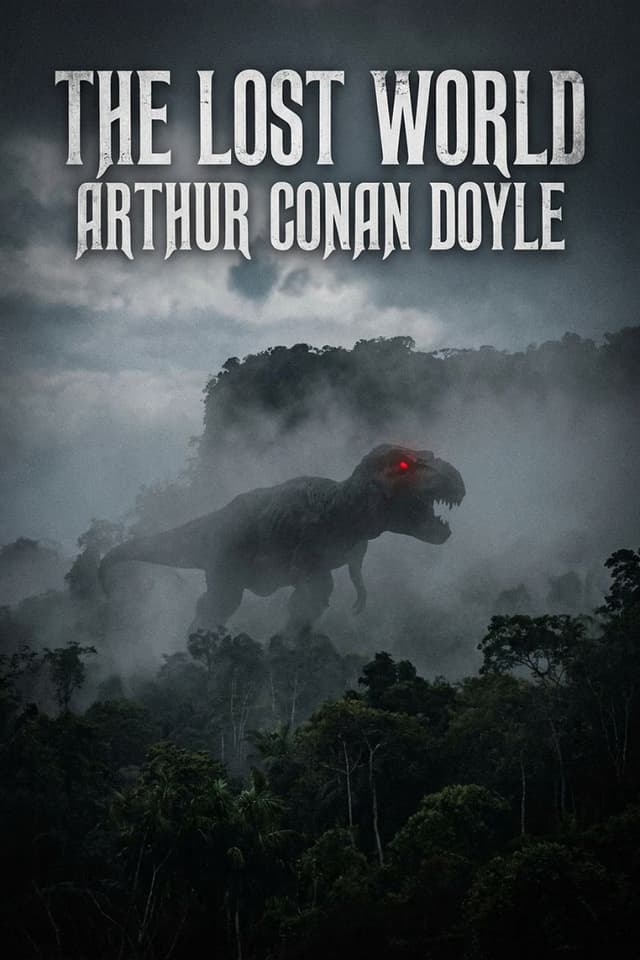
The Lost World
Read The Lost World by Arthur Conan Doyle for free on Novelhalla, and try out our easy-to-read modern edition of this classic book. You can also download the EPUB and read it on any device if you prefer!
The Plot
A Dangerous Assignment
Edward Malone is a young journalist at the Daily Gazette, eager and ambitious but untested. When the woman he loves, Gladys Hungerton, tells him she could never marry an ordinary man, that she dreams of a husband whose dangerous exploits have made him famous, Malone goes straight to his editor and asks for the most perilous assignment available.
What he gets is Professor George Edward Challenger.
Challenger is the most notorious scientist in London. A zoologist of genuine brilliance, he is also a man of volcanic temper, enormous physical strength, and complete intolerance for fools, a category in which he places most of humanity. He has recently returned from an expedition to South America with extraordinary claims: he has seen living dinosaurs. The scientific establishment has greeted his announcement with ridicule. Several journalists who attempted to interview him have been physically ejected from his home. One had his skull cracked. Challenger faces constant prosecution for assault but seems to consider this a minor inconvenience.
Malone's editor wants him to get the story. Everyone expects him to fail.
The Interview
Malone gains entry to Challenger's home through deception, pretending to be a student interested in the professor's work. Challenger sees through the ruse almost immediately. What follows is a violent confrontation that ends with Malone being hurled into the street while a policeman watches.
But Malone does something unexpected. He refuses to press charges.
This earns Challenger's grudging respect. The professor invites the young journalist back inside and, extracting promises of confidentiality, begins to tell his story. On a previous expedition to South America, Challenger encountered a dying American explorer named Maple White. In White's sketchbook were drawings of creatures that should have been extinct for millions of years. Challenger followed White's trail to its source: a remote plateau in the Amazon basin, cut off from the surrounding jungle by sheer cliffs, where prehistoric life has survived into the modern age.
He has brought back evidence: photographs, sketches, bones. But the scientific community refuses to believe him. His chief antagonist is Professor Summerlee, a rival zoologist who has made debunking Challenger's claims his personal mission.
The Challenge
That evening, Challenger faces his critics at a public meeting. The atmosphere is hostile. Summerlee leads the attack, demanding proof, dismissing every piece of evidence Challenger presents. The audience jeers. Challenger's temper rises.
Then someone proposes a solution. Let an independent expedition return to South America and verify the claims. If Challenger is lying, he will be exposed. If he is telling the truth, science will have to acknowledge the greatest discovery in history.
Challenger accepts. Summerlee volunteers to go along, confident that he will prove the whole thing a fraud. And Edward Malone, thinking of Gladys, thinking of fame and glory and the kind of adventure that makes a man worthy of love, volunteers as well.
The fourth member of the expedition is Lord John Roxton, a wealthy adventurer and big-game hunter who knows the Amazon intimately. Roxton has his own reasons for returning to South America: years earlier, he helped end the slave trade in the region, killing the slavers who preyed on the indigenous people. Some of them had brothers. Some of those brothers might still be alive.
Into the Amazon
The expedition travels to South America and begins the long journey upriver into the interior. The jungle closes around them. The climate is brutal. They hire local guides, some of whom seem nervous about where they are heading. The indigenous people speak of the plateau with superstitious dread.
Challenger grows more confident as familiar landmarks appear: a distinctive peak, a particular bend in the river, the ruins of Maple White's old camp. Summerlee remains skeptical until, one evening, something swoops down from the sky and snatches their dinner. It is not a bird. It is not any creature that should exist. It is a pterodactyl, a flying reptile that died out with the dinosaurs.
Summerlee apologizes to Challenger. Whatever lies ahead, the impossible is now proven possible.
The Plateau
They reach the lost world at last: an immense plateau rising from the jungle, its cliffs hundreds of feet high, apparently unscalable. The top is hidden in mist. Whatever lives up there has been isolated from the rest of the world for millions of years.
Challenger remembers a rock pinnacle standing close to the plateau's edge. If they can climb it, they might be able to bridge the gap. The climb is treacherous, but they succeed. They fell a tree to serve as a bridge. One by one, they cross into a world that time forgot.
What they find exceeds even Challenger's descriptions. Dinosaurs move through the prehistoric forest: iguanodons grazing in herds, stegosaurs wallowing in swamps, carnivores whose roars shake the ground. The expedition makes camp and begins to explore, cataloging wonders that will rewrite every natural history textbook ever written.
But the lost world holds more than dinosaurs. There are other inhabitants on this plateau, creatures that complicate the explorers' mission in ways they never anticipated. And their tree-bridge, their only route back to the world below, is not as secure as they believed.
The four Englishmen have found their way into paradise. Finding their way out may prove considerably more difficult.
About the Author: Arthur Conan Doyle
The Edinburgh Student
Arthur Ignatius Conan Doyle was born on May 22, 1859, in Edinburgh, Scotland, into a large Irish Catholic family. His father, Charles Doyle, was a civil servant and illustrator who struggled with alcoholism and was eventually institutionalized. His mother, Mary Foley Doyle, was a vivacious woman with a gift for storytelling who sparked her son's imagination with tales of adventure and chivalry.
Doyle was educated by Jesuits, first in England and then in Austria, receiving a rigorous classical education. By the time he enrolled at the University of Edinburgh to study medicine in 1876, he had abandoned Catholicism, though he retained a lifelong interest in questions of mortality and the afterlife.
At Edinburgh, Doyle encountered Dr. Joseph Bell, a surgeon whose extraordinary powers of observation and deduction would later inspire the creation of Sherlock Holmes. Bell could examine a patient and deduce their occupation, habits, and recent activities from the smallest details. Doyle watched, learned, and remembered.
The Struggling Doctor
Doyle graduated in 1881 and spent several years as a ship's surgeon, traveling to the Arctic on a whaling vessel and to West Africa. These voyages awakened his sense of adventure and provided material for his early fiction. He established a medical practice in Southsea, near Portsmouth, but patients were scarce. To fill the empty hours, he wrote.
His first Sherlock Holmes story, A Study in Scarlet, appeared in 1887. It attracted little attention. But when the Strand Magazine began publishing Holmes stories in 1891, the detective became a sensation. Doyle found himself famous, wealthy, and increasingly resentful of the character who overshadowed all his other work.
In 1893, weary of Holmes, Doyle killed him off at the Reichenbach Falls. The public outcry was extraordinary. Young men wore black armbands in mourning. Doyle received furious letters and death threats. He held out for a decade before resurrecting Holmes in 1903, though he never stopped wishing he could escape his creation's shadow.
The Adventurer
Doyle lived the kind of life he wrote about. He was a large, athletic man who played cricket, football, and golf, learned to ski, and took up motoring and ballooning in their earliest days. He twice ran for Parliament, unsuccessfully. He investigated and helped overturn miscarriages of justice, contributing to the establishment of the Court of Criminal Appeal. He served as a war correspondent during the Boer War and wrote a defense of British conduct that led to his knighthood in 1902.
He married twice: first to Louise Hawkins in 1885, who died of tuberculosis in 1906, and then to Jean Leckie in 1907. He had five children between his two marriages.
Professor Challenger, whom Doyle introduced in The Lost World, was by the author's own admission his favorite creation. Where Holmes was cold, cerebral, and refined, Challenger was passionate, physical, and gloriously rude. Doyle dressed up as Challenger for promotional photographs, donning a false beard and bushy eyebrows, and clearly relished playing the part.
The Believer
The great tragedy of Doyle's later life was the First World War. His son Kingsley died of wounds and influenza in 1918. His brother Innes died the following year. The losses drove Doyle deeper into spiritualism, a belief system he had flirted with for decades. He became convinced that the dead could communicate with the living, and he spent the final years of his life as spiritualism's most prominent advocate.
His friendship with the magician Harry Houdini foundered on this issue: Houdini, dedicated to exposing fraudulent mediums, could not accept Doyle's credulous enthusiasm. Most embarrassingly, Doyle championed the Cottingley Fairies photographs, images of young girls posing with what appeared to be fairies, which were later revealed to be obvious fakes.
Doyle died on July 7, 1930, at his home in Crowborough, Sussex. He had suffered a heart attack the previous autumn but continued his spiritualist lecturing until his health completely failed. He was seventy-one years old. His family and the spiritualist community celebrated rather than mourned his passing, believing he had simply moved to the other side.
Fun Facts About the Book
Doyle in Disguise
For the first edition of The Lost World, Doyle arranged for promotional photographs showing the members of the fictional expedition. He disguised himself as Professor Challenger, wearing an enormous false beard and bushy eyebrows, while friends and family posed as the other characters. Some newspapers printed these photographs as genuine documentation of a real expedition, and Doyle delighted in the confusion.
The Real Lost World
Doyle based the novel's setting on accounts of real South American plateaus, particularly the tepuis of Venezuela and the Huanchaca Plateau in Bolivia. The explorer Percy Harrison Fawcett, who later vanished mysteriously while searching for a lost city in Brazil, lectured at the Royal Geographical Society about these remote regions in 1911. Doyle attended and was fascinated by descriptions of impenetrable forests and "monstrous tracks of unknown origin."
Fooling Houdini
In 1922, Doyle showed test footage from the upcoming film adaptation to a meeting of the Society of American Magicians, which included Harry Houdini. He did not reveal that it was from a movie. The New York Times ran a front-page article the next day, baffled by the "extraordinarily lifelike" monsters. Doyle refused to explain, enjoying the hoax.
The First Monster Movie
The 1925 silent film adaptation of The Lost World was a landmark in cinema history. Featuring pioneering stop-motion animation by Willis O'Brien, it was the first feature film to bring dinosaurs convincingly to life on screen. O'Brien would later use the techniques he developed on this film to create King Kong. The Lost World was added to the National Film Registry in 1998 for its historical significance.
Challenger's Favorite
Doyle always said that Professor Challenger, not Sherlock Holmes, was his favorite character. He wrote of Challenger: "He had always amused me more than any other which I had invented." The author identified with Challenger's passion, his impatience with fools, and his willingness to fight for what he believed.
Naming Dinosaurs
The novel's influence extends even to paleontology. In 1996, scientists discovered a new species of dinosaur and named it Irritator challengeri. The genus name "Irritator" referred to the researchers' frustration when they discovered that the fossil's snout had been artificially elongated by collectors. The species name honored Professor Challenger.
A Genre is Born
The success of The Lost World led to the term "lost world" being applied to an entire subgenre of adventure fiction. Edgar Rice Burroughs followed with The Land That Time Forgot in 1918. Michael Crichton titled his Jurassic Park sequel The Lost World in explicit homage to Doyle. The influence runs through a century of dinosaur stories.
Themes
The Lure of the Unknown
Malone joins the expedition to impress a woman, but what drives him deeper into danger is something else: the pure intoxication of discovery. The novel celebrates the human hunger to see what lies beyond the next horizon, to stand where no one has stood before. This appetite for the unknown can be reckless and destructive, but it is also what makes exploration possible.
Science Versus Skepticism
The conflict between Challenger and Summerlee embodies the tension at the heart of scientific progress. Challenger has seen something extraordinary, but his evidence is insufficient to convince his peers. Summerlee's skepticism is reasonable, even admirable, but it could also prevent the greatest discovery in history. The novel asks how we should respond to claims that challenge everything we think we know.
The Violence of Empire
Lord John Roxton is a hero, but he is also a killer. His campaign against the slavers was righteous, but it has created enemies who follow him into the jungle. The expedition itself is an act of imperial adventure, Europeans claiming the right to explore, catalog, and potentially exploit a place that is not theirs. The novel does not fully reckon with these implications, but they shadow the adventure.
Nature Red in Tooth and Claw
The lost world is beautiful, but it is also deadly. Dinosaurs are not noble creatures awaiting human appreciation; they are predators and prey, engaged in the same struggle for survival that has characterized life for millions of years. The novel strips away romantic illusions about nature and presents it as Darwin described: magnificent, terrible, and utterly indifferent to human concerns.
The Problem of Proof
Challenger has seen wonders, but how can he prove them to people who were not there? The novel grapples with the challenge of communicating extraordinary experiences to skeptical audiences. Even photographs and bones may not be enough. Sometimes you have to bring back something that cannot be denied.
The Book's Legacy
The Lost World was an immediate success when it appeared in 1912, and its influence has only grown in the century since. It did not invent the idea of humans encountering surviving dinosaurs, but it codified the formula so effectively that the term "lost world" became a genre in itself.
The 1925 film adaptation pioneered special effects techniques that would define monster movies for generations. Willis O'Brien's stop-motion dinosaurs led directly to King Kong, which led to Godzilla, which led to every giant creature that has stomped across movie screens for the past hundred years. When Steven Spielberg made Jurassic Park, he was working in a tradition that began with Doyle.
The novel also established Professor Challenger as one of the great characters in adventure fiction. Where Sherlock Holmes solved crimes through cold logic, Challenger punched his way through obstacles with brilliant, bellowing fury. He appeared in four more stories and inspired countless imitations: brilliant eccentrics whose genius is matched only by their inability to tolerate ordinary people.
Perhaps most importantly, The Lost World captured something essential about the appeal of dinosaurs. They are not just big animals; they are emissaries from a world utterly unlike our own, proof that the Earth has been many different places over its long history. The novel taps into the wonder that children feel when they first see a dinosaur skeleton and realize that such creatures actually lived. That wonder has not faded in over a century, and The Lost World remains one of its purest expressions.