Novelhalla
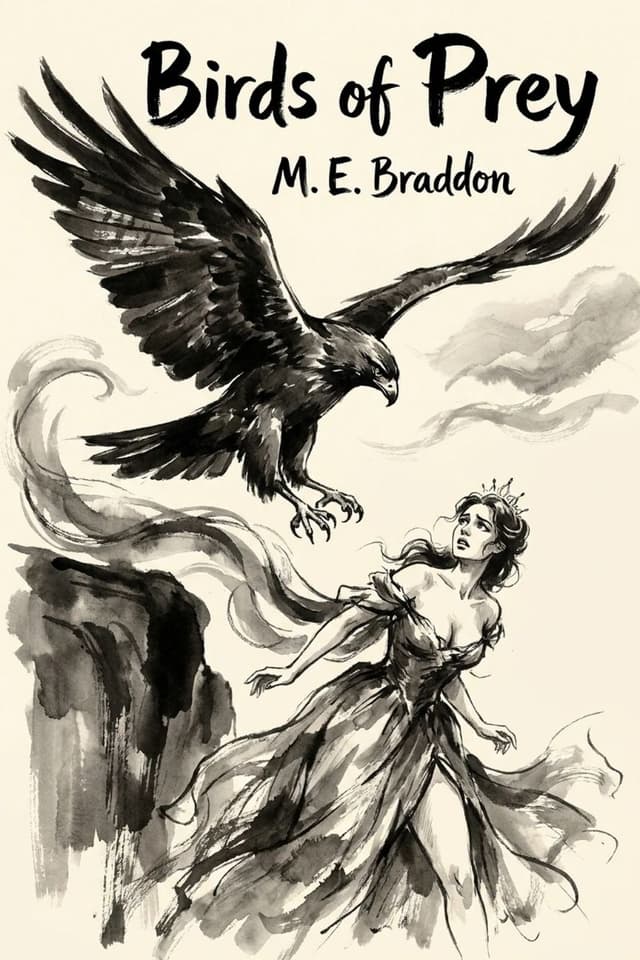
Birds of Prey
Read Birds of Prey by M. E. Braddon for free on Novelhalla, and try out our easy-to-read modern edition of this classic book. You can also download the EPUB and read it on any device if you prefer!
The Plot
A Very Respectable House
On a quiet street in Bloomsbury stands a house so spotless, so neat, and so perfectly proper that everyone assumes the man who lives there must be just as upstanding. That man is Philip Sheldon, a surgeon-dentist with polished manners, a calm face, and a practice that's quietly falling apart. Faced with the failure of his newly established London practice, depraved dentist Philip Sheldon hatches an evil plot to recoup his losses.
Then an old friend comes to town. Tom Halliday is a big, good-natured Yorkshire farmer who has just sold his land and has money in his pocket. He went to school with Philip, and he's always looked up to him. Years ago, the two men competed for the same woman, the pretty Georgina Cradock, and Tom won. Philip took the loss badly but kept his feelings to himself, the way he keeps most things to himself.
Now Tom and Georgina are staying under Philip's roof. Philip has been reading the Lancet with unusual interest. And Tom has started to feel unwell, with an illness nobody can quite put a name to.
Fortune Hunters
Philip isn't the only Sheldon who needs money. His brother George is a lawyer in Gray's Inn with a nose for opportunity and not too many scruples. His specialty is digging up forgotten heirs to unclaimed fortunes and taking a cut. George has his eye on a big prize, the estate of a wealthy man who died without anyone around to inherit it. Somewhere out there, buried in old church registers and faded family Bibles, there might be a rightful heir. Whoever finds that person first stands to profit handsomely.
George also has a sharp sense that something about his brother isn't adding up. And he isn't the type to let useful knowledge go to waste.
The Cardsharp's Daughter
Meanwhile, in the shabby lodgings and gambling rooms of London and the Continent, we meet Captain Horatio Paget, a gentleman swindler with lovely manners and no conscience at all. His daughter Diana has grown up in this world, moving from one cheap hotel to the next, watching her father fleece rich young men at cards. She's proud, beautiful, bitter, and secretly in love with her father's young partner in crime, Valentine Hawkehurst.
Valentine is a clever, likable rogue who's half ashamed of the life he's drifted into. When things go wrong for the Captain, Valentine gets Diana out of harm's way, and she ends up with a respectable roof over her head at last. Years later, she's companion to her sweet, sunny old schoolfriend Charlotte Halliday, in a comfortable household where Philip Sheldon is very much in charge.
The Hunt Begins
When Valentine turns up to visit Diana, he meets Charlotte and falls for her completely. Suddenly the drifting gambler wants to be a better man, and that means money earned honestly, or at least more honestly than before. George Sheldon offers him a deal: track down the missing heir to that unclaimed fortune and earn a share of the reward. The trackless forest was the genealogy of the Haygarths; and in the enchanted castle he was to find the crown of success in the shape of three thousand pounds.
So Valentine heads off into the English countryside, chasing down elderly villagers with long memories, reading crumbling gravestones, and piecing together a family scandal from the previous century. But he isn't the only one interested in where the trail leads. Captain Paget smells a profitable secret. George is watching his investment. And Philip Sheldon, who notices everything, has started watching Valentine. Diana, meanwhile, is stuck watching the man she loves fall for her best friend.
Everybody in this story is hunting something. The question is who'll end up as the prey.
About the Author: Mary Elizabeth Braddon
Early Life
Mary Elizabeth Braddon was born at number 2 Frith Street, Soho Square, London on 4 October 1835. She was the third child of Fanny (White) Braddon and solicitor Henry Braddon; her sister Maggie was eleven years older and her brother Edward six. When Braddon was four, Fanny left Henry because of his infidelities, and Mary grew up with her mother. That brother Edward went on to have quite a career of his own: he left for India and later Australia, where he became Premier of Tasmania.
On the Stage
Money was tight, so Mary took a bold step for a respectable young woman of her day and went on the stage. In the early 1850s she took to the stage under the name of Mary Seyton, her mother accompanying her throughout. She worked as an actress for eight years as a way to support herself and her mother. That backstage world of fakery, costume, and performance shows up all through her fiction, especially in charming frauds like Captain Paget.
Scandal and Success
Braddon met John Maxwell, a publisher of periodicals, in April 1861 and moved in with him later that year. However, Maxwell was already married with five children, and his wife was living in an asylum in Ireland. The arrangement caused plenty of gossip. Then came her breakthrough. She is best known for her 1862 novel Lady Audley's Secret, which is considered one of the foundational examples of sensation fiction. That book sold into eight editions within three months.
Editor and Mother
Braddon raised Maxwell's children and had six children with Maxwell, and they lived as common law husband and wife. In 1874, after the death of his first wife, she married John Maxwell. She also ran her own magazine. Belgravia was a monthly London illustrated literary magazine founded by Braddon, established in 1866, featuring serialized novels, poems, travel narratives, and biographies, as well as essays on fashion, history, and science. One of her sons, W. B. Maxwell, became a novelist too.
Later Years
Braddon never stopped writing. She was the author of approximately ninety books written between 1860 and 1915, and novel after novel flowed from her pen, often at the rate of two per year. She settled in Richmond, where one of her greatest pleasures was to go riding in Richmond Park. She died at Lichfield House on 4 February 1915 and was buried at Richmond Cemetery.
Fun Facts About the Book
It Launched a Magazine
This novel was the opening act of Braddon's career as an editor. Birds of Prey was the serial novel which kicked off the magazine's publication, and it ran in serialized form with a new installment each month from the first issue of Belgravia in November 1866 well into 1867. Readers waited a whole month between installments.
Braddon Knew Exactly What She Was Making
Braddon didn't pretend this was anything other than a page-turner. She called it a "strong sensation story", and she built it to keep her new magazine's readers coming back.
Only Half the Story
This book is the first of two. These are two fairly obscure Victorian novels which form one story, and the sequel, Charlotte's Inheritance, came out in 1868. If you get hooked, you'll want the second volume ready to go.
Illustrated Installments
When it ran in Belgravia, the story came with pictures. It was illustrated by M. E. Edwards, November 1866 to October 1867 (monthly).
A Villain With a Medical Degree
Most sensation novels of the 1860s got their thrills from reckless, passionate villains. Braddon tried something chillier. The danger here comes from carefully planned murders committed by a rational doctor rather than the impetuous actions of a passionate woman.
Published in Three Volumes
After its magazine run, the novel was published in 1867 in London by Ward, Lock and Tyler, in the classic three-volume format that Victorian circulating libraries loved.
A Writer Writing About Writers
Valentine Hawkehurst is more than a reformed gambler. Scholars point out that the inclusion of Bohemian writers like Valentine Hawkehurst lets Braddon reflect in a self-conscious fashion on the business of authorship. Since Braddon was turning out serials at a ferocious pace herself, she knew that world inside and out.
Themes
Respectable Faces, Rotten Hearts
The whole novel is built on the gap between how things look and how they really are. Philip Sheldon's neat house and calm manners convince everyone he's a solid citizen. Captain Paget's elegant manners get him into the best company. Braddon keeps asking how far anyone can trust a polished surface.
Money and Greed
Nearly every man in this book is chasing money, through medicine, law, cards, or genealogy. The title says it all. They circle around fortunes and around the vulnerable people attached to them, and the only real question is how far each one is willing to go.
Redemption Through Love and Work
Valentine Hawkehurst is the heart of the book. He starts as a drifter living by his wits and slowly begins to want something better. One scholar notes that he is redeemed at first by his love for Charlotte Halliday and later through his discovery of the pleasures of work.
Friendship and Jealousy
Diana Paget is one of the most interesting characters Braddon ever wrote. She's proud and resentful, and she has every reason to envy Charlotte's easy, sheltered life. Watching how she handles her own heartbreak is one of the most satisfying threads in the novel.
Trust in Doctors
Braddon takes a sharp look at the blind faith Victorians placed in medical men. She utilizes Belgravia, a periodical venue for "light" literature, to question the power dynamics set up and reinforced by prominent and "serious" medical journals such as The Lancet.
The Past Never Stays Buried
The heir hunt sends Valentine back through generations of family history, forgotten marriages, and old secrets. Braddon shows that the past is never really gone. It's just waiting in a parish register for someone to find it.
The Book's Legacy
Birds of Prey never got the fame of Lady Audley's Secret, but it has a loyal following among readers who've gone looking past Braddon's most famous book. Some fans even rank it above her best-known work, with one reader saying of Lady Audley's Secret, "I loved "Lady Audley's Secret" but these two are better IMO."
The novel helped put Belgravia on the map, and the magazine went on to become one of the main homes for Victorian sensation fiction. Belgravia's circulation peaked at 18,000 in 1868, shortly after this story finished its run.
In recent years, scholars have taken a fresh interest in the book for its sharp take on medical authority and its picture of London's bohemian underworld. Modern readers tend to love its mix of slow-burning dread, con-artist comedy, and genuine romance. Philip Sheldon is still one of the creepiest villains in Victorian fiction because he's so quiet, so reasonable, and so believable.