Novelhalla
A Princess of Mars
Read A Princess of Mars by Edgar Rice Burroughs for free on Novelhalla, and try out our easy-to-read modern edition of this classic book. You can also download the EPUB and read it on any device if you prefer!
The Plot
A Stranger on Mars
Captain John Carter is a former Confederate soldier prospecting for gold in the Arizona Territory after the Civil War. Fleeing an Apache attack, he takes shelter in a mysterious cave and is struck by a strange paralysis. When he wakes, he is no longer on Earth. He is standing naked and alone on the surface of Mars, a dying desert world its inhabitants call Barsoom.
Carter quickly discovers that Mars has changed him. The planet's weaker gravity gives him extraordinary strength and the ability to leap enormous distances. He is, by Martian standards, something close to superhuman. But strength alone will not keep him alive. He has landed in the territory of the Tharks, a tribe of Green Martians: towering, six-limbed, tusked warriors who live by raiding and value nothing so much as ferocity in combat.
Captured by the Tharks, Carter earns their grudging respect through his fighting ability and his refusal to show fear. He is taken under the watch of Sola, a surprisingly gentle Thark woman, and begins learning the Barsoomian language and customs. He also catches the attention of Tars Tarkas, a Thark chieftain who is himself unusual among his people for being capable of something the Green Martians are taught to despise: compassion.
The Princess
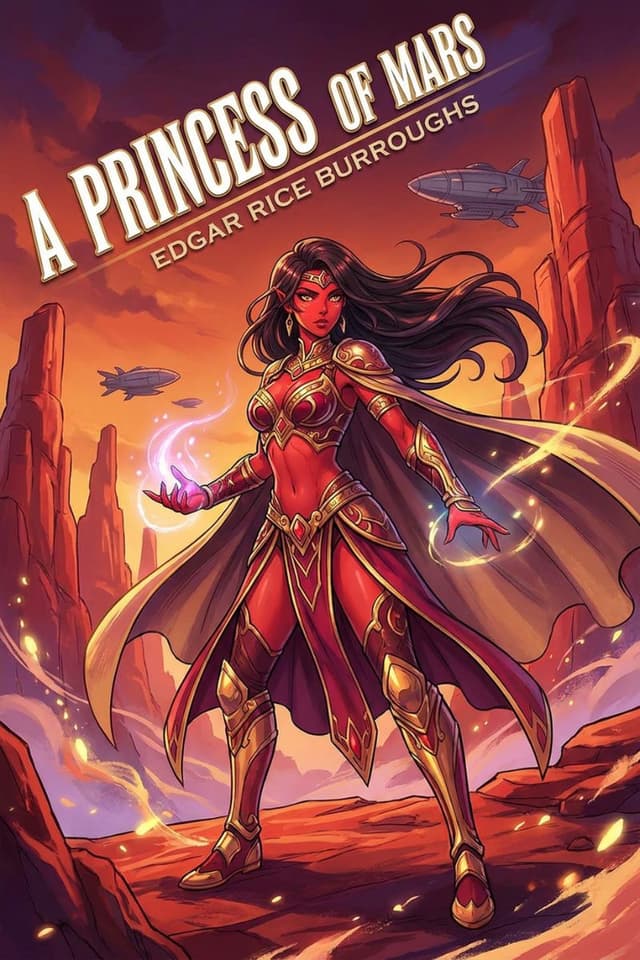
Everything changes when the Tharks intercept an airship and capture Dejah Thoris, Princess of Helium. Dejah Thoris belongs to the Red Martians, a humanoid race whose civilization is far more advanced and far more familiar than the brutal Thark society. She is proud, brilliant, and in terrible danger.
Carter is drawn to her immediately. But Dejah Thoris is a political prisoner, and the Tharks have no intention of letting her go. Worse, powerful figures within the tribe have their own plans for the princess, none of them good. Carter finds himself torn between the position he has earned among the Tharks and his determination to protect Dejah Thoris and return her to her people.
What follows is a desperate escape across the Martian wilderness, a journey through warring tribes and hostile cities, and a love story conducted under constant threat of death.
The War
The politics of Barsoom prove as treacherous as its deserts. The city-state of Zodanga, ancient enemy of Helium, threatens to crush Dejah Thoris's people unless she agrees to a forced marriage with its prince. The Green Martians nurse their own feuds and power struggles. And Carter, an outsider with no standing in either world, must find a way to unite unlikely allies if he hopes to save the woman he loves and the civilization she represents.
The story builds toward a massive confrontation, but even victory comes at a cost Carter never anticipated.
About the Author: Edgar Rice Burroughs
Early Life
Edgar Rice Burroughs was born in 1875 in Chicago, the son of a businessman and Civil War veteran. He attended private schools, was briefly enrolled at Phillips Academy in Andover (from which he was expelled), and graduated from Michigan Military Academy in 1895. He tried to enter West Point, failed the entrance exam, and enlisted in the regular army, serving at Fort Grant in Arizona with the 7th Cavalry before being discharged due to illness.
A Long Search for Direction
For the next fifteen years, Burroughs tried nearly every occupation imaginable. He worked as a teacher, a railroad policeman, a gold prospector, a shopkeeper, a cowboy, a pencil sharpener salesman, an office manager at Sears, and a bookkeeper. He married Emma Hulbert in 1900 and had three children, but by his mid-thirties he was struggling to support his family and considered himself a failure.
Everything changed when he started reading pulp fiction magazines and decided he could write stories at least as good as the ones being published. As he later recalled, he thought the material was so bad that he could produce something equally worthless and get paid for it. He was wrong about the worthless part.
A Writer's Life
Burroughs submitted his first story to The All-Story Magazine in 1911. It was serialized as "Under the Moons of Mars" beginning in February 1912 and earned him $400, a sum that felt like a fortune. Later that same year, he published "Tarzan of the Apes" in the same magazine, and his career was launched. By 1914, Tarzan had made him famous. He would go on to write nearly seventy novels spanning science fiction, fantasy, adventure, westerns, and historical romance.
In 1919 he bought a ranch near Hollywood to be closer to the filming of Tarzan movies. The community that grew up around it eventually took the name Tarzana, California. In 1923 he incorporated himself as Edgar Rice Burroughs, Inc., becoming one of the first authors to run his own publishing business.
Final Years
Burroughs witnessed the attack on Pearl Harbor while visiting his eldest son in Hawaii. At age sixty-six, he became the oldest American war correspondent of World War II, covering the Pacific theater. He returned home after suffering heart problems and spent his final years in Encino, California. He died on March 19, 1950, at age seventy-four. An impact crater on Mars was later named in his honor.
Fun Facts About the Book
Burroughs's First Story
A Princess of Mars was not only the first book in the Barsoom series but the first fiction Burroughs ever published. It predates Tarzan of the Apes by several months in magazine publication. The man who would become one of the bestselling authors of the twentieth century was a failed pencil sharpener salesman when he wrote it.
The Pen Name
Burroughs was so worried that people would think he was insane for writing such a fantastical story that he submitted it under the pen name "Normal Bean," a joke meant to assure readers he was of sound mind. A typesetter at the magazine, assuming it was a typo, changed it to "Norman Bean." The pun was lost.
The Title
Burroughs originally submitted the manuscript under the title "Dejah Thoris, Martian Princess." The magazine editor changed it to "Under the Moons of Mars" for serialization. When the story was finally published as a novel in 1917, it received its now-famous title, A Princess of Mars.
Real Science, Wrong Answers
Burroughs based his vision of Mars on the widely publicized theories of astronomer Percival Lowell, who believed he had observed a network of artificial canals on the planet's surface, evidence of an advanced civilization struggling to survive on a dying world. Lowell's theories were already being disputed by other scientists when Burroughs wrote the novel, but the image of Mars as an ancient, desiccating world crisscrossed by canals was irresistible. The canals turned out to be an optical illusion, but the fiction they inspired endures.
The Grandfather of Superheroes
John Carter's superhuman strength on Mars, explained by the planet's lower gravity, directly inspired the creation of Superman. Jerry Siegel, co-creator of Superman, cited the John Carter stories as a key influence. The original explanation for Superman's powers was that he came from a planet with much greater gravity than Earth, essentially the Carter concept in reverse. The idea of an ordinary person gaining extraordinary abilities by traveling to a world with different physical laws began here.
The Ripple Effect
The novel's influence on science fiction and popular culture is staggering. Ray Bradbury, Arthur C. Clarke, and Robert A. Heinlein all cited Burroughs as an inspiration. The Barsoom stories directly inspired Flash Gordon, which in turn influenced George Lucas when he created Star Wars. James Cameron has said that Avatar is essentially his version of John Carter. Carl Sagan read the books as a boy and credited them with sparking his lifelong fascination with Mars and the search for extraterrestrial life.
The Framing Device
The novel uses a clever narrative frame. A fictionalized version of Burroughs appears as the narrator's nephew, claiming that his "Uncle Jack" (John Carter) left behind a manuscript with instructions not to publish it for twenty-one years. Carter himself is presented as an ageless, immortal figure with no memory of his life before the age of thirty, a mystery that is never fully explained.
A Century of Failed Films
Hollywood tried to adapt the novel for decades. An animated version was attempted at MGM in the 1930s. Ray Harryhausen wanted to make it. Robert Rodriguez, Jon Favreau, and Kerry Conran all circled the project at different times. Disney finally released John Carter in 2012, directed by Pixar's Andrew Stanton, but the film was a notorious box-office disappointment despite being a reasonably faithful adaptation.
The Barsoom Series
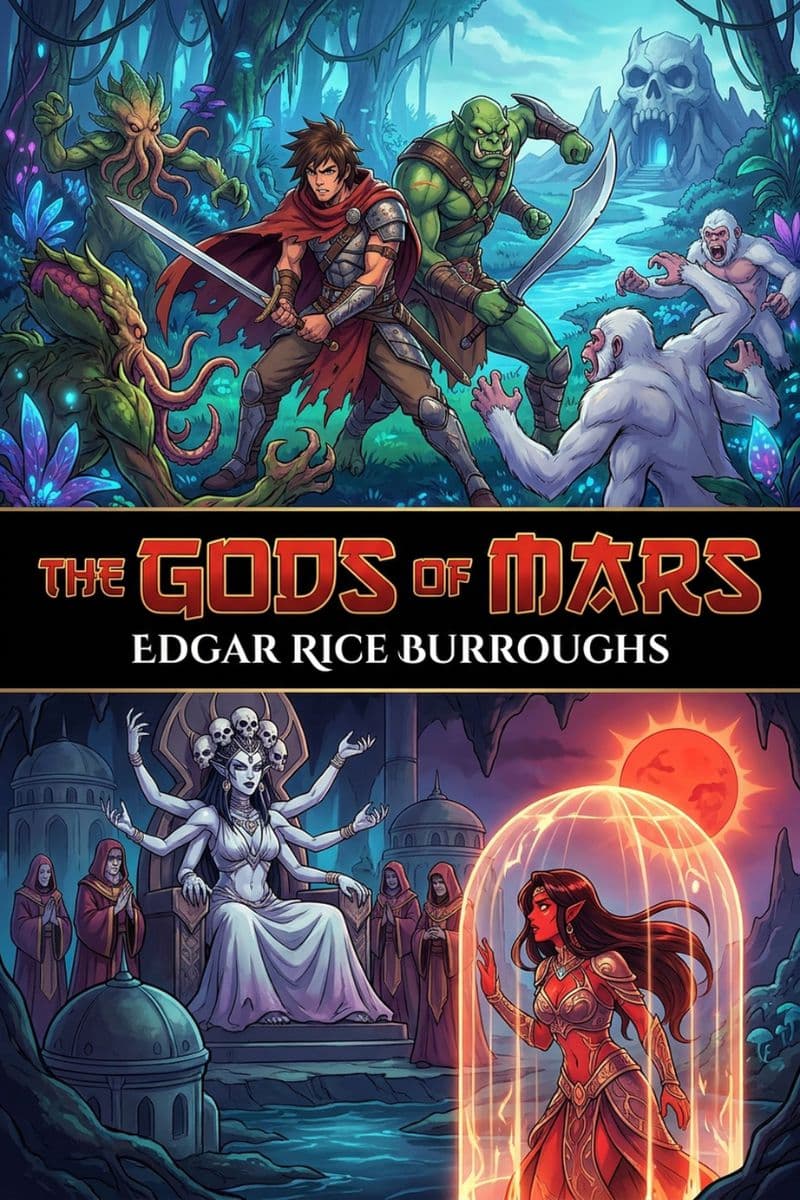
A Princess of Mars was the first of eleven novels Burroughs set on Mars. The immediate sequels, The Gods of Mars and The Warlord of Mars, continue Carter's story directly. Later volumes follow other characters and explore different regions of Barsoom. Burroughs kept writing Martian tales for three decades, even as real astronomical discoveries made his vision of the planet increasingly impossible.
Themes
The Outsider as Hero
Carter arrives on Barsoom with no status, no allies, and no understanding of the world around him. His journey from prisoner to prince is driven not by birthright but by courage, adaptability, and a willingness to fight for what he believes is right. The novel asks what happens when someone is stripped of every social context and must prove their worth from nothing.
Civilization and Savagery
Barsoom is a world of stark contrasts. The Green Martians are warlike nomads who suppress all tender emotion and raise their children communally to prevent attachment. The Red Martians have built great cities and value art, science, and family. Carter moves between these worlds, and the novel explores whether compassion is a weakness or a strength, whether civilization is defined by technology or by how a society treats its most vulnerable members.
A Dying World
Mars is old. Its oceans have dried up, its atmosphere is thinning, and its civilizations are in decline. The planet's atmosphere is sustained only by a single great factory, and when that factory fails, all life on Barsoom faces extinction. The novel's backdrop of planetary decay gives the adventure an undercurrent of melancholy and urgency.
Love Across Worlds
The romance between Carter and Dejah Thoris is the engine of the story. They come from different planets, different species, different cultures. Their love must overcome not just physical danger but the vast gulf between their worlds. The novel treats this cross-cultural romance with surprising sincerity, suggesting that connection can transcend even the most fundamental differences.
Loyalty and Honor
Carter's defining qualities are his loyalty and his refusal to abandon those who depend on him. Tars Tarkas is redeemed by his capacity for love. Sola risks everything because she is kind in a world that punishes kindness. The novel repeatedly argues that personal honor and faithfulness to others are the truest measures of character.
Earned Merit Over Inherited Rank
The Thark chieftains maintain power through combat. The Red Martian aristocracy is hereditary but depends on competence. Carter rises through both systems by ability rather than birth. The novel has a distinctly American suspicion of unearned privilege and a faith that talent and bravery should determine a person's place in the world.
The Book's Legacy
A Princess of Mars is one of those rare novels that, while not always considered great literature in the traditional sense, changed the landscape of storytelling. It essentially invented the planetary romance as a genre and established the template for science fiction adventure that would dominate the twentieth century. Without it, there is likely no Flash Gordon, no Superman, no Star Wars, no Avatar.
The novel reads differently now than it did in 1912. Its prose is purple by modern standards, its hero is idealized to the point of invincibility, and its treatment of certain cultures reflects the attitudes of its era. But the sheer invention of the thing remains remarkable. Burroughs built an entire world from scratch, with its own geography, languages, species, politics, and ecology, and made readers believe in it completely.
The story endures because its core elements are timeless: a stranger in a strange land, a love worth fighting for, a world worth saving. John Carter leaping across the Martian desert, sword in hand, remains one of the most indelible images in adventure fiction. The dying planet of Barsoom, with its ancient cities and red deserts and thinning air, is one of the great imaginary places.
More than a century after its publication, A Princess of Mars continues to be read, adapted, and argued about. It is the book that made Edgar Rice Burroughs famous, that launched a thousand imitators, that put a Civil War veteran on Mars and in doing so helped launch the modern age of science fiction and fantasy.