Novelhalla
The Ghost Kings
Read The Ghost Kings by H. Rider Haggard for free on Novelhalla, and try out our easy-to-read modern edition of this classic book. You can also download the EPUB and read it on any device if you prefer!
The Plot
The Missionary's Daughter
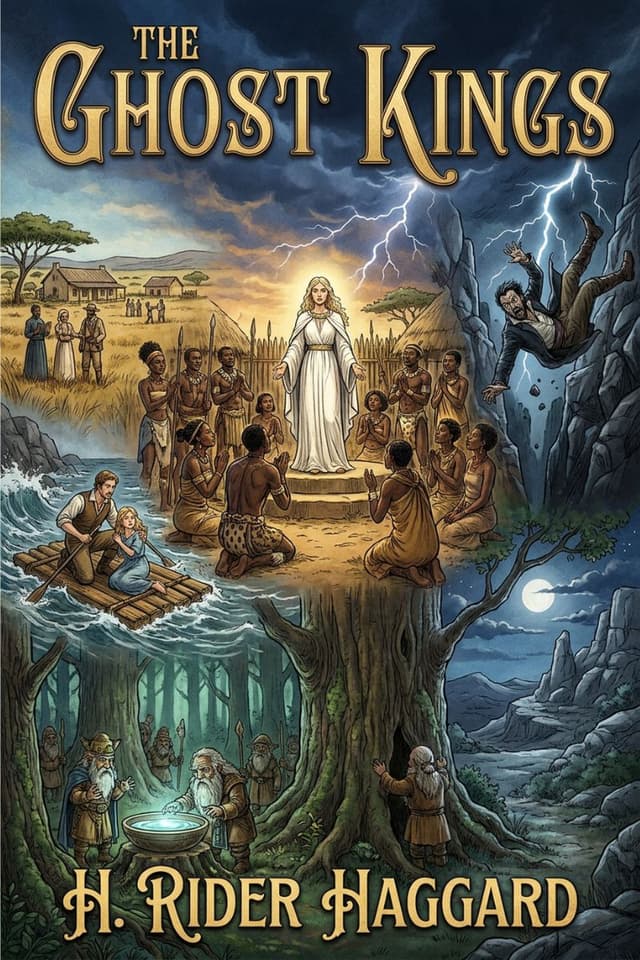
Rachel Dove has spent nearly her entire young life being dragged across the wild frontier of southern Africa. Her father is a missionary, a stubborn, zealous man with an unshakeable conviction that he can convert anyone he meets to the Gospel, including the Zulu king. Her mother suffers in silence, endowed with a strange gift of second sight that lets her glimpse things others cannot. The family has already buried two children in African soil.
Rachel is brave, beautiful, and utterly isolated. She has no friends her own age, no community beyond the scattered settlements and mission stations her father moves between. She knows the African bush better than she knows England, a country she can barely remember. The land is all she has, and the land is dangerous.
Then comes the flood.
The Boy in the Water
A storm tears through the region, and Rachel is caught in a flash flood that would have killed her if not for a teenage boy named Richard Darrien. He pulls her from the water, and in the way of two young people who have just survived something terrible together, they form an instant, fierce bond. Richard is English, strong, quiet, and already marked by the kind of self-reliance that Africa demands of anyone who wants to survive it.
They are young, and the connection between them feels like something larger than circumstance. But the wilderness doesn't care about young love. Richard leaves. Years pass. Rachel doesn't see him again.
She grows up in his absence, becoming a woman of striking beauty and quiet power, still living under her father's roof, still moving through a world that offers her no real safety.
The Man Called Ishmael
When Rachel's family settles near the borders of Zululand, they encounter a solitary white man living in the bush. He calls himself Ishmael. He is well-spoken, clearly educated, and something about him is deeply wrong. He has gone native in the worst possible way, acquiring a harem of wives and the habits of a petty tyrant. He is drawn to Rachel with an intensity that makes her skin crawl.
Rachel rejects his attention, but Ishmael is not the kind of man who accepts rejection. He is cunning, patient, and connected to the Zulu king Dingaan in ways that give him leverage no one around Rachel fully understands. He begins to scheme, and what he wants is her.
Meanwhile, Rachel saves a young woman named Noie from a Zulu raiding party, killing a soldier in the process. Noie is no ordinary woman. She is half-Zulu, half something else entirely. Her father was a wizard of a mysterious people known as the Ghost Kings, a dwarf-like tribe of tree worshippers who live deep in the forests and can see the future in bowls of dew. Noie becomes Rachel's devoted companion and closest friend, bound to her by a loyalty that runs deeper than gratitude.
The Inkosazana
Word of Rachel spreads through Zululand. The Zulus do not see a missionary's daughter. They see something far more significant: the living incarnation of the Inkosazana-y-Zoola, the Great Lady of the Heavens, a legendary white goddess whose spirit is said to walk the earth in times of great change. Rachel is beautiful, she is fearless, and she commands a presence that unnerves even Dingaan's warriors.
The Zulu king sends for her. He wants the Inkosazana's counsel on a matter of enormous consequence: the Boer settlers are coming, and he must decide whether his nation will meet them with war or peace. Rachel's answer will carry the weight of prophecy.
This is where Rachel's life splits open. She is no longer just a girl in the bush. She is a figure of power in a kingdom on the edge of catastrophe, and every faction, Ishmael, Dingaan, the Zulu war council, wants to use that power for their own ends. Noie stands beside her, but even Noie has her own tangled loyalties, her own people waiting in the deep forest.
The Trap
Ishmael's schemes grow bolder. He conspires with elements of Dingaan's court to maneuver Rachel into his grasp, using Noie as bait and the threat of violence against Rachel's parents as leverage. The Zulus will not let their Inkosazana leave. Rachel is held in a golden cage of reverence and suspicion, powerful enough to command armies but not free enough to walk away.
Richard Darrien returns. He has crossed half of Africa to find her, and his arrival throws every calculation into chaos. Ishmael cannot tolerate a rival. Dingaan cannot afford to anger the Inkosazana. And Rachel, caught between the man she loves, the villain who hunts her, and a nation that worships her, begins to feel the ground shifting beneath her feet.
When tragedy strikes, it strikes with the force of a curse. Rachel's world collapses, and in her anguish, she turns on the Zulu nation with a prophecy so devastating that even Dingaan trembles. The warriors who once knelt before her now whisper that the Inkosazana's spirit has fled, leaving behind only grief and wrath.
Broken, dangerous, and carrying a curse that may already be unfolding, Rachel is led toward the one place that might hold answers: the hidden realm of the Ghost Kings, deep in the forest, where Noie's people read the future in water and guard secrets that are older than the Zulu nation itself. What waits for her there is not rescue. It is a reckoning.
About the Author: H. Rider Haggard
A Dreamer Sent to Africa
Henry Rider Haggard was born in 1856 in Norfolk, England, the eighth of ten children in a gentleman's household. His father considered him a dreamer and a disappointment, and rather than send him to university like his older brothers, packed him off to South Africa at nineteen to serve as assistant to the governor of Natal.
It was the making of him. Haggard arrived in southern Africa during one of the most volatile periods in its colonial history, witnessing the tensions between British settlers, Boer farmers, and the powerful Zulu kingdom. He served on the staff of Sir Theophilus Shepstone and personally hoisted the British flag at the annexation of the Transvaal in 1877. He traveled deep into the interior, visited Zulu kraals, and absorbed the landscapes, cultures, and conflicts that would fuel his fiction for the rest of his life.
The Bet That Changed Everything
Haggard returned to England in 1882, tried farming, trained as a barrister, and wrote two novels that nobody noticed. Then he read Robert Louis Stevenson's Treasure Island and bet his brother a shilling that he could write something just as good. He wrote King Solomon's Mines in about six weeks. Published in 1885 with posters across London declaring it "the most amazing book ever written," it became an instant bestseller and made Haggard famous overnight. He nearly sold the manuscript outright for a flat fee but at the last minute insisted on royalties, a decision that set him up financially for life.
She followed in 1887, selling over 83 million copies by the mid-twentieth century and becoming one of the bestselling books in history. Haggard had created the lost world genre almost single-handedly, and his influence rippled through generations of adventure fiction, from Edgar Rice Burroughs's Tarzan to Arthur Conan Doyle's The Lost World to the Indiana Jones films.
The Prolific Years
Haggard wrote roughly a novel a year for the rest of his life, producing over sixty books of fiction and nonfiction. He was friends with Rudyard Kipling, with whom he plotted The Ghost Kings before ultimately reworking most of the story on his own. He was deeply interested in agriculture and land reform, serving on multiple government commissions and writing extensively about rural England and the British colonies. He was knighted twice, first in 1913 and again in 1919 for his contributions during the First World War.
Final Years
Haggard's health declined in his later years, though he continued writing and traveling. He died in London in May 1925 at the age of sixty-eight. His reputation faded somewhat in the decades after his death, particularly as attitudes toward colonialism shifted, but his best novels have never gone out of print. King Solomon's Mines, She, and his Allan Quatermain adventures remain foundational texts of adventure and fantasy literature.
Fun Facts About the Book
Plotted with Rudyard Kipling
Haggard originally worked out the plot of The Ghost Kings in collaboration with his close friend Rudyard Kipling. However, by the time he sat down to write, Haggard had grown dissatisfied with most of what they had outlined. He kept only the Ghost Kings segment from Kipling's input, the mysterious dwarf tribe of tree worshippers, and reworked the rest of the novel around his own ideas. The collaboration is one of the great "what if" moments in adventure fiction.
Based on a Zulu Legend
Haggard drew on an actual Zulu tradition for the novel's central premise. The Zulus had a story of a white girl who, during the reign of King Dingaan, was believed to "hold the spirit" of a legendary goddess. She was said to be beautiful, brave, and powerful before the Battle of Blood River. According to the legend, after her parents were murdered, she cursed the nation, and the Zulus attributed their subsequent misfortunes to her wrath. Haggard wrote that this story captured his imagination and became the seed of the novel.
The Inkosazana Tradition
The title "Inkosazana-y-Zoola," meaning roughly "Great Lady of the Heavens," connects to real Zulu spiritual beliefs about a sky goddess associated with rain, fertility, and the natural world. Haggard wove this tradition into the novel's fabric, making Rachel not just a character but a living symbol within Zulu cosmology. The tension between Rachel's own identity and the mythic role projected onto her gives the novel much of its power.
A Novel Full of Second Sight
Haggard gives multiple characters, including Rachel and her mother, the gift of prophetic vision. This was not unusual for Haggard, who was personally fascinated by the paranormal. He and Andrew Lang, another close friend and collaborator, shared a deep interest in psychic phenomena, and Haggard frequently incorporated elements of mysticism and the supernatural into his otherwise grounded adventure stories.
Connected to the Haggard Universe
The Ghost Kings contains links to other Haggard novels, particularly Nada the Lily, which tells the story of the Zulu warrior Mopo. Characters and events from that earlier novel are referenced in The Ghost Kings, and readers familiar with Haggard's broader body of work will find threads connecting across multiple books. Haggard built a loose fictional universe decades before the concept became a publishing strategy.
Themes
The Collision of Worlds
The novel throws British Christianity, Zulu warrior culture, and the ancient mysticism of the Ghost Kings into violent contact with one another. Rachel stands at the intersection of all three, belonging fully to none of them. Haggard is fascinated by what happens when belief systems collide, and he does not grant automatic superiority to any one of them.
Power and Vulnerability
Rachel is simultaneously the most powerful and the most vulnerable person in the story. As the Inkosazana, she commands the reverence of an entire nation. As a young woman alone in hostile territory, she can be kidnapped, threatened, and manipulated. The novel explores how power that depends on other people's belief is both immense and terrifyingly fragile.
The Corruption of Civilization
Ishmael is not a product of the African wilderness. He is a product of English civilization who has shed its restraints while keeping its cruelty. Haggard uses him to argue that the real savagery in the colonial encounter doesn't always come from the side the Victorians expected. Ishmael is more dangerous than any Zulu warrior in the book because he operates without honor.
Love Across Distance
Rachel and Richard's love is tested primarily by absence. They meet as teenagers, are separated for years, and must find each other again across a landscape that seems designed to keep them apart. Haggard treats their bond as something fated and unbreakable, but he makes them earn every reunion through danger and loss.
Prophecy and Free Will
Rachel is told what the future holds. She sees visions. The Ghost Kings read the future in their bowls of dew. But the novel keeps asking whether knowing the future changes it, or whether prophecy is just another trap. Rachel's curse on the Zulu nation is spoken in anguish, but its fulfillment seems to have a momentum of its own.
The Book's Legacy
The Ghost Kings occupies a distinctive place in Haggard's vast body of work. It combines the adventure plotting of his early bestsellers with a more ambitious exploration of spirituality, myth, and the psychology of power. The novel's portrait of Rachel Dove as a woman caught between cultures and belief systems is among the most complex female characterizations in Victorian adventure fiction.
The book is also notable as one of Haggard's most fantasy-inflected works. The Ghost Kings themselves, with their tree worship, prophetic dew bowls, and hidden forest civilization, represent one of his most imaginative contributions to the lost world genre he pioneered. Readers who know Haggard only through King Solomon's Mines or She will find here a stranger, more atmospheric story that pushes further into the territory between adventure and the supernatural.
While less widely read than Haggard's most famous novels, The Ghost Kings has maintained a devoted readership among fans of Victorian adventure fiction and remains in print more than a century after its first publication.